論文解説
IANN: A Unified Framework for Equivariant InterAtomic Neural Networks with User-Friendly Implementation
IANN:使いやすい実装を備えた等変原子間ニューラルネットワークのための統一フレームワーク
- 課題 複数の等変MLIPがそれぞれ別のコードベースで公開されているため、同じ条件での比較や公開先の切り替えには多くの再実装が必要です。
- 手法 複数のアーキテクチャを一つのAtomsDataオブジェクトと共通の学習器にまとめ、力と応力は辺ベクトルに対する解析的微分で計算します。
既存のMLIPソフトウェアの分断
機械学習原子間ポテンシャル(MLIP)は、DFTに近い精度を、はるかに低い計算コストで得られます。ただし、最新の等変アーキテクチャの多くは、それぞれ別のコードベースで公開されており、データ形式、設定の仕組み、学習ループ、チェックポイントの構造、分子動力学のインターフェースがばらばらです。そのため、同じデータで二つのアーキテクチャを公平に比べたり、学習したモデルを実際のシミュレーションに移したり、新しい構成要素を加えたりするには、かなりの再実装が必要です。この論文は、この問題を一つの統合フレームワークで減らすことを目標としています。
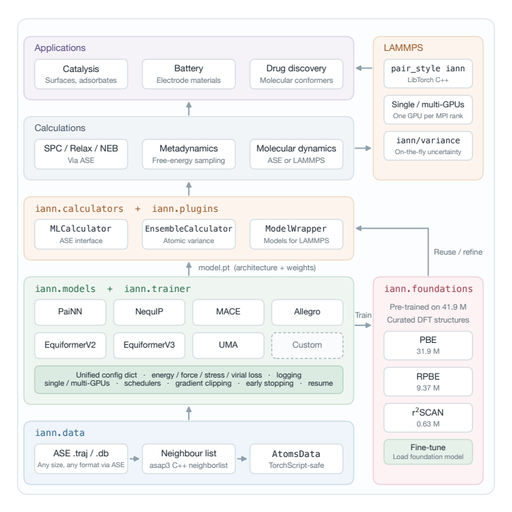
Figure 1 : Software structure of the IANN framework: five main layers with two auxiliary layers.
出典 · CC BY 4.0 · Changzhi Ai, Xueping Qin, Dimosthenis Sokaras, Frank Abild-Pedersen, Johannes Voss · IANN: A Unified Framework for Equivariant InterAtomic Neural Networks with User-Friendly Implementation · 論文の図を引用 · 元のPDFの9ページ目から図の部分を抽出しています。統一されたデータオブジェクトと解析的微分
IANNは、PaiNN、NequIP、MACE、Allegro、EquiformerV2、EquiformerV3、UMAのすべてを、同じAtomsDataの入力と出力の構造で扱えるように実装しています。原子構造は、カットオフ半径内の原子対をつなぐ有向グラフに変換され、辺ベクトルは周期境界条件におけるイメージの移動を含めて構成されます。力、応力、ビリアルは、力の出力ヘッドを別に設けて予測するのではなく、予測エネルギーを辺ベクトルで一度微分して得ます。力は、辺ごとの勾配を中心原子と隣接原子へscatter-addで集めて計算し、応力とビリアルは、同じ辺の勾配と辺ベクトルの外積の和として求めます。
そのため、アーキテクチャを変えても、損失、学習器、計算機、TorchScriptのエクスポートのコードは変わりません。
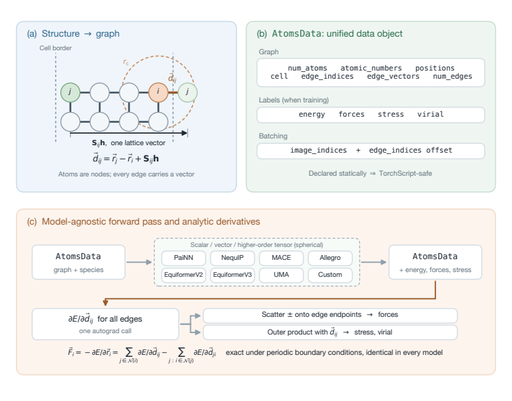
Figure 2 : The underlying mechanism: a shared graph convention, a unified data object, and a
出典 · CC BY 4.0 · Changzhi Ai, Xueping Qin, Dimosthenis Sokaras, Frank Abild-Pedersen, Johannes Voss · IANN: A Unified Framework for Equivariant InterAtomic Neural Networks with User-Friendly Implementation · 論文の図を引用 · 元のPDFの12ページ目から図の部分を抽出しています。七つのアーキテクチャのMPtrjでの比較
著者らは、MPtrjデータセットを、同じ分割、同じ損失の重み、5.5 Å のカットオフ、Adamによる最適化で学習しました。モデルの容量は約100万パラメータ程度に揃えており、結果としてパラメータ数は0.57Mから1.43Mの範囲でした。検証セットはMPtrjの5%を保留した分割で、評価は平均絶対誤差(MAE)で行いました。エネルギーのMAEは、UMAが0.029 eV/atomで最も低く、MACEが0.054 eV/atomで最も高くなりました。力のMAEは、UMAが0.040 eV/Å、EquiformerV3が0.046 eV/Å、PaiNNが0.050 eV/Åでした。この比較はパラメータ数を共通の基準にしたものです。
論文でも、これを厳密なアブレーション実験とは見なしていないと述べられています。
適用範囲と未対応の物理
この手法は、Eq. (1)の局所エネルギー分解に基づいているため、長距離静電気、電荷移動、磁気の自由度は捉えられず、現在サポートされていません。また、公開されている基盤モデルは学習に使われたDFTパラメータを引き継ぐため、交換相関汎関数が異なると絶対エネルギーを移せません。元のサードパーティ実装のチェックポイントはIANNに直接読み込めないため、このフレームワークのモデルは最初から学習するか、IANN基盤のチェックポイントからファインチューニングする必要があります。
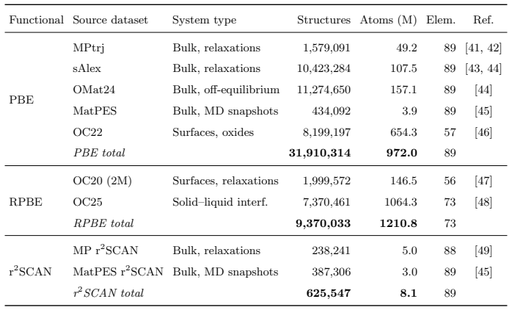
Table 1 : Curated DFT databases grouped by exchange-correlation functional.
出典 · CC BY 4.0 · Changzhi Ai, Xueping Qin, Dimosthenis Sokaras, Frank Abild-Pedersen, Johannes Voss · IANN: A Unified Framework for Equivariant InterAtomic Neural Networks with User-Friendly Implementation · 論文の図を引用 · 元のPDFの14ページ目から図の部分を抽出しています。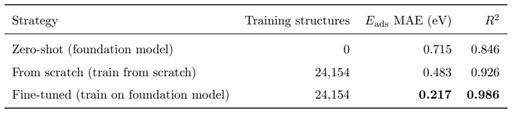
Table 4 : Performance comparison across zero-shot, training from scratch, and fine-tuning.
出典 · CC BY 4.0 · Changzhi Ai, Xueping Qin, Dimosthenis Sokaras, Frank Abild-Pedersen, Johannes Voss · IANN: A Unified Framework for Equivariant InterAtomic Neural Networks with User-Friendly Implementation · 論文の図を引用 · 元のPDFの21ページ目から図の部分を抽出しています。論文情報
- 著者
- Changzhi Ai, Xueping Qin, Dimosthenis Sokaras, Frank Abild-Pedersen, Johannes Voss
- 学会・ジャーナル
- arXiv · プレプリント
- 公開日
- 2026年11月15日
- 登録日
- 2026年11月17日
- 更新日
- 2026年11月15日
- バージョン
- v1
- arXiv
- 2611.19793
- カテゴリ
- cond-mat.mtrl-sci · cs.LG · physics.comp-ph
- ライセンス
- CC BY 4.0
- 掲載内容
- 論文情報・解説・論文の図
この解説は、Refivuの韓国語解説をAIで翻訳したものです。不正確な翻訳や誤りが含まれる可能性があります。論文と図の利用条件は各出典に従います。
アブストラクト
Machine-learning interatomic potentials (MLIPs) now approach density functional theory (DFT) accuracy at a fraction of its cost, but the practical benefit is limited by software fragmentation: each state-of-the-art architecture is released as a separate codebase, with its own data format, configuration system, training loop and molecular-dynamics interface. Comparing two architectures on the same dataset, or moving a trained model into a production simulation, therefore requires substantial re-engineering. We introduce IANN (InterAtomic Neural Network), an open-source PyTorch framework that reimplements equivariant graph neural networks - PaiNN, NequIP, MACE, Allegro, EquiformerV2, EquiformerV3 and UMA - behind a unified data object, a unified trainer and a single deployment route, so that the architecture is a one-word change in a configuration dictionary. Forces, stresses and virials are obtained for every architecture from one analytic differentiation of the energy with respect to the edge vectors of the atomic graph, exact under periodic boundary conditions. Distributed training is configured automatically from the SLURM, PBS or MPI environment, so the same script runs unchanged from a workstation to a multi-node GPU allocation. Self-describing checkpoints serve directly as ASE calculators, as ensembles reporting uncertainties, or as TorchScript models run inside LAMMPS through bundled C++ pair styles with single- and multi-GPU inference. Trained on a common dataset of millions of structures, the architectures can be compared under identical conditions. We further release PaiNN foundation models trained on 41.9 million curated DFT structures from MPtrj, Alexandria, OMat24, MatPES, OC20, OC22, OC25, MPr2SCAN and MatPESr2SCAN, spanning the PBE, RPBE and r2SCAN functionals. Additionally, IANN provides an agent interface to facilitate integration with autonomous agents.
この論文を引用
Changzhi Ai, Xueping Qin, Dimosthenis Sokaras, Frank Abild-Pedersen, Johannes Voss (2026). IANN: A Unified Framework for Equivariant InterAtomic Neural Networks with User-Friendly Implementation. arXiv:2611.19793v1. https://arxiv.org/abs/2611.19793v1
BibTeX
@misc{ai2026iann,
  title = {{IANN: A Unified Framework for Equivariant InterAtomic Neural Networks with User-Friendly Implementation}},
  author = {Changzhi Ai and Xueping Qin and Dimosthenis Sokaras and Frank Abild-Pedersen and Johannes Voss},
  year = {2026},
  eprint = {2611.19793},
  archivePrefix = {arXiv},
  url = {https://arxiv.org/abs/2611.19793v1}
}