論文解説
Benchmarking Protein Structure Tokenizers as Generation Targets for Language Models
構造トークナイザの書きやすさを同じ条件で比べる
- 課題 タンパク質の立体構造を言語モデルに扱わせるトークナイザは、再構成の正確さで選ばれてきました。しかし、言語モデルがその構造の列を実際に書けるかは測られていませんでした。
- 手法 本研究は、基盤モデルや学習条件を揃えたまま、構造トークナイザだけを8種類入れ替えて同じ9Bモデルを学習させます。そのうえで、生成された構造のTM-scoreで書きやすさを比べます。
- 結果 最良のDPLM-2はTM-scoreが0.6623に達し、最低のVanillaVQの0.3781を大きく上回りました。
再構成精度では測れない書き込みやすさ
言語モデルに構造を扱わせる一般的な方法は、骨格をK種のコードワードのいずれかに対応させる構造トークナイザで離散化し、その符号を語彙に加えることです。つまり、各残基が1つのコードワードになり、骨格は文字列としてテキストや配列と並べてモデルに読ませられます。ところが、トークナイザの良し悪しは、符号化して復号したときに構造がどれだけ残るかという再構成精度で語られてきました。この数字はコードから構造を読み出せるかを表すだけで、次トークン予測で学習したモデルが有効な列を書けるかは分かりません。
本研究はこの後者の性質を書き込みやすさ(writability)と呼び、読みやすさとは別に測ることを目的にしています。従来の構造生成モデルは、トークナイザ、基盤モデル、データ、計算量が同時に違うため、トークナイザだけの寄与を切り分けられませんでした。そこで、同じ条件で8種のトークナイザを比べる設計が必要になります。
基盤モデルを固定し、トークナイザだけを差し替える設計
中核の考え方は、同じ9Bの基盤モデルに構造トークンだけを語彙として加え、トークナイザを差し替えて同じ学習を繰り返すことです。学習データ、サンプル順序、レシピ、2Bトークンのコサインスケジュールは全アームで同一で、違うのは構造トークンを作るトークナイザと、出力を採点する復号器だけです。推論時はアミノ酸配列とタスク指示を入力として、残基ごとに1トークンを貪欲復号(greedy decoding)で出し、その列をトークナイザ自身の復号器で座標に変換します。
ただし、復号器が元から持つ構造の下駄が違うため、生のTM-scoreは同じ土俵で比べられません。そこで、同じ経路で一様ランダムなトークンを通した床(random-token floor)と、正解を一度符号化して復号した天井(reconstruction ceiling)を測り、その区間で正規化します。redemption rateは\( RR = \frac{TM_{model} - S_4}{S_1 - S_4} \)で定義され、分子がモデルの超えた分、分母が床から天井までの区間です。天井が低いと区間が狭まりRRが大きく出るため、本研究はRRを必ず天井とともに示しています。
近い符号語が近い構造を表すかという局所性
本研究が注目したのは、出力空間で近い符号語が、座標空間でも近い構造を表しているかどうかです。符号語が二値符号であれば、近さはハミング距離(Hamming distance)で測れます。DPLM-2は13ビットの符号語を持ち、FoldToken4は二値符号を持つため、この検証の対象になります。
1つ目の検定では、正解の骨格を符号化した後に30%の位置を1ビット反転させた場合と、ランダムな符号語に置き換えた場合を比べます。DPLM-2では、前者のTM低下が0.019、後者が0.347となり、ランダムに置き換えた方が18倍大きく崩れます。FoldToken4-l12では両者の差がほとんどなく、ビットに並んでいても構造の類似を符号化していないことになります。
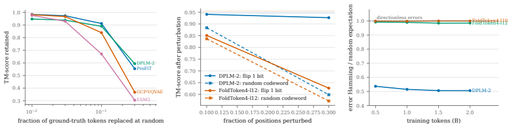
Figure 3 . (a) Replacing a fraction of ground-truth tokens with uniformly random ones; this ordering is not the writability ordering. (b) Perturbing a fraction of positions by one bit (solid) versus by a random codeword (dashed); dotted lines are each tokenizer’s reconstruction ceiling. (c) Mean Hamming distance of the model’s own token errors, divided by the expectation for a uniformly random wrong codeword; 1.0 means directionless.
出典 · CC BY 4.0 · Yong Liu, Zhanpeng Shi, Peicong Lin, Zhenyi Zhong, Yizhou Dang, Wendi Wu, Haoling Li, Jiayu Gu, Duo An, Shuangjia Zheng · Benchmarking Protein Structure Tokenizers as Generation Targets for Language Models · 論文の図を引用 · 元のPDFの7ページ目から図の部分を抽出しています。2つ目の検定は、学習後のモデルが実際にこの局所性を使っているかで、アーカイブされた貪欲生成の誤りを使います。2BトークンのDPLM-2では、誤りのハミング距離がランダムな誤り符号語の期待値の0.506倍となり、FoldToken4-l12の0.985倍より構造的に近い誤りを出しています。つまり、符号のビットに構造が載っているトークナイザほど、モデルの間違いも構造的に安く、その書き込みは0.13 TM高くなっています。
この比率は学習の途中で止まっており、DPLM-2は0.5Bから2Bトークンで0.537、0.515、0.506、0.506と下がった後、1.5B以降は変わりません。同じ期間にTMは0.5919、0.6455、0.6564、0.6623と伸び続けるため、後半のTMの伸びは誤りの局所性では説明できません。本研究はこの局所性を因果ではなく、8種にまたがる相関と2つの機構測定に基づく最も有力な説明として扱っています。
2Bトークン時点の書き込みやすさの順位
DPLM-2の0.6623とVanillaVQの0.3781の間で、トークナイザだけが違う条件の差が生じています。学習量ごとの曲線を見ると、床と天井の帯で各トークナイザの区間を確認できます。コードワード数は順位を決めません。最良のDPLM-2と最悪のProFiTはともに8192のコードワードを使っています。
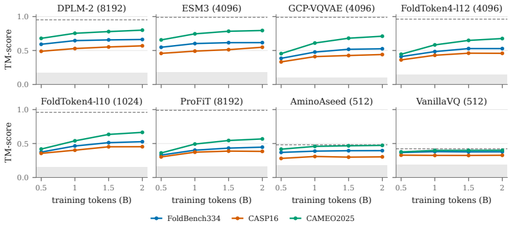
Figure 1 . Writability under identical conditions. Each panel is one tokenizer (codebook size in parentheses); the three curves are the three evaluation sets. The shaded band is that tokenizer’s random-token floor 𝑆4 and the dashed line is its reconstruction ceiling 𝑆1, both measured through the same decoder and scorer; panels share axes. Identity is carried by panel title rather than colour, since eight categorical hues cannot be separated reliably under colour-vision deficiency.
出典 · CC BY 4.0 · Yong Liu, Zhanpeng Shi, Peicong Lin, Zhenyi Zhong, Yizhou Dang, Wendi Wu, Haoling Li, Jiayu Gu, Duo An, Shuangjia Zheng · Benchmarking Protein Structure Tokenizers as Generation Targets for Language Models · 論文の図を引用 · 元のPDFの5ページ目から図の部分を抽出しています。再構成精度も順位を決めません。8種のうち6種は0.95 TMを超えて再構成しますが、その6種の最終TMは0.4467から0.6623まで広がります。ProFiTは天井が0.9902で最も高い一方、RRは33.9%で最も低く、読むことと書くことは別の性質だと考えられます。
ノイズフロアと参照なし指標
同じ設定でESM3を2回学習し、9組の対差の標準偏差は0.0067となりました。そこで|ΔTM|が0.013未満の差は区別できないと定め、全アームの比較に同じ閾値を使っています。この閾値では、FoldToken4-l12、FoldToken4-l10、GCP-VQVAEの3者がTM差0.001から0.003しかなく、同じ群にまとめられます。一方でDPLM-2とESM3の0.046は、ノイズの3.5倍あるため順位として残ります。
参照なしの指標パネルは、参照構造を使わず生成された骨格の結合の妥当性などを測り、TMとは別の軸として作られています。一様ランダムな入力だけでも床の値はトークナイザ間で大きく違い、CA–CA結合の妥当性はDPLM-2で0.806、ProFiTで0.793、GCP-VQVAEで0.149、ESM3で0.087になります。
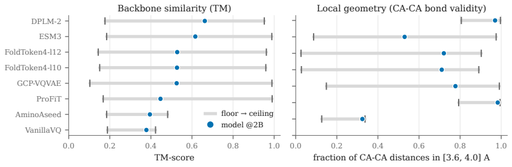
Figure 2 . Every score read between its own floor and ceiling, at 2B tokens on FoldBench334. Left: backbone similarity. Right: local geometry , the fraction of consecutive CA–CA distances inside [3.6, 4.0] Å. Bar ends are the random-token floor and the reconstruction ceiling for that tokenizer; the dot is the trained model. The two panels order the tokenizers almost inversely.
出典 · CC BY 4.0 · Yong Liu, Zhanpeng Shi, Peicong Lin, Zhenyi Zhong, Yizhou Dang, Wendi Wu, Haoling Li, Jiayu Gu, Duo An, Shuangjia Zheng · Benchmarking Protein Structure Tokenizers as Generation Targets for Language Models · 論文の図を引用 · 元のPDFの6ページ目から図の部分を抽出しています。ESMFoldとの差はどこで生じるか
同じESM2-3Bの特徴を使うESMFoldは、FoldBench334で0.870に達し、DPLM-2の0.6623との差は0.209です。DPLM-2は正解トークンから復号すると長距離接触の0.983を回収できるため、表現の上限は十分で、失われるのは入力から出力列に変える過程です。配列距離で分けると、短距離の捕捉率は72.3%、長距離は63.2%で、アーム間の幅は長距離が42.8ポイント、短距離が15.4ポイントです。長距離の捕捉率と最終TMの相関は+0.976で、短距離の+0.786より強く、長距離接触が生成列に残るかが分かれ目だと著者らは見ています。
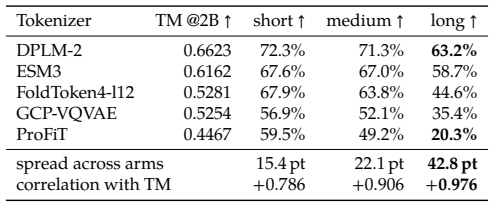
Table2 . Contact capture by sequence separation at 2B tokens on FoldBench334, as the fraction of the floor-to-ceiling interval the model realises. Floors (nearest-in-sequence) are 0.071 / 0.047 / 0.033 and ceilings (ground-truth tokens decoded) are 0.91–0.94 / 0.90–0.93 / 0.98–0.99 across arms. The long-range band spreads the arms nearly three times as far as the short- range band.
出典 · CC BY 4.0 · Yong Liu, Zhanpeng Shi, Peicong Lin, Zhenyi Zhong, Yizhou Dang, Wendi Wu, Haoling Li, Jiayu Gu, Duo An, Shuangjia Zheng · Benchmarking Protein Structure Tokenizers as Generation Targets for Language Models · 論文の図を引用 · 元のPDFの8ページ目から図の部分を抽出しています。差の半分は、入力に既にある長距離情報を出力に移せないことによると見積もられます。ESM2-3B自身の接触予測はP@L/5で0.813に達し、モデルは0.633です。0.633を0.813まで上げると+0.091 TMに相当し、これは0.209の差の44%にあたります。残りは離散化そのものの代価と見積もられます。長距離の天井0.983を外挿すると予測TMは0.840で、それでもESMFoldの0.870には届きません。ただし、これは観測範囲の外への外挿です。
表3は、この分解をまとめたものです。3つの項は重なるため、合計が0.209になるような厳密な分割ではありません。

Table 3 . Decomposition of the 0.209 TM gap between the most writable arm (DPLM-2 at 2B tokens) and ESMFold on the same 333 targets from the same ESM2-3B features. Terms overlap and are not strictly additive.
出典 · CC BY 4.0 · Yong Liu, Zhanpeng Shi, Peicong Lin, Zhenyi Zhong, Yizhou Dang, Wendi Wu, Haoling Li, Jiayu Gu, Duo An, Shuangjia Zheng · Benchmarking Protein Structure Tokenizers as Generation Targets for Language Models · 論文の図を引用 · 元のPDFの9ページ目から図の部分を抽出しています。復号と選択で縮められる差の上限
もし分布の中にもっと良い構造があるなら、貪欲復号より良い選択を行うのが最も安い対策になります。本研究は各対象で温度1.0の32サンプルを引き、oracle最大、medoid、ランダムトークン列を比べています。oracle最大は貪欲復号より+0.0515 TM高く、正解を使わないmedoidは+0.0095 TMにとどまります。
medoidは正解を使わずに選べますが、oracle上限の18%しか回収できません。32サンプルを生成するため推論コストは32倍になり、その対価として得られるのは0.01 TM程度です。つまり、復号の改善は差全体の約5%にとどまり、残りは表現と離散化の側にあると本研究は読んでいます。
500残基を超える鎖で崩れる理由
500残基以上では0.549に下がり、長距離接触の捕捉が66.0%から40.1%に落ちる一方、短距離は70.7%から59.0%への低下にとどまります。この区間は26対象しかないため、数値は粗い見積もりとして読むべきです。
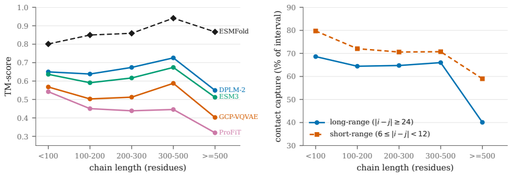
Figure 4 . Chain length. Left: TM by length bucket for four arms and ESMFold on the same targets. Model arms peak at 300–500 residues and fall beyond 500; ESMFold rises with length, so the gap widens monotonically. Right: contact capture by band for DPLM-2, as the fraction of the floor-to-ceiling interval realised. The long-range band collapses beyond 500 residues while the short-range band degrades gently.
出典 · CC BY 4.0 · Yong Liu, Zhanpeng Shi, Peicong Lin, Zhenyi Zhong, Yizhou Dang, Wendi Wu, Haoling Li, Jiayu Gu, Duo An, Shuangjia Zheng · Benchmarking Protein Structure Tokenizers as Generation Targets for Language Models · 論文の図を引用 · 元のPDFの10ページ目から図の部分を抽出しています。一方、ESMFoldは鎖長とともに伸び、相関は+0.172です。そのため、ESMFoldとの差は100残基未満の0.151から500残基以上の0.327へと広がります。このため、自己回帰の生成が長くなることによる誤りの蓄積など、別の要因がありうると考えられます。
ビットを直接学習させる介入の否定的結果
局所性が原因なら、モデルにビットを予測させれば改善するはずだという仮説を立て、事前に判定基準を決めた二つの介入を試しました。D2Hはインデックスの交差エントロピーを残しながら、ハミング距離で近い符号語へ平滑化する方法で、ε = 0.2を使いました。D2Bは目的関数をビットごとの二値交差エントロピーに替える方法で、DPLM-2のトークンを用いてベースラインと同じ条件で学習されています。
D2Bは1.39Bトークンで止まり、0.5Bでの3つの評価セットの差は+0.002、+0.014、−0.002で、ノイズの範囲内です。ただし、D2Hは誤り比が0.507でベースラインの0.506と変わらず、機構が動いていないため、この実行は無効として扱われます。
D2Bは誤り比を0.537から0.526へ動かしたため、機構は変わったのに性能は動かないという意味のある否定になります。ここから、トークン精度を構造品質の代理に使うのは誤りだと考えられます。D2Bは0.5Bでトークン誤り率が95.1%で、ベースラインの93.9%より高いのに、TMは同じです。
真の接頭辞では救えないProFiT
ProFiTは接頭辞の一貫性(prefix consistency)が0.0011とほぼゼロで、ESM3の0.5927と比べて、途中まで切った鎖を再符号化すると大半のトークンが変わります。仮説は、生成が早い段階のトークンを確定させられないことが弱さの原因だというものです。そこで最初のq割(q = 0.25、0.5、0.75)を正解に固定します。採点は、モデルが自分で書いた部分だけに限り、正解の複製を性能に数えないようにしています。全体で採点するとESM3の効果がq = 0.25で+0.029から+0.078に膨らみます。
ESM3の効果はq = 0.25で+0.029、q = 0.75で+0.068と増え、q = 0.75ではProFiTを上回ります。ProFiTは+0.055、+0.055、+0.062とほぼ横ばいで、正解の四分の三を与えても改善は小さいままです。著者らは、低いprefix consistencyを書きにくさの原因ではなく症状と見なし、双方向や拡散による復号を勧める根拠にはならないと考えています。
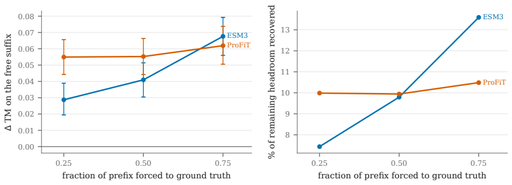
Figure 5 . Ground-truth prefix rescue, scored only on the suffix the model wrote itself. Left: absolute Δ TM with paired bootstrap 95% intervals. Right: the same effect as a fraction of the headroom remaining to each tokenizer’s reconstruction ceiling, which removes the advantage ProFiT gets from starting lower.
出典 · CC BY 4.0 · Yong Liu, Zhanpeng Shi, Peicong Lin, Zhenyi Zhong, Yizhou Dang, Wendi Wu, Haoling Li, Jiayu Gu, Duo An, Shuangjia Zheng · Benchmarking Protein Structure Tokenizers as Generation Targets for Language Models · 論文の図を引用 · 元のPDFの11ページ目から図の部分を抽出しています。一般能力は保たれ、思考の長さは縮む
基盤モデルは350項目のMMLU-Proで0.7743の正答率を示し、語彙を拡張しただけでは同じ値のままです。2Bトークンのチェックポイントは0.7257(ProFiT)から0.7629(ESM3)の範囲にあり、大きな崩れは見られません。一方、学習中の一般テキストの損失は2.1663から2.1695までの差が0.003しかなく、この指標では保持の差を見分けられません。
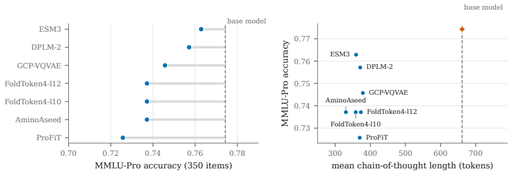
Figure 6 . General-capability guardrail at 2B tokens. Left: MMLU-Pro accuracy against the base model (dashed). Right: accuracy versus mean chain-of-thought length; the diamond is the base model. Every arm loses roughly half its reasoning length regardless of tokenizer.
出典 · CC BY 4.0 · Yong Liu, Zhanpeng Shi, Peicong Lin, Zhenyi Zhong, Yizhou Dang, Wendi Wu, Haoling Li, Jiayu Gu, Duo An, Shuangjia Zheng · Benchmarking Protein Structure Tokenizers as Generation Targets for Language Models · 論文の図を引用 · 元のPDFの12ページ目から図の部分を抽出しています。平均のChain-of-Thoughtの長さは基盤モデルの661トークンから、全アームで331–379トークンへ減り、43–50%の減少です。減り方はトークナイザによらず同じなので、学習レシピの影響と考えられ、正答率だけを見ると見落とされます。TMと正答率低下の相関はPearsonで+0.825ですが、組ごとの比較では有意な差はなく、関係は観察にとどめています。
限界
DPLM-2が8種中で最も書きやすいという主張は、この基盤モデル、レシピ、2Bトークンの予算に限られます。ESM3とGCP-VQVAEの差は0.163から0.091へ縮み、この比較は2B以下の予算に限って述べています。評価はすべて貪欲復号で、サンプリングやbest-of-nについては結論を出していません。
ノイズフロアは1アームを1回だけ再実行した9組の対差からの下界で、3〜5回の繰り返しがあれば正式な推定になります。ビットの局所性は因果としては確かめられておらず、その介入実験であるD2HとD2Bは効果を示していません。長さの段差は500残基以上の26対象に依存し、計算量で段差が動くかは検証していません。分解の第二項は観測範囲の外挿で、三つの項は重なるため、表3の値は厳密な分割ではありません。
論文情報
- 著者
- Yong Liu, Zhanpeng Shi, Peicong Lin, Zhenyi Zhong, Yizhou Dang, Wendi Wu, Haoling Li, Jiayu Gu, Duo An, Shuangjia Zheng
- 学会・ジャーナル
- arXiv · プレプリント
- 公開日
- 2026年11月24日
- 登録日
- 2026年11月25日
- 更新日
- 2026年11月24日
- バージョン
- v1
- arXiv
- 2611.32168
- カテゴリ
- q-bio.QM · cs.AI
- ライセンス
- CC BY 4.0
- 掲載内容
- 論文情報・解説・論文の図
この解説は、Refivuの韓国語解説をAIで翻訳したものです。不正確な翻訳や誤りが含まれる可能性があります。論文と図の利用条件は各出典に従います。
アブストラクト
Discrete structure tokenizers are the standard way to give a language model access to protein three-dimensional structure, yet they are selected on how accurately they can be read, their reconstruction fidelity, while the property that governs generation is how well a model can write them. We measure this property, writability, directly: holding the base model, data, recipe and compute fixed, we swap only the tokenizer and train the same 9B model to emit structure tokens residue by residue, over eight tokenizers, four compute budgets and three evaluation sets (96 cells). At 2B tokens final writability runs from TM 0.662 down to 0.378 under identical conditions, with five of the eight arms clearing the TM 0.5 mark at which a fold is usually called correct and three falling short of it. Neither codebook size nor reconstruction ceiling explains where an arm lands; the best and worst both use 8192 codewords. What does explain the spread is local structure preservation of the code space. In DPLM-2 a one-bit codeword error costs 0.019 TM where a random codeword costs 0.347, and the trained model's own errors are correspondingly local, at 0.51 of the random Hamming expectation; FoldToken4 fails both tests at the same codebook size and is 0.13 TM less writable. Three controls discipline how such a benchmark may be read. A same-recipe rerun puts the noise floor at $σ=0.0067$ TM, which collapses an apparent six-way ranking into four tiers. A reference-free geometry panel turns out to be nearly orthogonal to TM (Pearson $-0.58$), with the worst arm by TM producing the most physically valid backbones. And two pre-registered interventions are null for a reason the mechanism measurements reveal: the quantity they target saturates at 1.5B tokens while TM is still rising. All 131 evaluation cells, including raw generated token streams, are released.
論文の図
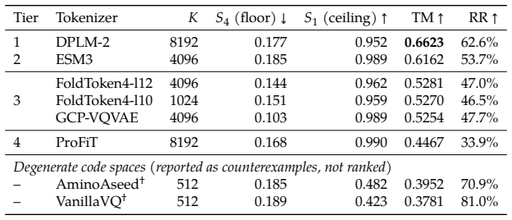
Table 1 .Final writability at 2B tokens on FoldBench334, with each tokenizer’s own floor and ceiling. RR is the redemption rate. Arms whose TM differs by less than the measured noise floor of 0.013 are grouped into one tier and are not ordered within it. The two arms marked † have reconstruction ceilings below 0.5: their high RR is an artifact of a narrow interval, not a success.
出典 · CC BY 4.0 · Yong Liu, Zhanpeng Shi, Peicong Lin, Zhenyi Zhong, Yizhou Dang, Wendi Wu, Haoling Li, Jiayu Gu, Duo An, Shuangjia Zheng · Benchmarking Protein Structure Tokenizers as Generation Targets for Language Models · 論文の図を引用 · 元のPDFの5ページ目から図の部分を抽出しています。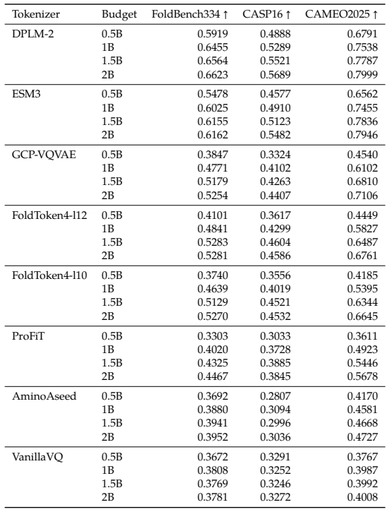
Table 4 . The complete grid: greedy TM-score for every tokenizer, compute budget and evaluation set (96 cells). Within- column comparisons smaller than 0.013 TM are below the measured run-to-run noise floor (Section 3).
出典 · CC BY 4.0 · Yong Liu, Zhanpeng Shi, Peicong Lin, Zhenyi Zhong, Yizhou Dang, Wendi Wu, Haoling Li, Jiayu Gu, Duo An, Shuangjia Zheng · Benchmarking Protein Structure Tokenizers as Generation Targets for Language Models · 論文の図を引用 · 元のPDFの18ページ目から図の部分を抽出しています。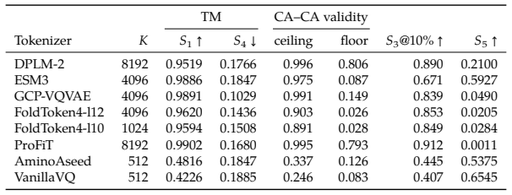
Table5 . T okenizer scorecard, measured on FoldBench334 without training any model.𝑆1 is the reconstruction ceiling, 𝑆4 the uniform-random floor, both through that tokenizer’s own decoder. Bond-validity columns are the fraction of consecutive CA–CA distances inside [3.6, 4.0] Å at the ceiling and at the floor. 𝑆3 is the TM retained after replacing 10% of ground-truth tokens at random. 𝑆5 is prefix consistency.
出典 · CC BY 4.0 · Yong Liu, Zhanpeng Shi, Peicong Lin, Zhenyi Zhong, Yizhou Dang, Wendi Wu, Haoling Li, Jiayu Gu, Duo An, Shuangjia Zheng · Benchmarking Protein Structure Tokenizers as Generation Targets for Language Models · 論文の図を引用 · 元のPDFの19ページ目から図の部分を抽出しています。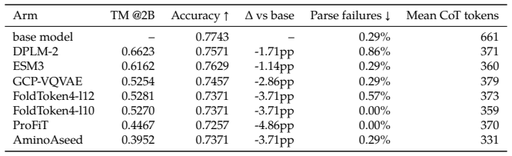
Table 6 . General-capability guardrail: MMLU-Pro on a pre-registered 350-item stratified subset, official 5-shot chain-of- thought protocol, at the 2B-token checkpoint. No pairwise difference is significant (exact McNemar); see Section 9.
出典 · CC BY 4.0 · Yong Liu, Zhanpeng Shi, Peicong Lin, Zhenyi Zhong, Yizhou Dang, Wendi Wu, Haoling Li, Jiayu Gu, Duo An, Shuangjia Zheng · Benchmarking Protein Structure Tokenizers as Generation Targets for Language Models · 論文の図を引用 · 元のPDFの19ページ目から図の部分を抽出しています。この論文を引用
Yong Liu, Zhanpeng Shi, Peicong Lin, Zhenyi Zhong, Yizhou Dang, Wendi Wu, Haoling Li, Jiayu Gu, Duo An, Shuangjia Zheng (2026). Benchmarking Protein Structure Tokenizers as Generation Targets for Language Models. arXiv:2611.32168v1. https://arxiv.org/abs/2611.32168v1
BibTeX
@misc{liu2026benchmarking,
  title = {{Benchmarking Protein Structure Tokenizers as Generation Targets for Language Models}},
  author = {Yong Liu and Zhanpeng Shi and Peicong Lin and Zhenyi Zhong and Yizhou Dang and Wendi Wu and Haoling Li and Jiayu Gu and Duo An and Shuangjia Zheng},
  year = {2026},
  eprint = {2611.32168},
  archivePrefix = {arXiv},
  url = {https://arxiv.org/abs/2611.32168v1}
}