論文解説
SLIC: Reinforcement Fine-Tuning Small LMs for Multi-Turn Analog Circuit Optimization
SLIC:マルチターンのアナログ回路最適化に向けた小規模言語モデルの強化ファインチューニング
- 課題 アナログ回路設計は、プロセス技術と密接に結びついたマルチターンのシミュレーションに基づく作業です。PDKが独占的なため、外部のLLMを使うことは難しいです。
- 手法 SLICでは、4Bの言語モデルをSFTの後にマルチターンのGRPOで学習させます。構造化された回路表現、離散化された相対更新、ドメインゲート付きの報酬、RGRSによるロールアウト選択を組み合わせています。
- 結果 SLIC-RANDOMは分布内の8ターンでPass@1 87.1%と報告されています。SLIC-SOFTMAXは保留トポロジーで72.6%と報告されています。このポリシーは、他の技術ノードとTSMC 65 nm PDKにも、追加のファインチューニングなしで適用されました。
アナログ回路設計の最適化の難しさ
アナログ集積回路設計は、仕様どうしのトレードオフを何度も調整する作業です。プロセス技術と密接に結びついているため、回路や技術ノードごとに設計の生産性を広げることは難しいです。さらに、公開されている設計データは少なく、プロセス設計キット(PDK)は独占的です。そのため、外部でホストされる大規模言語モデルに設計情報を送る方法は、実務環境では使いにくいです。この論文では、4B規模の言語モデルをローカルに配備し、シミュレータのフィードバックを受けながら、マルチターンで回路サイズを調整する学習方法を扱います。
構造化された回路表現と相対更新の振る舞い
SLICは、回路を構成要素、編集可能な属性、構造の境界を明示したXML形式で表現します。ポリシーは推論の後、対象素子、パラメータ、方向、比率からなる離散化された相対更新を出力します。シミュレータは、この更新を現在のパラメータ値に掛ける形で適用するため、絶対値を新たに生成することはありません。学習では、教師モデルによるシミュレータのロールアウトのうち、有効で性能が改善したターンだけを選び、SFTで初期化してから、マルチターンのGRPOに進みます。報酬はドメイン有効性ゲートを通過してから、仕様ごとのスコアを合計します。すべての仕様を満たした成功設計には、平均余裕度に基づくボーナスを与えます。
Reward-Guided Rollout Steeringの候補選択
RGRSは、各ターンで同じ相互作用の履歴から、G個の候補編集をサンプリングし、各候補をシミュレーションして測定値と報酬を得ます。すべての候補の遷移はグループ相対更新に使われ、次のターンの親状態は、1つの候補を選んで決まります。適格候補集合は、有効な候補がある場合は有効な候補に限定され、なければ全候補が対象になります。連続選択ポリシーは、RANDOM(一様ランダム)、GREEDY(最高スコア)、SOFTMAX(スコアに応じた確率選択)の3つで比較されます。SOFTMAXは高いスコアを優先しますが、ほかの適格候補にも0ではない選択確率を残します。著者らは、この構造では一度に1つの候補しか進まないため、候補集合と学習ロールアウトの長さを増やしても、サンプリングコストは線形に保たれると説明しています。
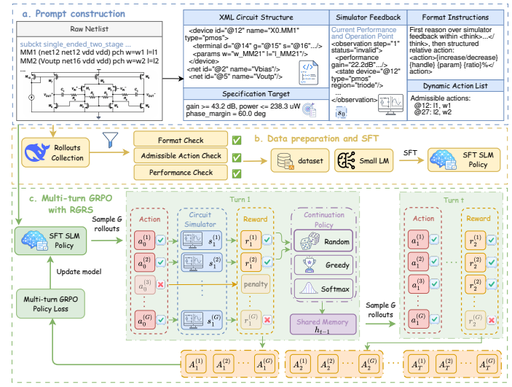
Figure 1 : Overview ofSLIC. Given a goal-conditioned analog circuit optimization task, SLIC builds a structured prompt from the circuit representation and target specifications, then trains a language- model agent through SFT and simulator-interactive RL. The upper path shows SFT data construction from filtered teacher rollouts. The lower loop shows multi-turn GRPO with Reward-Guided Rollout Steering (RGRS), where multiple candidate responses propose relative parameter updates that are evaluated through simulation, one eligible continuation is selected to advance the trajectory, and all candidates contribute to group-relative policy updates. Subscripts denote interaction steps, and superscripts index candidates within each group.
出典 · CC BY 4.0 · Yan Xu, Zhengqi Gao, Ching-Yun Ko, Zhang-Wei Hong, Wenjie Lu, Tao Yu, Xin Zhang, Duane S. Boning, Ruonan Han · SLIC: Reinforcement Fine-Tuning Small LMs for Multi-Turn Analog Circuit Optimization · 論文の図を引用 · 元のPDFの2ページ目から図の部分を抽出しています。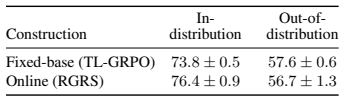
Table 6 : Trajectory construction with dynamic filtering, no slack bonus, and stopping at success. RGRS uses random continuation. Turn 8 Pass@1 (%).
出典 · CC BY 4.0 · Yan Xu, Zhengqi Gao, Ching-Yun Ko, Zhang-Wei Hong, Wenjie Lu, Tao Yu, Xin Zhang, Duane S. Boning, Ruonan Han · SLIC: Reinforcement Fine-Tuning Small LMs for Multi-Turn Analog Circuit Optimization · 論文の図を引用 · 元のPDFの21ページ目から図の部分を抽出しています。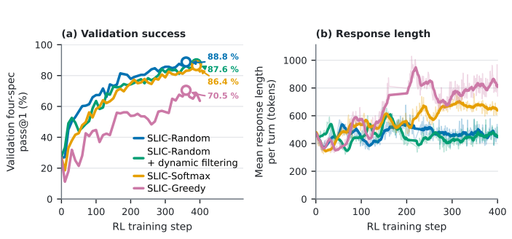
Figure 6 : Training dynamics of SLIC under different continuation strategies. (a) Four-specification Pass@1 on the validation set used for checkpoint selection; open circles mark the best validation checkpoint for each variant. (b) Mean generated response length per turn during training, including both reasoning and actions.
出典 · CC BY 4.0 · Yan Xu, Zhengqi Gao, Ching-Yun Ko, Zhang-Wei Hong, Wenjie Lu, Tao Yu, Xin Zhang, Duane S. Boning, Ruonan Han · SLIC: Reinforcement Fine-Tuning Small LMs for Multi-Turn Analog Circuit Optimization · 論文の図を引用 · 元のPDFの25ページ目から図の部分を抽出しています。有効性と性能を分けた正規化
論文では、有効性の利得と性能の利得を、同じグループ平均と標準偏差で一括して正規化するのではなく、それぞれ別々に正規化してから足し合わせています。有効性の利得は全候補集合で、性能の利得は測定可能な候補集合で計算され、測定のない候補は性能比較から除外されます。結合正規化では、無効行動のペナルティと測定された設計との差がグループ分散を大きくし、性能差を圧縮しうる、というのが著者らの解釈です。分離正規化を用いたSLIC-SOFTMAXは、結合正規化と比べて、分布内Pass@1が6.2ポイント、分布外Pass@1が4.9ポイント高いと報告されています。
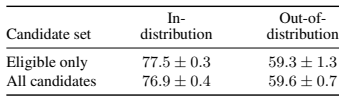
Table 7 : Continuation candidate set with soft- max selection, joint normalization, and contin- ued optimization after success. Turn 8 Pass@1 (%).
出典 · CC BY 4.0 · Yan Xu, Zhengqi Gao, Ching-Yun Ko, Zhang-Wei Hong, Wenjie Lu, Tao Yu, Xin Zhang, Duane S. Boning, Ruonan Han · SLIC: Reinforcement Fine-Tuning Small LMs for Multi-Turn Analog Circuit Optimization · 論文の図を引用 · 元のPDFの21ページ目から図の部分を抽出しています。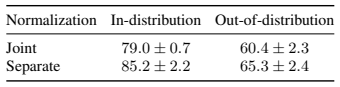
Table 8 : Normalization ablation for Qwen3.5- 4B with random continuation and continued optimization after success. Results are four- specification Pass@1 (%) at Turn 8.
出典 · CC BY 4.0 · Yan Xu, Zhengqi Gao, Ching-Yun Ko, Zhang-Wei Hong, Wenjie Lu, Tao Yu, Xin Zhang, Duane S. Boning, Ruonan Han · SLIC: Reinforcement Fine-Tuning Small LMs for Multi-Turn Analog Circuit Optimization · 論文の図を引用 · 元のPDFの21ページ目から図の部分を抽出しています。分布内と保留トポロジーでの評価
分布内の評価は、PTM 65 nm技術の840個の課題で行われました。4B SLIC-RANDOMは、8ターンで4つの仕様のPass@1が87.1%と報告されています。同じ条件でGPT-6-Astraは90.6%で、より高い値です。Tree MT-GRPOは、単純な分布内トポロジーでは8ターンで96.3%を示し、SLIC-RANDOMの92.7%を上回ります。ただし、分布内全体のPass@1は81.2%で、SLIC-RANDOMの87.1%を下回ります。この比較の結果は、PTM 65 nmの条件と著者らが測定した設定で得られた値です。
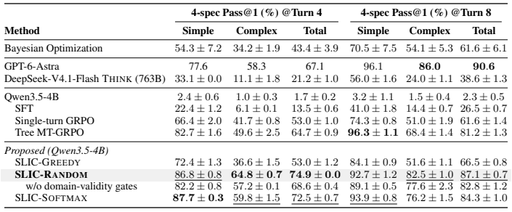
Table 1 : In-distribution evaluation at the PTM 65 nm technology node over 840 tasks with break- downs by topology complexity. GPT-6-Astra is evaluated once on the full evaluation set. Bayesian Optimization uses 96 and 192 simulator calls per topology to match SLIC’s total simulation budget. Boldand underline denote the best and second-best mean results in each column respectively.
出典 · CC BY 4.0 · Yan Xu, Zhengqi Gao, Ching-Yun Ko, Zhang-Wei Hong, Wenjie Lu, Tao Yu, Xin Zhang, Duane S. Boning, Ruonan Han · SLIC: Reinforcement Fine-Tuning Small LMs for Multi-Turn Analog Circuit Optimization · 論文の図を引用 · 元のPDFの7ページ目から図の部分を抽出しています。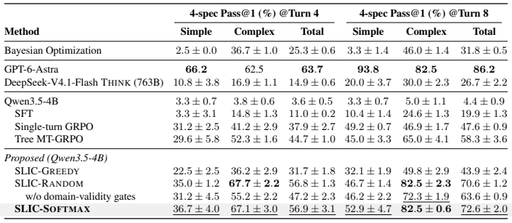
Table 2 : Out-of-distribution evaluation at the PTM 65 nm technology node over 240 tasks, with breakdowns by topology complexity (two simple and four complex). GPT-6-Astra is evaluated once on the full evaluation set. Bayesian Optimization uses 96 and 192 simulator calls per topology to match SLIC’s total simulation budget.Boldand underline denote the best and second-best reported mean results in each column respectively.
出典 · CC BY 4.0 · Yan Xu, Zhengqi Gao, Ching-Yun Ko, Zhang-Wei Hong, Wenjie Lu, Tao Yu, Xin Zhang, Duane S. Boning, Ruonan Han · SLIC: Reinforcement Fine-Tuning Small LMs for Multi-Turn Analog Circuit Optimization · 論文の図を引用 · 元のPDFの8ページ目から図の部分を抽出しています。技術ノードと商用PDKへの転移
PTM 65 nmで学習したポリシーは、22 nmから130 nmまでのPTMノードと、TSMC 65 nm PDKに、追加のファインチューニングなしで適用されました。各技術では、初期パラメータを有効範囲に合わせ、目標仕様はPTM 65 nmの値を再利用します。SLIC-SOFTMAXは、5つの未観測PTMノードで、分布内73.3~79.8%、保留トポロジーで61.9~71.0%と報告されています。TSMC 65 nm PDKでは、SLIC-RANDOMの保留トポロジーPass@1は49.9%で、学習なしの転移評価として示されています。論文では、この低下はPTMが単純化したプロセス効果によると説明されていますが、原因を直接測定したとは主張されていません。
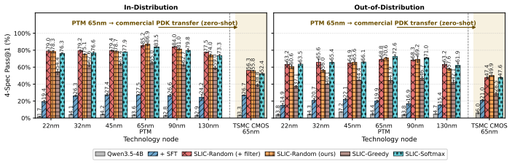
Figure 2 : Technology transfer under four-specification Pass@1 evaluation within eight turns. Policies are trained on PTM 65 nm and evaluated across PTM nodes from 22 to 130 nm and a TSMC CMOS 65 nm PDK without additional fine-tuning. Initial parameters are adjusted to the valid ranges of each technology, while the PTM 65 nm target specifications are reused. Left: a 420-task subset of the full 840 in-distribution tasks. Right: 240 held-out topology tasks.
出典 · CC BY 4.0 · Yan Xu, Zhengqi Gao, Ching-Yun Ko, Zhang-Wei Hong, Wenjie Lu, Tao Yu, Xin Zhang, Duane S. Boning, Ruonan Han · SLIC: Reinforcement Fine-Tuning Small LMs for Multi-Turn Analog Circuit Optimization · 論文の図を引用 · 元のPDFの8ページ目から図の部分を抽出しています。構成要素のアブレーション実験と報酬設計
ドメイン有効性ゲートを外すと、8ターンのPass@1は分布内で4.3ポイント、分布外で7.0ポイント下がります。成功条件付きのslackボーナスを加えた設定は、動的フィルタリングの下で、分布内で8.5ポイント、保留トポロジーで12.1ポイント改善します。連続選択ポリシーでは、GREEDYよりもRANDOMとSOFTMAXのほうが高く見られ、SOFTMAXとRANDOMの差は統計的に有意ではないと報告されています。このアブレーション実験の結果は、各構成要素を取り除いたときの変化を示すものであり、他の学習設定と組み合わせたときの効果をすべて代表するわけではありません。
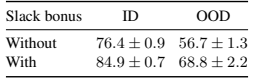
Table 3 : Slack bonus ablation with random continuation and dynamic filtering.
出典 · CC BY 4.0 · Yan Xu, Zhengqi Gao, Ching-Yun Ko, Zhang-Wei Hong, Wenjie Lu, Tao Yu, Xin Zhang, Duane S. Boning, Ruonan Han · SLIC: Reinforcement Fine-Tuning Small LMs for Multi-Turn Analog Circuit Optimization · 論文の図を引用 · 元のPDFの8ページ目から図の部分を抽出しています。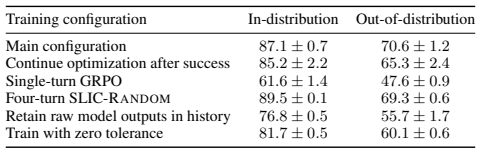
Table 10 : Ablations relative to the main SLIC-RANDOMconfiguration, which uses separate normal- ization, the success-conditional slack bonus, stopping at success, an eight-turn training budget, and structured history. All policies are evaluated at Turn 8.
出典 · CC BY 4.0 · Yan Xu, Zhengqi Gao, Ching-Yun Ko, Zhang-Wei Hong, Wenjie Lu, Tao Yu, Xin Zhang, Duane S. Boning, Ruonan Han · SLIC: Reinforcement Fine-Tuning Small LMs for Multi-Turn Analog Circuit Optimization · 論文の図を引用 · 元のPDFの22ページ目から図の部分を抽出しています。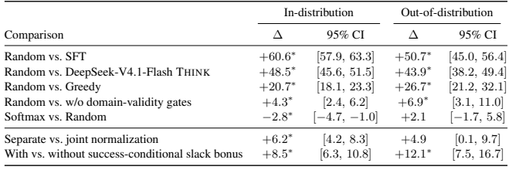
Table 14 : Task-paired differences in four-specification Pass@1 within eight turns. Differences ( ∆, in percentage points) are computed as the first method minus the second. Random, Softmax, and Greedy denote the corresponding SLIC variants. The normalization and slack-bonus comparisons use their respective matched training settings. Confidence intervals are pointwise 95% percentile bootstrap intervals. ∗ indicates significance at α= 0.05 after Holm correction across all 18 Turn 8 tests in the analysis.
出典 · CC BY 4.0 · Yan Xu, Zhengqi Gao, Ching-Yun Ko, Zhang-Wei Hong, Wenjie Lu, Tao Yu, Xin Zhang, Duane S. Boning, Ruonan Han · SLIC: Reinforcement Fine-Tuning Small LMs for Multi-Turn Analog Circuit Optimization · 論文の図を引用 · 元のPDFの30ページ目から図の部分を抽出しています。適用範囲と限界
著者らは、SLICが与えられたトポロジー内の素子サイズ調整に焦点を当てていると述べています。トポロジー生成、PVT変動の検証、物理レイアウトを含む設計フロー全体は、今後の課題として残すとしています。評価対象も増幅器の4つの仕様に限られ、LDO、LNA、PAや、ノイズやオフセットのような追加の目的は扱っていません。また、主要な結果はPTM 65 nmの学習条件と特定のバックボーン(Qwen3.5-4B)で得られたものであり、他のバックボーンの結果は付録の表で別途報告されています。
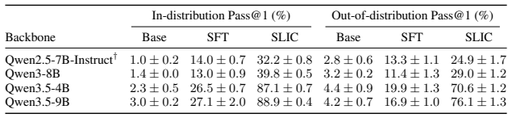
Table 4 : Generalization across backbones at Turn 8 on 840 ID and 240 OOD tasks. Qwen3 and Qwen3.5 backbones follow the main SLIC-RANDOMconfiguration. †Qwen2.5-7B-Instruct uses SLIC-SOFTMAXwith 800 RL updates (Appendix G.2).
出典 · CC BY 4.0 · Yan Xu, Zhengqi Gao, Ching-Yun Ko, Zhang-Wei Hong, Wenjie Lu, Tao Yu, Xin Zhang, Duane S. Boning, Ruonan Han · SLIC: Reinforcement Fine-Tuning Small LMs for Multi-Turn Analog Circuit Optimization · 論文の図を引用 · 元のPDFの9ページ目から図の部分を抽出しています。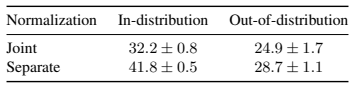
Table 12 : Qwen2.5-7B-Instruct four-specification Pass@1 (%) at Turn 8.
出典 · CC BY 4.0 · Yan Xu, Zhengqi Gao, Ching-Yun Ko, Zhang-Wei Hong, Wenjie Lu, Tao Yu, Xin Zhang, Duane S. Boning, Ruonan Han · SLIC: Reinforcement Fine-Tuning Small LMs for Multi-Turn Analog Circuit Optimization · 論文の図を引用 · 元のPDFの24ページ目から図の部分を抽出しています。論文情報
- 著者
- Yan Xu, Zhengqi Gao, Ching-Yun Ko, Zhang-Wei Hong, Wenjie Lu, Tao Yu, Xin Zhang, Duane S. Boning, Ruonan Han
- 学会・ジャーナル
- arXiv · プレプリント
- 公開日
- 2026年11月10日
- 登録日
- 2026年11月11日
- 更新日
- 2026年11月10日
- バージョン
- v1
- arXiv
- 2611.13452
- カテゴリ
- cs.LG
- ライセンス
- CC BY 4.0
- 掲載内容
- 論文情報・解説・論文の図
この解説は、Refivuの韓国語解説をAIで翻訳したものです。不正確な翻訳や誤りが含まれる可能性があります。論文と図の利用条件は各出典に従います。
アブストラクト
Analog integrated circuit (IC) design is a multi-turn, simulator-grounded engineering task that demands iterative reasoning over coupled performance tradeoffs, yet proprietary process design kits (PDKs) make hosted large language model workflows difficult to deploy in practical design settings. We present SLIC (Small LM Iterating on Circuits), a reinforcement fine-tuning framework that trains a 4B-scale, locally deployable language model for closed-loop analog circuit optimization. SLIC pairs structured circuit representations with discretized relative-update actions, domain- and success-gated multiobjective rewards, and Reward-Guided Rollout Steering (RGRS), which turns per-step simulator feedback into signals for both policy learning and online rollout construction in this sparse, highly constrained domain. We further release an open, goal-conditioned benchmark of 41 amplifier topologies with standardized protocols for in-distribution validation, held-out topology evaluation, and cross-technology-node transfer. Trained solely with open source 65 nm CMOS predictive technology models (PTM), SLIC-Random achieves 87.1% in-distribution four-specification Pass@1 within eight turns, surpassing the 763B DeepSeek-V4.1-Flash Think by 48.5 percentage points. Beyond the training distribution, SLIC-Softmax reaches 72.6% Pass@1 on held-out topologies, and the trained policies consistently transfer across five unseen technology nodes without additional fine-tuning. This transfer extends to a commercial TSMC 65 nm CMOS PDK, where SLIC-Random achieves 49.9% held-out-topology Pass@1, demonstrating practical deployment through local inference without transmitting proprietary data to external LLM services. Performance further scales with test-time simulator interactions, reaching up to 83.2% held-out-topology Pass@1 at a 32-turn budget.
この論文を引用
Yan Xu, Zhengqi Gao, Ching-Yun Ko, Zhang-Wei Hong, Wenjie Lu, Tao Yu, Xin Zhang, Duane S. Boning, Ruonan Han (2026). SLIC: Reinforcement Fine-Tuning Small LMs for Multi-Turn Analog Circuit Optimization. arXiv:2611.13452v1. https://arxiv.org/abs/2611.13452v1
BibTeX
@misc{xu2026slic,
  title = {{SLIC: Reinforcement Fine-Tuning Small LMs for Multi-Turn Analog Circuit Optimization}},
  author = {Yan Xu and Zhengqi Gao and Ching-Yun Ko and Zhang-Wei Hong and Wenjie Lu and Tao Yu and Xin Zhang and Duane S. Boning and Ruonan Han},
  year = {2026},
  eprint = {2611.13452},
  archivePrefix = {arXiv},
  url = {https://arxiv.org/abs/2611.13452v1}
}