論文解説
JFinBench: A Continuously Refreshable Japanese Financial Benchmark from the Latest Certification Exams
JFinBench:最新の資格試験から継続的に更新できる日本語金融ベンチマーク
- 課題 既存の金融ベンチマークは英語と米国中心の資料が多く、試験も古いため、日本の金融と最新性を同時に評価するのは難しいです。
- 手法 試験PDFを、コーディングエージェントが書いた変換コードと人手による全件検証で構造化し、最新の日本の金融試験の例題321個を作成しました。
既存の金融ベンチマークの限界
日本の金融は地域の税法、会計基準、規制によって異なりますが、既存の金融ベンチマークは英語と米国中心の資料が多く、この領域を十分に扱えていません。日本の金融を扱った既存のベンチマークも、選択式が中心であるか試験数が少なく、計算形式の解答や図表に依存する問題が欠けています。また、公開された問題は時間がたつと学習データに入り込み、スコアが暗記を反映するおそれがあります。JFinBenchは、この二つの問題、すなわち国ごとの金融知識の範囲とベンチマークの最新性の維持を同時に対象としています。
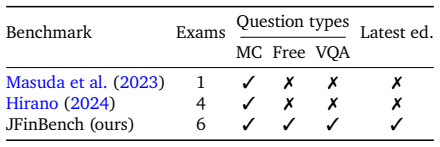
Table 1 | Exam-based Japanese financial benchmarks. MC: multiple choice. Free: free-response, form, and essay answers graded with rubrics. VQA: image-dependent questions retained as visual inputs.
出典 · CC BY 4.0 · Issa Sugiura, Taro Makino, Takashi Ishida · JFinBench: A Continuously Refreshable Japanese Financial Benchmark from the Latest Certification Exams · 論文の図を引用 · 元のPDFの3ページ目から図の部分を抽出しています。エージェントによる構築パイプライン
著者らは、試験PDFを例題に変換する工程を、人が関与するエージェントパイプラインとして設計しました。まず、すべての試験に共通のスクリプトがページを画像としてレンダリングし、VLMでMarkdownの書き起こしを作成します。そのうえで、文字の多重集合によってPyMuPDFの抽出テキストと照合し、欠落と幻覚を標識します。次に、コーディングエージェントが試験ごとに、書き起こしを問題、選択肢、正解、図領域を含むレコードに変換するコードと、元のページと並べて見られる確認ページを作成します。最後に、人が全例題を元のページと照合して確認し、問題点を自然言語でエージェントに返します。試験の形式が異なっても共通スクリプトを使うため、新しい試験や新しい版を追加する際に新たに書くコードと人による検証だけが必要です。
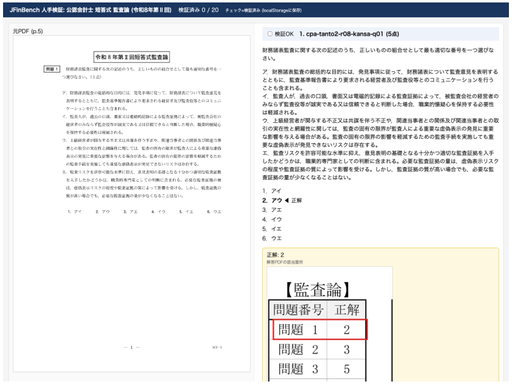
Figure 8 | Human verification interface (shown: CPA short-answer exam, auditing).Left:the source exam PDF page. Right:the final record with example ID (cpa-tanto2-r08-kansa-q01), question, options, and the answer key with the corresponding region of the answer-key PDF.
出典 · CC BY 4.0 · Issa Sugiura, Taro Makino, Takashi Ishida · JFinBench: A Continuously Refreshable Japanese Financial Benchmark from the Latest Certification Exams · 論文の図を引用 · 元のPDFの21ページ目から図の部分を抽出しています。ツールなしの評価結果
ツールなしで12個のモデルを評価した結果、Claude Fable 5の総合スコアは95.8、GPT-6 Astraは93.6でした。この二つのモデルは、税理士試験を除くほとんどの試験で96から100点の範囲に入りました。最も高いオープンウェイトモデルであるKimi K3.1 Proは83.4点で、Claude Fable 5より12パーセントポイント低い結果でした。総合スコアは6つの試験の平均を同じ重みで算出した値で、スコアは最大の推論努力で3回実行した平均です。失敗例の大半は知識不足によるもので、計算ミスはまれでした。
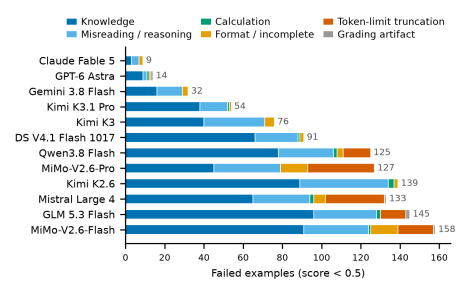
Figure 4 | Error type distribution of each model (w/o tools, failed examples with score< 0.5, run 1 at maximum effort). Knowledge errors are the most common cause for most models, and token-limit truncation is concentrated in a handful of models.
出典 · CC BY 4.0 · Issa Sugiura, Taro Makino, Takashi Ishida · JFinBench: A Continuously Refreshable Japanese Financial Benchmark from the Latest Certification Exams · 論文の図を引用 · 元のPDFの8ページ目から図の部分を抽出しています。ツール使用時のスコアの変化
シェルとWebアクセスを与えた設定では、すべてのモデルのスコアが上がりました。最も高いharnessで比べると、最高のオープンウェイトモデルと最高の独自モデルの差は12.4ポイントから4.4ポイントに縮まりました。Harbor環境でTerminus-2、mini-SWE-agent、公式harnessを比較し、解答資料を使った試行はスコア0として扱いました。ツール使用の前後でのモデル順位の相関はSpearman 0.87で、知識の多いモデルはツールを使っても依然として上位でした。著者らは、これをパラメータ内の知識が何を検索すべきか、そして見つけた内容をどう適用するかに役立つものと解釈しています。
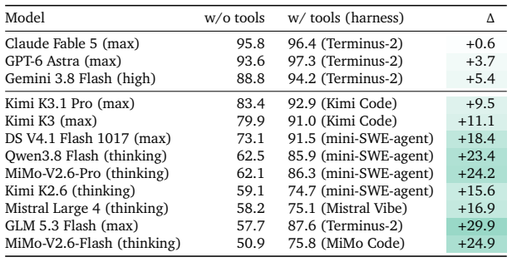
Table 4 | Comparison of each model’s score without and with tools (mean over 3 runs). For w/ tools, we report the best score among the Terminus-2, mini-SWE-agent, and official harnesses (Table 11). With shell and web access, every model improves, and the open-weight models gain 9.5 to 29.9 points.
出典 · CC BY 4.0 · Issa Sugiura, Taro Makino, Takashi Ishida · JFinBench: A Continuously Refreshable Japanese Financial Benchmark from the Latest Certification Exams · 論文の図を引用 · 元のPDFの9ページ目から図の部分を抽出しています。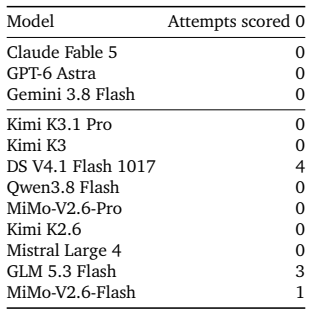
Table 10 | Number of attempts scored 0 for answer-key exposure (with tools, Terminus-2, summed over three runs of 321 tasks).
出典 · CC BY 4.0 · Issa Sugiura, Taro Makino, Takashi Ishida · JFinBench: A Continuously Refreshable Japanese Financial Benchmark from the Latest Certification Exams · 論文の図を引用 · 元のPDFの27ページ目から図の部分を抽出しています。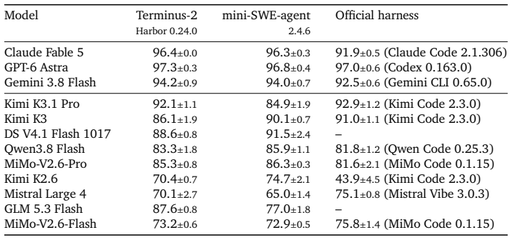
Table 11 | Overall with-tools score under different agent harnesses (mean±std over 3 runs). A dash marks official harnesses not supported by Harbor 0.24.0.
出典 · CC BY 4.0 · Issa Sugiura, Taro Makino, Takashi Ishida · JFinBench: A Continuously Refreshable Japanese Financial Benchmark from the Latest Certification Exams · 論文の図を引用 · 元のPDFの30ページ目から図の部分を抽出しています。限界
税理士試験を除くほとんどの試験で96から100点を記録した2つの先端的な独自モデルについては、このベンチマークがそれらを見分ける能力に限界があります。すべての試験は、報告された知識カットオフ以降に実施されましたが、カットオフは開発元が自ら示した値のため、データ汚染を完全に排除できるわけではありません。多くの開発元はカットオフを明示しておらず、データ収集後にも追加学習が行われた可能性があります。この評価は、報告されたカットオフ以降に実施された試験に基づいていますが、汚染がないことを保証するものではありません。
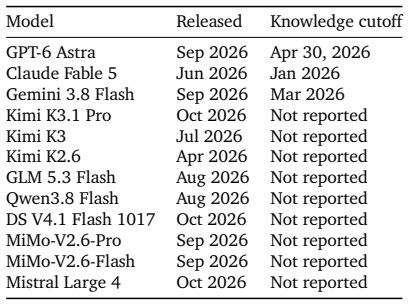
Table 6 | Release dates and developer-reported knowledge cutoffs.
出典 · CC BY 4.0 · Issa Sugiura, Taro Makino, Takashi Ishida · JFinBench: A Continuously Refreshable Japanese Financial Benchmark from the Latest Certification Exams · 論文の図を引用 · 元のPDFの20ページ目から図の部分を抽出しています。論文情報
- 著者
- Issa Sugiura, Taro Makino, Takashi Ishida
- 学会・ジャーナル
- arXiv · プレプリント
- 公開日
- 2026年11月13日
- 登録日
- 2026年11月16日
- 更新日
- 2026年11月13日
- バージョン
- v1
- arXiv
- 2611.18130
- カテゴリ
- cs.AI
- ライセンス
- CC BY 4.0
- 掲載内容
- 論文情報・解説・論文の図
この解説は、Refivuの韓国語解説をAIで翻訳したものです。不正確な翻訳や誤りが含まれる可能性があります。論文と図の利用条件は各出典に従います。
アブストラクト
Large language models (LLMs) are increasingly applied to finance, creating a need for benchmarks that evaluate their capabilities across financial systems with different regulations and practices. However, existing financial benchmarks provide limited coverage of country-specific financial systems, and they are difficult to keep up to date as released questions leak into training data. We introduce JFinBench, a Japanese financial benchmark comprising 321 examples from the 2026 editions of six regularly administered certification exams covering accounting, tax, financial planning, and banking. To construct it, we develop a human-in-the-loop agentic pipeline in which a coding agent writes exam-specific conversion code and a review page, while a human verifies every example and feeds corrections back to the agent. This pipeline adapts to heterogeneous exam formats and reduces the effort of incorporating new exam editions, enabling periodic refreshes that mitigate data contamination. Evaluating 12 recent LLMs, we find that Claude Fable 5 and GPT-6 Astra exceed 93% overall, while even the best open-weight model, Kimi K3.1 Pro, trails Claude Fable 5 by 12 percentage points. When models can additionally use a terminal and web access, they retrieve the knowledge they lack and every model improves. The gap narrows but about 4 points remain, and the ranking of models stays largely the same, suggesting that knowledge held in the model itself remains valuable even with tools. We release the dataset, the evaluation code, and the construction pipeline.
この論文を引用
Issa Sugiura, Taro Makino, Takashi Ishida (2026). JFinBench: A Continuously Refreshable Japanese Financial Benchmark from the Latest Certification Exams. arXiv:2611.18130v1. https://arxiv.org/abs/2611.18130v1
BibTeX
@misc{sugiura2026jfinbench,
  title = {{JFinBench: A Continuously Refreshable Japanese Financial Benchmark from the Latest Certification Exams}},
  author = {Issa Sugiura and Taro Makino and Takashi Ishida},
  year = {2026},
  eprint = {2611.18130},
  archivePrefix = {arXiv},
  url = {https://arxiv.org/abs/2611.18130v1}
}