論文解説
Does Learning Order Explain Forgetting? The Lie Bracket as an Early-Warning Signal for Catastrophic Forgetting Without Old Data
学習順序は忘却を説明するか?古いデータなしで破滅的忘却を早期に警告する信号としてのLie Bracket
- 課題 古いタスクのデータを使えず忘却を直接予測しにくい状況では、緩やかな忘却を事前に知らせる信号が必要です。
- 手法 2つの学習順序の差を表すLie bracketを、古いタスクの保存要約と現在のタスクのデータから推定し、忘却の予測に使います。
- 結果 緩やかな忘却を扱う、学習がよくできた3つの設定では、Stored bracketの順位相関が0.70から0.81となり、EWCペナルティの0.33から0.58より高くなりました。
緩やかな忘却とデータを使わない予測
この論文は、ニューラルネットワークが逐次学習で以前のタスクを忘れる現象、つまり破滅的忘却を扱っています。古いタスクのデータを保持できなければ、忘却を直接測り直すことはできません。特に、古いタスクの性能が少しずつ下がる緩やかな忘却は目立ちにくく、早期の警告が難しいです。著者らは、Dherin(2023)が提案したLie bracketがこの問題の信号になりうるという仮説を、実験で検証しています。この仮説は先行研究による推測であり、この論文はそのつながりを実測で確かめたものです。
学習順序の差と保存要約に基づくbracket
2つのタスクAとBについて、Aの後にB、Bの後にAと学習すると、最終的な重みが変わります。小さな学習率での1ステップでは、この差はLie bracket [A,B](θ)=H_B g_A−H_A g_Bに比例します。この関係は1回の小さなステップについての命題であり、数百回の確率的ステップでも成り立つかは、実証的な問いとして残ります。提案する信号では、Aの学習が終わった時点で重み、Aの勾配、上位K=20のHessian固有対を保存し、Aのデータを破棄します。その後、Bのデータを使って‖H_B ĝ_A − Ĥ_A g_B‖を計算します。ここでĝ_Aは、保存した勾配と固有対から作った局所モデルです。
EWCペナルティは、同じくデータを使わない条件での比較対象として用いられました。
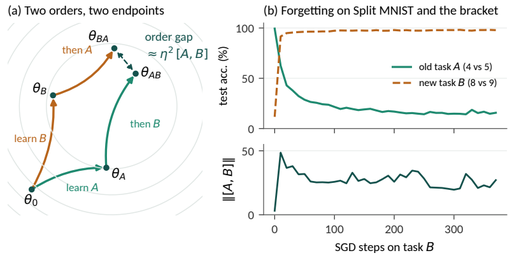
Figure 1 :(a) Training in the two orders ends at different weights; for one small step the gap is η2[A,B]. (b) A single Split MNIST run in the Domain-IL scenario. Accuracy on the old task falls from 99% to about 16% while the new task is learned within tens of steps, and the norm of the bracket jumps at the switch.
出典 · CC BY 4.0 · Ephraim Kofi Ayi Kwapong · Does Learning Order Explain Forgetting? The Lie Bracket as an Early-Warning Signal for Catastrophic Forgetting Without Old Data · 論文の図を引用 · 元のPDFの5ページ目から図の部分を抽出しています。
Table 5 :Check of Proposition 1: measured over predicted order gap (cosine in parentheses).
出典 · CC BY 4.0 · Ephraim Kofi Ayi Kwapong · Does Learning Order Explain Forgetting? The Lie Bracket as an Early-Warning Signal for Catastrophic Forgetting Without Old Data · 論文の図を引用 · 元のPDFの12ページ目から図の部分を抽出しています。緩やかな忘却の設定での比較結果
緩やかな忘却の設定(Task-IL)で、学習がよくできた3つの設定におけるStored bracketの順位相関は、MNISTが0.81、Fashion-MNISTが0.70、CIFAR-10特徴が0.76でした。同じ設定のEWCペナルティは、順に0.58、0.33、0.35でした。この結果はη=0.05、100回の実行で得られたものです。Fashion-MNISTでは、古いデータを再評価した値0.33より高い0.70を記録しました。
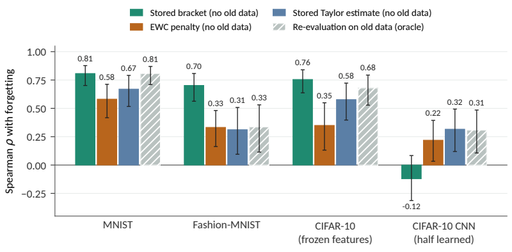
Figure 2 :Slow forgetting (Task-IL), η=0.05 , 100 runs per setup. Rank correlation of each signal with forgetting; bars show 95% bootstrap intervals. The first three signals use no old data. The hatched bar re-evaluates the old task on its own data and is shown for reference.
出典 · CC BY 4.0 · Ephraim Kofi Ayi Kwapong · Does Learning Order Explain Forgetting? The Lie Bracket as an Early-Warning Signal for Catastrophic Forgetting Without Old Data · 論文の図を引用 · 元のPDFの5ページ目から図の部分を抽出しています。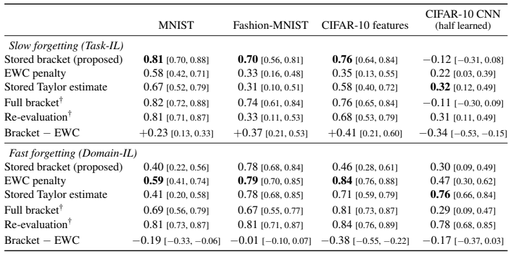
Table 3 :Rank correlation with forgetting, η=0.05 , 100 runs per cell, with 95% bootstrap intervals. The best data-free signal in each column is in bold. †Reference signals that use the old task’s data.
出典 · CC BY 4.0 · Ephraim Kofi Ayi Kwapong · Does Learning Order Explain Forgetting? The Lie Bracket as an Early-Warning Signal for Catastrophic Forgetting Without Old Data · 論文の図を引用 · 元のPDFの6ページ目から図の部分を抽出しています。速い忘却とCIFAR-10 CNNでの失敗
速い忘却の設定(Domain-IL)では、保存要約に基づくbracketがMNISTで0.40、CIFAR-10特徴で0.46を記録し、EWCペナルティの0.59と0.84より低くなりました。要約サイズをK=50または100に増やしても、CIFAR-10特徴の設定では0.49にとどまりました。古いタスクを半分だけ学習させたCIFAR-10 CNNでは、緩やかな忘却との相関が−0.12でした。速い忘却では、この割合は0.38です。原因の分析はこのCNNの設定に限られます。
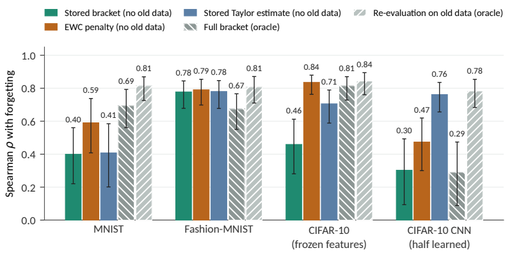
Figure 3 :Fast forgetting (Domain-IL), η=0.05 , 100 runs per setup. Hatched bars are reference signals that use old data.
出典 · CC BY 4.0 · Ephraim Kofi Ayi Kwapong · Does Learning Order Explain Forgetting? The Lie Bracket as an Early-Warning Signal for Catastrophic Forgetting Without Old Data · 論文の図を引用 · 元のPDFの7ページ目から図の部分を抽出しています。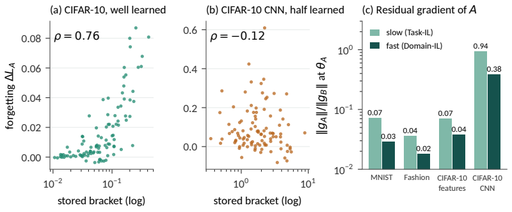
Figure 4 :(a,b) Stored bracket against forgetting for the same CIFAR-10 tasks in the slow scenario, with the old task well learned (frozen features, 97% accuracy) and half learned (small CNN, 78%). (c) Norm of the old task’s gradient atθ A relative to the new task’s.
出典 · CC BY 4.0 · Ephraim Kofi Ayi Kwapong · Does Learning Order Explain Forgetting? The Lie Bracket as an Early-Warning Signal for Catastrophic Forgetting Without Old Data · 論文の図を引用 · 元のPDFの8ページ目から図の部分を抽出しています。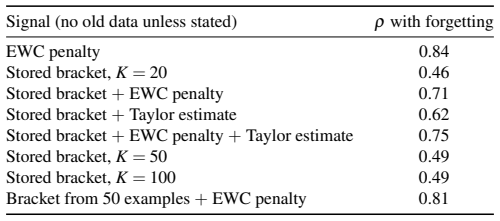
Table 9 :CIFAR-10 features, fast forgetting, η=0.05 . Combinations add the ranks of the signals. Rows with K=50,100 use 3 seeds (60 runs); the others use 5 seeds.
出典 · CC BY 4.0 · Ephraim Kofi Ayi Kwapong · Does Learning Order Explain Forgetting? The Lie Bracket as an Early-Warning Signal for Catastrophic Forgetting Without Old Data · 論文の図を引用 · 元のPDFの13ページ目から図の部分を抽出しています。実験範囲の限界
実験は、小さなMLPと1つの小さなCNN、そして2つのタスクの組A→Bだけで行いました。CIFAR-10の結果は、固定した事前学習済みバックボーンと学習可能なヘッドという設定によるものです。Task-ILはすべての実験で緩やかな忘却と、Domain-ILは速い忘却と共に現れ、この2つの性質を分けられませんでした。長いタスク順序は確認していません。
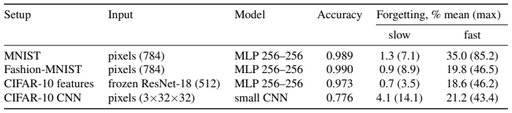
Table 1 :The four setups. Accuracy is the mean test accuracy of a task after it is trained alone. Forgetting is the mean (maximum) drop inA’s test accuracy after training onB, atη=0.05.
出典 · CC BY 4.0 · Ephraim Kofi Ayi Kwapong · Does Learning Order Explain Forgetting? The Lie Bracket as an Early-Warning Signal for Catastrophic Forgetting Without Old Data · 論文の図を引用 · 元のPDFの4ページ目から図の部分を抽出しています。論文情報
- 著者
- Ephraim Kofi Ayi Kwapong
- 学会・ジャーナル
- arXiv · プレプリント
- 公開日
- 2026年11月15日
- 登録日
- 2026年11月17日
- 更新日
- 2026年11月15日
- バージョン
- v1
- arXiv
- 2611.20087
- カテゴリ
- cs.LG · stat.ML
- ライセンス
- CC BY 4.0
- 掲載内容
- 論文情報・解説・論文の図
この解説は、Refivuの韓国語解説をAIで翻訳したものです。不正確な翻訳や誤りが含まれる可能性があります。論文と図の利用条件は各出典に従います。
アブストラクト
A network trained on task A and then task B ends at different weights than one trained on B and then A. To leading order this gap is set by the Lie bracket of the two tasks' gradient fields, and Dherin (2023) conjectured that a non-vanishing bracket may be linked to catastrophic forgetting. I test this conjecture empirically. Across Split MNIST, Split Fashion-MNIST and Split CIFAR-10, the forgetting of A is almost exactly the difference in A's loss between the two training orders (Spearman rho = 0.96-1.00). I then ask whether the bracket can predict that forgetting early in training on B and without any of A's data, using only a small summary stored when A finishes: its gradient and its top 20 Hessian eigenpairs. When the old task is well learned and forgetting is slow (task-incremental), this stored bracket ranks forgetting with rho = 0.70-0.81, against 0.33-0.58 for the penalty of Elastic Weight Consolidation, and matches or exceeds re-evaluating A on its own data. When forgetting is fast (domain-incremental), the stored summary goes stale and the EWC penalty is as good or better. The bracket fails outright when the old task is only half learned; I trace this to a residual gradient on A an order of magnitude larger, which makes first-order (slope) damage matter. The bracket is therefore a useful early-warning signal for the quiet kind of forgetting, under a clear condition.
この論文を引用
Ephraim Kofi Ayi Kwapong (2026). Does Learning Order Explain Forgetting? The Lie Bracket as an Early-Warning Signal for Catastrophic Forgetting Without Old Data. arXiv:2611.20087v1. https://arxiv.org/abs/2611.20087v1
BibTeX
@misc{kwapong2026does,
  title = {{Does Learning Order Explain Forgetting? The Lie Bracket as an Early-Warning Signal for Catastrophic Forgetting Without Old Data}},
  author = {Ephraim Kofi Ayi Kwapong},
  year = {2026},
  eprint = {2611.20087},
  archivePrefix = {arXiv},
  url = {https://arxiv.org/abs/2611.20087v1}
}