論文解説
When the Simulator Fails, Not the Policy: Auditing Contact Artifacts in Simulated Robot Benchmarks
シミュレータの接触不具合による失敗を監査して見分けるツール
- 課題 従来のシミュレーションベンチマークは、成功率で方策を評価するため、シミュレータの接触処理が起こした失敗も方策の失敗として数えられてしまいます。
- 手法 SIMUGUARDは、評価を変えずに各物理ステップを記録し、不自然に飛ぶ物体を見つけます。さらに、同じエピソードを再現して一つだけパラメータを変えて再実行し、原因を確かめます。
- 結果 物理エンジンの定数を一つ直すと、LingBot-VAのコンテナ系タスクの成功率が89%から98%に上がりました。
成功率に紛れ込む失敗:シミュレータの接触処理はどこまで方策の失敗として数えられているのか
シミュレーションベンチマークは、方策の成功率で比べるのが基本です。LIBERO、RoboCasa、RoboTwinはタスクと評価手順を固定し、シミュレータの物理を忠実なものとして扱います。そのため成功率は、失敗の数は示しても、その理由までは示しません。シミュレータの接触処理が引き起こした失敗も、方策の失敗と同じ数え方で計上されます。
問題が具体的に現れるのが、RoboTwin 2.0のPlace Can Basketです。LingBot-V Aは缶をバスケットの中に置き、缶はバスケットの壁に寄りかかって止まり、その後グリッパーが離れます。実際には二つの片は2.1 cm離れており、缶の速度は0.2 m/sから22 m/sに跳ね上がり、缶は1.65 m先まで飛んで失敗と記録されます。その間、どのロボットリンクも缶に触れておらず、ロボットはほぼ静止しています。記録には、缶が得た2.4 Jを説明するものがありません。
この失敗は一例にとどまりません。LingBot-V Aの5つのコンテナタスクの失敗44件のうち40件と、HyVLAの失敗10件のうち6件に、この種の射出が含まれます。さらにベンチマーク自身の模範デモンストレーションも同じように失敗するため、方策だけの問題とは言えません。つまり、成功率の一部はシミュレータの接触処理が作ったもので、方策の性能としてそのまま読めません。
著者らは、この射出を接触アーティファクトと呼びます。アーティファクトは、接触応答がオブジェクトを、ロボットの接触や重力では説明できない速さで動かすものです。その衝撃は一物理ステップだけ続き、二つのカメラフレームの間に入るため、映像では缶が飛んでいる様子しか見えません。そのため成功判定だけでは、方策とシミュレータのどちらがエピソードを決めたのかを区別できません。著者らはこの問題を解くため、接触の再報告をエピソードの結果までたどれる監査ツールを用意しました。
SIMUGUARDによる監査の流れ
SIMUGUARDは、評価スクリプトを変えずに、接触の一報告をエピソードの結果まで追うための監査プラグインです。ベンチマークの評価スクリプトにアダプタを付けて接続し、LIBERO、RoboTwin、RoboCasa、RoboDojoに対応します。既存研究は成功率に指標を足すか、ソルバが物理からどれだけ外れるかを測るもので、ロールアウト中の異常な接触とその結果を結びつけていません。
処理は記録、検出、リプレイ、再実行、採点の五段階で、各段階は毎物理ステップの情報を使います。記録では、毎物理ステップのアクチュエーション、物体状態、接触を保存し、検出ではそこから接触や重力では説明できない速さで動き出す物体を見つけます。ここでいう接触アーティファクトは、接触応答が物体を衝突の反作用や重力では説明できない速さで動かしたものを指します。インパルスは一物理ステップしか続かず、カメラの二つのフレームの間に収まるため、動画だけでは原因を判断できません。
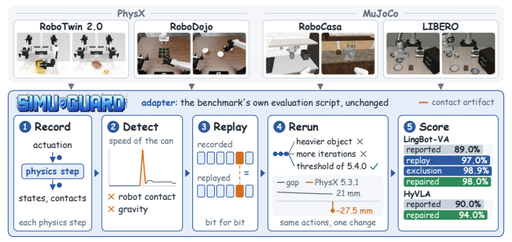
Figure 2 :SIMUGUARDaudits a simulated evaluation without changing it.Attached by an adapter to the benchmark’s own evaluation script, SIMUGUARDrecords every physics step, detects contact artifacts, replays the episode exactly, reruns it with the same actions and one change, and scores the rerun with the benchmark’s own success check. Rerun: a heavier object or more solver iterations leave the artifact; the triangle threshold of PhysX 5.4.0 removes it. Inset: the two pieces that start the ejection of Figure 1 are 21 mm apart, and PhysX 5.3.1 reports them 27.5 mm deep; with the threshold of 5.4.0 it reports no contact. Score, five container tasks in closed loop (Table 3): as run (gray), estimated from LingBot-V A’s recordings (blue, Section 3.6), and measured in the repaired engine (green).
出典 · CC BY 4.0 · Alex Zhou, Junhao Wu, Xueyang Zhou, Yixiao Huo, Hongcheng Gao, Di Zhu, Zhenghao Zhang, Yongchao Chen · When the Simulator Fails, Not the Policy: Auditing Contact Artifacts in Simulated Robot Benchmarks · 論文の図を引用 · 元のPDFの2ページ目から図の部分を抽出しています。リプレイは、シードからシーンを組み直し、記録したアクチュエーションを最初のステップから与えて、エピソードをビット単位で再現します。再実行は、このリプレイに対してシミュレーションパラメータを一つだけ変え、記録したアクチュエーションと成功判定は固定したままにします。再実行の結果もベンチマーク自身の成功判定で採点するので、評価の基準は変わりません。たとえば、報告された深さを一ステップではなく数ステップにわたって取り除くと、Place Can Basketのエピソードは成功判定を通るようになります。
具体例として、RoboTwin 2.0のPlace Can Basketでは、LingBot-VAが缶をバスケットに置いた後、4msの一物理ステップで缶の速さが0.2m/sから22m/sへ上がります。PhysXは、缶の一部がバスケットの壁の一部に2.75cmめり込んでいると報告しますが、実際の二つの片は2.1cm離れていました。SIMUGUARDは、この報告を含むエピソードをリプレイと再実行で追い、接触の一報告がエピソードの結果まで影響したかを確かめます。つまり、評価を変えずに、シミュレータの接触応答と成功判定の結果を一つにつなげることが、この節の目的です。
距離計算の固定閾値という原因
接触アーティファクトの発生時、PhysXは形状どうしの間に実際にはない接触を報告します。35エピソードでは、報告を出す二つの凸形状がそのステップ開始時点で中央値15 mm離れていました。報告された法線は34件で缶からバスケットへ向いており、同じ二つの物体のそのステップ前の1958の接触とは逆向きになっていました。報告された深さは、缶の片の遠い面から接触点までの距離で、隙間に片の厚みを足したものです。図2の挿入図では、21 mm離れた二つの片をPhysX 5.3.1が27.5 mm深いと報告します。
原因は、PhysXの距離計算に使われるGJKの退化判定にあります。GJKは三角形abcを、\( |ab \times ac|^2 \le 2^{-23} \) を満たすとき退化したものとして捨てます。この閾値はメートル単位の固定値で、形状の大きさに合わせて変わりません。有効な三角形が閾値を下回ると、アルゴリズムは最も近い点を見つける前に止まり、接触生成は向きの異なる面を選んで隙間を深さとして報告します。後のバージョンのPhysXでは、この閾値が七桁下げられています。
この説明を外部から確かめるため、記録された姿勢を一組の片に対してPhysXの接触生成だけに通す計算を行いました。その結果は、シミュレータが報告した接触と桁まで一致し、20件の偽の接触すべてを再現しました。閾値を5.4.0の値に合わせると、その20件はどれも報告されず、実在する4件の接触は深さを保ちました。シミュレータ内で同じ変更をすると、模範デモンストレーションのアーティファクトは60シードのうち、Place Can Basketで18件から1件、Stack Bowls Threeで6件から0件に減ります。原因が一つの定数に絞れることが、この章の中心の主張です。

Table 2 :One constant.False: the 20 onset contacts we traced (4 on Place Can Basket, 16 on Stack Bowls Three) whose two pieces do not intersect, recomputed outside the simulator from the recorded poses.Real: 4 onset contacts whose pieces do intersect.Expert: RoboTwin’s scripted demonstration on 60 seeds per task inside the simulator, episodes with an artifact and episodes that fail after a valid plan.
出典 · CC BY 4.0 · Alex Zhou, Junhao Wu, Xueyang Zhou, Yixiao Huo, Hongcheng Gao, Di Zhu, Zhenghao Zhang, Yongchao Chen · When the Simulator Fails, Not the Policy: Auditing Contact Artifacts in Simulated Robot Benchmarks · 論文の図を引用 · 元のPDFの7ページ目から図の部分を抽出しています。修復したエンジンでの成功率と推定の範囲
修復したエンジンでのクローズドループ評価では、LingBot-V Aが5つのコンテナタスクの100エピソードのうち98件で成功しました。ベンチマークのエンジンでは成功が89件で、アーティファクトを含むエピソードは12件ありました。ベンチマークのエンジンでは12エピソードにアーティファクトが含まれ、その中に失敗11件のうち10件がありました。修復したエンジンでは、アーティファクトを含むエピソードは一件もなく、成功は98件でした。
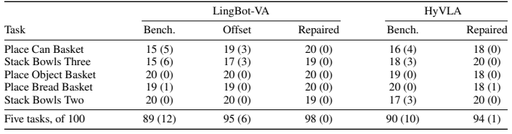
Table 3 :Closed loop evaluation in the repaired engine.Successes of 20, in parentheses episodes with an artifact.Bench.: RoboTwin as released (LingBot-V A reseeded per episode; HyVLA: the run of Table 1).Offset: contact offset 1 mm.Repaired: threshold of PhysX 5.4.0.
出典 · CC BY 4.0 · Alex Zhou, Junhao Wu, Xueyang Zhou, Yixiao Huo, Hongcheng Gao, Di Zhu, Zhenghao Zhang, Yongchao Chen · When the Simulator Fails, Not the Policy: Auditing Contact Artifacts in Simulated Robot Benchmarks · 論文の図を引用 · 元のPDFの8ページ目から図の部分を抽出しています。両方のエンジンで評価できた83シードで比較すると、修復したエンジンだけで成功したシードが8、ベンチマークだけで成功したシードが2でした。符号検定のp値は0.11で、成功率の差は単独では有意とは言えず、アーティファクトの減少のほうが明確な差です。HyVLAでは、修復したエンジンでの成功が94件で、監査した実行の90件を上回りました。アーティファクトは10件から1件に減り、残った1件では、パンが別のパンから2.4 m/sで離れる事例が見られました。この事例について、著者らはまだ追跡していません。
エンジンを変えられないベンチマークのために、記録から成功率を推定する方法もあります。フラグの立った12エピソードを除外すると87 of 88(98.9%)になり、閾値を入れてリプレイすると97 of 100になります。表1の大きな実行では、LingBot-V Aのリプレイ推定は91.9%、除外による推定は98.0%で、報告値の83.1%より高くなりました。著者らは、報告値と併せて、フラグの立ったエピソードがすべて失敗する場合と成功する場合の範囲として75.8%から98.5%を示すべきだとしています。
閾値を全ロールアウトに適用すると、Place Object Basketの成功率は90.0%から50.0%に下がります。一方で、修復したエンジンではPlace Object Basketは20 of 20で成功しており、変更のないタスクの結果は保たれています。つまり、後から当てる推定と、実行全体に効かせる設定とでは結果の意味が異なり、閾値を残すことは修復にはなりません。著者らは、全ロールアウトに閾値を残すと、変更のないタスクの率が半分になってしまうと述べています。
他のベンチマークでの出現:RoboTwin以外でも同じ現象は起きるのか
RoboDojoでは、40件のXR-1エピソードのうち7件に接触アーティファクトが含まれ、いずれも失敗でした。RoboDojoの射出速度は最大で6.30 m/sに達しました。一方、MuJoCo上のLIBEROでは400エピソードのうち2件、RoboCasaでは300件のうち5件で、どちらも1.6 m/s以下にとどまりました。つまり、MuJoCo上のアーティファクトは数が少なく、速度も遅いことが分かりました。
RoboDojoのチューブの例では、Insert Tubes(layout 2)で、デプネトレーションの上限を0.4秒前に入れて1 m/sに設定すると、4.31 m/sで飛び出していたチューブの速度が1.88 m/sに下がりました。この接触は、チューブの凸包から7.6 mm外側の点を、壁の向こう側として報告しており、RoboTwinと同じく隙間に壁の厚みを加えた値を深さとして扱っているように見えます。ただし、この偽の接触はRoboTwinで見られた閾値の経路を通らず、著者らはその原因となる段階をまだ特定していません。
LIBEROでは、Table 21の初期状態で、物体が支持面の内側に置かれていることが分かりました。MuJoCoはその重なりを10 ms以内に解消するため、物体を最大1.38 m/sで打ち出しました。一方、LIBEROでのエピソード中の例では、マグがマイクロ波に接触した際にMuJoCoが242.8 mmの深さを報告しましたが、距離の問い合わせでは1.4 mmでした。このエピソードは失敗しましたが、この接触が失敗の原因だったかはテストされていません。
検出の妥当性は、5名のロボティクス技術者が各クリップを独立に判定して確かめました。Place Can Basketでは、検出された事象を中心にしたクリップ40件のうち37件を物理的にあり得ないと判定し、適合率は0.925になりました。一方、hard negatives 20件では、物理的にあり得ないと判定されたものは一件もありませんでした。
限界と未解決の課題:何が確かめられ、何が残っているか
この節では、論文が示した結論のうち、どこまでが実測で確かめられ、どこが未解決のまま残っているかを整理します。修復したエンジンでのクローズドループ測定は、2つの方策と5タスクに限られ、各タスクは20シードでした。LingBot-V Aの83シードでの成功率の差は、単独では有意ではなく(p=0.11)、アーティファクトの差ほど確かではありません。そのため、成功率の改善の大きさは、このシード数では確定していないと読むべきです。
本研究は定数を一つだけ変えて試しており、PhysX 5.3.1の後続の完全なバージョンでRoboTwinを走らせてはいません。Stack Bowls Threeで追跡した深い接触21件のうち4件は実在する貫入で、1件は外部の計算では再現されていません。また、接触オフセットを1 mmにしても、Place Can Basketの37エピソードのうち4件では接触が残ります。つまり、閾値の修正だけで偽の接触がすべて消えたと言い切るには、この点の検証が不足しています。
RoboTwinのアーティファクトは、PhysX 5.3.1以前であることと、センチメートル規模の衝突形状という二つの条件が同時に満たされるときに起きます。これは、どちらか一方が欠けても同じ現象が起きるとは限らないことを意味します。一方で、RoboDojoで観測された1件の偽接触は閾値の経路を通らず、その原因はまだ特定されていません。この接触では、チューブが壁の反対側のペアとして扱われ、ギャップと壁の厚みが深さとして報告されていました。ただし、RoboDojoでのこの経路を、RoboTwinと同じ原因として扱うことはできません。したがって、この論文が閉じているのはRoboTwin上の一つの定数に限られ、他のエンジンや経路での偽接触の全体像は未解決のまま残っています。
論文情報
- 著者
- Alex Zhou, Junhao Wu, Xueyang Zhou, Yixiao Huo, Hongcheng Gao, Di Zhu, Zhenghao Zhang, Yongchao Chen
- 学会・ジャーナル
- arXiv · プレプリント
- 公開日
- 2026年10月30日
- 登録日
- 2026年11月3日
- 更新日
- 2026年10月30日
- バージョン
- v1
- arXiv
- 2610.41857
- カテゴリ
- cs.RO
- ライセンス
- CC BY 4.0
- 掲載内容
- 論文情報・解説・論文の図
この解説は、Refivuの韓国語解説をAIで翻訳したものです。不正確な翻訳や誤りが含まれる可能性があります。論文と図の利用条件は各出典に従います。
アブストラクト
Simulation benchmarks score robot policies by success rate, and every failed episode counts against the policy. Many of these failures are the simulator's fault, not the policy's; we find the cause and fix it. Testing a vision language action model and a world action model in simulation, we find that the policy often places the object and the simulator then ejects it, and that the benchmark's own scripted demonstrations fail the same way. We present SimuGuard, an auditing plugin for LIBERO, RoboTwin, RoboCasa and RoboDojo. It leaves the evaluation unchanged. At every physics step, it records the state and flags an object that starts moving at a contact faster than the robot's contact or gravity account for. It replays a recorded episode bit for bit, and it reruns the episode with one simulation parameter changed. With it we trace these episodes on RoboTwin to the collision detection of the physics engine: for geometry one to two centimeters apart, the engine reports a penetration of about two centimeters, and the solver throws the object out at several meters per second. The cause is one constant: the distance algorithm discards triangles below a fixed area threshold, which valid triangles fall below at the centimeter scale. With that constant changed and nothing else, episodes with an artifact fall from 12 in 100 to none, and the success rate on five container tasks rises from 89% to 98%. Success rates in simulation thus count failures that the simulator causes. Benchmarks on PhysX 5.3.1 or earlier should rerun in a repaired engine. Where the engine cannot change, they should report the success rate together with the range it spans when every flagged episode fails or passes: 75.8% to 98.5% around a reported 83.1% for LingBot-VA.
論文の図
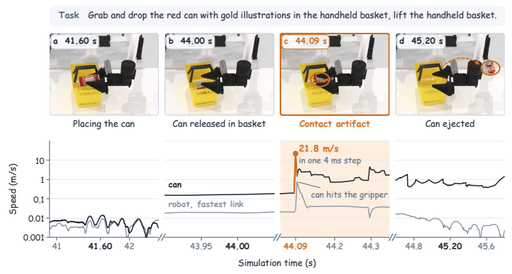
Figure 1 :A contact artifact turns a correct placement into a failure.After LingBot-V A places the 10 g can in the basket on Place Can Basket (a, b), the can’s speed rises from 0.2 to 22 m/s within one 4 ms physics step, a gain of 2.4 J of kinetic energy, while no robot link touches it and the fastest link moves at under 0.1 m/s (c); the can is ejected from the basket and the benchmark records a failure (d). The time axis has four linear segments, one under each frame.
出典 · CC BY 4.0 · Alex Zhou, Junhao Wu, Xueyang Zhou, Yixiao Huo, Hongcheng Gao, Di Zhu, Zhenghao Zhang, Yongchao Chen · When the Simulator Fails, Not the Policy: Auditing Contact Artifacts in Simulated Robot Benchmarks · 論文の図を引用 · 元のPDFの2ページ目から図の部分を抽出しています。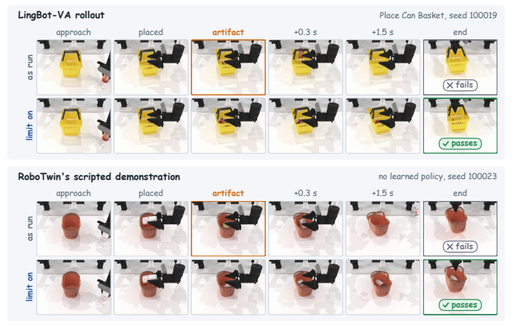
Figure 3 :Two episodes whose outcome the artifact window intervention flips.Each is shown as run and replayed with the depenetration limit switched on 0.1 s before the first artifact; seed, actions and physics up to the switch are identical.Top:LingBot-V A on Place Can Basket.Bottom:one of RoboTwin’s own scripted demonstrations, which the benchmark discards when it fails.
出典 · CC BY 4.0 · Alex Zhou, Junhao Wu, Xueyang Zhou, Yixiao Huo, Hongcheng Gao, Di Zhu, Zhenghao Zhang, Yongchao Chen · When the Simulator Fails, Not the Policy: Auditing Contact Artifacts in Simulated Robot Benchmarks · 論文の図を引用 · 元のPDFの3ページ目から図の部分を抽出しています。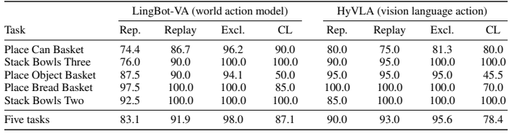
Table 1 :Success rates on RoboTwin 2.0under the four scores of Section 3.6, in percent.Rep.: as run.Replay: Equation (1), every episode with an artifact replayed with the limit switched on before it.Excl.: rate over the episodes without an artifact.CL: new closed loop rollouts with the limit on; as run rate on the shared seeds 81.8% (LingBot-V A) and 90.7% (HyVLA). Counts and the tasks outside the five: Table 22.
出典 · CC BY 4.0 · Alex Zhou, Junhao Wu, Xueyang Zhou, Yixiao Huo, Hongcheng Gao, Di Zhu, Zhenghao Zhang, Yongchao Chen · When the Simulator Fails, Not the Policy: Auditing Contact Artifacts in Simulated Robot Benchmarks · 論文の図を引用 · 元のPDFの7ページ目から図の部分を抽出しています。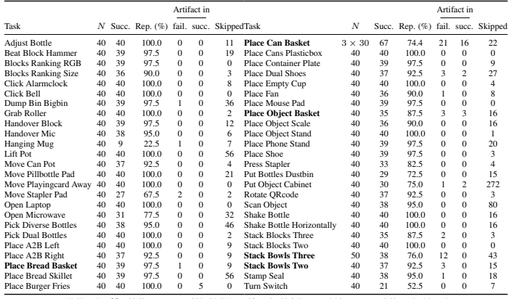
Table 5 :RoboTwin 2.0 runsof LingBot-V A.Artifact: episodes with a contact artifact among failures and successes.Skipped: seeds discarded because the scripted demonstration failed.Succ.: successes;Rep.: reported rate. Bold: the five tasks of Table 1. The 40 tasks outside the ten of the cross task study were run twice with 20 seeds each, and both passes are pooled.
出典 · CC BY 4.0 · Alex Zhou, Junhao Wu, Xueyang Zhou, Yixiao Huo, Hongcheng Gao, Di Zhu, Zhenghao Zhang, Yongchao Chen · When the Simulator Fails, Not the Policy: Auditing Contact Artifacts in Simulated Robot Benchmarks · 論文の図を引用 · 元のPDFの18ページ目から図の部分を抽出しています。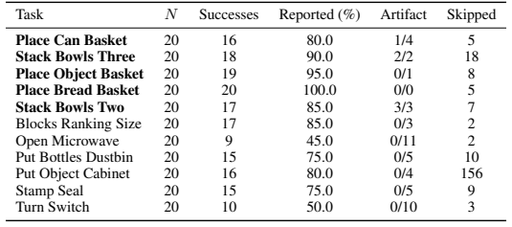
Table 6 :RoboTwin 2.0 runsof HyVLA.Artifact: failures that contain a contact artifact.Skipped: seeds discarded because the scripted demonstration failed.
出典 · CC BY 4.0 · Alex Zhou, Junhao Wu, Xueyang Zhou, Yixiao Huo, Hongcheng Gao, Di Zhu, Zhenghao Zhang, Yongchao Chen · When the Simulator Fails, Not the Policy: Auditing Contact Artifacts in Simulated Robot Benchmarks · 論文の図を引用 · 元のPDFの18ページ目から図の部分を抽出しています。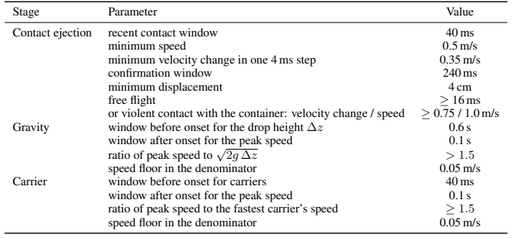
Table 7 :Detector parameters(Section 3.3), identical for all tasks and engines. The thresholds on velocity change are given for a 4 ms step and scale with the physics step on other engines.
出典 · CC BY 4.0 · Alex Zhou, Junhao Wu, Xueyang Zhou, Yixiao Huo, Hongcheng Gao, Di Zhu, Zhenghao Zhang, Yongchao Chen · When the Simulator Fails, Not the Policy: Auditing Contact Artifacts in Simulated Robot Benchmarks · 論文の図を引用 · 元のPDFの19ページ目から図の部分を抽出しています。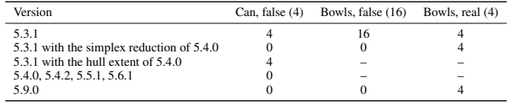
Table 10 :The false contact across versions of PhysX.Onset contacts returned by PhysX’s contact generation outside the simulator for the recorded poses: 4 false contacts on Place Can Basket, 16 false contacts and 4 real penetrations on Stack Bowls Three. A dash: not run.
出典 · CC BY 4.0 · Alex Zhou, Junhao Wu, Xueyang Zhou, Yixiao Huo, Hongcheng Gao, Di Zhu, Zhenghao Zhang, Yongchao Chen · When the Simulator Fails, Not the Policy: Auditing Contact Artifacts in Simulated Robot Benchmarks · 論文の図を引用 · 元のPDFの22ページ目から図の部分を抽出しています。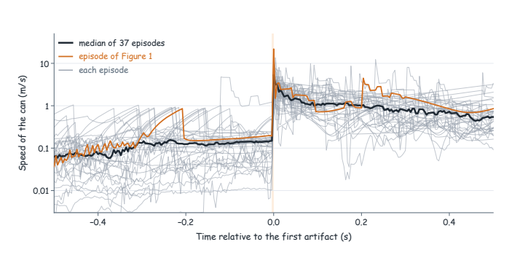
Figure 5 :The can’s speed around the first artifactin all 37 Place Can Basket episodes of LingBot-V A that contain one (21 failures, 16 successes), at every 4 ms step from 0.5 s before to 0.5 s after the onset. Gray: episodes; bold: median; orange: the episode of Figure 1. One step before the onset the can moves at a median 0.15 m/s. The largest one step rise in speed falls on the onset step in 33 episodes and within four steps in the other 4; it ranges from 0.53 to 21.6 m/s, median 5.7 m/s, more than an order of magnitude in the median.
出典 · CC BY 4.0 · Alex Zhou, Junhao Wu, Xueyang Zhou, Yixiao Huo, Hongcheng Gao, Di Zhu, Zhenghao Zhang, Yongchao Chen · When the Simulator Fails, Not the Policy: Auditing Contact Artifacts in Simulated Robot Benchmarks · 論文の図を引用 · 元のPDFの25ページ目から図の部分を抽出しています。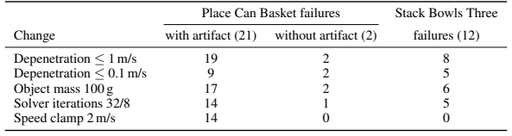
Table 14 :Replays from the first physics stepof the recorded failures: failures that pass the success check.
出典 · CC BY 4.0 · Alex Zhou, Junhao Wu, Xueyang Zhou, Yixiao Huo, Hongcheng Gao, Di Zhu, Zhenghao Zhang, Yongchao Chen · When the Simulator Fails, Not the Policy: Auditing Contact Artifacts in Simulated Robot Benchmarks · 論文の図を引用 · 元のPDFの26ページ目から図の部分を抽出しています。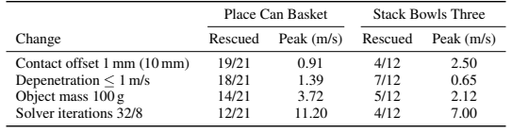
Table 15 :Replays switched on 0.1 s before the first artifact.LingBot-V A episodes with artifacts, replayed with one setting changed.Rescued: failures that pass.Peak: median object speed after the switch over all episodes with an artifact. The contact offset is changed on the task’s objects and containers, the other settings as in Section 3.5.
出典 · CC BY 4.0 · Alex Zhou, Junhao Wu, Xueyang Zhou, Yixiao Huo, Hongcheng Gao, Di Zhu, Zhenghao Zhang, Yongchao Chen · When the Simulator Fails, Not the Policy: Auditing Contact Artifacts in Simulated Robot Benchmarks · 論文の図を引用 · 元のPDFの26ページ目から図の部分を抽出しています。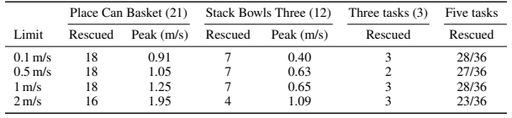
Table 16 :Limit value.LingBot-V A failures with artifacts that pass when replayed with the depenetration limit switched on 0.1 s before the first artifact, and the median peak speed of the object after the switch over these failures.Three tasks: Place Object Basket, Place Bread Basket and Stack Bowls Two, one failure each. The successes with an artifact were replayed at 1 m/s only.
出典 · CC BY 4.0 · Alex Zhou, Junhao Wu, Xueyang Zhou, Yixiao Huo, Hongcheng Gao, Di Zhu, Zhenghao Zhang, Yongchao Chen · When the Simulator Fails, Not the Policy: Auditing Contact Artifacts in Simulated Robot Benchmarks · 論文の図を引用 · 元のPDFの26ページ目から図の部分を抽出しています。
Table 19 :The benchmark’s own expert fails the same way.Place Can Basket: failures that contain an ejection, and failures that pass the success check when replayed with the depenetration limit switched on before it. The scripted expert acts on ground truth object poses with a motion planner; RoboTwin runs it on every seed before scoring a policy and skips the seed when it fails.
出典 · CC BY 4.0 · Alex Zhou, Junhao Wu, Xueyang Zhou, Yixiao Huo, Hongcheng Gao, Di Zhu, Zhenghao Zhang, Yongchao Chen · When the Simulator Fails, Not the Policy: Auditing Contact Artifacts in Simulated Robot Benchmarks · 論文の図を引用 · 元のPDFの28ページ目から図の部分を抽出しています。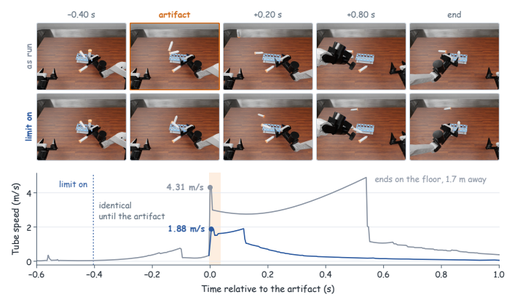
Figure 6 :RoboDojo, Insert Tubes (layout 2), XR-1.Head camera frames at fixed times relative to the first artifact, as run (top) and replayed with the depenetration limit of 1 m/s switched on 0.4 s before it (bottom), and the speed of the ejected tube in both runs. As run, the tube leaves the rack at 4.31 m/s within one step, flies off the table and lands 1.7 m away; the later peak of the gray curve is its fall. With the limit it leaves at 1.88 m/s, slows below 0.4 m/s within 0.3 s and stays on the table. Both rows are replays of the recording; the as run replay matches it bit for bit, and the limited one first differs at the artifact step.
出典 · CC BY 4.0 · Alex Zhou, Junhao Wu, Xueyang Zhou, Yixiao Huo, Hongcheng Gao, Di Zhu, Zhenghao Zhang, Yongchao Chen · When the Simulator Fails, Not the Policy: Auditing Contact Artifacts in Simulated Robot Benchmarks · 論文の図を引用 · 元のPDFの29ページ目から図の部分を抽出しています。
Table 20 :RoboDojo, Insert Tubes layout 2: speed at which the tube leaves, replayed with the depenetration limit switched on 0.4 s before the ejection.
出典 · CC BY 4.0 · Alex Zhou, Junhao Wu, Xueyang Zhou, Yixiao Huo, Hongcheng Gao, Di Zhu, Zhenghao Zhang, Yongchao Chen · When the Simulator Fails, Not the Policy: Auditing Contact Artifacts in Simulated Robot Benchmarks · 論文の図を引用 · 元のPDFの30ページ目から図の部分を抽出しています。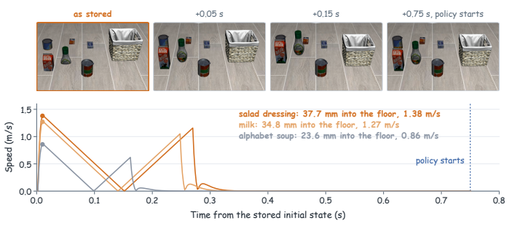
Figure 7 :LIBERO-Object task 0, stored initial state 0, built as the evaluation builds it (official LIBERO, robosuite 1.4.0, MuJoCo 3.2.3) and run through the 15 settle steps that precede every LIBERO policy step. As stored, the salad dressing, the milk and the alphabet soup sit 37.7, 34.8 and 23.6 mm inside the floor. MuJoCo pushes them out within 10 ms at 1.38, 1.27 and 0.86 m/s; they hop, land within 0.3 s and are at rest before the policy acts at 0.75 s. Depths and peak speeds match the audit of all 2000 stored states, of which 650 start inside a support.
出典 · CC BY 4.0 · Alex Zhou, Junhao Wu, Xueyang Zhou, Yixiao Huo, Hongcheng Gao, Di Zhu, Zhenghao Zhang, Yongchao Chen · When the Simulator Fails, Not the Policy: Auditing Contact Artifacts in Simulated Robot Benchmarks · 論文の図を引用 · 元のPDFの30ページ目から図の部分を抽出しています。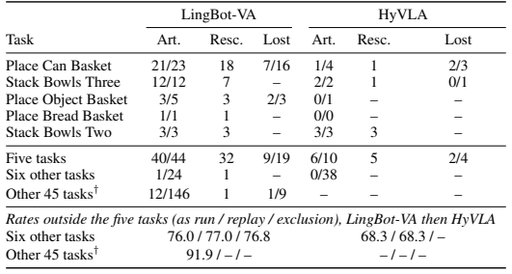
Table 22 :Counts behind Table 1.Art.: failures with an artifact, of all failures.Resc.: failures that pass under the limit.Lost: successes that fail under the limit, of all successes with an artifact. †Both passes of every task (Table 5); of the 40 tasks only the first pass, 4 failures and 3 successes with an artifact, was replayed, and the three Put Object Cabinet replays of the second pass diverge from the recording before the switch and are not counted.
出典 · CC BY 4.0 · Alex Zhou, Junhao Wu, Xueyang Zhou, Yixiao Huo, Hongcheng Gao, Di Zhu, Zhenghao Zhang, Yongchao Chen · When the Simulator Fails, Not the Policy: Auditing Contact Artifacts in Simulated Robot Benchmarks · 論文の図を引用 · 元のPDFの31ページ目から図の部分を抽出しています。この論文を引用
Alex Zhou, Junhao Wu, Xueyang Zhou, Yixiao Huo, Hongcheng Gao, Di Zhu, Zhenghao Zhang, Yongchao Chen (2026). When the Simulator Fails, Not the Policy: Auditing Contact Artifacts in Simulated Robot Benchmarks. arXiv:2610.41857v1. https://arxiv.org/abs/2610.41857v1
BibTeX
@misc{zhou2026when,
  title = {{When the Simulator Fails, Not the Policy: Auditing Contact Artifacts in Simulated Robot Benchmarks}},
  author = {Alex Zhou and Junhao Wu and Xueyang Zhou and Yixiao Huo and Hongcheng Gao and Di Zhu and Zhenghao Zhang and Yongchao Chen},
  year = {2026},
  eprint = {2610.41857},
  archivePrefix = {arXiv},
  url = {https://arxiv.org/abs/2610.41857v1}
}