論文解説
Collaborative Federated Learning For Healthcare: Multi-Modal COVID-19 Diagnosis at the Edge
医療向け協調的連合学習:エッジでのMulti-Modal COVID-19診断
- 課題 遠隔医療の施設で、X-rayやUltrasoundなどの胸部画像データを中央に集めずにCOVID-19を診断する問題です。
- 手法 クラスター型連合学習(CFL)では、モダリティごとにクライアントを分け、重みだけを集約します。これにより、X-rayとUltrasoundを一緒に診断する単一のマルチモーダルモデルを学習します。
- 結果 CFLは、X-rayとUltrasoundのどちらでも、マルチモーダルのconventional FLと比べてoverall F1-Scoreをそれぞれ16%と11%高めました。モダリティごとのベースラインとは概ね同程度です。
遠隔医療でのCOVID-19画像診断におけるデータの課題
遠隔医療の施設では、高度な診断装置や専門人材が不足していることが多くあります。この論文は、X-rayやUltrasoundなどの胸部画像を複数の施設で活用したい一方で、患者データを中央サーバーに移すと個人情報保護と遅延時間の問題が生じる点を出発点としています。
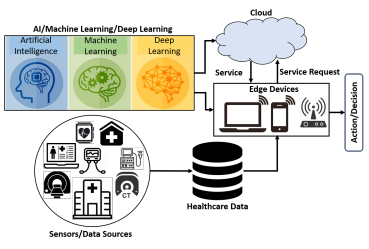
Fig. 1 : An illustration of AI/ML at edge in an IoT empowered healthcare environment.
出典 · CC BY 4.0 · Adnan Qayyum, Kashif Ahmad, Muhammad Ahtazaz Ahsan, Ala Al-Fuqaha, Junaid Qadir · Collaborative Federated Learning For Healthcare: Multi-Modal COVID-19 Diagnosis at the Edge · 論文の図を引用 · 元のPDFの1ページ目から図の部分を抽出しています。従来のCOVID-19画像診断の研究は、主にCTかX-rayのいずれか一つのモダリティに焦点を当てていました。連合学習を使った研究も、ほとんどが一種類の画像を基準にしていました。この論文は、モダリティごとにデータの分布が異なる状況で、一つのモデルで両方の画像を診断できるかを問いとしています。
クラスター型連合学習で二つのモダリティをまとめる手法
提案手法はclustered federated learning(CFL)です。X-rayを持つクライアントはクラスター1に、Ultrasoundを持つクライアントはクラスター2に属します。各クライアントは、他のクライアントの識別情報やデータを知らないと仮定します。サーバーは共有モデルMsと初期重みW0を各クライアントに送ります。
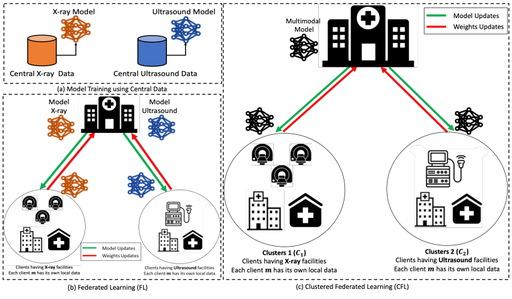
Fig. 2 : The proposed clustered federated learning based collaborative learning paradigm (Fig. 2 (c)) versus the method of model training using central data (Fig. 2 (a)) and the conventional federated learning model training method for multiple modalities (Fig. 2 (b)). The term “clients” refers to hospitals, clinics, and medical imaging facilities.
出典 · CC BY 4.0 · Adnan Qayyum, Kashif Ahmad, Muhammad Ahtazaz Ahsan, Ala Al-Fuqaha, Junaid Qadir · Collaborative Federated Learning For Healthcare: Multi-Modal COVID-19 Diagnosis at the Edge · 論文の図を引用 · 元のPDFの5ページ目から図の部分を抽出しています。各クライアントは、ローカルデータでMsを学習させたあと、重みをサーバーに送ります。サーバーはfederated averagingで重みを集約してWrを作り、それを再びクライアントに配布します。論文のEq. 1はWr = 1/n Σ wi×Wiで、nは参加クライアント数(|C1|+|C2|)、wiは各クライアントの重みを表します。学習の過程で、クライアントは元の画像ではなく重みだけを共有します。
入力画像はグレースケールに変換したあと256×256に調整し、正規化します。モデルはVGG16の出力層の前に、畳み込み層を1つ、全結合層を3つ追加した構成です。クラスの不均衡を減らすため、α-balanced focal lossをEq. 2として使い、学習はクライアントごとにlearning rate 0.0001のAdam optimizerで行います。
ベースラインと比較実験の設計
実験では2つのベースラインと比べます。1つ目は、X-rayとUltrasoundのそれぞれに別々のモデルを連合学習で学習させるspecialized FLベースラインです。これはモダリティごとの最良の事例に相当します。2つ目は、両方のモダリティのデータを持つクライアントで一つの共有モデルを作るconventional FLです。
データには2つの公開データセットを使い、それぞれを80%と20%に分けます。2つのデータセットのテストセットを合わせて、サーバー上のマルチモーダルなテストセットとします。評価では、Precision、Recall、F1-Scoreをクラスごとおよびデータセットごとに計算します。著者らは、精度だけでは不均衡データの性能を十分に判断しにくいと説明しています。
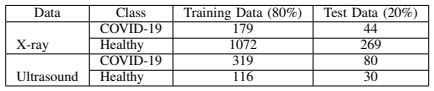
論文の図 TABLE I: The distribution of training and testing data of X-ray and Ultrasound datasets over different classes.
出典 · CC BY 4.0 · Adnan Qayyum, Kashif Ahmad, Muhammad Ahtazaz Ahsan, Ala Al-Fuqaha, Junaid Qadir · Collaborative Federated Learning For Healthcare: Multi-Modal COVID-19 Diagnosis at the Edge · 論文の図を引用 · 元のPDFの6ページ目から図の部分を抽出しています。論文のTable IIの設定は、communication roundsが30、50、100、epochsが5と10、batch sizeが16と32、learning rateが1e−3です。ただし、比較実験では、batch sizeを16、ローカルエポックを5に揃えて、ベースラインとCFLを学習させたと述べられています。
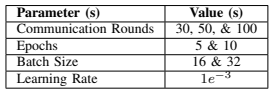
論文の図 TABLE II: Parameters of clustered federated learning (CFL) experiments.
出典 · CC BY 4.0 · Adnan Qayyum, Kashif Ahmad, Muhammad Ahtazaz Ahsan, Ala Al-Fuqaha, Junaid Qadir · Collaborative Federated Learning For Healthcare: Multi-Modal COVID-19 Diagnosis at the Edge · 論文の図を引用 · 元のPDFの7ページ目から図の部分を抽出しています。F1-Scoreの比較とモダリティごとの結果
CFLのマルチモーダルモデルは、X-rayでmulti-modal conventional FLより高いF1-Scoreになりました。Table IIIでは、X-rayのCOVID-19クラスのF1-Scoreは、CFLが0.76、マルチモーダルのconventional FLが0.41です。要旨では、overall F1-ScoreがX-rayで16%、Ultrasoundで11%向上したと報告されています。

論文の図 TABLE III: COMPARISON AGAINST THE TWO BASELINES IN TERMS OF PRECISION, RECALL, AND F1-SCORE. Promising results are obtained by CFL, outperforming the conventional FL while slightly lower performance is obtained compared to Central Baseline with the added advantage of improved privacy and data security. ∗A separate model is trained in federated learning settings for each modality.
出典 · CC BY 4.0 · Adnan Qayyum, Kashif Ahmad, Muhammad Ahtazaz Ahsan, Ala Al-Fuqaha, Junaid Qadir · Collaborative Federated Learning For Healthcare: Multi-Modal COVID-19 Diagnosis at the Edge · 論文の図を引用 · 元のPDFの8ページ目から図の部分を抽出しています。一方、specialized FLベースラインとの比較では、CFLは概ね同程度です。論文では、CFLはcentral baselineと比べてわずかに低い性能ですが、個人情報保護の面で利点があると説明されています。この結果は、2つのデータセットと二値分類の設定で得られたものです。
すべてのモデルで、Ultrasoundの画像の結果は、X-rayより全体的に高く観察されました。これは本実験のデータセットと設定で見られた観察であり、2つのモダリティの一般的な難易度の差に広げて解釈できる根拠は示されていません。
通信ラウンドごとの過学習と停止時点
通信ラウンドごとの精度と損失を見ると、conventional FLのマルチモーダルモデルは50 communication roundsのあとで過学習することが観察されています。一方、CFLのモデルは学習を続けますが、後半のラウンドで過学習の傾向が見られます。
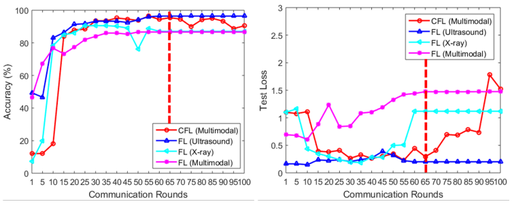
Fig. 5 : Comparison of clustered federated learning (CFL) with the specialized models (trained with conventional FL independently for each modality, i.e., X-ray and Ultrasound) and conventional federated learning (when the model is trained using multi-modal data) over increasing number of communication rounds.
出典 · CC BY 4.0 · Adnan Qayyum, Kashif Ahmad, Muhammad Ahtazaz Ahsan, Ala Al-Fuqaha, Junaid Qadir · Collaborative Federated Learning For Healthcare: Multi-Modal COVID-19 Diagnosis at the Edge · 論文の図を引用 · 元のPDFの8ページ目から図の部分を抽出しています。著者らは、2つのクラスターの重みが分かれ始める時点を損失曲線の変曲点と解釈し、その後はマルチモーダルモデルが両方のデータを一般化しにくいと説明しています。この解釈は、本実験の曲線に基づく著者らの解釈であり、他のデータセットやモデルで同じ時点が現れるという保証は示されていません。
適用範囲と残る課題
この研究の実験はシミュレーション環境で行われ、実運用環境の通信やデバイスの条件は確認されていません。データセットも公開されたCOVID-19画像データセットで、クラス分布の不均衡が大きく、画像のサイズや品質のばらつきも大きいです。したがって、結果は2つのデータセットと、COVID-19対正常の二値分類の条件でのみ確認されています。
また、データ分布の差としてはモダリティの差のみを考慮し、クライアントごとのサンプル数の差は扱っていません。著者らは、残る課題として、個人化学習、適応的な停止基準、攻撃に強い学習、非同期の分散学習を挙げています。
論文情報
- 著者
- Adnan Qayyum, Kashif Ahmad, Muhammad Ahtazaz Ahsan, Ala Al-Fuqaha, Junaid Qadir
- 学会・ジャーナル
- arXiv · プレプリント
- 公開日
- 2021年1月19日
- 登録日
- 2026年11月6日
- 更新日
- 2021年1月19日
- バージョン
- v1
- arXiv
- 2101.07511
- カテゴリ
- cs.LG · cs.DC
- ライセンス
- CC BY 4.0
- 掲載内容
- 論文情報・解説・論文の図
この解説は、Refivuの韓国語解説をAIで翻訳したものです。不正確な翻訳や誤りが含まれる可能性があります。論文と図の利用条件は各出典に従います。
アブストラクト
Despite significant improvements over the last few years, cloud-based healthcare applications continue to suffer from poor adoption due to their limitations in meeting stringent security, privacy, and quality of service requirements (such as low latency). The edge computing trend, along with techniques for distributed machine learning such as federated learning, have gained popularity as a viable solution in such settings. In this paper, we leverage the capabilities of edge computing in medicine by analyzing and evaluating the potential of intelligent processing of clinical visual data at the edge allowing the remote healthcare centers, lacking advanced diagnostic facilities, to benefit from the multi-modal data securely. To this aim, we utilize the emerging concept of clustered federated learning (CFL) for an automatic diagnosis of COVID-19. Such an automated system can help reduce the burden on healthcare systems across the world that has been under a lot of stress since the COVID-19 pandemic emerged in late 2019. We evaluate the performance of the proposed framework under different experimental setups on two benchmark datasets. Promising results are obtained on both datasets resulting in comparable results against the central baseline where the specialized models (i.e., each on a specific type of COVID-19 imagery) are trained with central data, and improvements of 16\% and 11\% in overall F1-Scores have been achieved over the multi-modal model trained in the conventional Federated Learning setup on X-ray and Ultrasound datasets, respectively. We also discuss in detail the associated challenges, technologies, tools, and techniques available for deploying ML at the edge in such privacy and delay-sensitive applications.
この論文を引用
Adnan Qayyum, Kashif Ahmad, Muhammad Ahtazaz Ahsan, Ala Al-Fuqaha, Junaid Qadir (2021). Collaborative Federated Learning For Healthcare: Multi-Modal COVID-19 Diagnosis at the Edge. arXiv:2101.07511v1. https://arxiv.org/abs/2101.07511v1
BibTeX
@misc{qayyum2021collaborative,
  title = {{Collaborative Federated Learning For Healthcare: Multi-Modal COVID-19 Diagnosis at the Edge}},
  author = {Adnan Qayyum and Kashif Ahmad and Muhammad Ahtazaz Ahsan and Ala Al-Fuqaha and Junaid Qadir},
  year = {2021},
  eprint = {2101.07511},
  archivePrefix = {arXiv},
  url = {https://arxiv.org/abs/2101.07511v1}
}