論文解説
Horizon-Scalable Q-Learning
Horizon-Scalable Q-Learning
- 課題 オフラインデータで方策のQ関数を学習するとき、ホライズンが長くなると、一段階TDでは誤差が蓄積し、多段階TDは最適でないデータ行動のバイアスを引き継ぎます。
- 手法 HQLは、各ログ行動を方策サンプルのbest-of-Nの最大値と比べるゲートで、多段階ターゲットを伸ばすかどうかを決めます。このゲートは行動密度を使わずに計算されます。
- 結果 HQLは組み合わせロック課題で価値誤差を低く保ち、OGBenchの平均成功率では0.74となり、最良のTDベースラインの0.49を上回ります。
長期ホライズンでQ学習が難しい理由
オフラインデータで目標方策の行動価値関数(Q関数)を学習する場合、課題の有効ホライズンが長くなるほど、価値情報を複数の遷移にわたって伝える必要があるため、学習は難しくなります。一段階の時間差学習(TD)は遷移ごとに一段階だけブートストラップするので行動バイアスには強いものの、価値は一度に一遷移しか移動しません。論文は、各段階のBellman残差が積み重なり、開始状態の価値誤差がホライズンに応じて大きくなりうることを分析しています。一方、多段階リターンは価値の伝播を速めますが、たどったデータセット行動が最適でない場合、その行動の分だけバイアスが累積します。そのため、固定したバックアップ長はすべてのTD更新に最適とは限りません。
論文は、このトレードオフを密度を使わずに調整する方法を扱っています。
ゲート付き多段階ターゲットと値比較ゲート
HQLは、データセットの各ログ行動に二値のゲートc_iを付けます。ゲートは、クリティックがログ行動Q(s_i,a_i)を、方策サンプラーから引いたN個の候補行動のうち最大値以上と評価したときだけ開きます。ゲートが開くとターゲットは一段階先まで伸び、閉じると一段階のブートストラップで切れます。ターゲットはウィンドウの末尾から逆向きに計算され、すべてのゲートが開けば補正なしの多段階リターンになり、すべて閉じれば一段階TDになります。ゲートはQの順序だけに依存するため、Qのスケール変更に対して不変で、行動密度を必要としません。ハイパーパラメータは候補数Nだけです。著者らは、このゲートをτ→∞の極限における指数勾配ベースの補正比率として導出しています。
この極限では、ソフトゲートは値比較ゲートと一致します。
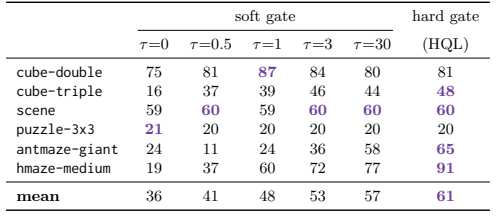
Table 7 :Soft gate versus hard gate.Success rate (%) at the end of online training, mean of the last three evaluations over five tasks, one seed. We bold the best score in each row at integer level.
出典 · CC BY 4.0 · Haoran Xu, Pragya Srivastava, Xinjie Liu, Siddhant Agarwal, Amy Zhang · Horizon-Scalable Q-Learning · 論文の図を引用 · 元のPDFの20ページ目から図の部分を抽出しています。組み合わせロック課題での価値誤差の検証
組み合わせロック課題は、真値Qを閉じた形で求められるため、価値推定の誤差を直接測れる決定的なチェーンです。この設定では、一段階TDは破損がなくても、ホライズンが長くなるにつれて誤差が急速に大きくなり、64-step TDは破損が生じるとすぐに発散します。HQLは、破損率とホライズンHの全体にわたって、2つのベースラインより低い誤差を保ちました。この結果は、本課題の設定と真値Qで得られたものであり、他の環境へ一般化するには別途確認が必要です。
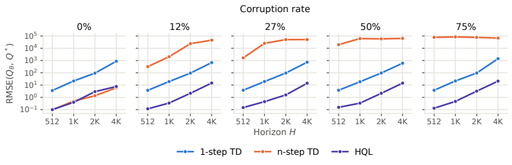
Figure 3 :Combination lock.HQL remains accurate under data corruption as the horizon grows. The figure illustrates the RMSE between the learnedQθ and the trueQ∗, averaged uniformly over all2H state–action pairs of the corrupted combination lock, after1M updates (log scale). Panels vary the corruption fraction of the dataset. n-step TD (n = 64) diverges as soon as any corruption is present; 1-step TD is unaffected by corruption but its error grows sharply with the horizonH.
出典 · CC BY 4.0 · Haoran Xu, Pragya Srivastava, Xinjie Liu, Siddhant Agarwal, Amy Zhang · Horizon-Scalable Q-Learning · 論文の図を引用 · 元のPDFの7ページ目から図の部分を抽出しています。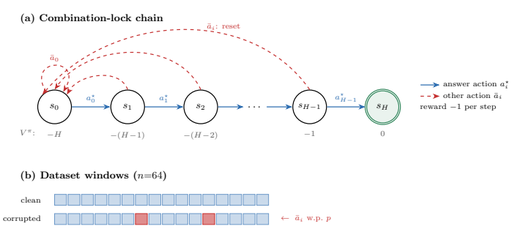
Figure 8 : The combination lock dataset with linearly arranged H states.
出典 · CC BY 4.0 · Haoran Xu, Pragya Srivastava, Xinjie Liu, Siddhant Agarwal, Amy Zhang · Horizon-Scalable Q-Learning · 論文の図を引用 · 元のPDFの15ページ目から図の部分を抽出しています。OGBenchとOCBenchでの比較設定
OGBenchの実験は、cube-double、cube-triple、scene、humanoidmaze-medium、antmaze-giant、humanoidmaze-giantの6つの状態ベースの設定で行われ、各設定の5つの課題の平均成功率を報告しています。すべての方法は、更新ごとに512個のクリティックターゲットを受け取り、同じ計算予算で比較します。ベースラインは、同じウィンドウをゲートなしで用いる16-window TD、8-step TD、1-step TD、Q-chunking、Long-horizon Q-Learningです。2つのベンチマークは設定が異なるため、スコアを1つの共通条件にまとめていません。
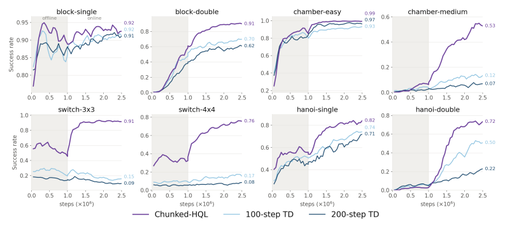
Figure 5 :Chunked-HQL versus n-step TD on OCBench.Success rate on eight50Hz tasks (one seed, smoothed over three evaluations; numbers are the mean of the last three). All methods use25-step chunks and the same best-of-16bootstrap. Chunked-HQL matches or outperforms both baselines on all eight tasks, especially onswitchandchamber-medium.
出典 · CC BY 4.0 · Haoran Xu, Pragya Srivastava, Xinjie Liu, Siddhant Agarwal, Amy Zhang · Horizon-Scalable Q-Learning · 論文の図を引用 · 元のPDFの8ページ目から図の部分を抽出しています。
Table 3 : How each method forms its512critic targets per update.
出典 · CC BY 4.0 · Haoran Xu, Pragya Srivastava, Xinjie Liu, Siddhant Agarwal, Amy Zhang · Horizon-Scalable Q-Learning · 論文の図を引用 · 元のPDFの16ページ目から図の部分を抽出しています。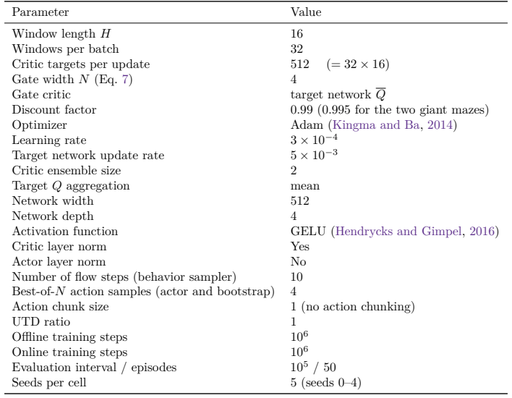
Table 4 : Hyperparameters for the OGBench benchmark experiment (Figures 4 and 9).
出典 · CC BY 4.0 · Haoran Xu, Pragya Srivastava, Xinjie Liu, Siddhant Agarwal, Amy Zhang · Horizon-Scalable Q-Learning · 論文の図を引用 · 元のPDFの16ページ目から図の部分を抽出しています。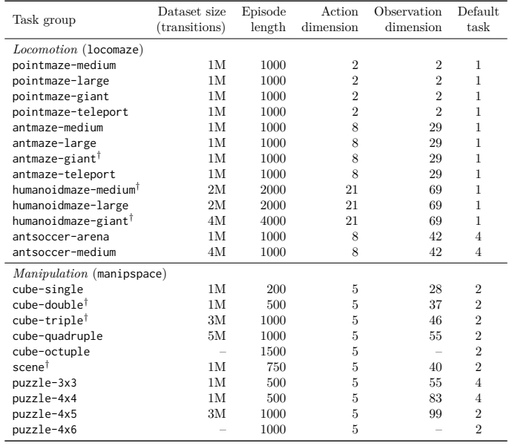
Table 5 : OGBench state-based task characteristics. Episode length is the maximum number of environment steps per episode. Rows marked†are the groups used in this work.
出典 · CC BY 4.0 · Haoran Xu, Pragya Srivastava, Xinjie Liu, Siddhant Agarwal, Amy Zhang · Horizon-Scalable Q-Learning · 論文の図を引用 · 元のPDFの18ページ目から図の部分を抽出しています。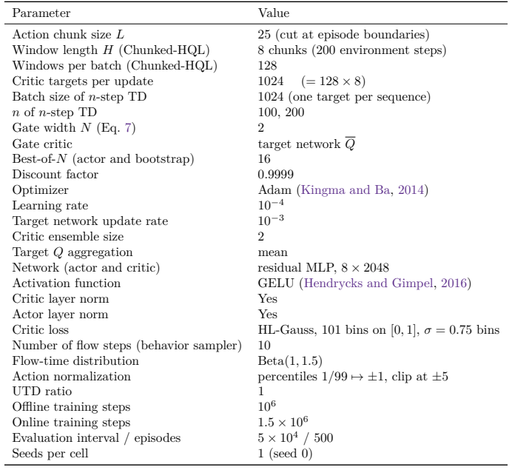
Table 6 : Hyperparameters for the OCBench benchmark experiment (Figure 5).
出典 · CC BY 4.0 · Haoran Xu, Pragya Srivastava, Xinjie Liu, Siddhant Agarwal, Amy Zhang · Horizon-Scalable Q-Learning · 論文の図を引用 · 元のPDFの19ページ目から図の部分を抽出しています。長期ホライズン課題の成功率の結果
OGBenchでのHQLの平均成功率は0.74で、最も強いTDベースラインである8-step TDは0.49です。差は1000段階以上の最も長いホライズン設定で最大になります。cube-tripleでは、HQLが0.54を記録しましたが、2つの多段階ベースラインはいずれも0を記録しました。16-window TDは、ゲートの有無を除けばHQLと同じ条件ですが、平均が最も低く、ゲートの効果を切り分けて示しています。これらの数値は、各実験条件に限った結果です。
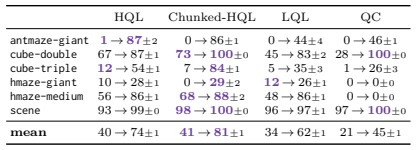
Table 1 :HQL and Chunked-HQL against LQL and QC. Success rates (%) are averaged over five tasks and reported as offline→ online with standard error over five seeds; we bold the best offline and the best online score at integer level. HQL and Chunked-HQL achieve the best results, especially on the long-horizon tasks.
出典 · CC BY 4.0 · Haoran Xu, Pragya Srivastava, Xinjie Liu, Siddhant Agarwal, Amy Zhang · Horizon-Scalable Q-Learning · 論文の図を引用 · 元のPDFの7ページ目から図の部分を抽出しています。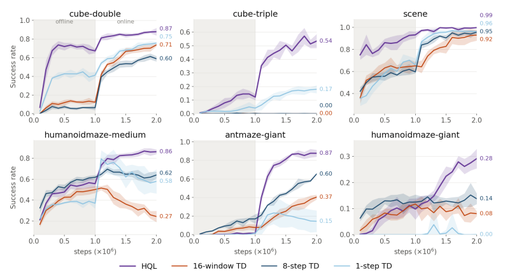
Figure 4 :HQL versus baseline TD methods at matched critic update budget.Success rate averaged over the five tasks of each configuration and over5seeds, with standard deviation shown as the band; gray marks the offline phase. HQL outperforms all baselines on all six configurations, especially on the challenging long-horizon ones.
出典 · CC BY 4.0 · Haoran Xu, Pragya Srivastava, Xinjie Liu, Siddhant Agarwal, Amy Zhang · Horizon-Scalable Q-Learning · 論文の図を引用 · 元のPDFの8ページ目から図の部分を抽出しています。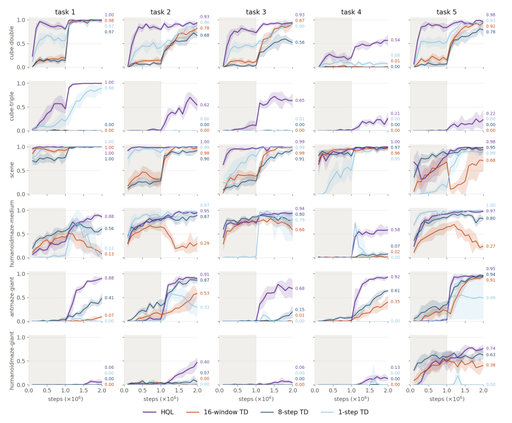
Figure 9 :Per-task view of the OGBench benchmark (Figure 4).Reading down a column shows how one task index behaves across environments, and a row shows how one environment varies over tasks.
出典 · CC BY 4.0 · Haoran Xu, Pragya Srivastava, Xinjie Liu, Siddhant Agarwal, Amy Zhang · Horizon-Scalable Q-Learning · 論文の図を引用 · 元のPDFの17ページ目から図の部分を抽出しています。ゲートが短いターゲットを選ぶ理由
著者らは、HQLが長いターゲットを作るからではなく、どのターゲットを伸ばすかを選ぶことで効果を生むと解釈しています。これは、n-step TDがすべてのターゲットを伸ばし、対象範囲内のすべての行動のバイアスを引き継ぐのとは対照的です。ウィンドウ長Hは8、16、32の間で性能差が小さかった一方、候補数Nは性能により大きく影響し、Nが小さいほど良い結果になりました。この解釈は著者らの説明であり、複数の設定の平均に基づいています。
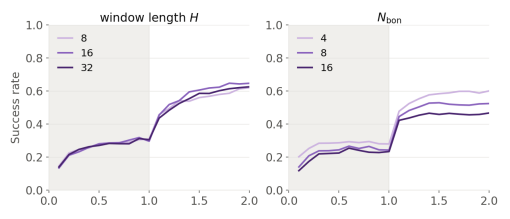
Figure 7 :HQL ablationsover window length H (left) and best- of-N gate widthN (right). H matters less thanN, and a smaller Ngives better results.
出典 · CC BY 4.0 · Haoran Xu, Pragya Srivastava, Xinjie Liu, Siddhant Agarwal, Amy Zhang · Horizon-Scalable Q-Learning · 論文の図を引用 · 元のPDFの9ページ目から図の部分を抽出しています。限界と適用範囲
著者らは、HQLの限界として、ゲートがクリティック自身のランキングに依存する点を挙げています。そのため、クリティックのランキングが不正確であれば、ゲートの判断も影響を受けるおそれがあります。実験は6つのOGBench設定、8つのOCBench課題、1つの組み合わせロック課題で行われ、一部のOCBench実験は1つのシードで報告されています。また、ソフトゲートの比較とVGF、QAMとの組み合わせは、それぞれの設定に限った結果です。これらの結果を、すべてのオフライン強化学習課題に広げて解釈すべきではありません。今後の課題としては、サブゴールの上で階層的にHQLを適用する方向が挙げられています。
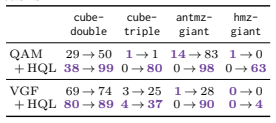
Table 2 :HQL as a drop-in critic for different policy extraction methods.Success rates (%) on task 2, offline→ online; we bold the better score of each pair. HQL improves both QAM and VGF on all four tasks.
出典 · CC BY 4.0 · Haoran Xu, Pragya Srivastava, Xinjie Liu, Siddhant Agarwal, Amy Zhang · Horizon-Scalable Q-Learning · 論文の図を引用 · 元のPDFの9ページ目から図の部分を抽出しています。論文情報
- 著者
- Haoran Xu, Pragya Srivastava, Xinjie Liu, Siddhant Agarwal, Amy Zhang
- 学会・ジャーナル
- arXiv · プレプリント
- 公開日
- 2026年11月7日
- 登録日
- 2026年11月10日
- 更新日
- 2026年11月7日
- バージョン
- v1
- arXiv
- 2611.10987
- カテゴリ
- cs.LG · cs.AI
- ライセンス
- CC BY 4.0
- 掲載内容
- 論文情報・解説・論文の図
この解説は、Refivuの韓国語解説をAIで翻訳したものです。不正確な翻訳や誤りが含まれる可能性があります。論文と図の利用条件は各出典に従います。
アブストラクト
Learning accurate off-policy state-action value functions (Q-functions) from offline datasets becomes harder as the task horizon grows. One-step temporal-difference (TD) learning bootstraps after every transition, so small per-step errors accumulate along the horizon, and early states can be badly misvalued even when the TD loss is small. Multi-step TD shortens this chain by following the dataset trajectory for several steps; however, since the behavior policy is often suboptimal, every followed action adds a bias, and no fixed number of steps suits a whole trajectory. In this paper, we propose Horizon-Scalable Q-Learning (HQL), a simple method that enables accurate long-horizon value learning by automatically balancing between one-step and multi-step returns. HQL extends a target through a dataset action only when the critic values it at least as highly as the best-of-N actions sampled from the BC policy, and otherwise falls back to a one-step target. We show that this rule is a principled off-policy correction that needs no action densities, which makes HQL compatible with expressive flow and diffusion policies. Experiments show that HQL avoids the failures of both one-step and multi-step TD on a combination-lock task across horizons, and outperforms prior horizon-reduction methods on long-horizon OGBench and OCBench tasks.
この論文を引用
Haoran Xu, Pragya Srivastava, Xinjie Liu, Siddhant Agarwal, Amy Zhang (2026). Horizon-Scalable Q-Learning. arXiv:2611.10987v1. https://arxiv.org/abs/2611.10987v1
BibTeX
@misc{xu2026horizon,
  title = {{Horizon-Scalable Q-Learning}},
  author = {Haoran Xu and Pragya Srivastava and Xinjie Liu and Siddhant Agarwal and Amy Zhang},
  year = {2026},
  eprint = {2611.10987},
  archivePrefix = {arXiv},
  url = {https://arxiv.org/abs/2611.10987v1}
}