論文解説
Where to Approximate in Neurosymbolic Inference?
ニューロシンボリック推論で近似をどこに入れるか
- 課題 重み付きモデル計数の計算は正確に行うのが難しく、近似が必要です。ただし、どの段階で近似すべきかは体系的に分かっていません。
- 手法 コンパイル、乗算・再圧縮、独立縮約の3段階パイプラインを定義します。テンソルトレイン(TT)ベースのAPRICOT戦略で因子を近似し、TTの積を再圧縮します。
- 結果 スドクのアブレーション実験と、複数タスクの推論と学習の実験では、依存関係を保存するTT再圧縮法が独立近似よりWMCの推定を大きく改善しました。補助変数のあるタスクでは学習も改善しています。
スドクのような制約でWMC計算が難しい理由
ニューロシンボリックシステムでは、ニューラルネットワークが予測した離散概念の確率が記号制約を満たす確率、すなわち重み付きモデル計数(WMC)を計算する必要があります。この計算は一般に#P-hardで、9×9のスドクのような大きな制約は既存の厳密コンパイラでは扱いにくいです。そのため多くの方法が近似計算を用いますが、近似をどの段階に入れるべきかについての体系的な基準はまだ整理されていません。この論文はこの空白に対処するため、近似を入れうる3段階を1つのパイプラインにまとめます。第1段階は各因子をコンパイルする段階、第2段階は因子を掛け合わせたり再圧縮したりする段階、第3段階は残った回路を独立の仮定で結合する段階です。
APRICOTパイプラインにおけるテンソルトレイン近似
APRICOTは、3段階パイプラインの最初の2段階をテンソルトレイン(TT)分解で実装します。制約の因子は密なテンソルとして作成した後、TT-SVDで近似されます。複数のTTは、同じ変数順序であればアダマール積で厳密に掛け合わせられます。このとき、ランクは2つのTTランクの積まで大きくなるため、TT-ROUNDのような再圧縮法で最大ランクを制限できます。最後の段階では、残ったK個の回路についてWMCを個別に計算し、独立の仮定で掛け合わせます。したがって、厳密な積、再圧縮の積、独立縮約の組み合わせが、既存の方法を包含する設計空間を形成します。
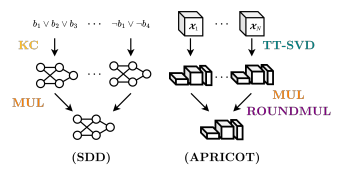
Figure 1 :Where can we approximatewhen compiling structured-decomposable circuits? We unify bottom-up approaches in a three-step pipeline:(Step I)compiles each factor ϕj into an exact or relaxedcircuit,(Step II)multiplies the resulting N circuits down to K exactlyor usingrecom- pression strategies, and(Step III)combines any K >1 remaining circuits with anindependence (fuzzy) approximation. Existing methods correspond to specific combinations of exact or approximate operations, but the framework also allows for new TT-based APRICOT strategies yet to be explored.
出典 · CC BY 4.0 · Samy Badreddine, Emile van Krieken, Luciano Serafini, Antonio Vergari · Where to Approximate in Neurosymbolic Inference? · 論文の図を引用 · 元のPDFの2ページ目から図の部分を抽出しています。
Figure 2 : Closed algebra over TTs. TTs (a) canapproximate discrete functionsunder an error crite- rion and (b) are closed under severalexact operationsincluding multiplications. As multiplications involve Kronecker products ⊗ of the cores resulting in an exponential increase in rank, algebraic recompression strategies (c) canapproximate the result of the operations.
出典 · CC BY 4.0 · Samy Badreddine, Emile van Krieken, Luciano Serafini, Antonio Vergari · Where to Approximate in Neurosymbolic Inference? · 論文の図を引用 · 元のPDFの5ページ目から図の部分を抽出しています。スドクのコンパイル設定に関するアブレーション実験
スドクの6×6と9×9のボードで、乗算の方法とTT-SVDの初期ランクを変えながら、コンパイル時間とモデル計数の対数誤差を比較します。参照値はボードごとのモデル数で、4×4では厳密SDDと適切なTT設定の両方が、数値精度の範囲内で正確な計数を回復します。論文は、独立近似は設定によって結果が予測しにくく、先に厳密な積を行うと忠実度が大きく改善すると報告しています。また、再圧縮の積は最も高い精度をもたらしますが、ランクの予算が限られている場合に積を多く試みすぎると、表現力の限界から性能が下がる可能性があります。
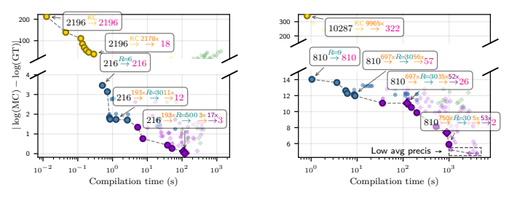
Figure 3 : Pareto front of absolute log inference error vs. compilation time for Sudoku 6x6 (left) and 9x9 (right). SDD pipelines are in yellow . APRICOT pipelines are in blue when they do not use recompressions, in violet when they use SVD-based recompressions (TT-ROUND and HATT ) and in green for interpolation-based strategies (TCI and RSI ).
出典 · CC BY 4.0 · Samy Badreddine, Emile van Krieken, Luciano Serafini, Antonio Vergari · Where to Approximate in Neurosymbolic Inference? · 論文の図を引用 · 元のPDFの8ページ目から図の部分を抽出しています。
Table 1 : Ablation of the multiplication schedule and maximum TT rank on Sudoku 6×6 . All pipelines use TT-ROUNDand reduce the 216 initial factors to five before fuzzy reduction.
出典 · CC BY 4.0 · Samy Badreddine, Emile van Krieken, Luciano Serafini, Antonio Vergari · Where to Approximate in Neurosymbolic Inference? · 論文の図を引用 · 元のPDFの26ページ目から図の部分を抽出しています。重み付き推論と学習における近似手法の比較
MNISTAdd、MNISTMul、CLEVR-Diff、CLEVR-CountDiffでは、厳密なSDDコンパイルは難しい設定で失敗します。一方、完全TT縮約であるAPRICOT Cは、独立近似よりはるかに正確な推定を報告しています。学習実験では、独立縮約は視覚スドクとCLEVR-Diffでは競争力がありますが、補助記号変数のある算術とCLEVR-CountDiffでは、依存関係を保存する方法が概念と出力の精度を大きく改善します。ただし、一部の設定では実行間の分散が大きく、最適化が収束しない場合もあります。
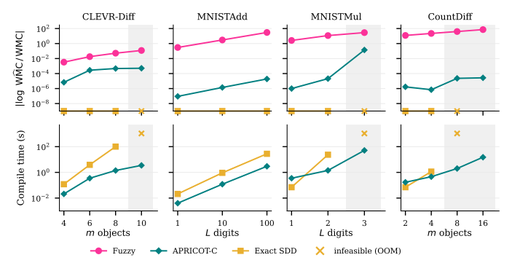
Figure 4 : Median absolute log WMC error and compilation time across tasks and problem sizes. Exact SDD compilation becomes infeasible on harder problems. Full TT reduction (APRICOT C) can scale further while producing estimates orders of magnitude more accurate than fuzzy.
出典 · CC BY 4.0 · Samy Badreddine, Emile van Krieken, Luciano Serafini, Antonio Vergari · Where to Approximate in Neurosymbolic Inference? · 論文の図を引用 · 元のPDFの9ページ目から図の部分を抽出しています。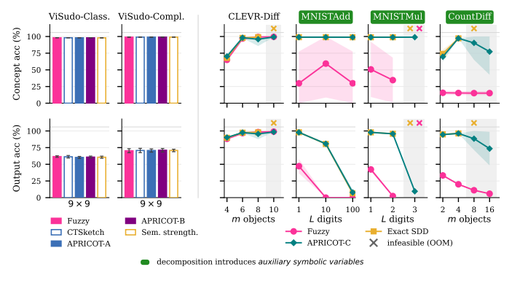
Figure 5 : Concept and output accuracy across tasks and problem sizes. APRICOT matches exact compilation when the latter is feasible, and outperforms fuzzy in larger regimes.
出典 · CC BY 4.0 · Samy Badreddine, Emile van Krieken, Luciano Serafini, Antonio Vergari · Where to Approximate in Neurosymbolic Inference? · 論文の図を引用 · 元のPDFの10ページ目から図の部分を抽出しています。適用範囲と限界
著者らは、TCIとRSIを含むほとんどのテンソルトレイン分解と再圧縮が、疎なブール値テンソルに合わせて設計されていないと述べています。そのため、この方法の効率を疎な制約全般に一般化するには、別途研究が必要です。また、スケジュールとランクの選択は課題ごとに異なり、結果は特定のベンチマークと設定で得られたものです。
論文情報
- 著者
- Samy Badreddine, Emile van Krieken, Luciano Serafini, Antonio Vergari
- 学会・ジャーナル
- arXiv · プレプリント
- 公開日
- 2026年11月10日
- 登録日
- 2026年11月11日
- 更新日
- 2026年11月10日
- バージョン
- v1
- arXiv
- 2611.13862
- カテゴリ
- cs.LG
- ライセンス
- CC BY 4.0
- 掲載内容
- 論文情報・解説・論文の図
この解説は、Refivuの韓国語解説をAIで翻訳したものです。不正確な翻訳や誤りが含まれる可能性があります。論文と図の利用条件は各出典に従います。
アブストラクト
Probabilistic neurosymbolic methods rely on weighted model counting (WMC) to combine neural predictors with symbolic constraints. Exact WMC is #P-hard and typically scales poorly, so many methods resort to approximations. By unifying existing approaches under a three-step bottom-up approximate compilation pipeline, we study where approximation budget is best allocated. Inspired by tensor networks, we instantiate two steps with tensor train decompositions and derive new pipelines that exactly multiply approximated factors and recompress their products via SVD- or interpolation-based schemes. Across six tasks in Sudoku, arithmetic reasoning, and scene understanding, and across increasing problem sizes, our pipelines produce WMC estimates orders-of-magnitude more accurate than prior methods. This translates into stronger downstream learning on tasks where reasoning relies on tight interactions between symbolic factors, where cruder approximations ignore these dependencies. Our pipelines open novel design space for effective approximate compilation of challenging probabilistic reasoning tasks.
この論文を引用
Samy Badreddine, Emile van Krieken, Luciano Serafini, Antonio Vergari (2026). Where to Approximate in Neurosymbolic Inference?. arXiv:2611.13862v1. https://arxiv.org/abs/2611.13862v1
BibTeX
@misc{badreddine2026where,
  title = {{Where to Approximate in Neurosymbolic Inference?}},
  author = {Samy Badreddine and Emile van Krieken and Luciano Serafini and Antonio Vergari},
  year = {2026},
  eprint = {2611.13862},
  archivePrefix = {arXiv},
  url = {https://arxiv.org/abs/2611.13862v1}
}