論文解説
Perturbing Inputs Improves Pretraining Distillation
入力の摂動による事前学習蒸留の改善
- 課題 教師モデルに学習テキスト外の摂動入力で予測させると、事前学習の蒸留で生徒モデルの性能が改善するかを検証します。
- 手法 学習初期の一定割合で教師モデルと生徒モデルにノイズまたはブレンドした摂動入力を与え、残りは通常の入力による標準の蒸留で学習します。
- 結果 隣接トークンブレンドは、標準の蒸留と比べて検証損失を135Mで0.025 nats、0.5Bで0.020 nats下げました。
研究課題:教師モデルが見ていない入力を学習に使えるか
事前学習で小さな言語モデルを作る際には、大きな教師モデルの次トークン分布に倣って学ぶ蒸留がよく使われます。ただし標準の蒸留では、生徒モデルは実際の学習テキスト上でのみ教師モデルの予測を受け取ります。教師関数はそのテキストの外でも定義されていますが、生徒モデルはその振る舞いについての情報を受け取れません。この論文は、教師モデルに学習テキスト外の摂動入力で予測させると生徒モデルの性能が改善するかを問うものです。ここで変わるのは生徒の入力だけではなく、教師モデルが生徒を導く入力そのものです。
この問いは、言語モデルの事前学習でよく使われるデータ拡張とは区別されます。一般的な拡張は、生徒の入力をマスキングやトークン置換で壊し、元の次トークンを目標とします。著者らは、教師モデルが壊れた入力の上で直接予測すれば、生徒が実際に見る入力に合った目標を与えられると説明しています。一方で、事前学習ではデータを繰り返さない場合が多く、教師モデルがきれいなテキストからすでに豊富な監督を与えている点から、この方法が役立つかは明らかではなかったと述べられています。
二段階の蒸留と摂動の方法
手法は、学習初期の一定割合の間に教師モデルと生徒モデルが同じ摂動入力を受け取る摂動段階と、その後にきれいな入力で通常の蒸留を行う段階から構成されます。入力は、one-hotベクトルを語彙項目の疎な重み付き和に変換したものです。教師モデルと生徒モデルはそれぞれ自分の埋め込み行列でこのベクトルを処理し、生徒モデルは凍結した教師モデルの次トークン分布に合わせて学習します。損失は、すべての位置で温度1のforward KLです。
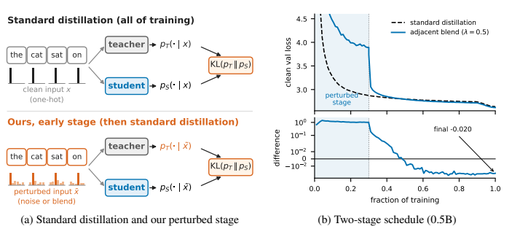
Figure 1 :Overview.(a) In standard distillation, teacher and student read the same clean text and the student is trained to match the teacher’s prediction on it. In the early stage of our method, both read a perturbed version of the text, and the student matches the teacher’s prediction on that perturbed input: the inputs on which the teacher supervises the student change, not only the student’s input. The bars under each token sketch its input vector over a toy vocabulary, one-hot for clean text and spread over several vocabulary items when perturbed (Fig. 2). The rest of training is standard distillation on clean text. (b) Clean validation loss of two 0.5B students trained from the same initialization on the same data order, one with standard distillation and one with adjacent blending (λ=0.5) for the first 30% of training, and their difference (symmetric log scale). While its inputs are perturbed, the blended student lags by about one nat. After the switch it recovers quickly, overtakes the baseline at about 47% of training and finishes 0.020 nats below it.
出典 · CC BY 4.0 · Ziyang Cai, Yihe Dong, Dimitris Papailiopoulos, Shivam Garg · Perturbing Inputs Improves Pretraining Distillation · 論文の図を引用 · 元のPDFの2ページ目から図の部分を抽出しています。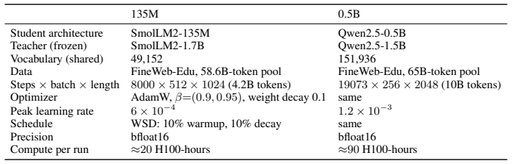
Table 3 :Training configuration.Both scales train the student from random initialization with a frozen teacher; the distillation loss is the forward KL divergence over the full vocabulary at temper- ature 1, with no next-token term.
出典 · CC BY 4.0 · Ziyang Cai, Yihe Dong, Dimitris Papailiopoulos, Shivam Garg · Perturbing Inputs Improves Pretraining Distillation · 論文の図を引用 · 元のPDFの13ページ目から図の部分を抽出しています。3種類の摂動を比較します。ノイズは正解トークンに、k=8個のランダムなトークンのGaussian重みを加え、σで大きさを調整します。Parallelブレンドは、2つの独立した文書を同じ位置でλと1−λの重みを使って混ぜます。Adjacentブレンドは、連続する2つのトークンを1つの位置にλと1−λの重みで合成します。このとき入力長を保つため、系列は2倍の長さで抽出します。学習率はwarmup–stable–decayのスケジュールに従い、最後のdecayは必ずきれいな入力で進みます。そのため、摂動段階のあとも最終的な収束はきれいなデータ上で行われます。

Figure 2 :Perturbation familieson a toy vocabulary. Each replaces the one-hot vector of a token with a sparse weighted combination of vocabulary items, with the position’s own token shown dark. Teacher and student both map the perturbed vector through their own embedding tables, and the student is trained to match the frozen teacher’s next-token distribution on it.
出典 · CC BY 4.0 · Ziyang Cai, Yihe Dong, Dimitris Papailiopoulos, Shivam Garg · Perturbing Inputs Improves Pretraining Distillation · 論文の図を引用 · 元のPDFの3ページ目から図の部分を抽出しています。主な結果:135Mと0.5Bの規模での改善
135Mの規模では、3種類の摂動はいずれも標準の蒸留より低い検証損失を示しました。隣接トークンブレンドが最も強く、λ=0.8で標準の蒸留と比べて0.025 nats低くなりました。これは、蒸留そのものがnext-token学習と比べて得る0.017 natsの約1.45倍に当たります。ノイズはσ=0.4で0.019 nats、Parallelブレンドはλ=0.7で0.018 natsを得ました。各摂動には明確な最適点があり、それを超えて強くすると性能は悪化しました。
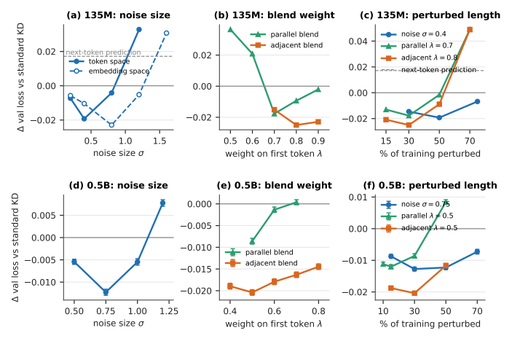
Figure 3 :Change in final validation loss against standard distillation(below zero is better). (a–c) 135M student with the SmolLM2-1.7B teacher, 4.2B tokens. The dashed line is next-token prediction without a teacher. (a) Noise size, with a 50% perturbed stage. The open markers in (a) are Gaussian noise added to each model’s input embedding; theirσis relative to the embedding’s root- mean-square value, so it is not in the same units as token noise. (b) Blend weight for both blends, with a 30% perturbed stage. (c) Length of the perturbed stage at each family’s best size. (d–f) 0.5B student with the Qwen2.5-1.5B teacher, 10B tokens, scored on the full validation split. Error bars are±2paired standard errors. (d) Noise size and (e) blend weight, with the same perturbed-stage lengths as in (a, b). (f) Length of the perturbed stage at each family’s best size.
出典 · CC BY 4.0 · Ziyang Cai, Yihe Dong, Dimitris Papailiopoulos, Shivam Garg · Perturbing Inputs Improves Pretraining Distillation · 論文の図を引用 · 元のPDFの4ページ目から図の部分を抽出しています。0.5Bの規模でも、隣接トークンブレンドが最も強い結果でした。λ=0.5で標準の蒸留と比べて0.020 nats低く、対になった標準誤差は0.0003でした。同じ実行の追加の2つのシードでは、0.021と0.019でした。ノイズはσ=0.75で0.012 nats、Parallelブレンドはλ=0.5で、30%段階では0.009 nats、15%段階では0.012 natsを得ました。
改善が教師側の入力から来ることを確認するアブレーション実験
アブレーション実験は、利得の源を確かめるために設計されました。教師モデルを使わないnext-token学習で同じ摂動を用いた場合、改善は0.003 natsにとどまりました。隣接トークンブレンドは、教師モデルがないとnext-token学習より0.03 nats劣りました。教師側の入力だけを摂動入力に変えると、生徒モデルはきれいなテキストを見ますが、摂動入力に対する教師モデルの予測を目標として受け取ります。このとき得た利得は、両方のモデルを摂動入力に変えた場合の約90%でした。逆に、生徒側の入力だけを摂動入力に変え、教師モデルの目標はきれいな入力から得ると、利得は約3分の1程度でした。
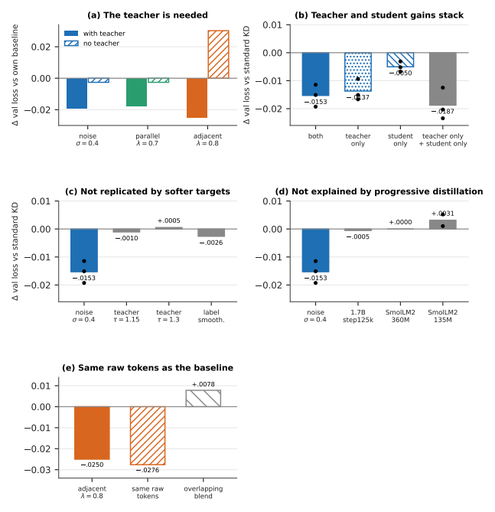
Figure 4 :Ablations(135M, SmolLM2-1.7B teacher; difference in final validation loss, lower is better). Bars show the mean over initialization seeds and dots the individual seeds, each compared with standard distillation from the same seed. (a) Each family at its best setting, with and without the teacher, each compared with its own unperturbed baseline (standard distillation or next-token prediction). (b) Token noise given to both models, to the teacher only, or to the student only. The grey bar is the sum of the two one-sided gains. (c) Clean inputs, with the teacher’s target softened instead, either by a temperatureτ(τ=1.15matches the entropy of the teacher’s prediction onσ=0.4 inputs) or by label smoothing to the same entropy. (d) Clean inputs for the first half of training, distilled from a weaker model (an early checkpoint of the teacher, or a smaller model) instead of the teacher. (e) Adjacent blending atλ=0.8, as in the main runs and on the same raw tokens as the baseline, and the overlapping variant described in the text (one seed).
出典 · CC BY 4.0 · Ziyang Cai, Yihe Dong, Dimitris Papailiopoulos, Shivam Garg · Perturbing Inputs Improves Pretraining Distillation · 論文の図を引用 · 元のPDFの6ページ目から図の部分を抽出しています。著者らは、この結果を根拠に、ノイズの実験では教師側の摂動が利得の大部分を説明すると解釈しています。これはアブレーション実験の結果に基づく解釈であり、3種類の摂動のすべてで同程度に確認された結論としては示されていません。同じ節では、平均4個のノイズ付き教師予測を使うと、単一サンプルの場合より利得が小さかったという結果も報告されています。著者らは、目標のばらつきが役立つと解釈しています。
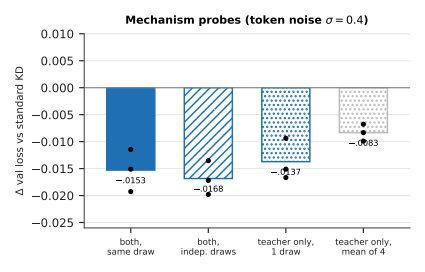
Figure 7 :Mechanism probes(135M, token noiseσ=0.4for the first 50% of training; difference from standard distillation, mean over seeds with individual seeds as dots).
出典 · CC BY 4.0 · Ziyang Cai, Yihe Dong, Dimitris Papailiopoulos, Shivam Garg · Perturbing Inputs Improves Pretraining Distillation · 論文の図を引用 · 元のPDFの14ページ目から図の部分を抽出しています。データ反復と調整済みweight decayのベースライン
データが限られた設定では同じテキストを何度も使うため、正則化が重要になります。135Mの規模では、同じ4.2Bトークンの予算の中で、最初の262Mトークンを16 epoch繰り返す実験が行われました。Weight decayをスイープした結果、デフォルトの0.1から1.0に上げると、標準の蒸留の損失は0.033 nats下がりました。調整済みのベースライン上で、トークンノイズ(σ=0.4、学習の最初の50%)は2つのシードで0.023と0.020 natsの利得を示しました。同じノイズを教師モデルなしで使うと0.008 natsだったので、教師モデルがある場合の利得は約2.6倍です。
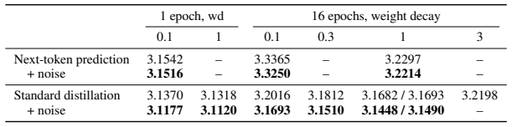
Table 4 :Data-constrained pretrainingat 135M: final validation loss with 16 epochs over 262M unique tokens, by weight decay, against the same 4.2B-token budget without repetition (1 epoch). Two values: two initialization seeds. The 1-epoch runs at weight decay 1 use one seed. Noise: token noiseσ=0.4for the first 50% of training. Bold: the better of each objective with and without noise.
出典 · CC BY 4.0 · Ziyang Cai, Yihe Dong, Dimitris Papailiopoulos, Shivam Garg · Perturbing Inputs Improves Pretraining Distillation · 論文の図を引用 · 元のPDFの13ページ目から図の部分を抽出しています。デフォルトのweight decay 0.1での利得0.032は、調整済みのweight decayがもたらす正則化の効果と重なるため、より大きく見えています。したがって、調整済みのベースラインで報告された値がこの設定の主な結果です。
量子化後の性能とzero-shot転移
0.5Bの生徒モデルは、post-training weight quantizationの後も検証損失の利得を示しました。GPTQ int4では、すべての摂動を加えた生徒モデルが、同じ方法で量子化した標準の蒸留より利得を維持しました。隣接トークンブレンドの利得は0.020から0.024 natsに増えました。デフォルトのround-to-nearestのint3では、標準の蒸留の損失増加は6.2 natsでしたが、両ブレンドはそれぞれ1.2と1.5 natsにとどまりました。著者らは、この差は中間の学習チェックポイントでも維持されており、線形層の重みの過剰尖度が両ブレンドで0.14と低く、標準の約0.5より小さいことと関係すると解釈しています。
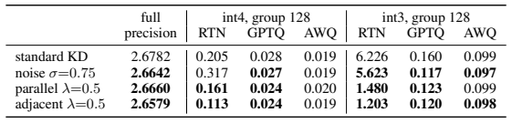
Table 1 :Increase in validation loss from post-training weight quantizationat 0.5B (nats; 512 fixed validation windows, paired across models). RTN: round-to-nearest; GPTQ and AWQ as im- plemented in llm-compressor. All linear layers except the output head are quantized; activations stay in 16 bits. Perturbed stage: 30%, or 15% for the parallel blend. Bold: better than standard KD.
出典 · CC BY 4.0 · Ziyang Cai, Yihe Dong, Dimitris Papailiopoulos, Shivam Garg · Perturbing Inputs Improves Pretraining Distillation · 論文の図を引用 · 元のPDFの8ページ目から図の部分を抽出しています。Zero-shotの評価では、0.5Bの平均精度が標準の蒸留の52.5%から、隣接トークンブレンドでは53.5%、ノイズでは53.6%に上がりました。Parallelブレンドは0.5点増えました。最も大きな向上はSciQの約4点とHellaSwagの約1点で、両ブレンドはLAMBADAで約1点下がりました。135Mでは、平均の差は最大0.6点でした。
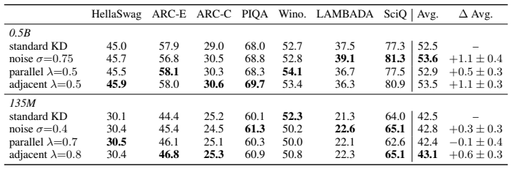
Table 2 :Zero-shot accuracy(%, lm-evaluation-harness; normalized accuracy for HellaSwag, ARC, PIQA and SciQ, accuracy for Winogrande and LAMBADA). Each family at its best setting for that scale, with a perturbed stage of 30% (0.5B parallel blend 15%, 135M noise 50%).∆Avg.: difference from standard distillation in the average over tasks,±paired bootstrap standard error over examples. Best value per scale in bold.
出典 · CC BY 4.0 · Ziyang Cai, Yihe Dong, Dimitris Papailiopoulos, Shivam Garg · Perturbing Inputs Improves Pretraining Distillation · 論文の図を引用 · 元のPDFの9ページ目から図の部分を抽出しています。適用範囲と限界
著者らは、実験の規模が限られていると述べています。より大きなモデルや、はるかに多くの学習データで利得が維持されるかは、この研究では確認されていません。最適な摂動の大きさと摂動段階の長さは、2つの規模の間で異なっていました。著者らは、その範囲を事前に決める原理を持たず、スイープで見つけたと書いています。また付録によると、学習予算の中で測定された結果が主な根拠であり、すべての設定が複数のシードで繰り返されたわけではありません。
この論文は、教師モデルが摂動入力で与える監督が有用でありうるという概念実証を示しています。教師モデルに別の入力を問い合わせるより広い設計は、今後の課題として残されています。
論文情報
- 著者
- Ziyang Cai, Yihe Dong, Dimitris Papailiopoulos, Shivam Garg
- 学会・ジャーナル
- arXiv · プレプリント
- 公開日
- 2026年11月8日
- 登録日
- 2026年11月10日
- 更新日
- 2026年11月8日
- バージョン
- v1
- arXiv
- 2611.11598
- カテゴリ
- cs.CL · cs.AI
- ライセンス
- CC BY 4.0
- 掲載内容
- 論文情報・解説・論文の図
この解説は、Refivuの韓国語解説をAIで翻訳したものです。不正確な翻訳や誤りが含まれる可能性があります。論文と図の利用条件は各出典に従います。
アブストラクト
Knowledge distillation trains a student language model to match a teacher's predictions on the training text. We ask whether learning the teacher's behavior beyond the training text can further improve the student. We investigate this using three input perturbations: additive token noise, blending two documents, and blending neighboring tokens. Specifically, for an early part of pretraining we perturb the inputs and train the student to match the teacher on them, and we spend the rest of the same token budget on ordinary distillation. When pretraining from scratch, the best method improves on standard distillation at both scales we tried, by 0.025 nats at 135M parameters and by 0.020 nats at 0.5B (mean of three seeds). At 135M this is 1.45 times the gain that distillation itself provides over next-token training. We also observe promising downstream transfer: at 0.5B, the best variant improves average zero-shot accuracy by about one percentage point across seven tasks. It also retains its validation-loss advantage after low-bit weight quantization. We also test a data-limited setting in which training data must be reused, and find that the gains persist. Finally, ablations suggest that, for additive noise, perturbing the teacher's inputs contributes most of the gain, while perturbing only the student's inputs yields much less.
この論文を引用
Ziyang Cai, Yihe Dong, Dimitris Papailiopoulos, Shivam Garg (2026). Perturbing Inputs Improves Pretraining Distillation. arXiv:2611.11598v1. https://arxiv.org/abs/2611.11598v1
BibTeX
@misc{cai2026perturbing,
  title = {{Perturbing Inputs Improves Pretraining Distillation}},
  author = {Ziyang Cai and Yihe Dong and Dimitris Papailiopoulos and Shivam Garg},
  year = {2026},
  eprint = {2611.11598},
  archivePrefix = {arXiv},
  url = {https://arxiv.org/abs/2611.11598v1}
}