論文解説
Evaluating LLM-Generated World Models for Neuro-Symbolic Reasoning
LLM生成の世界モデルによるニューロシンボリック推論の評価
- 課題 LLMが生成した世界モデルは、実行できても意図した意思決定問題を忠実に表しているかを別途検証する必要があります。
- 手法 POSG形式の世界モデルを、機械的妥当性、基準との構造一致、意味基準の3つのレーンで評価します。
- 結果 ゲームトラックでは134/135個が機械的検査を通過しましたが、平均の構造F1は0.366でした。国名の明示は、文化トラックで複数のLLMの構造F1を下げています。
実行だけでは不十分な形式的世界モデル
LLMに自然言語で状況を説明し、POSG形式の世界モデルを作らせると、計画や安全分析に使える形式表現が得られます。ただし、複数のエージェントが関わる状況では同じ状況を複数の方法で形式化でき、正解の世界モデルが一つに定まらないことが多いです。そのため、モデルが実行可能であるというだけでは、意図された意思決定問題を忠実に表しているとは見なせません。この論文は、機械的妥当性、基準との構造一致、意味基準のスコアを区別して、この隔たりを測定しています。下流プランナーは世界モデル上で方策を探すため、誤った世界モデルでは、プランナーがどれほど正確でも報酬を得られない意思決定問題を解くことになります。
3つのレーンによる評価方法
この論文は、生成されたPOSGを実行可能性、構造、意味の3段階に分けて評価します。Lane 1では、生成されたJSONまたはPythonの世界モデルが実行されること、遷移確率が正規化されていること、到達不能な状態がないことを確認します。Lane 2aでは、基準の世界モデルがあるときに、2つのモデルのプレイヤー、状態、行動を対応づけたうえで、固定の水平線まで展開し、カバレッジ、適合率、F1を計算します。この水平線での比較は有限性を保証しますが、その先に現れる違いを見落とすおそれがあります。Lane 2bは、基準がないときに状態遷移グラフの分岐、到達可能性、強連結成分、遷移エントロピーを調べます。
これは形を記述するだけで、正しさを証明するものではありません。Lane 3では、あらかじめ定めた包含・禁止基準をプログラムで点検します。人手によるアノテーションの手順はまだ実行されていません。
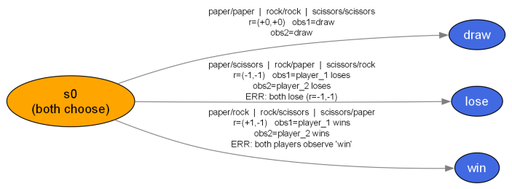
Figure 4 : State graph for a local Qwen G1 sample with reward-system awareness. A normal plausible graph could not prevent incorrect rewards and player-specific observations, illustrating why topology alone is insufficient.
出典 · CC BY 4.0 · Souhaila Djaffal, Amna Jamal, Gagana Madhugiri Devaraja, Anidipta Pal, Jobst Heitzig · Evaluating LLM-Generated World Models for Neuro-Symbolic Reasoning · 論文の図を引用 · 元のPDFの12ページ目から図の部分を抽出しています。ゲーム、状況、文化の3トラックの構成
実験は3つのトラックに分かれます。ゲームトラックでは、9つのゲーム(G1–G9)に対して作成したPOSG基準を用意し、5つのLLMそれぞれに同じプロンプトで3回ずつ依頼して135個の候補を得ています。その際、temperatureは0、出力上限は16,384トークン、推論は無効にしました。状況トラックは11個のオープンエンドなシナリオ(S1–S11)から成り、基準は作成されたPOSGではなく、基準から導出した機能集合です。文化トラックでは14個のシナリオ(C1–C14)を、匿名の説明と国名明示の2つの条件で評価し、temperature 0.7で条件ごとに1つの出力を生成します。このように、トラックごとに基準の性質が異なり、スコアを直接比べられる度合いも変わります。

Table 1 : Completed empirical results by track and evaluation lane. Game Lane 2a reports permutation- invariant structural agreement with an authored POSG reference, whereas Situational and Cultural Lane 2a report feature-multiset agreement against track-specific references (criteria-derived for Situational). Lane 3 reports predefined programmatic checks without human validation.
出典 · CC BY 4.0 · Souhaila Djaffal, Amna Jamal, Gagana Madhugiri Devaraja, Anidipta Pal, Jobst Heitzig · Evaluating LLM-Generated World Models for Neuro-Symbolic Reasoning · 論文の図を引用 · 元のPDFの6ページ目から図の部分を抽出しています。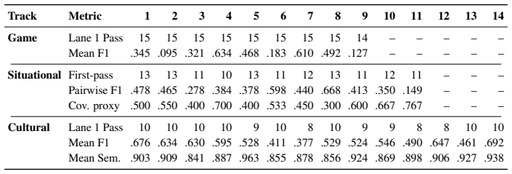
Table 5 : Case-level metrics by track.Mean F1: permutation-invariant structural overlap with reference (0–1, higher is closer).Pairwise F1: mean structural agreement across all world model pairs per case (situational track only).Cov. proxy: stakeholder-capacity proxy = generated player count divided by reference required count (capped at 1).Sem.: automated semantic expect/avoid score (cultural track only). (a) Game track (n= 15 per case, 5 LLMs × 3 runs). (b) Situational track (S1–S11: 5 LLMs × 3 generations = 15 attempts). (c) Cultural track (n= 10 per case, 5 LLMs × 2 prompt conditions).
出典 · CC BY 4.0 · Souhaila Djaffal, Amna Jamal, Gagana Madhugiri Devaraja, Anidipta Pal, Jobst Heitzig · Evaluating LLM-Generated World Models for Neuro-Symbolic Reasoning · 論文の図を引用 · 元のPDFの11ページ目から図の部分を抽出しています。ゲームトラック:実行可能性と構造一致の差
ゲームトラックでは、生成された世界モデルの大半が機械的検査を通過しました。Lane 1の通過は134/135個で、失敗例はDeepSeekのG9の1件だけです。ただし、Lane 1を通過した134個の候補について、順列不変F1の平均は0.366、中央値は0.178でした。基準と完全に一致したモデルは28個にとどまります。多くのLLMでカバレッジが適合率を上回っており、生成モデルは基準の構造を取りこぼすより、構造を付け加える傾向を示しました。Claude Opus 5は27個の成果物がすべて有効でしたが、平均適合率は0.142、平均F1は0.171で、パネルの中で最も低い結果でした。これは、実行可能性と基準構造の一致が別の評価であることを示しています。

Table 2 : Permutation-invariant structural comparison over 27 final artifacts per LLM. Means are supplemented by median and IQR; machine-readable results also report game-clustered bootstrap intervals.
出典 · CC BY 4.0 · Souhaila Djaffal, Amna Jamal, Gagana Madhugiri Devaraja, Anidipta Pal, Jobst Heitzig · Evaluating LLM-Generated World Models for Neuro-Symbolic Reasoning · 論文の図を引用 · 元のPDFの6ページ目から図の部分を抽出しています。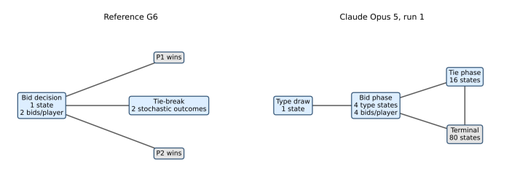
Figure 2 : Compressed phase graph for G6 versus the mechanically valid Claude Opus 5 artifact from run 1 (matched F1 0.0383). The candidate has 101 states. Unlike the two-bid-level reference, it introduces bids {0,1,2,3} despite the rubric explicitly disallowing invented bid amounts, and expands the dynamics through four type states and 16 tie states. Nodes are grouped by verified phase prefix for legibility.
出典 · CC BY 4.0 · Souhaila Djaffal, Amna Jamal, Gagana Madhugiri Devaraja, Anidipta Pal, Jobst Heitzig · Evaluating LLM-Generated World Models for Neuro-Symbolic Reasoning · 論文の図を引用 · 元のPDFの7ページ目から図の部分を抽出しています。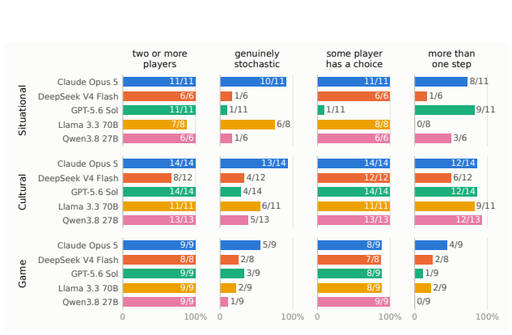
Figure 5 : Structural properties of Lane 1-valid world models generated by five LLMs across the situational, cultural, and game tracks.
出典 · CC BY 4.0 · Souhaila Djaffal, Amna Jamal, Gagana Madhugiri Devaraja, Anidipta Pal, Jobst Heitzig · Evaluating LLM-Generated World Models for Neuro-Symbolic Reasoning · 論文の図を引用 · 元のPDFの13ページ目から図の部分を抽出しています。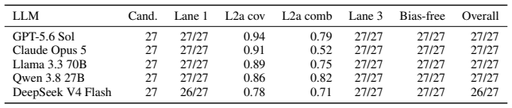
Table 8 : Game-track per-LLM aggregates (means over 9 cases × 3 runs; 27 candidates per LLM). Coverage stays near ceiling for all LLMs; combined F1 is the discriminating metric. Values are computed under the feature-multiset fallback backend; permutation-invariant matcher results for the same candidates appear in Tables 2 and 5.
出典 · CC BY 4.0 · Souhaila Djaffal, Amna Jamal, Gagana Madhugiri Devaraja, Anidipta Pal, Jobst Heitzig · Evaluating LLM-Generated World Models for Neuro-Symbolic Reasoning · 論文の図を引用 · 元のPDFの15ページ目から図の部分を抽出しています。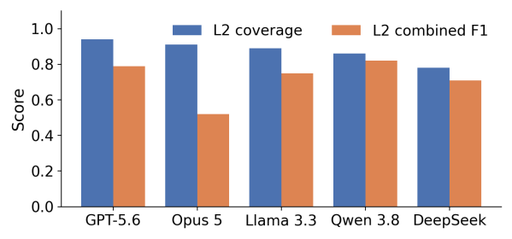
Figure 7 : Per-LLM Lane-2a coverage and combined F1 in the game track. Coverage remains near ceiling for every LLM, whereas combined F1 separates the LLMs, most visibly Claude Opus 5. Values are computed under the feature-multiset fallback backend; permutation-invariant matcher results for the same candidates appear in Tables 2 and 5.
出典 · CC BY 4.0 · Souhaila Djaffal, Amna Jamal, Gagana Madhugiri Devaraja, Anidipta Pal, Jobst Heitzig · Evaluating LLM-Generated World Models for Neuro-Symbolic Reasoning · 論文の図を引用 · 元のPDFの15ページ目から図の部分を抽出しています。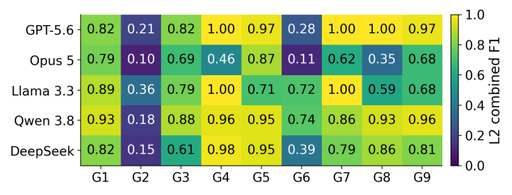
Figure 8 : Lane-2a combined F1 by LLM and case in the game track (see also Table 9). G2 and G6 depress every LLM simultaneously, suggesting reference properties that all candidates systematically miss rather than LLM-specific weaknesses. Values are computed under the feature-multiset fallback backend; permutation-invariant matcher results for the same candidates appear in Tables 2 and 5.
出典 · CC BY 4.0 · Souhaila Djaffal, Amna Jamal, Gagana Madhugiri Devaraja, Anidipta Pal, Jobst Heitzig · Evaluating LLM-Generated World Models for Neuro-Symbolic Reasoning · 論文の図を引用 · 元のPDFの16ページ目から図の部分を抽出しています。状況トラックと文化トラックの差
状況トラックでは、Lane 2aの平均F1は0.432です。この値は基準から導出した機能集合との一致を示すため、ゲームトラックのF1と直接比べることはしません。4つのLLMでは適合率が高くカバレッジが低く、期待される構造を欠く傾向が見られました。Claude Opus 5はカバレッジが最も高い一方、適合率が最も低い結果でした。文化トラックでは、国名を明示すると意味スコアは最大で−0.019変化しましたが、構造F1は4つのLLMで低下し、Qwen 3.8 27Bでは−0.144でした。この結果は、条件ごとに1つの標本しかないという前提のもとで解釈する必要があります。意味スコアだけでは、この構造の変化を見落とすおそれがあることも示しています。
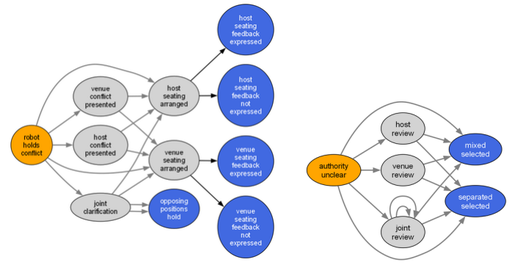
Figure 1 : Transition graphs of world models produced by two different LLMs (left: Qwen, right: GPT) given the same situational description (cultural test case C9 from our benchmark):“A hospitality robot at a private event venue in Riyadh is setting up seating for a corporate dinner. The host company has requested mixed-gender seating across tables. A member of the venue’s staff privately tells the robot that the venue has its own policy preferring gender-separated seating arrangements. ” See Section C.1 for a discussion of this case.
出典 · CC BY 4.0 · Souhaila Djaffal, Amna Jamal, Gagana Madhugiri Devaraja, Anidipta Pal, Jobst Heitzig · Evaluating LLM-Generated World Models for Neuro-Symbolic Reasoning · 論文の図を引用 · 元のPDFの3ページ目から図の部分を抽出しています。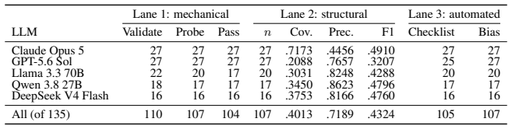
Table 4 : Situational S1–S9 results across all three evaluation lanes (27 first-pass candidates per LLM). Lane 1 reports mechanical validity, Lane 2a feature-multiset structural agreement for probe-passing candidates, and Lane 3 criterion-compliance checks; S10–S11 are excluded for a balanced subset.
出典 · CC BY 4.0 · Souhaila Djaffal, Amna Jamal, Gagana Madhugiri Devaraja, Anidipta Pal, Jobst Heitzig · Evaluating LLM-Generated World Models for Neuro-Symbolic Reasoning · 論文の図を引用 · 元のPDFの8ページ目から図の部分を抽出しています。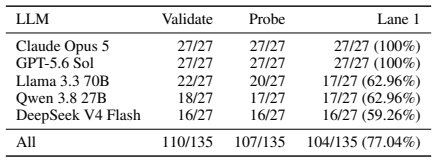
Table 10 : Situational S1–S9 first-pass mechanical funnel (three generations per LLM–case pair, 27 per LLM). “Probe” is the exhaustive sweep’s verdict; “Lane 1” is the gate used for the game and cultural tracks. Llama is the only LLM for which the probe and Lane 1 disagree. S10–S11 are excluded because Claude has two generations on S10 rather than three.
出典 · CC BY 4.0 · Souhaila Djaffal, Amna Jamal, Gagana Madhugiri Devaraja, Anidipta Pal, Jobst Heitzig · Evaluating LLM-Generated World Models for Neuro-Symbolic Reasoning · 論文の図を引用 · 元のPDFの16ページ目から図の部分を抽出しています。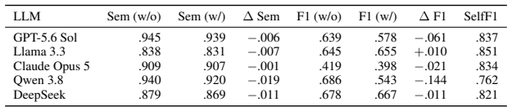
Table 12 : With-location versus anonymized location. ∆ values are with-location minus anonymized (positive = knowing the country helped). DeepSeek ran only with the country named; its anonymized figures are anchored to the other four LLMs’ mean location effect.
出典 · CC BY 4.0 · Souhaila Djaffal, Amna Jamal, Gagana Madhugiri Devaraja, Anidipta Pal, Jobst Heitzig · Evaluating LLM-Generated World Models for Neuro-Symbolic Reasoning · 論文の図を引用 · 元のPDFの18ページ目から図の部分を抽出しています。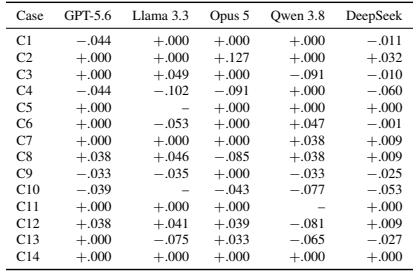
Table 13 : Per-case location deltas: semantic score with location minus without location. “–” marks cells with no parseable candidate in that condition. Effects concentrate on C4, C9, C10, and C13 rather than spreading uniformly.
出典 · CC BY 4.0 · Souhaila Djaffal, Amna Jamal, Gagana Madhugiri Devaraja, Anidipta Pal, Jobst Heitzig · Evaluating LLM-Generated World Models for Neuro-Symbolic Reasoning · 論文の図を引用 · 元のPDFの18ページ目から図の部分を抽出しています。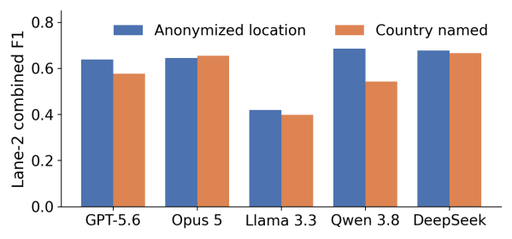
Figure 10 : Lane-2a combined F1 by LLM and prompt condition in the cultural track (see also Table 12). Naming the country lowers structural agreement for four of the five LLMs.
出典 · CC BY 4.0 · Souhaila Djaffal, Amna Jamal, Gagana Madhugiri Devaraja, Anidipta Pal, Jobst Heitzig · Evaluating LLM-Generated World Models for Neuro-Symbolic Reasoning · 論文の図を引用 · 元のPDFの19ページ目から図の部分を抽出しています。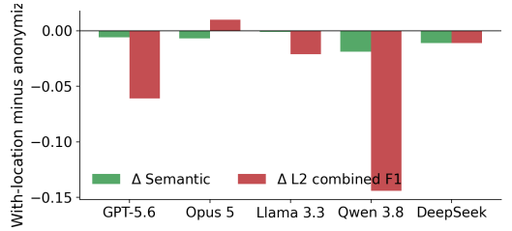
Figure 11 : Location effect per LLM in the cultural track: with-location minus anonymized semantic score and Lane-2a combined F1. Semantic effects are negligible, while the structural effect concen- trates on Qwen.
出典 · CC BY 4.0 · Souhaila Djaffal, Amna Jamal, Gagana Madhugiri Devaraja, Anidipta Pal, Jobst Heitzig · Evaluating LLM-Generated World Models for Neuro-Symbolic Reasoning · 論文の図を引用 · 元のPDFの20ページ目から図の部分を抽出しています。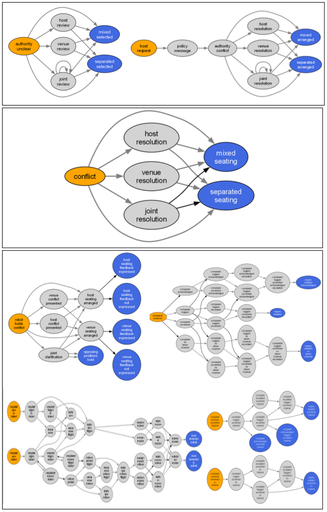
Figure 13 : C9 individual state graphs for the (model, location) pairs. Top box: GPT-5.6 under Saudi Arabia (left) vs No location (right). Middle box: Llama 3.3 under No location. Bottom box (clockwise from top-left) : Qwen 3.8 under Saudi Arabia, India, USA + Native American, and China (mixed religion).
出典 · CC BY 4.0 · Souhaila Djaffal, Amna Jamal, Gagana Madhugiri Devaraja, Anidipta Pal, Jobst Heitzig · Evaluating LLM-Generated World Models for Neuro-Symbolic Reasoning · 論文の図を引用 · 元のPDFの22ページ目から図の部分を抽出しています。適用範囲と残された検証
この結果は、小規模な手作業のベンチマークで得られた技術的な観察です。基準との比較は3段階の遷移の深さまでしか行わないため、それ以降の違いは評価できず、粒度の違いも有効な変形を減点するおそれがあります。また、意味評価とバイアス評価は、あらかじめ定めた基準をプログラムで点検した結果なので、診断的な性格を持ちます。人手によるアノテーションの手順は、まだ実行されていません。この論文では、生成された世界モデルが計画や方策の性能、到達可能性と可逆性の計算にどう影響するかは測定していません。
論文情報
- 著者
- Souhaila Djaffal, Amna Jamal, Gagana Madhugiri Devaraja, Anidipta Pal, Jobst Heitzig
- 学会・ジャーナル
- arXiv · プレプリント
- 公開日
- 2026年11月10日
- 登録日
- 2026年11月12日
- 更新日
- 2026年11月10日
- バージョン
- v1
- arXiv
- 2611.14419
- カテゴリ
- cs.AI
- ライセンス
- CC BY 4.0
- 掲載内容
- 論文情報・解説・論文の図
この解説は、Refivuの韓国語解説をAIで翻訳したものです。不正確な翻訳や誤りが含まれる可能性があります。論文と図の利用条件は各出典に従います。
アブストラクト
Formal world models can support planning, verification, and safety reasoning, but constructing them from open-ended natural-language situations is difficult, particularly in multi-agent settings where several formalizations may be plausible. We study whether five LLMs can generate such world models as partially observable stochastic games and whether mechanical validity is sufficient to establish that the resulting model faithfully represents the intended decision problem. We introduce a benchmark of 44 scenarios spanning game, situational, and cultural settings and evaluate generated world models along three dimensions: mechanical validity, reference-relative structural agreement, and semantic criteria. Across three empirical tracks, we analyze 410 first-pass generations. In the reference-backed game track, 134/135 generated world models pass a strict mechanical audit, yet mean permutation-invariant structural F1 is only 0.366, with just 28/134 mechanically valid models exactly matching the authored reference. In the cultural track, explicitly naming the country changes the generated structural representation for most LLMs while producing only small changes in automated semantic scores. These results show that executability is a necessary but insufficient criterion for LLM-generated world models: models that are mechanically valid can still differ substantially in the structure used by downstream neuro-symbolic reasoning and planning.
この論文を引用
Souhaila Djaffal, Amna Jamal, Gagana Madhugiri Devaraja, Anidipta Pal, Jobst Heitzig (2026). Evaluating LLM-Generated World Models for Neuro-Symbolic Reasoning. arXiv:2611.14419v1. https://arxiv.org/abs/2611.14419v1
BibTeX
@misc{djaffal2026evaluating,
  title = {{Evaluating LLM-Generated World Models for Neuro-Symbolic Reasoning}},
  author = {Souhaila Djaffal and Amna Jamal and Gagana Madhugiri Devaraja and Anidipta Pal and Jobst Heitzig},
  year = {2026},
  eprint = {2611.14419},
  archivePrefix = {arXiv},
  url = {https://arxiv.org/abs/2611.14419v1}
}