論文解説
DailyWildfireCAN: A Dataset and Benchmark for Next-Day Wildfire Spread Prediction in Canada
DailyWildfireCAN:カナダの翌日の山火事延焼予測のためのデータセットおよびベンチマーク
- 課題 カナダの山火事について、翌日の延焼を高解像度で予測できるベンチマークが不足しています。
- 結果 U-TAEは3つのテスト分割すべてでAUC-PRが最も高く、単一時点の最良のベースラインを上回りました。ただし、難易度が上がるほど性能は下がります。
翌日の山火事延焼予測のデータの空白
カナダの山火事は、広大な北方林と気候変動により規模と頻度が大きくなっています。翌日に火災がどこまで広がるかの予測は、消防資源の配置や避難判断に直接使われます。既存の深層学習研究は、主に米国のデータセットに依存してきました。Next Day Wildfire Spreadは1km格子のMODIS活性火災マスクを予測対象とし、WildfireSpreadTSは375m格子ですが、目標は翌日のVIIRS活性火災マップです。本論文では、この空白を埋めるため、カナダ全域の90m格子で1日に新たに焼けた面積を予測するベンチマークを構築すると提示しています。
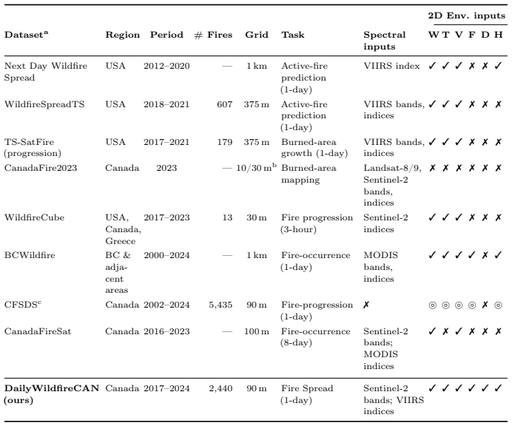
Table 1 : Comparison of DailyWildfireCAN with related wildfire datasets and benchmarks, discussed in Section 2, across geographic coverage, task, spatial grid size, satellite/spectral inputs, and 2D spatial environmental inputs: weather (W), terrain (T), vegetation/land cover (V) - including explicit greenness, fuel, or land-cover products, forest structure (F) - including stand metrics such as height, canopy closure, and biomass, forest disturbance history (D) - referring to land disturbances such as defoliation, wildfires, or harvesting over the past year, and human influence (H).
出典 · CC BY 4.0 · Mahacine Ettahri, Hager Radi Abdelwahed, Toluwaleke Olutayo, Daniel Aloise, Gaétan Marceau Caron · DailyWildfireCAN: A Dataset and Benchmark for Next-Day Wildfire Spread Prediction in Canada · 論文の図を引用 · 元のPDFの6ページ目から図の部分を抽出しています。ラベルの構成と入力特徴量
正解ラベルは、CFSDSの火災到達日付を90m格子にラスタ化して作ります。累積焼失マスクC_tでC_t(i,j)=0かつC_{t+1}(i,j)=1のピクセルだけを、翌日の延焼マスクY_{t+1}として示します。入力は、ASTER DEMから得た地形、ERA5-Land気象、VIIRS植生指数、SCANFI森林構造、CCRS土地被覆、CanLaD攪乱、人間影響指数、Sentinel-2バンドで構成されます。これに累積焼失マスクと正規化された火災到達時間マスクを補助チャンネルとして加えます。最終サンプルは256×256×50のテンソルです。1日の火災イベントを除き、入力が欠損しているサンプルを除外した結果、2,274件の活性火災イベントが残ります。
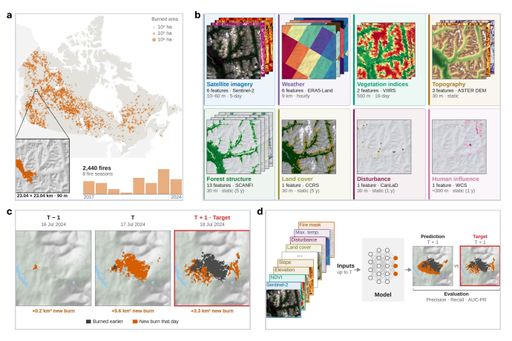
Figure 1 :DailyWildfireCAN Dataset and Benchmark. (a) Geographic coverage. Locations of the2,440wildfires (2017–2024), with marker size indicating total burned area. Bars show the number of fires per year. The inset shows one data sample with its burned area within a23.04 × 23.04km tile at90-m spatial grid.(b) Input features.The33input features for the example tile, grouped by data source. Each group indicates the number of features, source dataset, native spatial resolution and temporal frequency.(c) Daily Fire Progression.Evolution of an example fire from 16 to 18 July 2024. Dark grey indicates previously burned areas, while orange indicates newly burned areas on each day. The newly burned area on dayT + 1constitutes the prediction target.(d) Benchmark. Input features available up to dayT are used to predict the newly burned area on day T + 1. Predictions are evaluated against the observed target using precision, recall and area under the precision–recall curve (AUC-PR).
出典 · CC BY 4.0 · Mahacine Ettahri, Hager Radi Abdelwahed, Toluwaleke Olutayo, Daniel Aloise, Gaétan Marceau Caron · DailyWildfireCAN: A Dataset and Benchmark for Next-Day Wildfire Spread Prediction in Canada · 論文の図を引用 · 元のPDFの4ページ目から図の部分を抽出しています。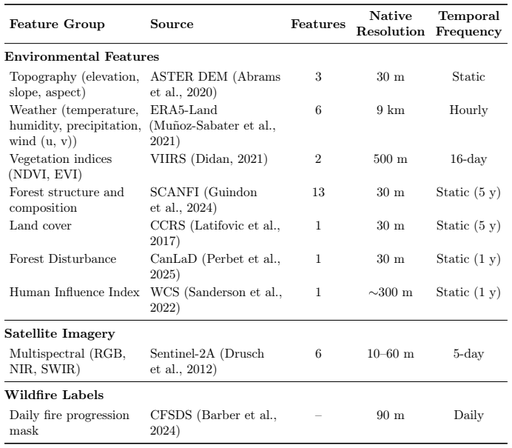
Table 2 : Summary of input features and wildfire labels used in DailyWildfireCAN, including their sources, feature counts, native spatial resolutions, and temporal frequencies. All inputs are harmonized to a common 90 m spatial grid in DailyWildfireCAN.
出典 · CC BY 4.0 · Mahacine Ettahri, Hager Radi Abdelwahed, Toluwaleke Olutayo, Daniel Aloise, Gaétan Marceau Caron · DailyWildfireCAN: A Dataset and Benchmark for Next-Day Wildfire Spread Prediction in Canada · 論文の図を引用 · 元のPDFの11ページ目から図の部分を抽出しています。空間・時間による分割設計
研究では10個の空間クラスタを作り、2024年を未観測の年として保留します。西側と東側のクラスタをそれぞれ1つずつテスト地域に固定し、保留クラスタから50km以内のイベントは学習と検証から除外します。残りの8クラスタは、年ごとに1つを検証に使う形で分けられます。この設計では、Test-Easyは学習地域内の2024年のイベント、Test-Mediumは保留空間クラスタの2017–2023年のイベント、Test-Hardは保留クラスタの2024年のイベントとして定義されます。
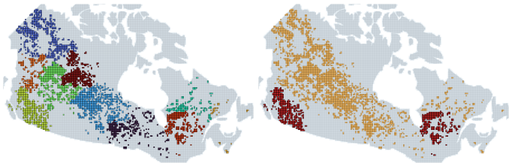
Figure 2 : Spatial distribution of DailyWildfireCAN events: (a) spatial clusters across Canada and (b) training clusters (yellow) and held-out test clusters (red).
出典 · CC BY 4.0 · Mahacine Ettahri, Hager Radi Abdelwahed, Toluwaleke Olutayo, Daniel Aloise, Gaétan Marceau Caron · DailyWildfireCAN: A Dataset and Benchmark for Next-Day Wildfire Spread Prediction in Canada · 論文の図を引用 · 元のPDFの16ページ目から図の部分を抽出しています。単一時点モデルと複数時点モデル
単一時点のベースラインとしては、U-Net、時間間隔の埋め込みを加えたU-Net with Time-Gap Encoding、Attention U-Net、Swin-U-Net、U-Mamba、OlmoEarth、DINOv3などを評価します。OlmoEarthとDINOv3は、凍結された特徴抽出器でSentinel-2バンドの埋め込みを作り、残りの入力はU-Netのエンコーダが処理して、ボトルネックで結合されます。複数時点のモデルは3日間の観測ウィンドウを使い、代表例はConvLSTMを組み合わせたU-Netと、時間注意機構を使うU-TAEです。学習損失は、焦点損失とDice損失をそれぞれ0.5の重みで合わせたものです。
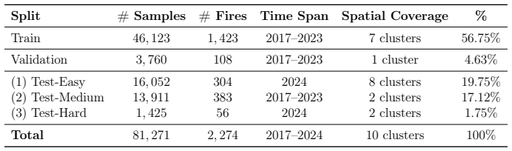
Table 3 : Dataset statistics for DailyWildfireCAN: Mono-Temporal.
出典 · CC BY 4.0 · Mahacine Ettahri, Hager Radi Abdelwahed, Toluwaleke Olutayo, Daniel Aloise, Gaétan Marceau Caron · DailyWildfireCAN: A Dataset and Benchmark for Next-Day Wildfire Spread Prediction in Canada · 論文の図を引用 · 元のPDFの17ページ目から図の部分を抽出しています。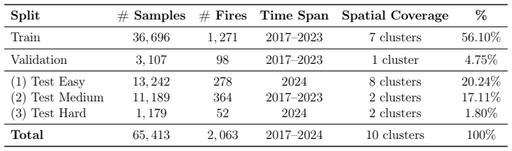
Table 4 : Dataset statistics for DailyWildfireCAN: Multi-Temporal (3-day Timeseries).
出典 · CC BY 4.0 · Mahacine Ettahri, Hager Radi Abdelwahed, Toluwaleke Olutayo, Daniel Aloise, Gaétan Marceau Caron · DailyWildfireCAN: A Dataset and Benchmark for Next-Day Wildfire Spread Prediction in Canada · 論文の図を引用 · 元のPDFの18ページ目から図の部分を抽出しています。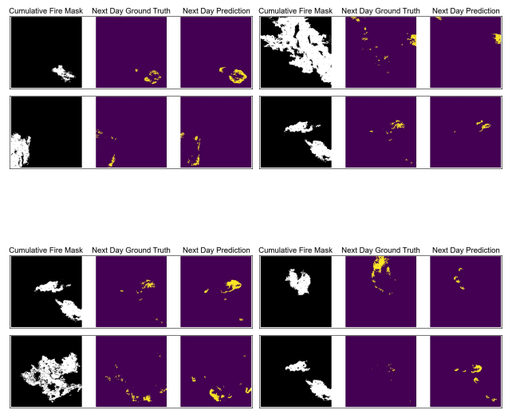
Figure 3 : Qualitative examples of next-day wildfire spread predictions for our two best models: (a) Mono-temporal: U-Net with Time-Gap Encoding and (b) Multi-Temporal: UTAE.
出典 · CC BY 4.0 · Mahacine Ettahri, Hager Radi Abdelwahed, Toluwaleke Olutayo, Daniel Aloise, Gaétan Marceau Caron · DailyWildfireCAN: A Dataset and Benchmark for Next-Day Wildfire Spread Prediction in Canada · 論文の図を引用 · 元のPDFの25ページ目から図の部分を抽出しています。テスト分割ごとのベンチマーク結果
3つの分割すべてで、難易度が上がるほど性能は下がります。この数値はシード平均に基づくもので、指標の比較は表の同じテスト分割の中で行うべきです。
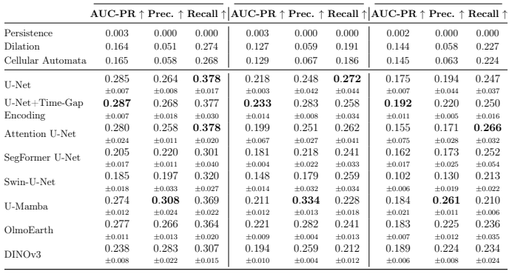
Table 5 :Mono-temporalbenchmark results for next-day wildfire spread prediction on DailyWildfireCAN. Performance metrics are reported as mean± standard deviation across three random seeds. The best mean performance for each metric within each test set is highlighted in bold.
出典 · CC BY 4.0 · Mahacine Ettahri, Hager Radi Abdelwahed, Toluwaleke Olutayo, Daniel Aloise, Gaétan Marceau Caron · DailyWildfireCAN: A Dataset and Benchmark for Next-Day Wildfire Spread Prediction in Canada · 論文の図を引用 · 元のPDFの22ページ目から図の部分を抽出しています。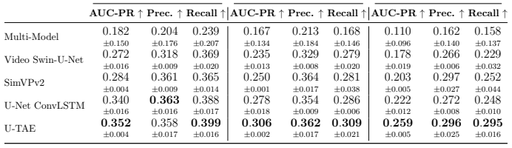
Table 6 :Multi-temporalbenchmark results for next-day wildfire spread prediction on DailyWildfireCAN. Performance metrics are reported as mean± standard deviation across three random seeds. The best mean performance for each metric within each test set is highlighted in bold. Models are ranked in ascending order of AUC-PR (worst to best).
出典 · CC BY 4.0 · Mahacine Ettahri, Hager Radi Abdelwahed, Toluwaleke Olutayo, Daniel Aloise, Gaétan Marceau Caron · DailyWildfireCAN: A Dataset and Benchmark for Next-Day Wildfire Spread Prediction in Canada · 論文の図を引用 · 元のPDFの24ページ目から図の部分を抽出しています。適用範囲と限界
論文は、性能がTest-EasyからTest-Hardへ向かうほど下がる点を限界として挙げています。また、データセットにはすでに活性化した火災のみが含まれ、発火予測のための負例は含まれません。消火活動や防火帯などの運用要因は、明示的にモデル化されていません。
論文情報
- 著者
- Mahacine Ettahri, Hager Radi Abdelwahed, Toluwaleke Olutayo, Daniel Aloise, Gaétan Marceau Caron
- 学会・ジャーナル
- arXiv · プレプリント
- 公開日
- 2026年11月10日
- 登録日
- 2026年11月12日
- 更新日
- 2026年11月10日
- バージョン
- v1
- arXiv
- 2611.14207
- カテゴリ
- cs.CV
- ライセンス
- CC BY 4.0
- 掲載内容
- 論文情報・解説・論文の図
この解説は、Refivuの韓国語解説をAIで翻訳したものです。不正確な翻訳や誤りが含まれる可能性があります。論文と図の利用条件は各出典に従います。
アブストラクト
Wildfires represent a critical ecological and socio-economic challenge in Canada, where vast boreal forests and a warming climate have amplified the frequency and severity of extreme fire seasons. Predicting next-day wildfire spread can support fire management, but requires capturing complex interactions among weather, fuels, and terrain. Deep learning has emerged as a promising approach to learning these relationships from heterogeneous environmental data, yet its development and evaluation depend on representative datasets. Existing deep learning research on wildfire spread relies predominantly on US-focused datasets, leaving Canadian fire environments underrepresented. To address this gap, we present DailyWildfireCAN, a multi-modal, multi-temporal dataset and benchmark for predicting next-day wildfire spread across Canada. The dataset tracks continuous fire progression over multi-day events at a high spatial and temporal resolution of 90-m and 24-hour, respectively. This resolution preserves fine-scale information relevant to fire-edge geometry, local fuel variations, and terrain effects, supporting research toward improved daily wildfire spread forecasting. DailyWildfireCAN covers 2,440 wildfire events across eight fire seasons 2017-2024 and integrates 33 features across diverse modalities, including topography, meteorology, land cover, vegetation and forest structure, human influence indices, and satellite imagery. We establish a comprehensive benchmark comparing mono-temporal and multi-temporal prediction models, accompanied by a multi-dimensional evaluation framework assessing robustness across wildfire characteristics, geographic regions, and temporal conditions, spatial prediction quality, and sensitivity to reference label variations.
この論文を引用
Mahacine Ettahri, Hager Radi Abdelwahed, Toluwaleke Olutayo, Daniel Aloise, Gaétan Marceau Caron (2026). DailyWildfireCAN: A Dataset and Benchmark for Next-Day Wildfire Spread Prediction in Canada. arXiv:2611.14207v1. https://arxiv.org/abs/2611.14207v1
BibTeX
@misc{ettahri2026dailywildfirecan,
  title = {{DailyWildfireCAN: A Dataset and Benchmark for Next-Day Wildfire Spread Prediction in Canada}},
  author = {Mahacine Ettahri and Hager Radi Abdelwahed and Toluwaleke Olutayo and Daniel Aloise and Gaétan Marceau Caron},
  year = {2026},
  eprint = {2611.14207},
  archivePrefix = {arXiv},
  url = {https://arxiv.org/abs/2611.14207v1}
}