論文解説
Text Is Just Another Shot in Vision-Language Models: Simple Probes on Frozen Encoders Do It
クラス名を学習データとして加える凸回帰で少数ショット分類を強くする
- 課題 少数の画像でCLIPを適応させる手法は、テキストによる分類器を基点にしてきました。しかし、視覚特徴が変わるとテキストをどれだけ重く扱うかは、十分に問われてきませんでした。
- 手法 TASPは、クラス名の埋め込みを学習サンプルとして損失に加え、同時にゼロショットの重みを正則化の中心に置く凸ロジスティック回帰です。
- 結果 凍結したPE-Core-Lの特徴を使うと、標準の複数データセットの平均精度が16ショットで91.4%になり、既存の少数ショット手法を上回りました。
テキスト基点の適応とその限界
少数ラベルでCLIPを適応させる研究は、ゼロショット分類器を出発点にする手法が中心になっています。プロンプト学習やアダプタ、キャッシュ、線形プローブの正則化など手法は多様ですが、テキストを基点に画像で補正するという一つの原則を共有しています。この原則はCLIPに対しては筋が通っています。CLIPの報告では、ゼロショット分類器が4ショットの線形プローブと同等で、1枚か2枚の画像を加えると精度が下がることがあるとされています。
ただしこれはCLIPという一つのエンコーダについての話で、その画像特徴は細かい構造や空間的な情報を捉えきれていないと指摘されています。一方、DINOv2やDINOv3のような自己教師ありエンコーダは、クラスをはるかにはっきり分けますが、テキストのヘッドを持たないか、弱いものしか持ちません。そのため、視覚表現が変わったときにテキストをどれだけ重く扱うべきかが問題になります。
クラス名をκ枚の画像とみなす
本研究の中心的な考え方は、クラス名の価値を、ラベル付きの画像何枚分に相当するかという尺度で測ることです。ガウス型の簡単な生成モデルを置くと、クラス名は κ=σ²/τ² 枚の追加画像と正確に等しくなります。σ² はクラス内の視覚的なばらつき、τ² はクラス名と画像のずれです。視覚的なばらつきσ²が大きい、つまりクラスをうまく分けられない視覚エンコーダほど、テキストは多くの枚数分の価値を持ちます。
事後平均は、支援画像の平均と、κ個分の重みを持つクラス名の埋め込みを加重平均したものになります。式で書くと \( \hat m_c = \frac{n\bar x_c + \kappa t_c}{n+\kappa} \) です。ここで \(\bar x_c\) は支援画像の平均、\(t_c\) はクラス名の埋め込み、\(n\) は支援画像の枚数です。n=0ならテキストだけになりゼロショット分類器に一致し、nがκに比べて大きければ視覚データだけの線形プローブに近づきます。テキストの寄与割合 κ/(n+κ) は、nが増えるにつれて1/nの速さで減ります。
検証データで最適化したκは、CLIPで4、PE-Core-Lで8と報告されています。著者らは、この式がテキストを学習サンプルとしても事前分布としても読めるため、重要なのは機構よりもテキストに割り当てる重みだと主張しています。
TASPの損失と最適化
TASPは多項ロジスティック回帰で、各クラスのクラス名をw個分の追加サンプルとして損失に加え、同時にゼロショット重みへの正則化の中心にします。支援画像の損失は、拡張した複数の視点の損失を平均してから加えます。そのため、拡張の数によって画像の重みが変わらないようにしています。目的関数は、クラスごとの画像とテキストの損失の重み付き和を C(n+w) で割ったものに、λ0/(2n) で重み付けした \( \|W-W_0\|_F^2 \) を足したものです。W0は s[t1,…,tC] で、sはロジットの倍率です。
λ0>0のとき目的関数はWについて厳密に凸で、全バッチのL-BFGSで数値的な最適解まで解きます。学習率の調整や早期停止は使いません。調整するのは w と λ0 の二つだけで、どちらもデータセットとショット数の間で共有されます。w=0、λ0=0とすると通常の線形プローブになり、w=nとλ0=0にすると画像とテキストの損失を等しく扱うクロスモーダル適応になります。
最小二乗損失に置き換えた閉形式版をTASCと呼びます。同じ w と λ0 の使い方で、解は W=(A+µI)^{-1}(B+µW0) の線形解法で求まります。TASCはPE-Core-Lで、TASPより1ショットで1.8ポイント、16ショットで1.3ポイント低くなります。視覚言語モデルと自己教師ありエンコーダを併用する場合、画像特徴は両者を連結した x=[f_VLM; f_SSL] になり、クラス名はVLM側のブロックだけに置かれます。少数の画像しかない段階では整列されたブロックが決定を担い、nが増えると視覚の尤度が効いて、クラスをよく分けるブロックの影響が強まります。
11データセットでの既存手法との比較
標準の11データセットベンチマークで、PE-Core-L特徴のTASPは、1ショットで87.1%、16ショットで91.4%の平均精度になりました。ViT-Bサイズのエンコーダでも、差は2.4から7.1ポイントあります。
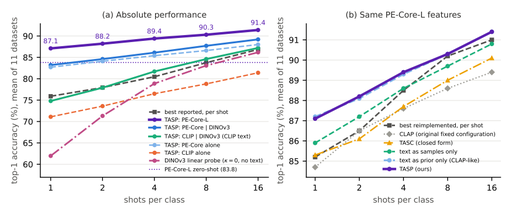
Figure 1 .Strong features explain the absolute gains; the probe remains competitive under controlled features.(a) Mean accuracy over the 11 datasets of the few-shot benchmark. Black dashed: the best reported value at each shot count among the 86 method and baseline curves reporting all 11 datasets with CLIP ViT-B/16, including arXiv preprints and methods using LLM-generated text. Coloured: TASP, a single logistic regression on frozen features in which each class name is one more training sample, with one hyper-parameter configuration per feature set for all datasets and shot counts, selected without ImageNet; pink dash-dot: DINOv3 linear probe without text (κ= 0); dotted purple: zero-shot classifier of PE-Core-L. (b) Controlled comparison on identical frozen PE-Core-L features, splits and model-selection protocol (11 datasets; ImageNet excluded from model selection): TASP, its samples-only, prior-only and closed-form variants, CLAP with its originally reported configuration, and the best reimplemented prior method at each shot count. We use the same splits, seeds and shots as the literature. ImageNet is included in evaluation but never used for hyperparameter selection (Sec. 4). Full controlled results: Tab. 2.
出典 · CC BY 4.0 · Reda Bensaid, Ismail Ben Ayed, François Leduc-Primeau, Vincent Gripon · Text Is Just Another Shot in Vision-Language Models: Simple Probes on Frozen Encoders Do It · 論文の図を引用 · 元のPDFの2ページ目から図の部分を抽出しています。ただし、この大きな差の多くはエンコーダの強さによるもので、論文でも主要な結論として扱われています。PE-Core-L単体のゼロショット分類器は83.8%で、8ショットまでは既存の最良値と同程度の水準です。そこにTASPが加える効果は、1ショットで+3.3ポイント、16ショットで+7.6ポイントです。
CLIP自身の上では、TASPは71.1%と81.4%で、強い線形プローブではあるものの、弱い視覚特徴に合わせて設計された既存の最良CLIP手法を下回ります。同じCLIPのテキストにDINOv3を加えると、74.8%と87.2%となり、4ショット以上では既存のCLIP手法を上回りました。つまり、この結果では、TASPの計算手順よりも特徴の強さが最終精度を大きく左右していると読めます。
同一特徴での既存手法との比較
既存手法を同じPE-Core-L特徴、同じ分割、同じモデル選択の手順で再実装し、比べました。CLAPは元の固定設定で使うと、TASPより1.7から2.4ポイント低く、1ショットで84.7%、16ショットで89.4%となりました。一方、CLAPと同じ考えを本研究と同じ手順で正則化の強さだけ選び直したテキスト事前分布のみの版は、TASPと十分の数ポイント以内の差に収まります。
事前分布として使う版がTASPにほぼ並ぶことから、差を生むのはテキストの扱いの形式より、テキストの重みの取り方だと解釈できます。キャッシュや残差で零点ロジットに固定する設計は、ショットが増えるにつれて差が広がります。
視覚言語モデルと自己教師あり特徴の併用
併用の効果は、視覚言語モデル単体の強さに依存します。16ショットでDINOv3を加えると、CLIPは80.6%から87.1%、SigLIPは85.0%から88.3%に向上します。一方、PE-Coreは87.0%から88.9%にとどまり、単体が強いモデルほど追加の効果は小さくなります。16ショットでのDINOv3の寄与は、CLIPで+6.5ポイント、PE-Core-Lでは+0.6ポイントにとどまりました。
統合は推論時のコストも増やします。統合特徴の処理速度は一つのViT-Bのおよそ半分になり、PE-Core-L 336pxは両方より高コストです。
テキストの重みとκの推定
PE-Core-Lで、テキストを学習サンプルとして使う重みwと、事前分布の強さλ0を変えると、検証精度は0.2ポイント以内で一定の尾根を描きます。つまり、テキストを事前分布にするか学習サンプルにするかは、重みが等しければ同じ推定量になるという命題の予測と整合します。ただし、テキストを学習サンプルだけで使う場合、つまり事前分布の強さを0にした場合は、1ショットでTASPより低くなります。
ShareLockヘッドを持つDINOv2-Lでは、κが1と推定され、テキストは約1枚分の価値しかないと読めます。κは支援画像から推定でき、検証なしでも推定κは画像のみより改善します。CLIPでは、画像のみで67.9%、推定κで70.9%、検証で最適化したκで73.8%です。ただし、CLIPのモダリティギャップにより推定のτ²が膨らみ、κは下方向に偏ると論文は述べています。
周波数を制限した分析では、高周波だけを残すとDINOv3は元の精度の65%、CLIPは49%を保持しました。この違いは、DINOv3がFGVC-AircraftやEuroSATなど細かい視覚情報に依存するデータセットで効く理由の一つとして挙げられています。
分布シフトと新規クラスでの評価
ImageNetで16ショット学習したモデルを変更せずに、4つの分布シフト先で評価すると、PE-Core-LのTASPは平均82.8%で、最良のCLIP系手法の61.6%を上回ります。ただし、SSL特徴を加えたPE-Core-L∥DINOv3は81.8%に下がり、強い視覚言語特徴の方が分布シフトに強いと読めます。
ベース・ツー・ノベルの設定では、基底クラスだけで16ショットを学習し、新規クラスはゼロショット分類器で予測します。PE-Core-Lの調和平均は90.8%で、追加データなしの既存最良の82.7%と、追加データを使う最良の84.4%を上回ります。この差の大半はPE-Core-Lの新規クラスでのゼロショット精度88.9%によるもので、TASP自体はテキストヘッドを調整しません。PE-CoreではPromptSRCが調和平均88.2%で、TASPの87.8%を上回り、テキストヘッドを適応させる手法が有利になる場合があります。
ファインチューニングを伴うCLIP-LoRAとの比較では、CLIP単体ではCLIP-LoRAが0.7から2.0ポイント上回ります。費用面では、事前抽出した特徴の上でTASPは1データセットあたり0.1秒、CLIP-LoRAは16ショットで中央値45分と報告されています。
限界
TASPは完全な学習不要の手法ではなく、凸問題を反復的に解きます。ただし収束は数秒で、学習率やエポックのスケジュールは要りません。視覚言語モデルが強い場合、SSLの併用の効果は小さく、PE-Core-Lでは16ショットで+0.6ポイントにとどまります。統合は推論速度を約半分に下げるため、効果と費用を比べて選ぶ必要があります。
κの推定は、CLIPのモダリティギャップの影響を受けるため、推定値がすべての視覚言語モデルで正確とは言えません。新規クラスでは、TASPは画像を使わずゼロショット分類器だけを使うため、テキストヘッドを適応させる手法が上回るケースがあります。
既存手法の数値は元論文の報告を転記したもので、多くはCLIP ViT-B/16向けにデータセットごとに調整されています。そのため、著者らは既存手法に有利な比較になっていると考えています。
論文情報
- 著者
- Reda Bensaid, Ismail Ben Ayed, François Leduc-Primeau, Vincent Gripon
- 学会・ジャーナル
- arXiv · プレプリント
- 公開日
- 2026年11月24日
- 登録日
- 2026年11月25日
- 更新日
- 2026年11月24日
- バージョン
- v1
- arXiv
- 2611.32672
- カテゴリ
- cs.CV
- ライセンス
- CC BY 4.0
- 掲載内容
- 論文情報・解説・論文の図
この解説は、Refivuの韓国語解説をAIで翻訳したものです。不正確な翻訳や誤りが含まれる可能性があります。論文と図の利用条件は各出典に従います。
アブストラクト
Few-shot adaptation of vision-language models has produced increasingly elaborate methods built on CLIP and on one shared principle: the zero-shot text classifier is the anchor, and labeled images only correct it. We argue that this principle reflects CLIP's visual features rather than a property of the task. We provide a simple Bayesian interpretation, in which a class name is worth exactly kappa = sigma^2 / tau^2 labeled images, the ratio between the visual spread of a class and the misalignment of its name. The Bayes classifier of this model counts text as kappa more samples. With modern frozen encoders, few-shot adaptation then reduces to a well-regularised convex probe. Specifically, we introduce TASP, a simple convex logistic regression on frozen features that incorporates class-name embeddings as weighted training examples and as a regularization prior. On the standard 11-dataset benchmark, TASP with frozen PE-Core-L features achieves 87.1% accuracy at 1 shot and 91.4% at 16 shots, outperforming state-of-the-art few-shot vision-language adaptation methods by 4.6 to 11.0 percentage points. While stronger representations explain much of this improvement, controlled comparisons on matched features show that existing frozen-encoder adaptation methods do not materially improve on this probe. We further find that the weight assigned to text matters more than how it is incorporated, and that combining self-supervised visual features with vision-language representations is most beneficial for weaker visual encoders. Together, these findings suggest that progress in few-shot vision-language adaptation depends more on representation quality and the appropriate use of text supervision than on increasingly complex adaptation mechanisms.
論文の図
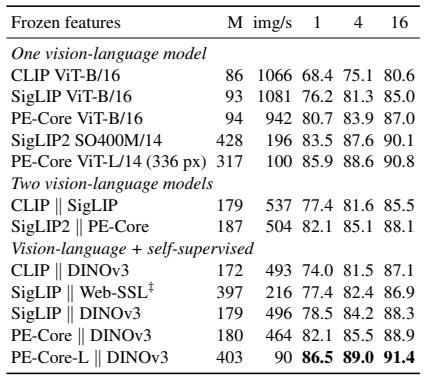
Table 3 .What the union needs(mean over all 11 datasets; the text-as-samples variant of TASP, rather than the full TASP used in Tab. 1; one configuration per row, selected without ImageNet). M: vision parameters (millions); img/s: measured encoding through- put on one RTX 4070, fp16 (a union costs the sum of its encoders). ‡Web-SSL DINO is trained on MetaCLIP’s own images (MC-2B) without retrieval around benchmark images. Other feature sets: Tab. 10. Bold: best in each column.
出典 · CC BY 4.0 · Reda Bensaid, Ismail Ben Ayed, François Leduc-Primeau, Vincent Gripon · Text Is Just Another Shot in Vision-Language Models: Simple Probes on Frozen Encoders Do It · 論文の図を引用 · 元のPDFの7ページ目から図の部分を抽出しています。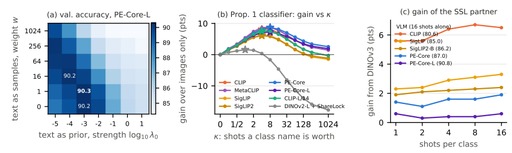
Figure 2 .The weight of the text, not its mechanism.(a) Validation accuracy of TASP on PE-Core-L (10 datasets, all shot counts) over the text weightw(text as samples) and the strengthλ 0 of the text-centred prior: a ridge of equal accuracy runs from “prior only” to “samples only”. (b) Gain of the Bayes classifier of Proposition 1 (posterior class means) over images only, as a function ofκ; stars mark the optimum. A class name is worth about 4–8 images with contrastive vision-language models and about one with the lightweight ShareLock head. (c) Gain brought by DINOv3 to the text-as-samples probe on each vision-language model (11 datasets; in parentheses, TASP on the model alone at 16 shots): the stronger the model alone, the less the partner adds.
出典 · CC BY 4.0 · Reda Bensaid, Ismail Ben Ayed, François Leduc-Primeau, Vincent Gripon · Text Is Just Another Shot in Vision-Language Models: Simple Probes on Frozen Encoders Do It · 論文の図を引用 · 元のPDFの8ページ目から図の部分を抽出しています。
Table 6 .Cost of the three families of methods(PE-Core, 16 shots, one RTX 4070; median and range over the 10 non-ImageNet datasets; TASP on PE-Core∥DINOv3, after caching the features).
出典 · CC BY 4.0 · Reda Bensaid, Ismail Ben Ayed, François Leduc-Primeau, Vincent Gripon · Text Is Just Another Shot in Vision-Language Models: Simple Probes on Frozen Encoders Do It · 論文の図を引用 · 元のPDFの13ページ目から図の部分を抽出しています。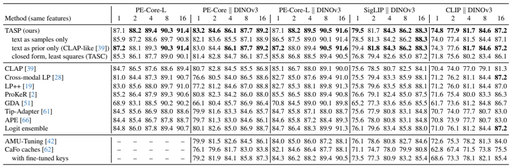
Table 9 . Prior methods on exactly our features, all shot counts (11 datasets; configurations selected on the 10 datasets other than ImageNet). Bold: best (ties included).
出典 · CC BY 4.0 · Reda Bensaid, Ismail Ben Ayed, François Leduc-Primeau, Vincent Gripon · Text Is Just Another Shot in Vision-Language Models: Simple Probes on Frozen Encoders Do It · 論文の図を引用 · 元のPDFの15ページ目から図の部分を抽出しています。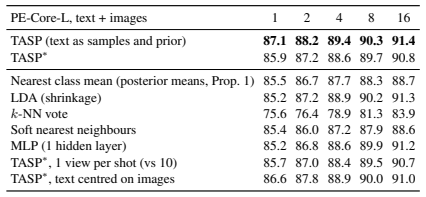
Table 10 . All feature sets, all shot counts (11 datasets; configu- rations selected globally on the 10 datasets other than ImageNet; text as samples). ‡ Web-SSL DINO is trained on MetaCLIP’s im- ages without retrieval curation. § self-supervised on ImageNet-1k only. Bold: best in each column.
出典 · CC BY 4.0 · Reda Bensaid, Ismail Ben Ayed, François Leduc-Primeau, Vincent Gripon · Text Is Just Another Shot in Vision-Language Models: Simple Probes on Frozen Encoders Do It · 論文の図を引用 · 元のPDFの16ページ目から図の部分を抽出しています。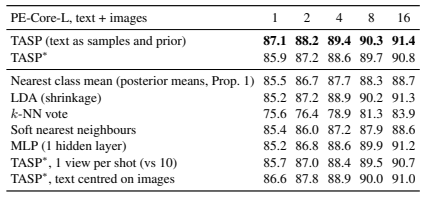
Table 11 . Other classifiers on the union of text and images, and two ablations (11 datasets; configurations selected globally on the 10 datasets other than ImageNet). ∗ text as samples only. Bold: best in each column.
出典 · CC BY 4.0 · Reda Bensaid, Ismail Ben Ayed, François Leduc-Primeau, Vincent Gripon · Text Is Just Another Shot in Vision-Language Models: Simple Probes on Frozen Encoders Do It · 論文の図を引用 · 元のPDFの16ページ目から図の部分を抽出しています。この論文を引用
Reda Bensaid, Ismail Ben Ayed, François Leduc-Primeau, Vincent Gripon (2026). Text Is Just Another Shot in Vision-Language Models: Simple Probes on Frozen Encoders Do It. arXiv:2611.32672v1. https://arxiv.org/abs/2611.32672v1
BibTeX
@misc{bensaid2026text,
  title = {{Text Is Just Another Shot in Vision-Language Models: Simple Probes on Frozen Encoders Do It}},
  author = {Reda Bensaid and Ismail Ben Ayed and François Leduc-Primeau and Vincent Gripon},
  year = {2026},
  eprint = {2611.32672},
  archivePrefix = {arXiv},
  url = {https://arxiv.org/abs/2611.32672v1}
}