論文解説
Understanding Mixture-of-Experts Language Models Beyond Expert Boundaries
専門家の境界を超えて理解するMixture-of-Expertsの言語モデル
- 課題 MoEモデルで専門家がドメインに特化しているかについては相反する主張があり、この論文はニューロンレベルでドメイン特化の計算がどのように組織されるかを調べます。
- 手法 RAMPで専門家-ニューロン座標のドメイン別重要度を計算し、それらを組み合わせて複数の専門家にまたがる共有ニューロン集合を選ぶRAMPr枝刈りを提案しています。
- 結果 ドメイン特化ニューロン集合は同じドメイン内でより多く重なります。75%のニューロンを維持すると平均性能の91.12–97.63%を保ち、50%維持ではメモリを36–43%削減します。
専門家の境界を越えて見る理由
MoE言語モデルで専門家がドメインに特化しているかは、議論のある問題です。一部の研究はドメインと関係する専門家の選好を報告していますが、別の研究はルーティングが主にトークンの同一性や構文パターンによって決まると分析しています。この論文は、この2つの立場の違いを専門家レベルではなくニューロンレベルで調べます。専門家単位で見るとドメイン特化は見えないかもしれませんが、ニューロン単位ではドメインによって選ばれるニューロン集合が変わるかを確認できる、というのが出発点です。
RAMPによる重要度の計算
著者らはRAMP(Routing-Aware Magnitude Profiling)を導入します。ニューロンの活性化の大きさだけでは寄与の大きさを十分に表せないため、出力射影列のノルムと専門家のルーティング重みを合わせて考慮します。専門家eのニューロンiについて、トークンtのルーティング重み付き活性化p_e(t)a_e,i(t)をドメインのテキスト全体で二乗して累積し、平方根を取ってから出力射影列ノルムを掛けます。こうして得たスコアをドメインごとの重要度として使い、各ドメインで上位r割合の専門家-ニューロン座標を選んで、ドメイン特化ニューロン集合を作ります。
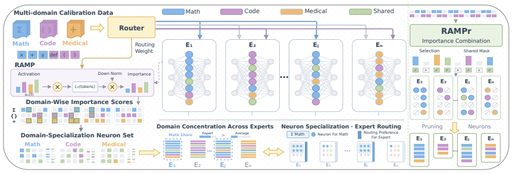
Figure 1 .Routing-weighted activation magnitudes and output projection norms quantify domain-wise neuron importance, revealing domain-specialized sets that span mixed experts. Their enrichment correlates with domain routing preferences. Aggregating these important scores guides multi-domain neuron pruning across experts, retaining different numbers of neurons in each expert.
出典 · CC BY 4.0 · Zhenhong Zhou, Mao Zheng, Mingyang Song, Qiankun Li, Kun Wang, Junfeng Fang · Understanding Mixture-of-Experts Language Models Beyond Expert Boundaries · 論文の図を引用 · 元のPDFの2ページ目から図の部分を抽出しています。ドメイン内外のニューロン集合の重なり
ドメイン特化かどうかは、同じドメインの識別サンプルと検証サンプルから得たニューロン集合がどれだけ重なるか、また異なるドメインの集合がどれだけ重なるかで確認します。1%の選択では、RAMPの重なりは同一ドメイン内で50.79–68.07%、ドメイン間で8.47–12.64%でした。6.25%の選択では、同一ドメイン内で57.77–74.33%、ドメイン間で15.23–23.68%でした。同一ドメインの重なりは、モデルと予算の組み合わせ24個すべてで、ドメイン間の重なりより大きくなりました。この結果は、選ばれたニューロンが個々のテキストサンプルを超えてドメインと関係していることを示しています。
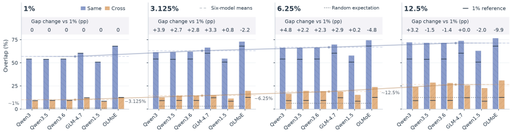
Figure 2 .Neuron-set overlap at four selection rates across six models. Blue and orange bars show same-domain and cross-domain overlap. Dashed lines and connected center points denote six-model means, while gray dotted lines mark random-set expectations. Dark ticks show each model’s overlap at 1% selection, and upper strips give the change in the same–cross gap relative to that setting, in percentage points.
出典 · CC BY 4.0 · Zhenhong Zhou, Mao Zheng, Mingyang Song, Qiankun Li, Kun Wang, Junfeng Fang · Understanding Mixture-of-Experts Language Models Beyond Expert Boundaries · 論文の図を引用 · 元のPDFの4ページ目から図の部分を抽出しています。重なり結果の適用範囲
著者らは、専門家レベルのルーティング選好とニューロンレベルの集合が同時に現れることを報告していますが、この結果がすべてのMoE構造やすべてのドメインで同じ大きさで現れるとまでは報告していません。また、ニューロン集合の重なりそのものは、ドメイン特化が因果的に必要であることを証明するものではなく、これについては別のアブレーション実験で扱っています。
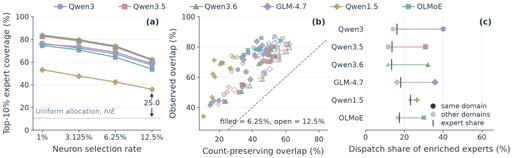
Figure 3 .(a) Share of each domain’s selected neurons held by the top ⌈0.1E⌉ experts, with the gray line marking uniform allocation and the arrow giving the gap in percentage points. (b) Observed overlap against the count-preserving expectation in Equation (5), with one marker per model, domain and selection rate, and the dashed line marking parity. (c) Validation dispatch share of each domain’s enriched experts, from the same domain in color and from other domains in gray, with black ticks marking their share of all experts.
出典 · CC BY 4.0 · Zhenhong Zhou, Mao Zheng, Mingyang Song, Qiankun Li, Kun Wang, Junfeng Fang · Understanding Mixture-of-Experts Language Models Beyond Expert Boundaries · 論文の図を引用 · 元のPDFの5ページ目から図の部分を抽出しています。RAMPrによる枝刈りの性能維持と効率
RAMPrは、複数のドメインで計算したRAMP重要度を組み合わせ、層ごとに1つの共有ニューロン集合を選ぶ枝刈り手法です。75%のニューロン維持条件では、RAMPr-Lは11個のタスクの平均性能の91.12–97.63%を保ちます。50%維持条件では、RAMPrはメモリを36–43%削減し、バッチprefill処理量を17–39%向上させます。この効率の数値は、バッチ32、入力2048トークン、固定ブロック幅128という測定条件で得られた値です。比較対象のREAPは専門家全体を取り除くため、この方式と同じ活性パラメータの削減は得られないと著者らは説明しています。
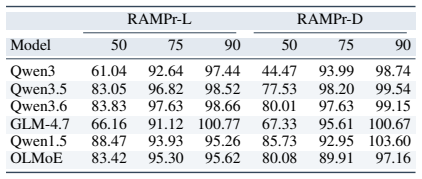
Table 2 .Mean performance retention (%) of RAMPr relative to the original model at 50%, 75% and 90% neuron retention.
出典 · CC BY 4.0 · Zhenhong Zhou, Mao Zheng, Mingyang Song, Qiankun Li, Kun Wang, Junfeng Fang · Understanding Mixture-of-Experts Language Models Beyond Expert Boundaries · 論文の図を引用 · 元のPDFの7ページ目から図の部分を抽出しています。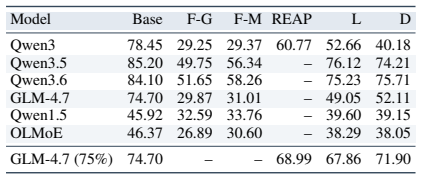
Table 3 .Raw-score 11-task macro-average against Fisher and REAP at 50% neuron retention, with GLM-4.7 also compared at 75%. F-G and F-M denote Fisher calibrated on GSM8K and MBPP, and REAP retains the same fraction of experts.
出典 · CC BY 4.0 · Zhenhong Zhou, Mao Zheng, Mingyang Song, Qiankun Li, Kun Wang, Junfeng Fang · Understanding Mixture-of-Experts Language Models Beyond Expert Boundaries · 論文の図を引用 · 元のPDFの7ページ目から図の部分を抽出しています。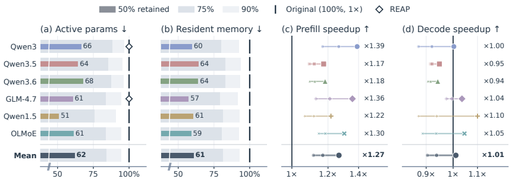
Figure 5 .RAMPr-L with fixed128 layout at batch 32 and 2048 input tokens, relative to the original model on the same GPU. The Mean row averages six models arithmetically in (a) and (b) and geometrically in (c) and (d). (a) Active parameters and (b) resident memory, with colored bars for 50% retention, gray bands for 75% and 90%, ticks at the original and diamonds for REAP. (c) Prefill and (d) decode speedups on log axes, with points from faint to solid for 90%, 75% and 50% retention and the original model at1×.
出典 · CC BY 4.0 · Zhenhong Zhou, Mao Zheng, Mingyang Song, Qiankun Li, Kun Wang, Junfeng Fang · Understanding Mixture-of-Experts Language Models Beyond Expert Boundaries · 論文の図を引用 · 元のPDFの8ページ目から図の部分を抽出しています。論文情報
- 著者
- Zhenhong Zhou, Mao Zheng, Mingyang Song, Qiankun Li, Kun Wang, Junfeng Fang
- 学会・ジャーナル
- arXiv · プレプリント
- 公開日
- 2026年11月10日
- 登録日
- 2026年11月11日
- 更新日
- 2026年11月10日
- バージョン
- v1
- arXiv
- 2611.13975
- カテゴリ
- cs.AI · cs.CL
- ライセンス
- CC BY 4.0
- 掲載内容
- 論文情報・解説・論文の図
この解説は、Refivuの韓国語解説をAIで翻訳したものです。不正確な翻訳や誤りが含まれる可能性があります。論文と図の利用条件は各出典に従います。
アブストラクト
In Mixture-of-Experts (MoE) models, the nature of expert specialization remains controversial. Reports of domain-associated expert preferences contrast with analyses attributing routing primarily to token identity or syntactic patterns. To clarify these differing accounts, we look beyond expert-level routing to investigate the neuron-level organization of domain-specialized computation using Routing-Aware Magnitude Profiling (RAMP), a measure developed for this analysis. Using mixed-domain calibration data, we identify domain-specialized neuron sets with 58-74% overlap across multi-source samples of the same domain, compared with 15-24% across domains. To understand how this organization evolves during training, we trace neuron importance throughout pre-training and post-training across three fully open MoE families. Neuron importance continues to reorganize between pre-training checkpoints despite comparatively stable expert-level importance rankings, while post-training largely preserves neuron rankings. Building on these neuron-level perspectives, we further introduce RAMP-based Pruning (RAMPr) to select neurons across experts for balanced multi-domain capability preservation. At 75% neuron retention, RAMPr preserves average 91-98% of original full performance across six models. At 50% retention, our pruning method can reduce resident GPU memory by 36-43% and improves batched prefill throughput by 17-39% effectively. Our code is available at https://github.com/ydyjya/Neuron-Level-Specialization-in-MoE
この論文を引用
Zhenhong Zhou, Mao Zheng, Mingyang Song, Qiankun Li, Kun Wang, Junfeng Fang (2026). Understanding Mixture-of-Experts Language Models Beyond Expert Boundaries. arXiv:2611.13975v1. https://arxiv.org/abs/2611.13975v1
BibTeX
@misc{zhou2026understanding,
  title = {{Understanding Mixture-of-Experts Language Models Beyond Expert Boundaries}},
  author = {Zhenhong Zhou and Mao Zheng and Mingyang Song and Qiankun Li and Kun Wang and Junfeng Fang},
  year = {2026},
  eprint = {2611.13975},
  archivePrefix = {arXiv},
  url = {https://arxiv.org/abs/2611.13975v1}
}