論文解説
A Functional Preservation Score for Auditing Connectome Operations: Compression, Alignment, Transport, and Local-Rule Writing
コネクトーム操作を監査するための機能保存スコア:圧縮、整列、転送、局所ルールの書き込み
- 課題 構造を変える操作が、ニューラルネットワークの入出力機能をどの程度保てているかを測る基準が不足しています。
- 手法 無意味な対照ベースラインで正規化したFPSを導入し、コネクトームの圧縮、リプレイの圧縮、移植段階の機能保存を同じ尺度で測定します。
- 結果 コネクトームの量子化は、一様な方法では有効スパース性の下限が高く、混合精度にすると下がります。移植パイプラインは、転送と書き込みの段階で目標配線のために忠実度が下がります。
構造変換の機能保存をどう測るか
枝刈り、量子化、個体間の整列、機能移植のように、ニューラルネットワークの構造を変える操作は広く使われています。しかし、その操作が入力と出力の機能をどの程度保つのかは、同じ基準で比べにくいのが現状です。この論文では、Functional Preservation Score(FPS)を導入し、基準システムと変形したシステムの出力の差を、無意味な対照ベースライン(null)で正規化します。検証は elegansのコネクトーム、海馬リプレイデータ、小規模シミュレーションに限られます。したがって結果は、シミュレーション内での一貫性を扱うものであり、生きた脳を読み書きできるかどうかは直接扱っていません。
FPSの正規化の仕組み
FPSは、基準システムの出力Yrefと変形システムの出力Yについて、raw(Y)を1から、YとYrefの差の二乗和を基準出力のばらつき項で割った値を引いた形で計算します。次に、無意味な対照ベースラインYnullのraw値を引き、その差を、1からraw(Ynull)を引いた正規化係数で割って、0から1の範囲に切り詰めます。式で表すと\( \mathrm{FPS}=\mathrm{clip}\!\left(\frac{raw(Y)-raw(Y_{\mathrm{null}})}{1-raw(Y_{\mathrm{null}})},0,1\right) \)です。ここでのYnullは、刺激と応答の対応をシャッフルした基準と、平均予測の基準のうち、raw値をより大きくする方です。
したがって、FPSが1なら基準の機能を再現しており、0なら変形システムは最良の無意味な対照より優れていないことを意味します。同一性課題では、再構成が元のイベントを最も近く識別する割合を使い、偶然の場合の値は正確に1/nです。主要な数値はパーセンタイル・ブートストラップによる95%信頼区間で報告し、比較は片側順列検定とCohenのdで確認します。
コネクトーム量子化のスパース性の下限
研究1では、実際のC. elegansの体性コネクトームを漏れ率つき循環モデルで動かし、運動出力の機能保存を測定します。より明確な結果は、量子化のスパース性の下限です。ただし、構造的な利点は条件によって変わり、独立したsigmoid-conductanceモデルでは再現されませんでした。そのため論文では、下限に関する主張のみを維持しています。
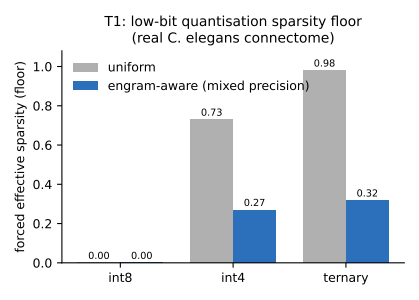
Figure 1 : Effective-sparsity floor by bit depth on the real connectome: uniform quantisation (grey) versus engram-aware mixed precision (blue).
出典 · CC BY 4.0 · Praveg Vashishtha · A Functional Preservation Score for Auditing Connectome Operations: Compression, Alignment, Transport, and Local-Rule Writing · 論文の図を引用 · 元のPDFの3ページ目から図の部分を抽出しています。リプレイ系列の圧縮と識別
偶然の場合の値は0.125です。固定サイズの増分保存では、superposition storeは徐々に悪化する一方、slot storeは崖のように急激に下がります。この結果は、当該のデータと設定で得られたもので、他のデータセットに一般化されたものではありません。
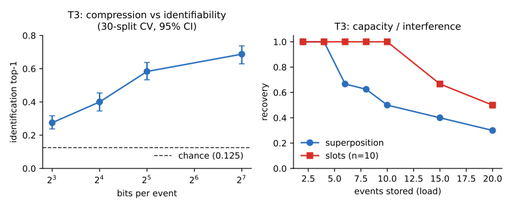
Figure 2 : Left: identification versus latent bit budget (30-split CV, 95% CI; dashed line is chance). Right: recovery from a fixed-size store versus load.
出典 · CC BY 4.0 · Praveg Vashishtha · A Functional Preservation Score for Auditing Connectome Operations: Compression, Alignment, Transport, and Local-Rule Writing · 論文の図を引用 · 元のPDFの3ページ目から図の部分を抽出しています。分割・整列・書き込み段階のシミュレーション検証
研究3では、分割・整列・書き込みパイプラインの各段階を、シミュレーションで個別に検証します。分割段階では、感覚・運動インターフェースを固定したまま、主張されたinterneuronのペイロードを取り除き、同じサイズのランダムなinterneuronの部分集合を取り除く場合と比べます。ただし、目標の配線を尊重すると、転送の忠実度は制約のないオラクルの1.00から0.40([0.31,0.49])に下がり、推定された対応では0.06([0.00,0.13])まで下がります。書き込み段階では、global optimiserが目標トポロジーで上限の1.00に到達します。厳密に局所的な報酬変調可塑性は0.55([0.36,0.73])にとどまり、差は0.45([0.27,0.64])です(10シード、p=10^-4、d=2.0)。
リップルタイミングは追加の利点を与えませんでした。これらの結果は、目標基質の配線が、転送と書き込みの両方に共通する限界であることを示しています。
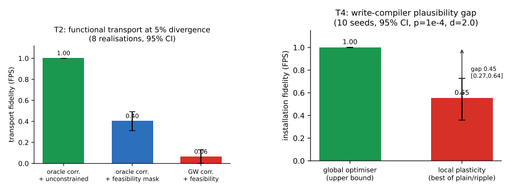
Figure 3 : Left: transport fidelity at5%divergence under three conditions (95% CI). Right: the write- compiler plausibility gap between a global optimiser and local plasticity.
出典 · CC BY 4.0 · Praveg Vashishtha · A Functional Preservation Score for Auditing Connectome Operations: Compression, Alignment, Transport, and Local-Rule Writing · 論文の図を引用 · 元のPDFの4ページ目から図の部分を抽出しています。適用範囲と残る課題
論文に示された限界は、規模とモデルに関するものです。コネクトームは306個のニューロンからなり、活動分析は135個以下のニューロン、ネットワーク実験は40個のニューロン程度です。ダイナミクスは単純なrateモデルで、一部のテストセットは小規模です。研究2の発散モデルでは、別の個体ではなく、モデルによって作られた差が使われています。FPSは機能的な測定であり、主観的な経験に関する主張ではありません。著者らは、移植パイプライン全体に必要な生物学的な前提条件は現時点では存在せず、この論文ではそれを扱っていないと述べています。そのため、この結果は特定の規模のシミュレーションで段階ごとの失敗箇所を見つけたものであり、実際の脳についての可能性の判断は、この研究の範囲外です。
論文情報
- 著者
- Praveg Vashishtha
- 学会・ジャーナル
- arXiv · プレプリント
- 公開日
- 2026年11月10日
- 登録日
- 2026年11月11日
- 更新日
- 2026年11月10日
- バージョン
- v1
- arXiv
- 2611.13681
- カテゴリ
- cs.NE · q-bio.NC
- ライセンス
- CC BY 4.0
- 掲載内容
- 論文情報・解説・論文の図
この解説は、Refivuの韓国語解説をAIで翻訳したものです。不正確な翻訳や誤りが含まれる可能性があります。論文と図の利用条件は各出典に従います。
アブストラクト
We introduce the Functional Preservation Score (FPS), a null-normalised, behaviourally grounded measure of how much of a neural network's input-output function survives a structural operation, and use it to audit the operations underlying speculative "mind-migration" pipelines on public data that runs on a single laptop. Across five pre-registered studies on the C. elegans connectome, whole-brain calcium activity, and hippocampal replay, FPS yields two positive characterisations and a three-part negative. Low-bit quantisation of a real connectome exhibits a structure-dependent sparsity floor: uniform int4/ternary quantisation is forced to roughly 73%/98% effective sparsity because heavy-tailed integer synaptic weights round to zero, while mixed-precision protection of hub neurons lowers these floors to about 27%/32%. Decoded hippocampal replay sequences compress heavily yet remain identifiable at a cross-validated top-1 accuracy of 0.69 (95% CI [0.63, 0.74]; chance 0.125; permutation p < 1e-3) from latents of order 10-50 bits per event, and a bounded incremental store shows a graceful-versus-cliff capacity trade-off. The migration pipeline fails in simulation at each stage for largely independent reasons: the putative "identity payload" is not a functionally separable module (p >= 0.16 at every tested size); cross-individual functional transport via Gromov-Wasserstein collapses once the target's wiring is respected (fidelity 1.00 to 0.40, [0.31, 0.49], p < 1e-3) or alignment is imperfect (0.06, [0.00, 0.13]); and biologically plausible local plasticity cannot reach the function the target topology provably admits (gap 0.45, [0.27, 0.64], p < 1e-3, d = 2.0). We release FPS, the data loaders, and all operations as a toolkit. All results are at nematode / small-network scale and concern coherence in simulation, not the feasibility of reading or writing a living brain.
この論文を引用
Praveg Vashishtha (2026). A Functional Preservation Score for Auditing Connectome Operations: Compression, Alignment, Transport, and Local-Rule Writing. arXiv:2611.13681v1. https://arxiv.org/abs/2611.13681v1
BibTeX
@misc{vashishtha2026functional,
  title = {{A Functional Preservation Score for Auditing Connectome Operations: Compression, Alignment, Transport, and Local-Rule Writing}},
  author = {Praveg Vashishtha},
  year = {2026},
  eprint = {2611.13681},
  archivePrefix = {arXiv},
  url = {https://arxiv.org/abs/2611.13681v1}
}