論文解説
Are Dense Rewards Worth Their Tokens in GRPO?
GRPOにおけるdense rewardはトークンコストに見合うのか
- 課題 トークンとGPU時間をそろえない比較では、dense rewardの利点が過大評価される可能性があります。
- 手法 matched-computeプロトコルでは、生成トークン数と学習時間をそろえたうえで、dense rewardとプロンプト選択を比較します。
- 結果 Monte-Carlo rewardはトークン基準で14.3ポイント低く、プロンプト選択はQwen3-0.6BとQwen2.5-1.5Bで小さなトークン基準の利点を示します。
トークンコストを除くと、dense rewardの利点は過大評価されます
RLVRではGRPOが1つのcompletionのすべてのトークンに同じadvantageを与えるため、中間段階に信用を配分するdense rewardが提案されてきました。そのうちMonte-Carlo rewardは、部分解からcontinuationをサンプリングして、各段階で成功確率がどれだけ変わったかを計算します。既存の2つの確認方法、すなわち同じ更新回数で比較する方法と、1バッチの勾配検定は、このrewardが使う生成トークン数と学習時間を反映していません。この論文は、この設定ではcontinuationが生成トークン全体の91%を占めると報告しており、そのコストを含めない比較で結論が変わるかを問います。
matched-computeプロトコルの予算設計
この論文は、生成トークン予算Bと学習GPU時間を同じ比較基準にそろえるmatched-computeプロトコルを提案します。トークン予算Bは、continuationと破棄されたgroupを含め、学習中に生成されたすべてのトークンを数えます。1回の実行はB個のトークンを生成した時点で終わります。主要なQwen2.5-1.5B設定では、Bはk=4のMonte-Carlo rewardが48 iterationの間に生成するトークン数として定められました。このとき、Monte-Carlo rewardは約50回、outcome-only GRPOは584回の更新を行います。学習時間にはプロンプト採点、生成、クレジット計算、更新、重み同期を含めますが、評価とログ記録は除きます。
同じseedのプロンプトの流れと評価サンプルを共有することで、seedごとに対になった差分を得ます。
Monte-Carlo rewardは更新回数の基準では上回り、トークン基準では下回ります
更新回数をそろえた比較では、Monte-Carlo rewardはoutcome-only GRPOを上回ります。著者らは、continuationの生成トークンコストが更新回数を減らすことで、この逆転が生じると説明しています。continuation数k=1、2、4を比べると、kが小さいほど差は縮まりますが、消えてはいません。学習をより長く行っても、4種類のdense-reward変種のいずれもoutcome-only GRPOを有意に上回れませんでした。
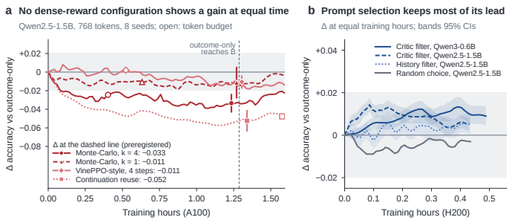
Figure 3 . At equal training time, no tested dense-reward variant showed a gain, and prompt selection keeps most of its lead. (a)A preregistered study ran every configuration beyond the training time that outcome-only GRPO needs to reach the token budget B (dashed line). Curves show each configuration minus outcome-only GRPO at equal training hours (MATH L4–5, mean over seeds); open markers show where each configuration reaches B. Bars give the preregistered contrasts at the dashed line with 95% CIs, and the legend gives their means.(b)The prompt filters, and random choice among the filter’s candidates, minus outcome-only GRPO at equal training hours, up to the time the faster configuration takes to reach the budget (exploratory, H200 GPUs). Bands are95%CIs; the gray bands mark±0.02.
出典 · CC BY 4.0 · Vikash Singh, Weicong Chen, Debargha Ganguly, Yanyan Zhang, Mohsen Hariri, Sreehari Sankar, Wang Yang, Chaoda Song, Alexander Nemecek, Osama Zafar, Yuting Shao, Kai Ye, Biyao Zhang, Xinpeng Li, Shouren Wang, Erman Ayday, Jing Ma, Sanmukh Rao Kuppannagari, Vipin Chaudhary · Are Dense Rewards Worth Their Tokens in GRPO? · 論文の図を引用 · 元のPDFの7ページ目から図の部分を抽出しています。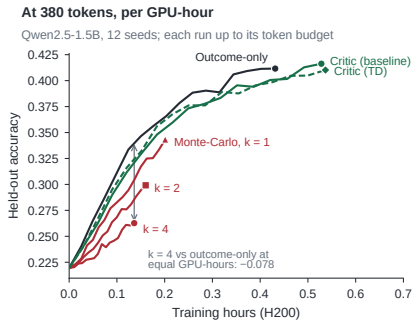
Figure 10 . At 380 tokens, the Monte-Carlo reward trails outcome-only GRPO at its own training time.Exploratory reanalysis of preregistered runs on H200 GPUs: accuracy against training hours for Qwen2.5-1.5B on MATH L4–5 (seeds 5–16, the same for every configuration), each run up to its token bud- get. The Monte-Carlo rewards reach the budget sooner because their continuations take less time per token than training does; the arrow marks the k= 4 reward’s deficit at its own training time (per-seed mean). Figure 3a and Section F run every configuration past outcome-only GRPO’s training time, at768tokens.
出典 · CC BY 4.0 · Vikash Singh, Weicong Chen, Debargha Ganguly, Yanyan Zhang, Mohsen Hariri, Sreehari Sankar, Wang Yang, Chaoda Song, Alexander Nemecek, Osama Zafar, Yuting Shao, Kai Ye, Biyao Zhang, Xinpeng Li, Shouren Wang, Erman Ayday, Jing Ma, Sanmukh Rao Kuppannagari, Vipin Chaudhary · Are Dense Rewards Worth Their Tokens in GRPO? · 論文の図を引用 · 元のPDFの40ページ目から図の部分を抽出しています。勾配検定は順序は当てますが、差の大きさを過大評価します
効率指標(E⟨u,ĥ⟩)^2/E∥u∥^2は、更新方向uが期待精度の勾配推定ĥとどれだけ一致するかを、ノイズも含めて測ります。トークンあたりの効率は、更新が消費したトークン数で割った値です。この検定は、3つのMonte-Carlo rewardのトークンあたりの順序を、k=1、2、4の順で学習結果と一致させます。ただし、この誤差は検証しようとしている利点と同程度の大きさです。そのため、この検定は順序の指標としては有用ですが、1~2ポイント程度の利点を確かめる証拠としては使いにくいです。
プロンプト選択の利点はQwenの2モデルでのみ見られます
プロンプト選択では、24個の候補のうち予測成功率が1/2に最も近い6個と、ランダムな2個を学習に使います。この方式は候補の採点にforward passだけを使うため、生成トークンは追加されません。6つのモデルのうち、Qwen3-0.6Bでは1.7ポイント、Qwen2.5-1.5Bでは0.8ポイントのトークン基準の利点が見られました。この利点は、新しいseedと、学習に使っていない1,543問のMATHテスト問題でも再現されました。同じ候補からランダムに選ぶ対照群では、この利点は再現されませんでした。ただし、学習時間を基準にすると利点は1.0ポイントと0.5ポイントに小さくなります。この値は探索的な分析によるものです。
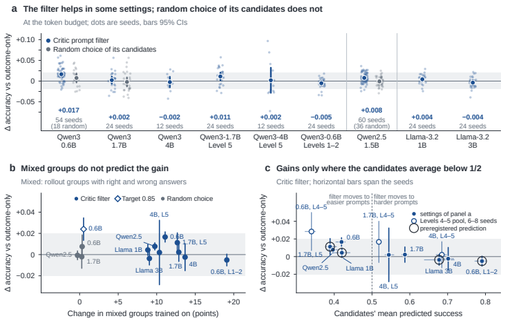
Figure 4 . Where prompt selection helps is predicted by how hard its candidates are, not by how many informative groups it adds. At matched generated tokens:(a)Accuracy at the budget minus outcome-only GRPO on the same seeds, for the critic filter and for random choice of 8 of its 24 candidates (dots: seeds; bold: the filter’s mean). The pool is MATH levels 3–5 unless labeled; Llama models train on the strict verifier.(b)Change in the share of mixed-outcome groups trained on before B against the change in accuracy, both relative to outcome-only GRPO; the diamond is the filter aimed at predicted success 0.85.(c)The critic’s mean predicted success of the candidates against the change in accuracy; the dashed line marks 1/2. Hollow points are the first studies, on a level 4–5 pool, and rings mark the four settings with a preregistered prediction. Bars are95%CIs over seeds; the gray band marks±0.02.
出典 · CC BY 4.0 · Vikash Singh, Weicong Chen, Debargha Ganguly, Yanyan Zhang, Mohsen Hariri, Sreehari Sankar, Wang Yang, Chaoda Song, Alexander Nemecek, Osama Zafar, Yuting Shao, Kai Ye, Biyao Zhang, Xinpeng Li, Shouren Wang, Erman Ayday, Jing Ma, Sanmukh Rao Kuppannagari, Vipin Chaudhary · Are Dense Rewards Worth Their Tokens in GRPO? · 論文の図を引用 · 元のPDFの8ページ目から図の部分を抽出しています。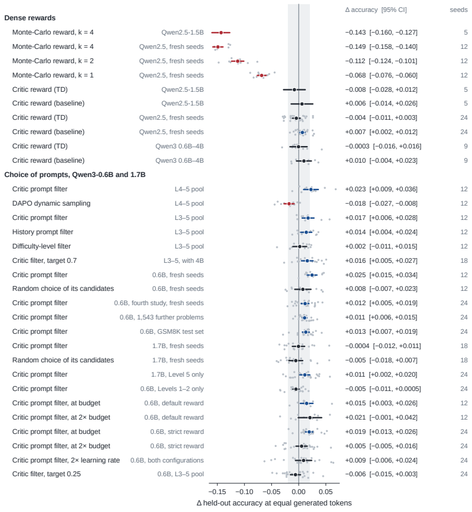
Figure 7 . Every matched-compute comparison, part 1: dense rewards, and the choice of prompts on Qwen3-0.6B and 1.7B. Held-out accuracy at the token budget minus outcome-only GRPO on the same seeds and evaluation draws, on the 200 level 3–5 test problems (level-5 or level 1–2 problems for those pools), except in the rows marked “further test problems” and “GSM8K” (part 2). Gray dots are seeds; bars are 95% paired-t CIs, blue when above zero and red when below; the band marks ±0.02. “Fresh seeds” rows come from studies that repeated an earlier comparison on new seeds. “Default reward” and “strict reward” rows train both configurations for twice the budget with that verifier as the reward. Tables 3 and 4 mark which rows are preregistered primary contrasts.
出典 · CC BY 4.0 · Vikash Singh, Weicong Chen, Debargha Ganguly, Yanyan Zhang, Mohsen Hariri, Sreehari Sankar, Wang Yang, Chaoda Song, Alexander Nemecek, Osama Zafar, Yuting Shao, Kai Ye, Biyao Zhang, Xinpeng Li, Shouren Wang, Erman Ayday, Jing Ma, Sanmukh Rao Kuppannagari, Vipin Chaudhary · Are Dense Rewards Worth Their Tokens in GRPO? · 論文の図を引用 · 元のPDFの22ページ目から図の部分を抽出しています。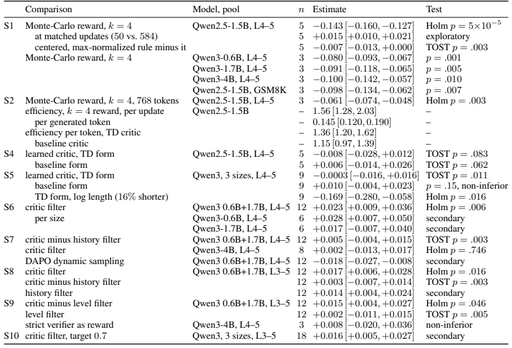
Table 6 . Results of the first matched-compute studiesquoted in Sections 3 and 4. Differences are in held-out accuracy at B against outcome-only GRPO on the same seeds unless stated, with 95% paired-t CIs; efficiencies are ratios to outcome-only GRPO with 95% bootstrap CIs. “Holm” marks a preregistered primary contrast; other rows are secondary or, where marked, exploratory.
出典 · CC BY 4.0 · Vikash Singh, Weicong Chen, Debargha Ganguly, Yanyan Zhang, Mohsen Hariri, Sreehari Sankar, Wang Yang, Chaoda Song, Alexander Nemecek, Osama Zafar, Yuting Shao, Kai Ye, Biyao Zhang, Xinpeng Li, Shouren Wang, Erman Ayday, Jing Ma, Sanmukh Rao Kuppannagari, Vipin Chaudhary · Are Dense Rewards Worth Their Tokens in GRPO? · 論文の図を引用 · 元のPDFの25ページ目から図の部分を抽出しています。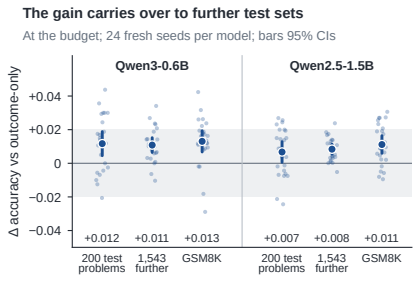
Figure 9 . The prompt filter’s gain carries over to further test sets.Critic filter minus outcome-only GRPO at the token budget, on the same runs: the 200 test problems of every study, the 1,543 numeric-answer MATH test problems of levels 3–5 that no study had evaluated on, and the1,319 GSM8K test problems, on Qwen3- 0.6B (S34) and Qwen2.5-1.5B (S33), 24 fresh seeds each. Dots are seeds, bars 95% paired-t CIs, and the gray band marks ±0.02.
出典 · CC BY 4.0 · Vikash Singh, Weicong Chen, Debargha Ganguly, Yanyan Zhang, Mohsen Hariri, Sreehari Sankar, Wang Yang, Chaoda Song, Alexander Nemecek, Osama Zafar, Yuting Shao, Kai Ye, Biyao Zhang, Xinpeng Li, Shouren Wang, Erman Ayday, Jing Ma, Sanmukh Rao Kuppannagari, Vipin Chaudhary · Are Dense Rewards Worth Their Tokens in GRPO? · 論文の図を引用 · 元のPDFの29ページ目から図の部分を抽出しています。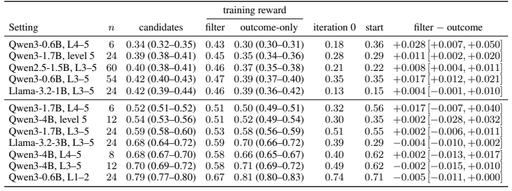
Table 8 . Where the critic filter helps(exploratory). Candidates: the critic’s mean predicted success of the 24 candidates per iteration (seed mean, with the range over seeds). Training reward: mean group reward over the iterations started before B (strict verifier for the Llama models, whose configurations train on it). Iteration 0: training reward of the first iteration, before any update, the same in both configurations (the base model on its first 8 training prompts per seed). Start: outcome-only GRPO’s accuracy on the test set before training. Last column: filter minus outcome-only accuracy atB(95%paired-tCI).
出典 · CC BY 4.0 · Vikash Singh, Weicong Chen, Debargha Ganguly, Yanyan Zhang, Mohsen Hariri, Sreehari Sankar, Wang Yang, Chaoda Song, Alexander Nemecek, Osama Zafar, Yuting Shao, Kai Ye, Biyao Zhang, Xinpeng Li, Shouren Wang, Erman Ayday, Jing Ma, Sanmukh Rao Kuppannagari, Vipin Chaudhary · Are Dense Rewards Worth Their Tokens in GRPO? · 論文の図を引用 · 元のPDFの34ページ目から図の部分を抽出しています。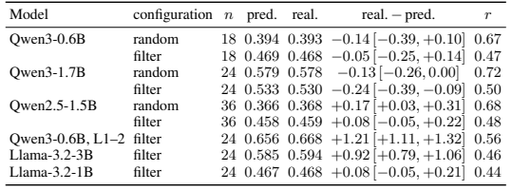
Table 9 . Calibration of the prompt critic(exploratory), on the prompts trained in the iterations before B in which the critic was in use: mean predicted and realized group success, their difference per seed in points (95%CI), and the correlation over groups.
出典 · CC BY 4.0 · Vikash Singh, Weicong Chen, Debargha Ganguly, Yanyan Zhang, Mohsen Hariri, Sreehari Sankar, Wang Yang, Chaoda Song, Alexander Nemecek, Osama Zafar, Yuting Shao, Kai Ye, Biyao Zhang, Xinpeng Li, Shouren Wang, Erman Ayday, Jing Ma, Sanmukh Rao Kuppannagari, Vipin Chaudhary · Are Dense Rewards Worth Their Tokens in GRPO? · 論文の図を引用 · 元のPDFの34ページ目から図の部分を抽出しています。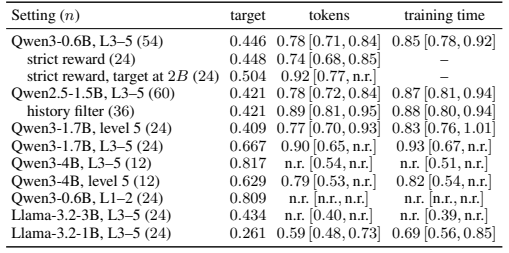
Table 11 . Share of the budget, and of outcome-only GRPO’s training time, that the critic filter needs to reach outcome-only GRPO’s accuracy at B (exploratory; 1 means no saving). The history-filter row uses the critic-free filter of S22 on the same seeds. Training time includes the critic’s scoring and excludes evaluation.
出典 · CC BY 4.0 · Vikash Singh, Weicong Chen, Debargha Ganguly, Yanyan Zhang, Mohsen Hariri, Sreehari Sankar, Wang Yang, Chaoda Song, Alexander Nemecek, Osama Zafar, Yuting Shao, Kai Ye, Biyao Zhang, Xinpeng Li, Shouren Wang, Erman Ayday, Jing Ma, Sanmukh Rao Kuppannagari, Vipin Chaudhary · Are Dense Rewards Worth Their Tokens in GRPO? · 論文の図を引用 · 元のPDFの38ページ目から図の部分を抽出しています。学習率の調整で大部分を揃えられる初期の優位
プロンプト選択の利点は学習初期に大きく現れ、後半には縮小します。この利点は、ベースラインを十分にチューニングした場合と比べて見るべきだと解釈できます。
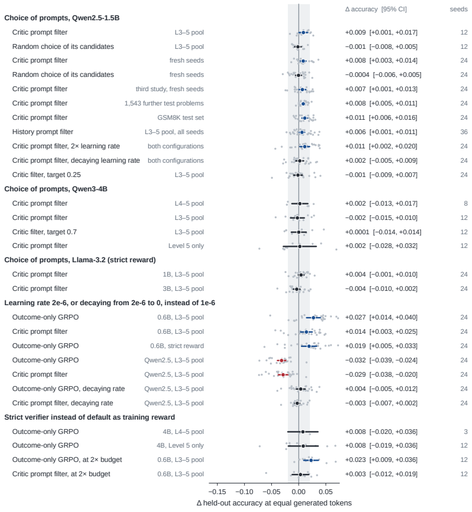
Figure 8 . Every matched-compute comparison, part 2: the choice of prompts on Qwen2.5-1.5B, Qwen3-4B, and the Llama models, the learning rate, and the verifier.As in Figure 7. In the last two blocks, a run at twice the learning rate or with a learning rate decaying linearly from 2×10 −6 to 0 at the budget, or trained on the strict verifier, minus the same configuration at 10−6 or trained on the default verifier.
出典 · CC BY 4.0 · Vikash Singh, Weicong Chen, Debargha Ganguly, Yanyan Zhang, Mohsen Hariri, Sreehari Sankar, Wang Yang, Chaoda Song, Alexander Nemecek, Osama Zafar, Yuting Shao, Kai Ye, Biyao Zhang, Xinpeng Li, Shouren Wang, Erman Ayday, Jing Ma, Sanmukh Rao Kuppannagari, Vipin Chaudhary · Are Dense Rewards Worth Their Tokens in GRPO? · 論文の図を引用 · 元のPDFの23ページ目から図の部分を抽出しています。適用範囲と限界
主要な比較は、小型モデル、MATHの問題セット、380または768トークンのcompletion長などの特定の条件で実施されました。著者らは、Qwen系列以外のモデルではプロンプト選択の利点が予測どおりには現れなかったと報告しており、より大きな規模、別のタスク、より長い学習期間への一般化は確認されていないと明記しています。この結果は、当該の実験条件と予算で得られたものです。
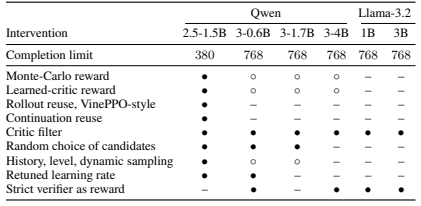
Table 2 . Which interventions were tested at which model. •: preregistered study with 8 or more seeds; ◦: pilot or pooled esti- mate with 3–9 seeds per model; –: not tested. Completion limit in tokens; on Qwen2.5-1.5B, a preregistered study also compared the Monte-Carlo reward and both kinds of reuse at768tokens, to equal training time.
出典 · CC BY 4.0 · Vikash Singh, Weicong Chen, Debargha Ganguly, Yanyan Zhang, Mohsen Hariri, Sreehari Sankar, Wang Yang, Chaoda Song, Alexander Nemecek, Osama Zafar, Yuting Shao, Kai Ye, Biyao Zhang, Xinpeng Li, Shouren Wang, Erman Ayday, Jing Ma, Sanmukh Rao Kuppannagari, Vipin Chaudhary · Are Dense Rewards Worth Their Tokens in GRPO? · 論文の図を引用 · 元のPDFの19ページ目から図の部分を抽出しています。論文情報
- 著者
- Vikash Singh, Weicong Chen, Debargha Ganguly, Yanyan Zhang, Mohsen Hariri, Sreehari Sankar, Wang Yang, Chaoda Song, Alexander Nemecek, Osama Zafar, Yuting Shao, Kai Ye, Biyao Zhang, Xinpeng Li, Shouren Wang, Erman Ayday, Jing Ma, Sanmukh Rao Kuppannagari, Vipin Chaudhary
- 学会・ジャーナル
- arXiv · プレプリント
- 公開日
- 2026年11月10日
- 登録日
- 2026年11月11日
- 更新日
- 2026年11月10日
- バージョン
- v1
- arXiv
- 2611.13560
- カテゴリ
- cs.CL · cs.AI
- ライセンス
- CC BY 4.0
- 掲載内容
- 論文情報・解説・論文の図
この解説は、Refivuの韓国語解説をAIで翻訳したものです。不正確な翻訳や誤りが含まれる可能性があります。論文と図の利用条件は各出典に従います。
アブストラクト
RLVR trains language models to reason by rewarding correct final answers. A widely used algorithm, group-relative policy optimization (GRPO), gives every token of a solution the same credit, so dense process rewards have been proposed to credit intermediate steps, for example with a Monte-Carlo reward that scores each step by sampling continuations from it. Comparing such a reward with GRPO per training update, or vetting it with a gradient test on a single batch, leaves out what it costs: in our setting, the continuations alone take 91% of all generated tokens. We introduce a matched-compute protocol that gives every training intervention the same budget, measured in generated tokens and training GPU-hours, and tests it in preregistered studies with controls for side effects. Across 1,668 runs on six models, matching compute reverses the ranking. On Qwen2.5-1.5B, the Monte-Carlo reward leads standard GRPO per update, yet ends 14.3 percentage points lower at equal tokens and 7.8 points lower at equal training time, and none of four dense-reward variants outperforms GRPO even with as much training time. A per-token gradient test orders these rewards as training does but overestimates each by one to two points, as much as the gains it is meant to detect. In contrast, training on the prompts whose predicted success is nearest 1/2 improves accuracy at matched compute, by 1.7 points on Qwen3-0.6B and 0.8 on Qwen2.5-1.5B. These gains replicate on fresh seeds and unseen problems, and a simple rule, that the candidate prompts are predicted to fail more often than not, predicted where they appear in five of six preregistered tests. Both gains come early in training, and standard GRPO with twice the initial learning rate comes within half a point of them. We argue that training interventions should be validated at matched compute, which overturns some apparent gains and confirms others.
この論文を引用
Vikash Singh, Weicong Chen, Debargha Ganguly, Yanyan Zhang, Mohsen Hariri, Sreehari Sankar, Wang Yang, Chaoda Song, Alexander Nemecek, Osama Zafar, Yuting Shao, Kai Ye, Biyao Zhang, Xinpeng Li, Shouren Wang, Erman Ayday, Jing Ma, Sanmukh Rao Kuppannagari, Vipin Chaudhary (2026). Are Dense Rewards Worth Their Tokens in GRPO?. arXiv:2611.13560v1. https://arxiv.org/abs/2611.13560v1
BibTeX
@misc{singh2026dense,
  title = {{Are Dense Rewards Worth Their Tokens in GRPO?}},
  author = {Vikash Singh and Weicong Chen and Debargha Ganguly and Yanyan Zhang and Mohsen Hariri and Sreehari Sankar and Wang Yang and Chaoda Song and Alexander Nemecek and Osama Zafar and Yuting Shao and Kai Ye and Biyao Zhang and Xinpeng Li and Shouren Wang and Erman Ayday and Jing Ma and Sanmukh Rao Kuppannagari and Vipin Chaudhary},
  year = {2026},
  eprint = {2611.13560},
  archivePrefix = {arXiv},
  url = {https://arxiv.org/abs/2611.13560v1}
}