論文解説
BioMem: Agentic Memory for Biomedical LLM Agents
BioMem:生物医学LLMエージェント向けエージェント型メモリ
- 課題 生物医学エージェントのメモリが、情報を保存・検索・更新・活用する過程で根拠をどれだけ正確に扱えるかが中心的な問題です。
- 手法 学習が不要なHMRUは、密ベクトル検索とBM25ベースの語彙検索を組み合わせ、交差エンコーダで再順位付けしたうえで、タスク別の活用指示を加えてfrozen言語モデルに渡します。
- 結果 HMRU-IはRiTeK-PharmKGとRiTeK-ADIntのexact-match F1をA-MEMベースラインより高くしましたが、臨床予測での効果はタスクによって異なり、オピオイド過剰摂取予測のAUPRCは改善しませんでした。
生物医学エージェントのメモリの信頼性の課題
生物医学LLMエージェントは、患者記録、時間とともに変わる観察、複数の情報源に散らばった情報を扱う必要があるため、モデルのパラメータに含まれる知識だけでは不十分です。これを補うため、過去のやり取りをメモリとして保存し検索するシステムが使われています。しかし、メモリは情報を保存する際に変形され、検索で選ばれたり漏れたりし、その後の更新を経て、最終的に言語モデルが活用します。この論文では、この過程それぞれがどれほど正確で信頼できるかを、生物医学タスクで合わせて検討しています。
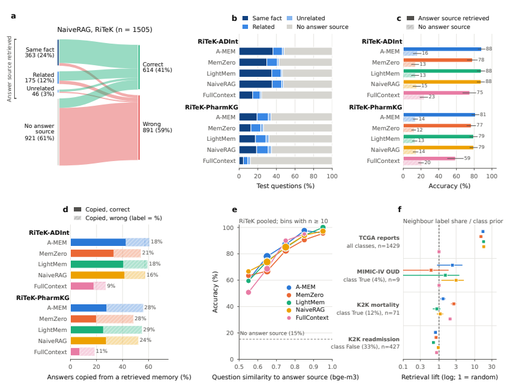
Figure2 :Memoryretrievalqualityandutilizationacrossbiomedicaltasks. a,Evidence-to-outcomeflows forNaiveRAGonthepooledRiTeKtestquestions.b,Distributionofthestrongestretrievedevidencecategory across five memory methods.c, Answer accuracy stratified by whether retrieved memory contains an answer matching the ground truth.d, Proportions of predictions matching a retrieved source answer, separated by correct and incorrect predictions.e, Answer accuracy by BGE-M3 similarity between the test question and the strongest answer-matching source question; bins contain at least ten questions.f, Retrieval enrichment for the ground-truth class relative to its training-set prior in four classification tasks; error bars show 95 per cent confidence intervals.
出典 · CC BY 4.0 · Mingchen Li, Yongkang Xiao, Rumeng Li, Rui Zhang, Hong Yu · BioMem: Agentic Memory for Biomedical LLM Agents · 論文の図を引用 · 元のPDFの6ページ目から図の部分を抽出しています。HMRUの検索と活用の構成
HMRUは学習なしで適用されるフレームワークです。密ベクトル検索の結果とBM25ベースの語彙検索の結果を合わせたのち、交差エンコーダによる再順位付けで上位のメモリを選びます。その後、選ばれたメモリにタスクの説明、質問、タスク別の活用指示を組み合わせ、frozenの言語モデルに入力する文脈を構成します。ここでは検索の改善(HMRU-R)とタスク認識の活用指示(HMRU-I)を分けて比較しているため、各変更がどの部分に寄与しているかを区別して見られます。パラメータの更新は行わず、言語モデルの重みはそのまま保たれます。
生物医学の質問応答と臨床予測の結果
HMRU-Iは、RiTeK-PharmKGでのexact-match F1をA-MEMベースラインの39.27から43.48に、RiTeK-ADIntでは52.94から57.64に高めました。同じHuatuoGPT-3-27Bバックボーンで得られたこの結果は、質問応答タスクについてのものです。臨床予測では、効果にばらつきがありました。

Table 1 : Comparative evaluation of agentic memory approaches on biomedical benchmarks. Bold and underlined values indicate the best and second-best distinct results within each language model, respectively. For RiTeK datasets,∗ denotes exact match and† denotes ROUGE-1.
出典 · CC BY 4.0 · Mingchen Li, Yongkang Xiao, Rumeng Li, Rui Zhang, Hong Yu · BioMem: Agentic Memory for Biomedical LLM Agents · 論文の図を引用 · 元のPDFの3ページ目から図の部分を抽出しています。観察分析の範囲とメモリの忠実性
メモリ進化の分析では、A-MEMのメモリのうち、元の学習記録が裏付けない文脈を持つものの割合が、MIMIC-IVのオピオイド過剰摂取予測で初期の12%から最終的に44%へ増加しました。ただし、この分析はLLMベースの評価者が判定した観察であり、根拠の存在と正解との関連は因果効果を意味しません。したがって、繰り返しの書き直しが誤りを引き起こすと断定するのではなく、検索された根拠があっても正しい活用が保証されるわけではない点も併せて読む必要があります。
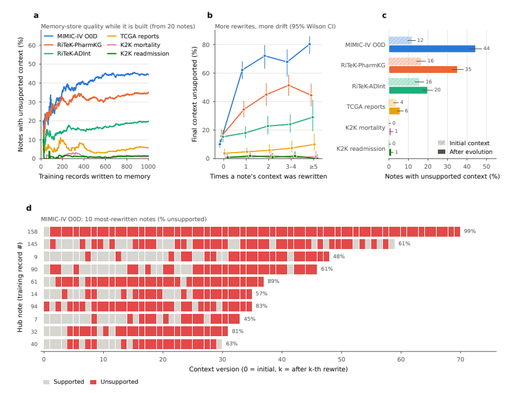
Figure 3 :Memory evolution in A-MEM. a, Proportion of memory nodes with unsupported context during sequentialmemoryconstructionacrosssixbiomedicaltasks.b,Associationbetweencontextrewritefrequency and unsupported context rate, with 95 per cent Wilson confidence intervals.c, Proportion of memory notes containing source-unsupported context in their initial and final states after memory evolution.d, Evolution trajectories of the ten most frequently rewritten nodes in MIMIC-IV OOD. Gray and red indicate supported and unsupported context, respectively. Unsupported content is determined by an LLM evaluator against the original training record.
出典 · CC BY 4.0 · Mingchen Li, Yongkang Xiao, Rumeng Li, Rui Zhang, Hong Yu · BioMem: Agentic Memory for Biomedical LLM Agents · 論文の図を引用 · 元のPDFの9ページ目から図の部分を抽出しています。論文情報
- 著者
- Mingchen Li, Yongkang Xiao, Rumeng Li, Rui Zhang, Hong Yu
- 学会・ジャーナル
- arXiv · プレプリント
- 公開日
- 2026年11月10日
- 登録日
- 2026年11月11日
- 更新日
- 2026年11月10日
- バージョン
- v1
- arXiv
- 2611.13426
- カテゴリ
- cs.CL
- ライセンス
- CC BY 4.0
- 掲載内容
- 論文情報・解説・論文の図
この解説は、Refivuの韓国語解説をAIで翻訳したものです。不正確な翻訳や誤りが含まれる可能性があります。論文と図の利用条件は各出典に従います。
アブストラクト
Large language models (LLMs) have demonstrated considerable potential in biomedical applications, while agentic memory systems have emerged as a promising approach to preserving and utilizing information across tasks and interactions. However, a fundamental question remains: how effectively and reliably do these systems retain, retrieve, update, and utilize biomedical information? In this study, we systematically investigate agentic memory in the biomedical domain, focusing on task effectiveness, retrieval quality, information fidelity, and long-term robustness. We evaluate five memory approaches across four LLMs in three representative settings: biomedical knowledge reasoning, clinical prediction, and long-term conversational memory. Our analyses reveal how memory construction, evidence relevance, and conversational history shape downstream biomedical performance, highlighting the distinct challenges of retrieving relevant information, preserving its fidelity, and effectively utilizing it for reasoning. Building on these findings, we introduce Hybrid Memory Retrieval and Utilization (HMRU), a training-free framework that jointly enhances evidence accessibility and task-aware utilization to improve biomedical reasoning and long-term conversational memory. HMRU achieves an average relative improvement of 8.6% across biomedical question-answering and conversational memory benchmarks, with additional gains in selected clinical prediction tasks. It further reduces conversational answer errors by 24.9% and closes 48.0% of the performance gap to full-context inference. Our findings provide a systematic characterization of biomedical agentic memory and practical insights into developing more effective and reliable memory-augmented LLM systems.
この論文を引用
Mingchen Li, Yongkang Xiao, Rumeng Li, Rui Zhang, Hong Yu (2026). BioMem: Agentic Memory for Biomedical LLM Agents. arXiv:2611.13426v1. https://arxiv.org/abs/2611.13426v1
BibTeX
@misc{li2026biomem,
  title = {{BioMem: Agentic Memory for Biomedical LLM Agents}},
  author = {Mingchen Li and Yongkang Xiao and Rumeng Li and Rui Zhang and Hong Yu},
  year = {2026},
  eprint = {2611.13426},
  archivePrefix = {arXiv},
  url = {https://arxiv.org/abs/2611.13426v1}
}