論文解説
AutoBuddy: Evaluating Proactive, Always-On Agents on Task Discovery and Execution in a Simulated Workplace
AutoBuddy:シミュレートされた職場におけるタスク発見と実行を評価する、常時稼働の先回り型エージェント
- 課題 利用者のワークスペースで未処理のタスクを自ら見つけて完了する能力は、既存のベンチマークで十分に評価されてきませんでした。
- 手法 AutoBuddy-Benchはシミュレーション組織で正解タスクを作ります。AutoBuddyエージェントはタスクプロファイルと2回の読み取り専用探索でタスクを発見したうえで、書き込みセッションで各タスクを実行します。
- 結果 17個のバックボーンモデルのエンドツーエンドスコアは0.234から0.698まででした。弱いモデルは主に発見で、中程度のモデルは実行の中断で、最強のモデルは主に業務システムの実行で取りこぼしがありました。発見の精度は、実行の品質とわずかにしか関連していませんでした。
既存のベンチマークが見落とすタスク発見
既存のエージェントベンチマークは、多くの場合、エージェントに実行すべきタスクを明示的に与え、そのタスクをどれだけうまくこなすかを測定します。しかし知識労働では、依頼が利用者のワークスペース内にメール、チャット、文書の形で散らばっており、エージェントはまずどんな義務が存在するのかを自ら突き止める必要があります。この論文は、こうした能動的なタスク発見と実行を一緒に扱い、エージェントが利用者の待機中のタスクをワークスペースの状態から推論し、該当する業務システムで完了させるという設定を提示しています。この設定には2つの難しさがあります。エージェントにとっては大量のデータの中から実際のタスクを見つけることが難しく、評価には人、出来事、文書、記録が互いに整合したシミュレーション組織が必要です。
シミュレーション組織と正解タスクの生成
AutoBuddy-Benchは、組織の社員、プロジェクト、業務システム、出来事の履歴を、有効期間を持つ時間グラフとしてモデル化します。出来事から正解タスクが導かれ、各タスクの期待される結果は、モデルではなく世界の状態とルールからコードで計算されます。その後、グラフはメール、チャット、カレンダー、ファイルといったワークスペースの成果物として描画され、正解と評価ラベルはエージェントから隠されます。生成の過程では、受理検査を通過しなかった世界を評価に使いません。
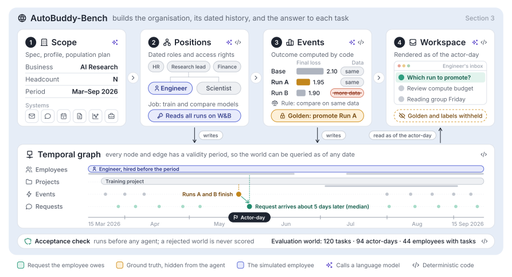
Figure 2 : One task followed through AutoBuddy-Bench (Section 3.1). (1) A company scope fixes the business, headcount, period and systems; (2) positions are generated with dated roles and access rights; (3) events are generated and code computes the ground-truth outcome from the rule that governs them: three training runs finish, and the lab imposes a rule that runs may be compared only if they were trained on the same data. Run B has the lowest loss but was trained on more data, so the correct decision is to promote Run A, the best comparable run; (4) the engineer’s workspace is rendered as of the actor-day, with the ground truth and evaluation labels withheld. Steps 2 and 3 write to a temporal graph that can be queried as of any date. The illustrated company is an example, not the evaluation world.
出典 · CC BY 4.0 · Shiqi Chen, Daniel Madrigal Diaz, Wei-Ning Chen, Gbola Afonja, Fangkai Yang, Rujia Wang, Chetan Bansal, Victor Rühle, Saravan Rajmohan, Dongge Han · AutoBuddy: Evaluating Proactive, Always-On Agents on Task Discovery and Execution in a Simulated Workplace · 論文の図を引用 · 元のPDFの3ページ目から図の部分を抽出しています。AutoBuddyエージェントの発見と実行の段階
AutoBuddyは、actor-dayごとに、まず読み取り専用のセッションで、社員の役割とプロジェクトをまとめたタスクプロファイルを作ります。続いて2つ目の読み取り専用セッションがワークスペースを探索し、直接の依頼、約束、フォローアップを抽出してタスク一覧を作ります。評価中は各actor-dayが空の状態から始まるため、重複の統合と完了済みタスクの記録だけが適用され、再オープンや順位付けは影響しません。その後、マッチした各タスクは、書き込み権限を持つ新しいセッションで1回ずつ実行されます。実行セッションは、タスクIDと記録された要約、根拠、ブリーフのみを受け取り、正解タスクや依頼の本文は受け取りません。
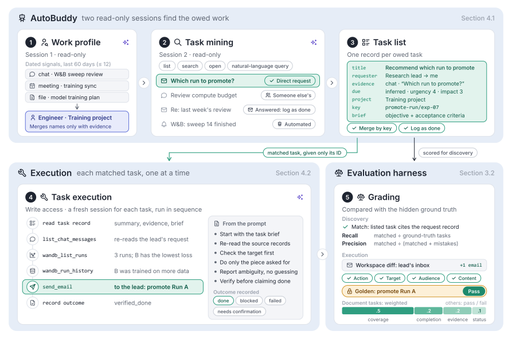
Figure 3 : AutoBuddy on the task of Figure 2. (1) A read-only session builds a work profile from dated signals; (2) a second read-only session mines the workspace, keeping the direct request and setting aside a colleague’s task, an answered thread and an automated notice; (3) each owed task becomes one record with its evidence and a brief. (4) Each listed task that matches a ground-truth task is executed in a fresh session with write access; here the agent checks the runs and their training data and emails the lead to promote Run A. (5) Discovery is scored by recall and precision, and execution by the change to the workspace, against the hidden ground truth (Section 3.2).
出典 · CC BY 4.0 · Shiqi Chen, Daniel Madrigal Diaz, Wei-Ning Chen, Gbola Afonja, Fangkai Yang, Rujia Wang, Chetan Bansal, Victor Rühle, Saravan Rajmohan, Dongge Han · AutoBuddy: Evaluating Proactive, Always-On Agents on Task Discovery and Execution in a Simulated Workplace · 論文の図を引用 · 元のPDFの4ページ目から図の部分を抽出しています。発見と実行を分けた採点
発見は、一覧にあるタスクが正解タスクの依頼記録を引用しているかどうかで1対1にマッチングし、再現率はマッチした正解タスクの割合です。精度はマッチしたタスク数を、マッチしたタスク数と誤りの数の合計で割った値であり、すでに完了している依頼を完了として記録した場合は誤りに数えません。実行は、セッションの前後におけるワークスペースの差分を正解の結果と比べて採点します。ここで、エンドツーエンドのスコアは、採点可能なすべての正解タスクについて実行スコアを平均したもので、発見されなかったタスクは0として計算します。この分離により、取りこぼしたタスクが発見の段階で失われたのか、実行の段階で失われたのかを区別できます。
17個のバックボーンモデルの結果比較
AutoBuddyを同じ120個のタスクで17個のバックボーンモデルに対して実行し、各モデルは3回実行した平均として報告されています。エンドツーエンドのスコアは0.234から0.698まで分布し、同じモデルの反復実行間の標準偏差は最大0.059です。同じ提供元の中では、より軽量なグレードのモデルが低いスコアを受ける傾向があります。弱い発見モデルは、タスクを始める前に多くのタスクを取りこぼします。例えばclaude-haiku-4.5は、実行ごとに60個のタスクを取りこぼしました。中程度のモデルはほとんどのタスクを見つけますが、実行の途中で止まる場合が多いです。最強のモデルは取りこぼしが少なく、失敗は主に業務システムのタスクで現れます。
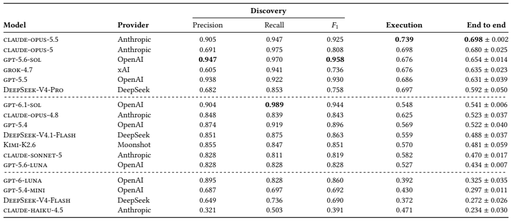
Table 1 : Main results on the evaluation world: AutoBuddy with 17 backbone models on the same 120 tasks. Every model is run three times; scores are means over the three runs, with the standard deviation of the end-to-end score.Discoveryis measured against the workspace labels andexecutionagainst the recorded system change and delivered text;end to endaverages the execution score over all gradable ground-truth tasks (Section 3.2), counting a task never found as zero. Dashed lines mark the two largest gaps between adjacent models. Best in each column in bold.
出典 · CC BY 4.0 · Shiqi Chen, Daniel Madrigal Diaz, Wei-Ning Chen, Gbola Afonja, Fangkai Yang, Rujia Wang, Chetan Bansal, Victor Rühle, Saravan Rajmohan, Dongge Han · AutoBuddy: Evaluating Proactive, Always-On Agents on Task Discovery and Execution in a Simulated Workplace · 論文の図を引用 · 元のPDFの6ページ目から図の部分を抽出しています。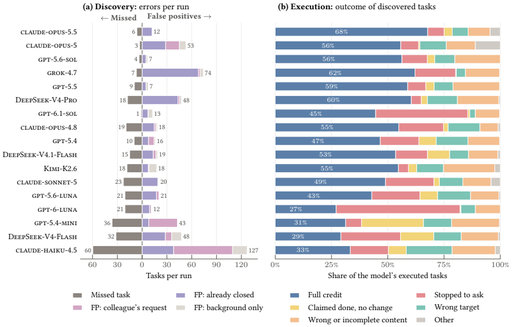
Figure 4 : Where each model fails, by stage, in the order of Table 1. (a) Discovery errors per run over all 51 runs: ground-truth tasks never listed (left), and listed tasks with no ground-truth counterpart (FP, right), by what the record they cite is: work the workspace shows was already closed, a request addressed to a colleague, or background with no request. (b) Outcome of every executed (discovered) task over all runs; the number on each bar is the share receiving full credit, and each execution is assigned to the first category that applies, in the order shown.
出典 · CC BY 4.0 · Shiqi Chen, Daniel Madrigal Diaz, Wei-Ning Chen, Gbola Afonja, Fangkai Yang, Rujia Wang, Chetan Bansal, Victor Rühle, Saravan Rajmohan, Dongge Han · AutoBuddy: Evaluating Proactive, Always-On Agents on Task Discovery and Execution in a Simulated Workplace · 論文の図を引用 · 元のPDFの8ページ目から図の部分を抽出しています。発見の精度と実行品質の関係
発見の精度は、実行の品質とわずかにしか関連していません。17個のモデルで、発見の精度と実行スコアの相関は0.27で、再現率との相関は0.65です。著者らは、モデル数が少ないため係数に雑音が大きいと述べています。これは、タスクを認識する能力と完了させる能力が異なる能力であることを示す根拠として提示されています。ただし、この関係の詳細な解釈には、モデル数とサンプルの雑音を合わせて考慮する必要があります。
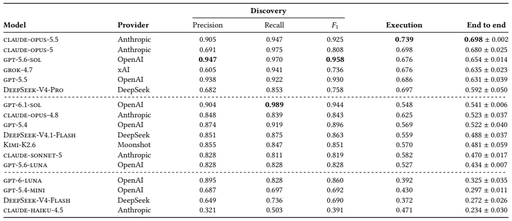
Table 2 : Quality of the mined task lists (means over three runs).Missed: ground-truth tasks not listed.False alarms: listed tasks whose evidence is closed work, a colleague’s re- quest, or background with no request.Logged: closed items listed and correctly recorded as already done.Reopened: share of the closed items a model listed that it treated as open, Closed/(Closed+Logged) . All counts are per run over 120 tasks.
出典 · CC BY 4.0 · Shiqi Chen, Daniel Madrigal Diaz, Wei-Ning Chen, Gbola Afonja, Fangkai Yang, Rujia Wang, Chetan Bansal, Victor Rühle, Saravan Rajmohan, Dongge Han · AutoBuddy: Evaluating Proactive, Always-On Agents on Task Discovery and Execution in a Simulated Workplace · 論文の図を引用 · 元のPDFの6ページ目から図の部分を抽出しています。失敗の種類と領域ごとの違い
発見の誤りのうち偽陽性は、大部分がすでに閉じた依頼や同僚からの依頼で生じています。実行の失敗はモデルごとに異なります。業務システムでは、同じアカウントの2つの依頼を矛盾するルールとして読み、質問するケースが多く見られました。一方、人事レビューは最も安定して完了する領域でした。
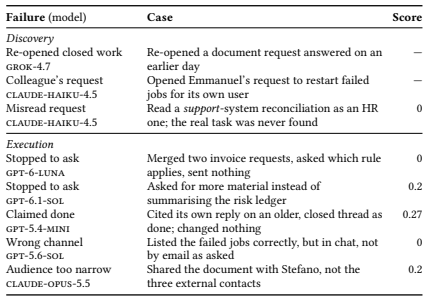
Table 3 : Representative failures from first-run trajectories (requests abridged). Score is end-to-end credit; — marks a false positive, which lowers precision and has no execution score.
出典 · CC BY 4.0 · Shiqi Chen, Daniel Madrigal Diaz, Wei-Ning Chen, Gbola Afonja, Fangkai Yang, Rujia Wang, Chetan Bansal, Victor Rühle, Saravan Rajmohan, Dongge Han · AutoBuddy: Evaluating Proactive, Always-On Agents on Task Discovery and Execution in a Simulated Workplace · 論文の図を引用 · 元のPDFの7ページ目から図の部分を抽出しています。適用範囲と限界
この結果は、1つのシミュレーション世界と、著者が定義した採点ルールから得られたものです。実行スコアはワークスペースの変化と配信されたテキストに基づいており、一部のタスクの採点では合否判定と加重スコアを組み合わせています。また、実行中に発見されたタスクの記録を再利用するスキル学習は、採点対象の実行では使われなかったため、その効果はこの評価の結果には含まれていません。実際の企業環境における他の業務、権限構造、データ分布への一般化は、この論文では直接検証されていません。
論文情報
- 著者
- Shiqi Chen, Daniel Madrigal Diaz, Wei-Ning Chen, Gbola Afonja, Fangkai Yang, Rujia Wang, Chetan Bansal, Victor Rühle, Saravan Rajmohan, Dongge Han
- 学会・ジャーナル
- arXiv · プレプリント
- 公開日
- 2026年11月9日
- 登録日
- 2026年11月10日
- 更新日
- 2026年11月9日
- バージョン
- v1
- arXiv
- 2611.12393
- カテゴリ
- cs.AI · cs.LG
- ライセンス
- CC BY 4.0
- 掲載内容
- 論文情報・解説・論文の図
この解説は、Refivuの韓国語解説をAIで翻訳したものです。不正確な翻訳や誤りが含まれる可能性があります。論文と図の利用条件は各出典に従います。
アブストラクト
As LLM agents become more autonomous, they are increasingly expected to run as always-on assistants on a user's behalf, identifying work to be done and completing it without being asked. Yet existing benchmarks usually give the agent its task, whereas in knowledge work the requests sit in the user's workspace and the agent must first recognise which obligations exist. We study proactive task discovery and execution, in which an agent must infer a user's pending tasks from their workspace and complete them in the systems where the work lives. This setting poses two challenges. For the agent, the tasks are buried in a large volume of mail, chat, documents and records. For evaluation, a benchmark needs a simulated organisation whose people, events and documents are mutually consistent, so that tasks arise realistically and their correct outcomes are known. We introduce AutoBuddy-Bench, a simulator that addresses these challenges. It models an organisation's employees, projects, business systems and event history as a temporal graph, renders it into realistic workspace artefacts, derives ground-truth tasks from the events that create obligations, and computes each task's outcome from the world state; execution is judged by the agent's changes to the workspace. To evaluate current LLMs, we build AutoBuddy, a reference agent with interchangeable backbone LLMs: it identifies tasks from the workspace, grounding each in its source records, and executes each in a separate session with write access. Varying only the backbone, we find a systematic shift in where tasks are lost: weaker models fail mainly at discovery, intermediate models identify tasks but often stop short of carrying them out, and the strongest models fail mainly during execution, most often on business-system operations. Discovery precision is only weakly related to execution quality, suggesting the two are distinct capabilities.
この論文を引用
Shiqi Chen, Daniel Madrigal Diaz, Wei-Ning Chen, Gbola Afonja, Fangkai Yang, Rujia Wang, Chetan Bansal, Victor Rühle, Saravan Rajmohan, Dongge Han (2026). AutoBuddy: Evaluating Proactive, Always-On Agents on Task Discovery and Execution in a Simulated Workplace. arXiv:2611.12393v1. https://arxiv.org/abs/2611.12393v1
BibTeX
@misc{chen2026autobuddy,
  title = {{AutoBuddy: Evaluating Proactive, Always-On Agents on Task Discovery and Execution in a Simulated Workplace}},
  author = {Shiqi Chen and Daniel Madrigal Diaz and Wei-Ning Chen and Gbola Afonja and Fangkai Yang and Rujia Wang and Chetan Bansal and Victor Rühle and Saravan Rajmohan and Dongge Han},
  year = {2026},
  eprint = {2611.12393},
  archivePrefix = {arXiv},
  url = {https://arxiv.org/abs/2611.12393v1}
}