論文解説
ORCHID-SAGE: Fully Reproducible CALPHAD Assessment from Evidence to Phase Diagram
ORCHID-SAGE:根拠から相図まで完全に再現可能なCALPHAD評価
- 課題 CALPHADデータベースは評価者の判断が記録されないため、再生成や更新が難しいです。
- 手法 評価の判断と実行を一般プロトコル、特定プロトコル、実行カードに記録し、スクリプトとAIエージェントにそれを再実行させます。
- 結果 Cr–Ni系の再生成では、スクリプトとAIエージェントの両方が共晶点1614 Kと CrNi2上端860 Kを再現し、13個の検査を通過しました。
CALPHAD評価が再生成されない理由
CALPHADデータベースでは、熱力学モデルの最終パラメータだけが公開されることが多いです。評価者がどの観測値を使い、どの不確かさを与え、どの相を除外したかは、たいてい記録されません。そのため、他の人が同じデータベースを作り直したり更新したりするのは困難です。著者らは、この判断過程を機械可読なプロトコルとして記録しなければ、自律型実験室やAIエージェントがデータベースを継続的に更新するのは難しいと主張しています。この論文では、Cr–Niという1つの系でその可能性を検証しています。
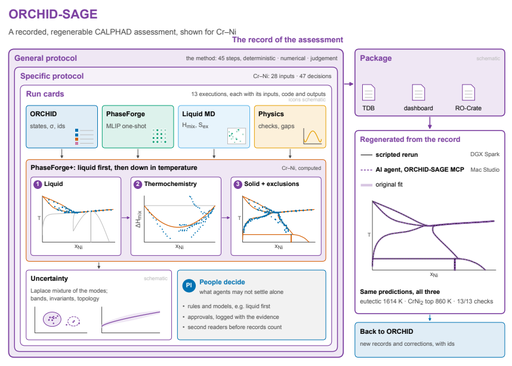
Figure 1 : ORCHID-SAGE, shown for Cr–Ni. The record (general protocol, specific protocol with its decisions, run cards) wraps the assessment: ORCHID evidence, the PhaseForge one-shot model, liquid molecular dynamics, physical checks, the PhaseForge+ sequence from liquid to solid, uncertainty and the decisions made by people. The record is packaged and regenerated from itself, by a script and by an AI agent, with the same predictions. Icons are schematic. ORCHID v2026.10 and records extracted for this work; record identifiers are provided with the source data.
出典 · CC BY 4.0 · Raymundo Arróyave · ORCHID-SAGE: Fully Reproducible CALPHAD Assessment from Evidence to Phase Diagram · 論文の図を引用 · 元のPDFの2ページ目から図の部分を抽出しています。ORCHID-SAGEの3段階の記録
ORCHID-SAGEは、一般プロトコル、特定プロトコル、実行カードの3段階で評価を記録します。一般プロトコルは任意の二元系に適用される方法の規則を、特定プロトコルは1つの系の入力、決定事項、実行計画を、実行カードは各実行のコマンド、ハッシュ、シード、出力を記録します。段階は決定論的計算、数値最適化、判断の段階に分けられます。再実行時には、決定論的な段階は同じ出力を、数値の段階は宣言された許容誤差内での一致を、判断の段階は決定規則と責任者を求めます。ゲートは記録の完全性を検査し、適合度ランキングは、エネルギーの妥当性、相のトポロジー、定量的一致の順に候補を選びます。
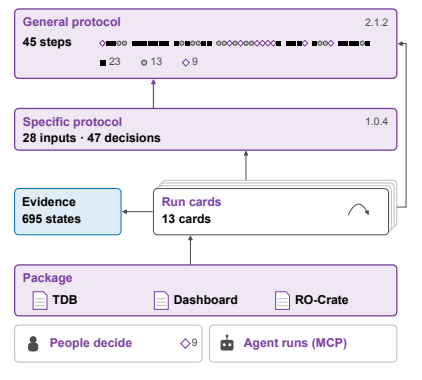
Figure 3 : The ORCHID-SAGE standard, shown for Cr–Ni. The general protocol describes the method in steps of three kinds (deterministic, numerical and judgment), the specific protocol applies it to one database with its inputs, runs and decisions, and the run cards record each execution. The pack- age delivers the database with its header, the dashboard, and the record as an RO-Crate, in which the arrows correspond to PROV relations. People decide at the judgment steps, and an agent can run the specific protocol through the ORCHID- SAGE server.
出典 · CC BY 4.0 · Raymundo Arróyave · ORCHID-SAGE: Fully Reproducible CALPHAD Assessment from Evidence to Phase Diagram · 論文の図を引用 · 元のPDFの4ページ目から図の部分を抽出しています。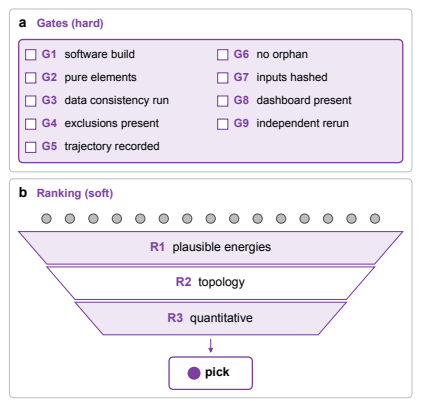
Figure 4 : Gates and ranking in the general protocol. (a) The nine gates check the integrity of the process and of the record, and an assessment that fails any of them is incomplete, how- ever well it fits the data. (b) Candidate fits are not gated but ranked, first by the plausibility of their energies, then by topology and finally by quantitative agreement, and the most reasonable fit is picked with its misses reported as notes. Both panels are schematic.
出典 · CC BY 4.0 · Raymundo Arróyave · ORCHID-SAGE: Fully Reproducible CALPHAD Assessment from Evidence to Phase Diagram · 論文の図を引用 · 元のPDFの5ページ目から図の部分を抽出しています。根拠の固定と一回性モデル
評価は、ORCHIDに保存された完全に定義された平衡状態の観測値を根拠として用います。観測値は、出典から得られた不確かさで重み付けされます。不確かさがない場合は、ORCHIDの規則に従って決めます。相の除外は、熱力学的距離と不確かさに応じて、10, 50, 100 J/molという等級のエネルギー尺度で扱われ、実際の尺度は等級と状態の不確かさのうち大きい方です。初期モデルはPhaseForgeで作成され、純元素のGibbsエネルギーにはSGTE技術を使い、固溶体と化合物の混合エネルギーはSQS構造から機械学習原子間ポテンシャルで計算されます。液体の混合エネルギーは分子動力学で求めます。緩和中に構造が変わった場合は、中間点を値として、半区間を不確かさとして使います。
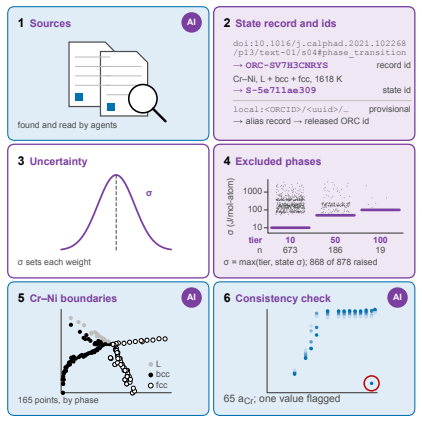
Figure 5 : Evidence used in this work. (1) Sources are found and read by AI agents. (2) Each value is stored as a record of a fully defined state, with a record id derived from its source (here the Cr–Ni eutectic, ORC-SV7H3CNRYS) and a state id derived from the state itself. (3) The uncertainty of each record sets its weight in the fit. (4) Excluded phases enter with an energy scale set by their certainty tier or by the uncertainty of the state, whichever is larger. (5) The 165 Cr– Ni phase-boundary points. (6) The consistency check on the activities of Pugliese and Fitterer [30], with one inconsistent value flagged, not changed. ORCHID v2026.10 and records extracted for this work; record identifiers are provided with the source data.
出典 · CC BY 4.0 · Raymundo Arróyave · ORCHID-SAGE: Fully Reproducible CALPHAD Assessment from Evidence to Phase Diagram · 論文の図を引用 · 元のPDFの5ページ目から図の部分を抽出しています。液体から固体へ向かう精緻化の順序
精緻化はPhaseForge+で行います。目的関数は不確かさで重み付けした観測値の尤度であり、勾配はJansson導関数で計算します。相の除外はヒンジ項でペナルティを与え、デフォルトのマージンτは100 J/mol原子です。手順は、液体と最初に融ける相を液相線、固相線、融解不変点、液体の過剰エントロピーに合わせる段階から始まります。その後、熱化学データと活量データを加え、最後に相境界データと除外する相を追加します。保有相は固定せず、一回性エネルギーに不確かさを与えた観測値でまとめておきます。
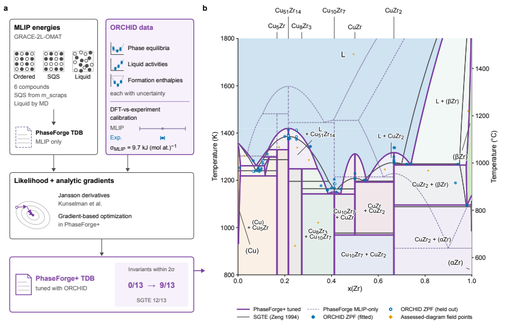
Figure 2 : An example of an automated workflow for CALPHAD model refinement:a, PhaseForge constructs the starting description from MLIP compound, solid-solution and liquid energies on SGTE unary references, and PhaseForge+ combines these with uncertainty-weighted ORCHID observations using the gradient-capable ESPEI development branch.b, Refined diagram (violet), initial MLIP description (dashed) and SGTE assessment (grey), with fitted and held-out literature points and assessed assemblages. Reproduced, under CC BY 4.0 from [5].
出典 · CC BY 4.0 · Raymundo Arróyave · ORCHID-SAGE: Fully Reproducible CALPHAD Assessment from Evidence to Phase Diagram · 論文の図を引用 · 元のPDFの3ページ目から図の部分を抽出しています。物理検査と不確かさの伝播
最終候補は、目的関数とは独立した物理検査を受けます。純元素の相の順序と融点は、SGTEと一致している必要があります。液体は、混和ギャップが報告されていない組成範囲で凸でなければなりません。固溶体の混和ギャップは目的関数にペナルティがないため、凸性の制約で確認します。この制約は、許容温度Tallow以上でのみ適用します。モデルの不確かさは、最終段階の出発点をパラメータの差に基づいてモードにまとめ、各モードでHessianを使ってLaplace近似を作ってから、混合で推定します。この混合からパラメータを抽出し、5 K格子で相分類して、許容される相の確率を求めます。
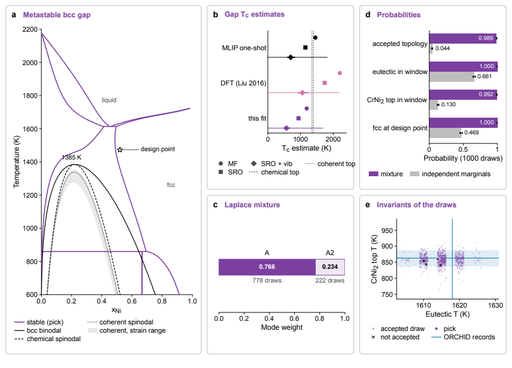
Figure 12 : Physics and uncertainty of the final fit. (a) Stable diagram (purple) with the metastable miscibility gap of BCC_A2: binodal, chemical spinodal and coherent spinodal (grey band, range of coherency strain energies), all inside the stable two- phase fields; star, the design point at xNi = 0.52 and 1473 K. (b) Estimates of the critical temperature of the bcc gap as a regular solution, with short-range order and with the excess vibrational entropy, for the one-shot model, the DFT values of Liu et al. [36] and the fit. (c) Weights of the two modes in the Laplace mixture. (d) Probabilities of the accepted topology, the eutectic and CrNi2 ranges and single-phase fcc at the design point, from the mixture (purple) and from independent marginals (grey). (e) Eutectic and CrNi2-top temperatures of the 1000 draws, with the ORCHID records (blue) and the final fit (diamond). ORCHID v2026.10 and records extracted for this work; record identifiers are provided with the source data.
出典 · CC BY 4.0 · Raymundo Arróyave · ORCHID-SAGE: Fully Reproducible CALPHAD Assessment from Evidence to Phase Diagram · 論文の図を引用 · 元のPDFの15ページ目から図の部分を抽出しています。スクリプトとAIエージェントによる再生成
検証の中心は、特定プロトコルだけでデータベースを再び作れるかを確認することです。スクリプトの再実行はDGX Sparkで、AIエージェントの再実行はMCPサーバーを通じてMac Studioで行いました。13個の検査のうち、決定論的な検査5個は両方の再実行で同一でした。数値検査8個は許容誤差内で一致しました。スクリプトの再実行では判断の段階で異なる出発点が選ばれましたが、同じモードに属していました。AIエージェントの再実行は46ターン、2時間38分、モデル利用料US$1.64で完了し、13個の検査をすべて通過しました。両方の再実行における共晶点とCrNi2上端の温度は、元の評価と同じでした。
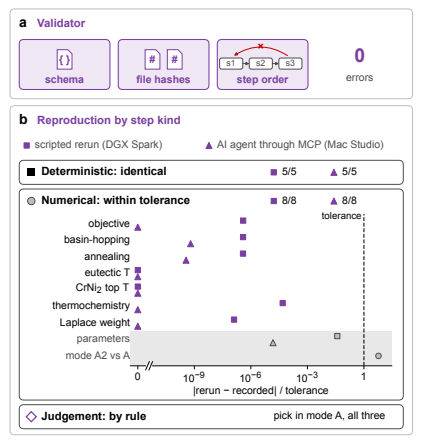
Figure 8 : Verification of the specific protocol and of its reruns. (a) The validator checks that every document conforms to the schema, that every referenced file exists with its recorded hash and that no step uses an input before it is produced. (b) Two independent reruns, one scripted on a DGX Spark and one by an AI agent through the ORCHID-SAGE server on the Mac Studio, compared with the original by step kind: deterministic outputs are identical, numerical outputs are shown relative to their declared tolerances, and the judgment step picks a start in the same mode in all three runs. The parameters are compared only as a note (grey).
出典 · CC BY 4.0 · Raymundo Arróyave · ORCHID-SAGE: Fully Reproducible CALPHAD Assessment from Evidence to Phase Diagram · 論文の図を引用 · 元のPDFの12ページ目から図の部分を抽出しています。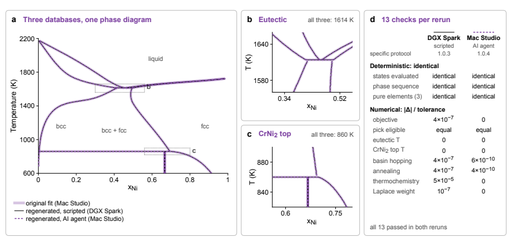
Figure 9 : Regeneration of the Cr–Ni database from its record. (a) Phase diagrams calculated from the database of the original assessment (broad light purple line) and from the databases regenerated by the scripted rerun on a DGX Spark (black line) and by the AI agent on the Mac Studio (dashed purple line). (b) The eutectic and (c) the top of CrNi 2, enlarged, with the temperature given by all three databases. (d) The checks of the specific protocol for each rerun: deterministic checks give identical results, and numerical checks are shown as the difference from the recorded value relative to its tolerance.
出典 · CC BY 4.0 · Raymundo Arróyave · ORCHID-SAGE: Fully Reproducible CALPHAD Assessment from Evidence to Phase Diagram · 論文の図を引用 · 元のPDFの13ページ目から図の部分を抽出しています。Cr–Ni相図と不確かさの結果
一回性モデルは相の種類は合っていましたが、fcc Crのエネルギー差のため、共晶点を約1935 Kと高めに予測しました。液体、固相線、固体相のデータを順に加えた最終モデルは、共晶点を1614 K、CrNi2上端を860 Kに合わせました。これらの値は、ORCHIDの記録にある1618 Kと863 Kに近いです。最終モデルのLaplace混合では98.9%のdrawが許容される相を示しました。共晶点とCrNi2上端の範囲の確率は、それぞれ90%の区間として示されました。独立した周辺分布でサンプリングすると、許容される相は4.4%に低下したため、パラメータ相関が不確かさにとって重要でした。
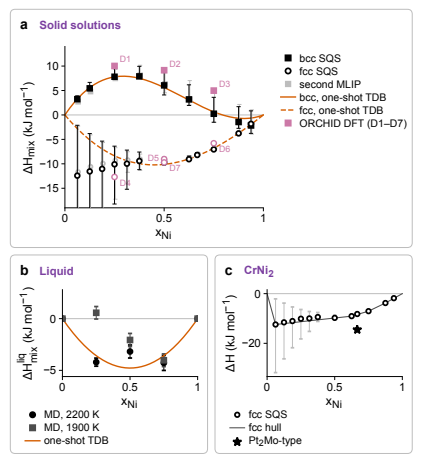
Figure 6 : Energetics of the one-shot model of Cr–Ni, in kJ/mol of atoms. (a) Mixing enthalpies of the bcc (squares) and fcc (circles) SQS, calculated with GRACE-2L-SMAX- OMAT-large (black) and GRACE-2L-OMAT (grey), with the interval between the unrelaxed and fully relaxed energies as error bars, the Redlich–Kister terms of the one-shot model (orange) and the DFT records of ORCHID (pink) [ 36, 37]. (b) Mixing enthalpy of the liquid from molecular dynamics at 2200 K and 1900 K, with the single term of the one-shot model. (c) CrNi2 against the fcc SQS and their convex hull. ORCHID v2026.10; record identifiers are provided with the source data.
出典 · CC BY 4.0 · Raymundo Arróyave · ORCHID-SAGE: Fully Reproducible CALPHAD Assessment from Evidence to Phase Diagram · 論文の図を引用 · 元のPDFの7ページ目から図の部分を抽出しています。Cr側bcc境界の不一致
最終モデルは、Crの多い側のbcc単相の状態16個を、bcc+fccまたはbcc+液体の領域内に置いています。これらの状態は3つの研究で報告されたもので、モデルのbcc境界は観測よりもCr側の高い組成まで広がっています。同じ領域にあるJetteらのfcc状態3個は、モデルのfcc境界の外側に位置しました。そのため、この不一致はモデルと根拠の間の衝突として記録されています。
適用範囲と暫定的な推定器
本論文の実験は、Cr–Niという1つの系に限られます。過剰エントロピーの計算に用いたペアエントロピー推定器は、著者らが独立した検討を経ていないと述べているため、暫定的な結果として扱われます。また、再生成の検証は、プロトコルと既に生成された一回性エネルギー計算の一部の点検に基づいており、MLIPの計算すべてを独立に再実行したものではありません。したがって、この結果はCr–Ni評価が記録から再生成できたことの根拠であり、すべての二元系や三元系で同じ再現性が確保されたという根拠ではありません。
論文情報
- 著者
- Raymundo Arróyave
- 学会・ジャーナル
- arXiv · プレプリント
- 公開日
- 2026年11月12日
- 登録日
- 2026年11月13日
- 更新日
- 2026年11月12日
- バージョン
- v1
- arXiv
- 2611.16308
- カテゴリ
- cond-mat.mtrl-sci · cs.AI
- ライセンス
- CC BY 4.0
- 掲載内容
- 論文情報・解説・論文の図
この解説は、Refivuの韓国語解説をAIで翻訳したものです。不正確な翻訳や誤りが含まれる可能性があります。論文と図の利用条件は各出典に従います。
アブストラクト
Knowledge of phase stability is the first requirement for materials design, and predicting the conditions under which new materials can be synthesized has become a key capability of self-driving laboratories (SDLs). For inorganic materials, notably alloys, these predictions come from thermodynamic databases built with the CALPHAD method. Building a database, however, requires expert judgment at many steps, and because these decisions are rarely recorded, others can use a database but cannot regenerate or update it. Machines can already collect the data, build a first model with machine-learned interatomic potentials and refine it against experiments. The assessment itself, the sequence of judgments that turns these parts into a reliable database, is still carried out by human experts. We argue that it can be automated reproducibly only if the expert knowledge behind an assessment is encoded in formal protocols, so that an assessment delivers a record of its construction and not only its parameters. We introduce ORCHID-SAGE, a standard that organizes this record into reproducible and automatable protocols. In this first attempt, applied to Cr-Ni, the database was regenerated from its record by a script on a second machine, by an AI agent working only through the Model Context Protocol (MCP) and by a refit from public sources only, with the same predictions. Recorded in this way, a database need no longer be fixed at publication but can be updated by AI agents as SDLs and other sources provide new evidence, while the judgment remains with people and on the record.
この論文を引用
Raymundo Arróyave (2026). ORCHID-SAGE: Fully Reproducible CALPHAD Assessment from Evidence to Phase Diagram. arXiv:2611.16308v1. https://arxiv.org/abs/2611.16308v1
BibTeX
@misc{arryave2026orchid,
  title = {{ORCHID-SAGE: Fully Reproducible CALPHAD Assessment from Evidence to Phase Diagram}},
  author = {Raymundo Arróyave},
  year = {2026},
  eprint = {2611.16308},
  archivePrefix = {arXiv},
  url = {https://arxiv.org/abs/2611.16308v1}
}