論文解説
LawKAN: Group-Law Layers for Composition -- When Imposing a Known Law Pays Off
LawKAN:合成のための群法則層 — 既知の法則を課すことが利益になるとき
- 課題 合成規則が既知の回転・姿勢計算において、一般的なニューラルネットワークが法則を学び直す非効率を減らすための研究です。
- 手法 KANのエッジとノードの分割を保ったまま、ノードに正確な群の法則を入れます。学習するのはエッジと0初期化の補正だけです。
- 結果 合成SU(2)ベンチマークでは、少ないパラメータでベースラインより低い誤差になりました。FR3アームの補正では、分離した補正が古典的フィッティングより低い誤差を出しています。
群の合成をモデルの学習に任せるときの課題
回転を何度も繋げてロボットの姿勢を計算するように、合成の規則があらかじめ分かっているタスクでは、一般的なニューラルネットワークはその規則を最初から学び直す必要があります。この過程で合成誤差が蓄積され、データが少ないほど不利になります。逆に、古典的な補正推定器は法則を直接コーディングしますが、ハードウェアのばらつきを捉えられない場合があります。LawKANは、この両極端の間で、既知の群の法則はノードに正確に入れ、法則で説明できない残りだけを学習する構造を扱います。この解説では、その構造がどの条件で利益になり、どこで損失になるかを中心に見ていきます。
エッジ学習と正確な群の法則ノード
LawKANは、KANのエッジとノードの分割を保ったまま、ノードの演算を加算ではなく群の法則に置き換えます。SU(2)の場合、各段の軸と位相の組 (α, β) は固定されたフーリエ特徴に変換され、エッジ行列 W_i がそれをso(3)の回転ベクトルへ送ります。ノードはこのベクトルを指数写像で単位四元数 q_i に変換し、データの合成順序に従ってHamilton積 Q = q_n···q_1 を計算します。ノードには学習パラメータがなく、学習されるのはエッジの係数だけです。任意で0に初期化された補正 ψ を合成結果に右から掛けて加えられ、初期状態ではノードは正確な法則と同じになります。この構造の鍵は、エッジが特徴空間の中で対数座標を表現できるとき、合成を正確に表現できるという点です。
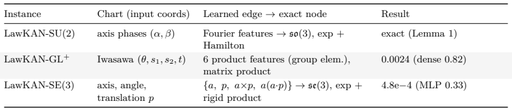
Table 1 :The three instances: one exact node, different charts and learned edges (GL+(2, R): the edge emits the group element directly, since the exponential is not global). Errors:SU(2)exact; GL+(2, R)relative Frobenius; SE(3) per-coordinate probe. Details in Section D.4.
出典 · CC BY 4.0 · Anna Mishchenko, Nikolai Gavrilin · LawKAN: Group-Law Layers for Composition -- When Imposing a Known Law Pays Off · 論文の図を引用 · 元のPDFの9ページ目から図の部分を抽出しています。
Table 10 :Edge types studied here: the feature map into the node’s target.
出典 · CC BY 4.0 · Anna Mishchenko, Nikolai Gavrilin · LawKAN: Group-Law Layers for Composition -- When Imposing a Known Law Pays Off · 論文の図を引用 · 元のPDFの28ページ目から図の部分を抽出しています。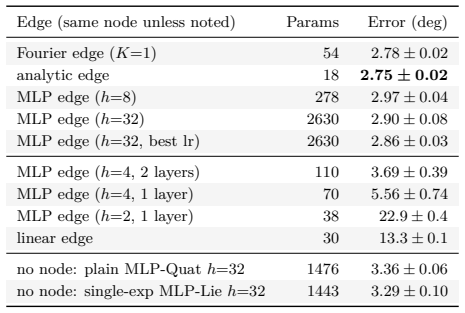
Table 17 :Node/edge isolation on the composition task (5 seeds): one fixedexp +Hamilton node, different edges (upper block); no-node controls (lower block). Mean± std, geodesic degrees; bold marks the best row. The54-parameter Fourier edge is the default used in the main text and is within noise of the18-parameter analytic edge.
出典 · CC BY 4.0 · Anna Mishchenko, Nikolai Gavrilin · LawKAN: Group-Law Layers for Composition -- When Imposing a Known Law Pays Off · 論文の図を引用 · 元のPDFの37ページ目から図の部分を抽出しています。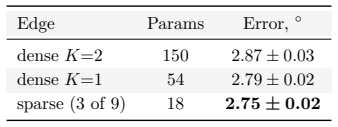
Table 27 :Fourier-order and feature sparsity abla- tion of LawKAN-SU(2) (E19.2, comp2): the exact solution needs three of the nine features; E19.2 uses 5 seeds, and denseK=2is an independent 10-seed rerun of E13.
出典 · CC BY 4.0 · Anna Mishchenko, Nikolai Gavrilin · LawKAN: Group-Law Layers for Composition -- When Imposing a Known Law Pays Off · 論文の図を引用 · 元のPDFの48ページ目から図の部分を抽出しています。合成回転ベンチマークの結果とベースライン
合成実験では、固定角度0.7と1.1 rad、入力ノイズσ=0.03の条件で2つの回転を合成し、ネットワークにプローブベクトルの向きを予測させました。評価指標は測地線角度誤差です。LawKAN-SU(2)は54個のパラメータで2.78°の誤差を示し、同じ実験で最も強い固定行列ベースラインは3.36°でした。測定されたBayes下限は約2.73°と報告されており、LawKANはそれより約0.05°上に位置しています。ただし、この結果は固定角度の設定と特定の入力ノイズでの比較であり、チューニングしたベースラインや全条件については、論文の表と付録に別途記載されています。
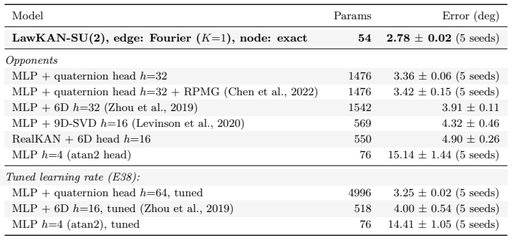
Table 2 :Opponent matrix: geodesic error (deg), mean± std, input/output noiseσ=0.03( h: hidden width); the rotation amounts are fixed, not fed as input. The full21-row table is Table 14 (Appendix E); the lower block gives the same opponents at their best learning rate (E38).
出典 · CC BY 4.0 · Anna Mishchenko, Nikolai Gavrilin · LawKAN: Group-Law Layers for Composition -- When Imposing a Known Law Pays Off · 論文の図を引用 · 元のPDFの10ページ目から図の部分を抽出しています。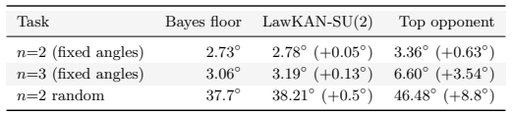
Table 16 :Bayes floor (the reported-metric minimizer gives the same floor) and the gap to it; unroundedn=2floor 2.733◦ (matched to the E1 test draws, E40) (Appendix D).
出典 · CC BY 4.0 · Anna Mishchenko, Nikolai Gavrilin · LawKAN: Group-Law Layers for Composition -- When Imposing a Known Law Pays Off · 論文の図を引用 · 元のPDFの36ページ目から図の部分を抽出しています。法則が合わないときの損失
この構造の利益は、タスクの実際の法則がノードに入れた群の法則と一致するときに生じます。つまり、誤った法則を強制すると、ノードは損失を被ります。また、エッジが正確な特徴空間を持てない場合、学習では取り除けない誤差の下限が残ります。この制限は、既知の法則が存在するという前提の範囲を定める重要な境界です。
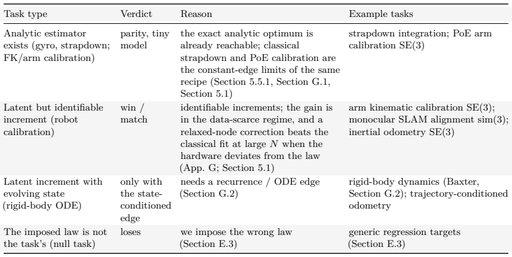
Table 6 :When the group-law node pays off: the task-type map, the paper’s main object (read a row by task type; the verdict, its structural reason and example tasks follow). The structural reason is the analytic optimum (parity), identifiability (win/match), or the absence of an analytic component. The last column names example tasks, measured here or in the literature.
出典 · CC BY 4.0 · Anna Mishchenko, Nikolai Gavrilin · LawKAN: Group-Law Layers for Composition -- When Imposing a Known Law Pays Off · 論文の図を引用 · 元のPDFの20ページ目から図の部分を抽出しています。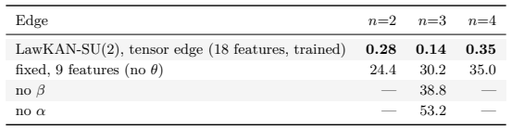
Table 28 :Variable-angle exactness (E29;θ∼U [0.2, 2.5], full SO(3) readout): constructed tensor weights are exact to 9.7×10 −7; edges missing theθchannel (or another feature group) leave positive floors.
出典 · CC BY 4.0 · Anna Mishchenko, Nikolai Gavrilin · LawKAN: Group-Law Layers for Composition -- When Imposing a Known Law Pays Off · 論文の図を引用 · 元のPDFの49ページ目から図の部分を抽出しています。FR3ロボットアーム補正での分離補正
実際のFR3ロボットアームの補正では、著者らは正確なSE(3)ノードの上に2スロットの補正 ψ(306パラメータ)を載せ、エッジを固定したまま補正だけを別に学習しました。エンドポイントの位置誤差は、N=20, 40, 60, 80の学習ポーズで測定されました。分離した2スロット補正はN≥60で1.12–1.14 mm程度となり、同じ条件のGauss–Newtonは1.29–1.33 mmでした。正確なノード単独では1.37–1.40 mmでした。この結果は1台のロボットで得られたものです。また、補正の効果が容量の増加によるものではないことを確かめる対照実験も併せて報告されています。
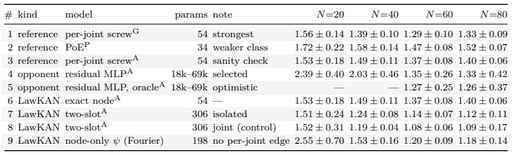
Table 3 :Real-robot calibration (FR3 arm): end-point position error (mm; mean±std over5seeds, each a random split). Nominal10.65 ± 1.90mm; the base-only fit saturates near4.4mm. Superscripts give each row’s optimizer and loss (the matched pair shares them, rows 3 and 6):A Adam+bounded2(1 −cos )pose loss; G GN on the position residual (strongest);P PoE least squares (weaker). The note marks the independent-implementation sanity check (agrees with the exact node to machine precision, X42), the isolated versus joint (control) correction, and the analytic-edge ablation; the oracle row picks the best configuration on the test set itself (it uses test information, so its error is an optimistic best-case bound, not a deployable model), reported forN≥60. The opponent’s width and learning rate are selected per seed on validation data; the18k–69k range is that per-seed selection, so the capacity comparison is against the best per-seed opponent.
出典 · CC BY 4.0 · Anna Mishchenko, Nikolai Gavrilin · LawKAN: Group-Law Layers for Composition -- When Imposing a Known Law Pays Off · 論文の図を引用 · 元のPDFの13ページ目から図の部分を抽出しています。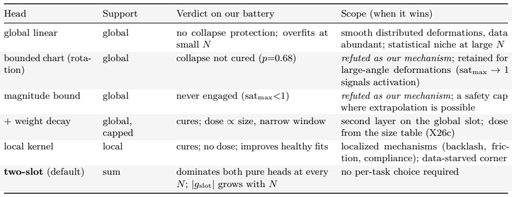
Table 25 :The correction slot: one support axis, measured scopes. Each entry was registered before its run (App. K); the winding and magnitude hypotheses were refuted and are reported. The two-slot sum is the default: it dominates both pure heads at every training size (App. G).
出典 · CC BY 4.0 · Anna Mishchenko, Nikolai Gavrilin · LawKAN: Group-Law Layers for Composition -- When Imposing a Known Law Pays Off · 論文の図を引用 · 元のPDFの45ページ目から図の部分を抽出しています。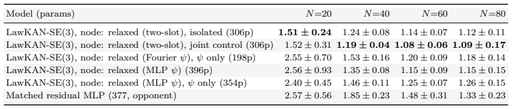
Table 26 :Almost laws on the real FR3: held-out position error (mm), 5 seeds, same splits as Table 3. Extends Table 3 with the remaining variants (ψ-only, MLP-ψ, matched residual MLP); the exact, GN and two-slot rows are in that table (the two-slot rows are repeated here for comparison). Relaxed variants add a zero-initialized shared correction ψ to the law;ψ-only counterparts have no per-joint corrections. The single-head variants show that the win does not depend on one head.
出典 · CC BY 4.0 · Anna Mishchenko, Nikolai Gavrilin · LawKAN: Group-Law Layers for Composition -- When Imposing a Known Law Pays Off · 論文の図を引用 · 元のPDFの46ページ目から図の部分を抽出しています。適用範囲と補正の失敗の様子
Kinovaソケットの実験では、グローバル補正ヘッドだけを使うと、少量データで崩壊が起きました。論文は、この不安定さを局所カーネルヘッドが取り除くと報告しており、グローバルスロットだけの問題としてまとめています。また、多くの検証は単一のロボット、複数のデータセット、3~10個のシードにまたがっているため、一般化の範囲は限定的です。この点は、補正構造の適用を判断する際に併せて読むべき制限です。
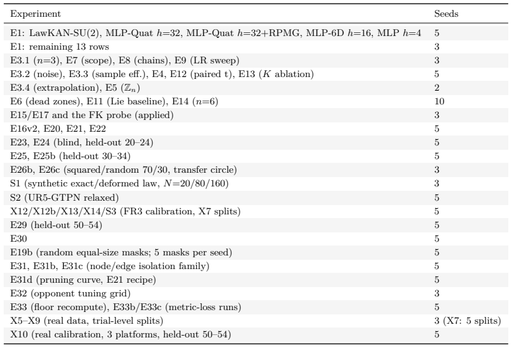
Table 8 :Seed counts for the core and applied blocks (E1–X10; E-numbers of Table 7). Later blocks state seeds in their captions and inrepro/registry.json.
出典 · CC BY 4.0 · Anna Mishchenko, Nikolai Gavrilin · LawKAN: Group-Law Layers for Composition -- When Imposing a Known Law Pays Off · 論文の図を引用 · 元のPDFの26ページ目から図の部分を抽出しています。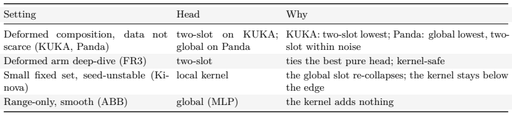
Table 21 :Which correction head to apply, by setting. The two-slot (the default) is trained jointly (sequential- on-residual matches it, Section 3.4); the local kernel is the collapse-safe choice for a small, fixed, seed-unstable configuration set; a plain global head suffices where the deformation is smooth.
出典 · CC BY 4.0 · Anna Mishchenko, Nikolai Gavrilin · LawKAN: Group-Law Layers for Composition -- When Imposing a Known Law Pays Off · 論文の図を引用 · 元のPDFの42ページ目から図の部分を抽出しています。論文情報
- 著者
- Anna Mishchenko, Nikolai Gavrilin
- 学会・ジャーナル
- arXiv · プレプリント
- 公開日
- 2026年11月9日
- 登録日
- 2026年11月11日
- 更新日
- 2026年11月9日
- バージョン
- v1
- arXiv
- 2611.12567
- カテゴリ
- cs.LG · cs.RO
- ライセンス
- CC BY 4.0
- 掲載内容
- 論文情報・解説・論文の図
この解説は、Refivuの韓国語解説をAIで翻訳したものです。不正確な翻訳や誤りが含まれる可能性があります。論文と図の利用条件は各出典に従います。
アブストラクト
Many tasks compose transformations by a known rule: chained rotations in robotics and navigation. Learned models relearn it, compounding error; classical estimators hardcode it and miss hardware deviations. We impose the known structure and learn only the remainder: an exact non-commutative group law sits in the node of a self-contained layer, its edges learn local increments, and a zero-initialized correction psi learns unknown deviations of the law. A pre-training criterion predicts exact representability. On fixed-angle SU(2) composition, a 54-parameter dense edge is the most accurate dense model, at 27x fewer parameters than the strongest fixed-matrix baseline, and lies 0.05 deg above the Bayes floor. On real robot arms, an isolated 306-parameter psi reaches 1.12-1.14 mm versus 1.29-1.33 mm for Gauss-Newton at N >= 60, and the recipe transfers across three vendors and two protocols. The recipe matches classical fits where the data obey the law and loses where the imposed law is not the task's.
この論文を引用
Anna Mishchenko, Nikolai Gavrilin (2026). LawKAN: Group-Law Layers for Composition -- When Imposing a Known Law Pays Off. arXiv:2611.12567v1. https://arxiv.org/abs/2611.12567v1
BibTeX
@misc{mishchenko2026lawkan,
  title = {{LawKAN: Group-Law Layers for Composition -- When Imposing a Known Law Pays Off}},
  author = {Anna Mishchenko and Nikolai Gavrilin},
  year = {2026},
  eprint = {2611.12567},
  archivePrefix = {arXiv},
  url = {https://arxiv.org/abs/2611.12567v1}
}