論文解説
Decomposing Earth Embeddings with Sparse Autoencoders
Sparse Autoencoderによる地球埋め込みの分解
- 課題 地球埋め込みの各次元には複数の物理的な概念が混ざっているため、解釈や頑健性の評価が難しいです。
- 手法 Sparse autoencoderで埋め込みを過完全な辞書上の疎な特徴に分解します。そのうえで、再構成、空間スケール、概念整合性を、frozen-decoderのベースラインと比べる評価プロトコルを提案しています。
- 結果 BatchTopKとMatryoshka SAEは、AlphaEarthで同じL0のすべてのベースラインより再構成が良くなりました。概念整合性と空間スケールの一部の効果はfrozenベースラインにも現れており、疎性に由来するものです。領域適用性の距離は、キャノピー高さでのみ改善が見られました。
地球埋め込みの解釈が難しい理由
衛星観測に基づく地球埋め込みは、ピクセルごとに農業、生態、水文などの複数の応用の入力として使われています。しかし、各次元は互いに無関係な物理的概念を一緒に含んでいるため、解釈や頑健性の確認が難しいです。本論文は、Sparse autoencoderを地球埋め込みに適用し、過完全な辞書上の疎で近似的に単意味的(monosemantic)な特徴へ分解することを目標としています。あわせて、自然言語モデル向けのLLM解釈評価が衛星ピクセルにはそのまま移せない、という問題も扱います。
Sparse Autoencoderと3つの疎化手法
SAEは、各埋め込みeをはるかに広い潜在ベクトルzに符号化し、再び再構成します。zは0でない要素が少数だけで、再構成誤差L_recを最小化するように学習されます。デコーダの列は辞書の原子で、学習中に単位ノルムへ再正規化されます。比較対象のBatchTopKは、学習バッチ全体でB·k個の最大の事前活性値を残します。テスト時には、学習中に推定した固定閾値で各ピクセルを独立に符号化します。Matryoshka BatchTopKは、最初のn_s個の原子だけで再構成させる損失項を加え、粗い概念から細かい概念へと続く構成を誘導します。ReLU+ℓ1はReLUを使い、ℓ1ペナルティを加えます。ペナルティの重みを調整して、平均の活性特徴数がkに合うようにします。
再構成、空間スケール、概念整合性の3つの基準
評価プロトコルでは3つの基準を使います。1つ目は、同じL0で再構成の品質を比べるため、FVEを使うことです。FVEは、再構成誤差の和を、埋め込みの平均からの偏差の二乗和で割り、その値を1から引いたものです。2つ目は、特徴の相関長をsemivarianceで推定し、空間スケールを測ることです。3つ目は、特徴が参照プロダクトのクラスとどの程度整合するかを、folded AUROCで測ることです。folded AUROCはAUROCと1−AUROCのうち大きい方なので、クラスを高く分離する特徴も低く分離する特徴も整合とみなされます。ベースラインには、デコーダをランダムに固定してエンコーダだけを学習したfrozen-decoder SAE、PCA、ICA、NMF、生の埋め込みを用います。
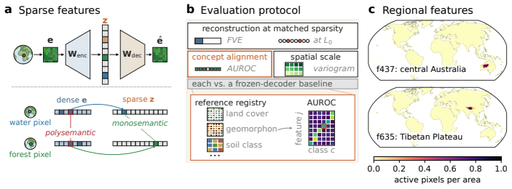
Figure 1 : Overview. (a) An SAE decomposes the embedding of each pixel into a sparse code whose features are meant to be monosemantic, whereas a dense dimension is polysemantic. (b) The evaluation protocol scores reconstruction at matched sparsity, alignment with reference concepts and spatial scale, each compared with baselines, including an SAE with a frozen random decoder. (c) For two SAE features, the share of pixels on which the feature is active in each 2◦×2◦ cell (about 220km), averaged over the test patches in the cell.
出典 · CC BY 4.0 · Vitus Benson, Fanny Yang, Markus Reichstein · Decomposing Earth Embeddings with Sparse Autoencoders · 論文の図を引用 · 元のPDFの2ページ目から図の部分を抽出しています。再構成結果とfrozen-decoderベースラインの役割
AlphaEarthでは、BatchTopKとMatryoshkaの各変種が、与えられたL0のすべてのベースラインより良い再構成を示しました。L0=16では、BatchTopKとMatryoshkaの平均コサイン類似度は0.99に近く、Tesseraでは0.95から0.96の範囲です。frozen-decoderベースラインは、ランダムな原子から16個を選んで使うだけでも、最初の16個の主成分より多くの分散を説明します(0.78 対 0.70)。しかし、学習済みの原子を使うと、L0=16で説明されない分散は2.7%に減り、frozenベースラインの22%より小さくなります。Tesseraでは、frozenベースラインがPCAと同程度のため、この場合のSAEの優位性はほとんど学習によるものです。
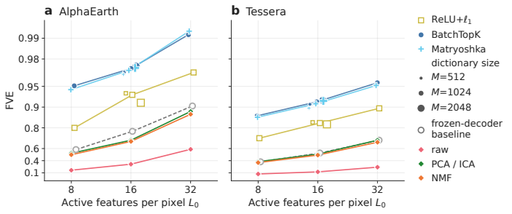
Figure 2 : Reconstruction against sparsity on (a) AlphaEarth and (b) Tessera. The fraction of variance explained (FVE) against the mean number of active features per pixel, L0. Marker size shows the dictionary sizeM. All trained SAEs reconstruct better than every baseline at everyL 0.
出典 · CC BY 4.0 · Vitus Benson, Fanny Yang, Markus Reichstein · Decomposing Earth Embeddings with Sparse Autoencoders · 論文の図を引用 · 元のPDFの7ページ目から図の部分を抽出しています。空間スケールと概念整合性の解釈
特徴の相関長を見ると、生の次元の中央値は1,240 kmですが、SAE特徴の中央値は20から33 kmです。パッチ内分散の割合も、SAE特徴では23から32%で、生の次元の9%より大きくなっています。ただし、frozen-decoderベースラインも同程度の規模に広がっているため、この空間スケールの差は、学習された辞書よりも疎性に由来すると読めます。概念整合性についても、AlphaEarthのMatryoshka特徴の88%が最大1つの概念グループと整合しており、生の次元は中央値で12個のグループと整合しています。同じ指標でfrozenベースラインも89%が最大1つのグループと整合しているため、この係数は学習された辞書の証拠としては使いにくいです。
論文では、単一特徴の整合数が疎性と絡み合っていると説明されています。
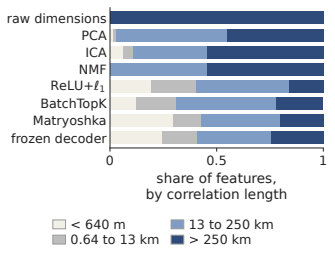
Figure 3 : Share of features by correlation length ℓj (§2.3). SAE features vary on finer scales than raw dimensions. Appendix C.1 shows the full semivariance curves.
出典 · CC BY 4.0 · Vitus Benson, Fanny Yang, Markus Reichstein · Decomposing Earth Embeddings with Sparse Autoencoders · 論文の図を引用 · 元のPDFの7ページ目から図の部分を抽出しています。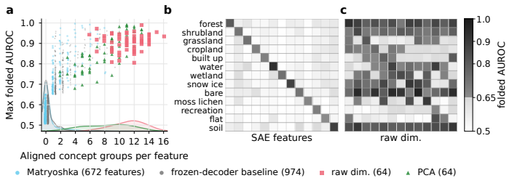
Figure 4 : Concept alignment on AlphaEarth. (a) Number of concept groups features are aligned with, against their largest folded AUROC; the legend gives the number of live features per model. (b, c) Folded AUROC of the best-aligned feature (column) for each concept group (row), for the Matryoshka SAE and the raw dimensions (13of20groups shown); dark cells are aligned.
出典 · CC BY 4.0 · Vitus Benson, Fanny Yang, Markus Reichstein · Decomposing Earth Embeddings with Sparse Autoencoders · 論文の図を引用 · 元のPDFの8ページ目から図の部分を抽出しています。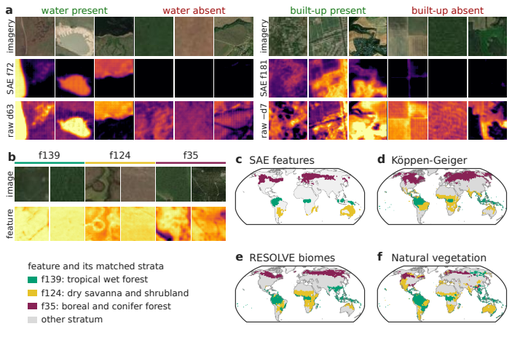
Figure 5 : Aligned features on AlphaEarth. (a) Imagery and activation of the best-aligned Matryoshka feature and raw dimension, on three test patches containing the class and three without ( − marks a sign-flipped dimension). (b) Top-activating patches of three woody-vegetation features, (c) their footprints and (d–f) the matching strata of Köppen-Geiger climate zones, RESOLVE biomes and potential natural vegetation. Appendix E contains more examples.
出典 · CC BY 4.0 · Vitus Benson, Fanny Yang, Markus Reichstein · Decomposing Earth Embeddings with Sparse Autoencoders · 論文の図を引用 · 元のPDFの9ページ目から図の部分を抽出しています。領域適用性に基づくOOD評価
2つ目の応用は、学習ピクセルとの距離によってテストピクセルが分布外かを判断する、領域適用性(area of applicability)の推定です。合成共変量シフトの設定では、リッジ回帰によりキャノピー高さと標高を予測します。各ホールドアウトについて、5個の最も近い学習ピクセルまでの平均ユークリッド距離を、生の埋め込みとSAEのコードから計算します。リッジの重みで次元に重みを付けた距離と、重みなしの距離を比べ、評価は予測絶対誤差の順位とのSpearman ρで行います。キャノピー高さでは、SAE重み付き距離が大部分のホールドアウトで生の距離より高いρを示しました。標高では、この利点は見られませんでした。
ランダムな疎コードと適用範囲の限界
キャノピー高さで見られた利得は、学習された辞書だけでは説明できません。AlphaEarthでは、同じ大きさと疎性をもつランダムな疎コードもSAEと同程度の利得を示し、Tesseraでは約3分の1程度でした。また、SAEに基づく推定が常により厳密というわけではなく、いくつかのホールドアウトでは、SAE距離が生の距離より誤差の順位を合わせられませんでした。著者らは、この方法は共変量シフトを扱うものであり、概念シフトやラベルシフトは直接捉えられないと説明しています。したがって、SAEに基づく領域適用性の推定は、実用ツールというより研究のアイデアとして読むのが適切です。
Bettiらの単意味性スコアに関する補助検討
付録の補助評価では、Bettiらが提案した単意味性スコアMSとGeoMSをSAEに適用しました。平均で見ると、学習されたSAEはfrozen-decoderベースラインの3つのシードより高いスコアを示します。ただし、最大値で見ると、2つの方式を安定して区別できません。したがって、このスコアを報告する際は、一様分布の場合の値とfrozenベースラインを併せて示すことが論文の提案です。
論文情報
- 著者
- Vitus Benson, Fanny Yang, Markus Reichstein
- 学会・ジャーナル
- arXiv · プレプリント
- 公開日
- 2026年11月8日
- 登録日
- 2026年11月10日
- 更新日
- 2026年11月8日
- バージョン
- v1
- arXiv
- 2611.11398
- カテゴリ
- cs.LG · cs.CV · physics.geo-ph
- ライセンス
- CC BY 4.0
- 掲載内容
- 論文情報・解説・論文の図
この解説は、Refivuの韓国語解説をAIで翻訳したものです。不正確な翻訳や誤りが含まれる可能性があります。論文と図の利用条件は各出典に従います。
アブストラクト
Earth observation foundation models produce global metre-resolution embeddings that underpin work across agriculture, ecology, hydrology, and beyond. Yet these embeddings are opaque: each dimension entangles unrelated physical concepts, which makes them difficult to interpret and their robustness hard to assess. Here, we propose sparse autoencoders (SAEs) as a principled way to decompose Earth embeddings into sparse, approximately monosemantic features over an overcomplete dictionary. Because LLM judges of interpretations do not transfer to satellite pixels, and spatial autocorrelation matters, we introduce a tailored evaluation protocol. It scores any SAE on reconstruction at matched sparsity, alignment with reference concepts, and spatial scale, each against baselines that include an SAE whose decoder is a frozen random dictionary. On this protocol, SAEs reconstruct AlphaEarth and Tessera embeddings better than every baseline at matched sparsity. Their features align with far fewer reference concepts than raw embedding dimensions (on AlphaEarth, 88% align with at most one of 20 concept groups, most with none, against a median of 12 per raw dimension). They also carry more of their variance at fine spatial scales (23 to 32% within a 640 m patch for BatchTopK and Matryoshka, against 9%). An SAE with a frozen random decoder shares both properties, which therefore follow from sparsity, whereas only a learned dictionary reconstructs the embedding accurately: on AlphaEarth, trained SAEs leave eight times less variance unexplained. We test the sparse code on two applications, discovering land-cover sub-concepts and detecting out-of-distribution pixels by area-of-applicability estimation. Both indicate how sparse features could be used, but neither is yet reliable enough for practical use. Together, these results are a step toward Earth observation models whose features can be inspected.
この論文を引用
Vitus Benson, Fanny Yang, Markus Reichstein (2026). Decomposing Earth Embeddings with Sparse Autoencoders. arXiv:2611.11398v1. https://arxiv.org/abs/2611.11398v1
BibTeX
@misc{benson2026decomposing,
  title = {{Decomposing Earth Embeddings with Sparse Autoencoders}},
  author = {Vitus Benson and Fanny Yang and Markus Reichstein},
  year = {2026},
  eprint = {2611.11398},
  archivePrefix = {arXiv},
  url = {https://arxiv.org/abs/2611.11398v1}
}