論文解説
OPSRL-SSP: Optimistic Posterior Sampling for Stochastic Shortest Path with Minimax-Optimal Regret
OPSRL-SSP:ミニマックス最適リグレットを持つ確率的最短経路問題のための楽観的事後サンプリング
- 課題 不確実性のある確率的最短経路問題で、事後サンプリング法がミニマックス最適な後悔の上界を達成するかを検討します。
- 手法 対数スケジュールの事後サンプル候補、Dirichletの膨張、pseudo-stateを組み合わせた楽観的事後サンプリングのアルゴリズムOPSRL-SSPを提案します。
- 結果 正のコスト条件で主項Õ(B⋆√(SAK))の後悔上界を主張しています。シミュレーションベンチマークでは、複数のベースラインと競合するか、それより低い累積後悔を報告しています。
確率的最短経路問題と事後サンプリングの空白
確率的最短経路(SSP)問題は、目標状態に到達しつつ期待累積コストを最小化する目標指向の強化学習の設定です。有限ホライズンMDPと割引MDPを含みますが、到達時間は方策によって変わり、不適切な方策では無限に大きくなりうるため、探索の設計は難しくなります。既存の楽観主義原理(OFU)に基づく手法はミニマックス最適な主項を達成しましたが、信頼集合や探索ボーナスの計算に負担があります。事後サンプリング(PSRL-SSP)は経験的に有力な代替手法ですが、後悔上界にはミニマックス下界と比べて余分な√S因子が残っている点が、この論文の出発点です。
OPSRL-SSPの楽観的事後サンプリングの構造
OPSRL-SSPはエポックごとに動作し、各状態-行動ペアについて、Dirichlet事後分布から対数個の遷移候補をサンプリングします。論文では、これを楽観性を引き出す3つの仕組みとして説明しています。一つ目は、楽観的な境界値 −2B⋆ を持つpseudo-state s0を状態空間に追加することです。二つ目は、エポックの開始ごとに時間とともに対数的に増える候補数Jtを使い、各時点の失敗確率を足し合わせられるようにすることです。三つ目は、Dirichlet集計の膨張パラメータκtを適用し、各ペアで楽観的な遷移候補が一定の下限確率を持つようにすることです。拡張状態空間でサンプリングされた候補のうち最小の予測コストを選んでベルマン固定点を計算し、その方策をエポック中に実行します。
ミニマックス最適な主項と適用条件
定理1は、信頼確率1−δで累積後悔RKがÕ(B⋆√(SAK)+B⋆S²A)以下であると主張しています。この結果は、cmin>0の正のコスト設定、B⋆ ≥ 1、および最適価値関数の最大値がB⋆以下であるという仮定のもとで成り立ちます。主項B⋆√(SAK)は、ミニマックス下界Ω(B⋆√(SAK))と一致しており、著者らは、これによってPSRL-SSPの余分な√S因子が取り除かれると説明しています。ゼロコストSSPは、コストをε以上に引き上げる摂動によって扱われ、その場合の上界はÕ(Bε√(SAK)+BεS²A)+KεT⋆で与えられます。この結果は摂動された問題に適用され、元の問題の後悔については、摂動項KεT⋆を追加で考慮する必要があります。
実験設定と比較結果
実験は、固定されたRandomMDPとGridWorldのインスタンス、および独立に生成した20個のheld-out RandomMDPインスタンスで行われました。GridWorldは10×10の格子で、シード1の固定インスタンスについて、500回の反復、5,000エピソードで評価されました。固定インスタンスの結果では、OPSRL-SSPはULCVI、SVI-SSP、EB-SSP、PSRL-SSPと競合し、LCB-ADVANTAGE-SSPやϵ-greedy Q-learningよりも低い累積後悔を示しました。held-out実験では、20インスタンスの平均終点累積後悔とnAUCが、チューニングされたULCVI、EB-SSP、LCB-ADVANTAGE-SSPの設定より低く、Bernstein-SSPおよびPSRL-SSPとは競合していたと報告されています。
これらの結果は、特定の設定と比較対象から得られたものです。
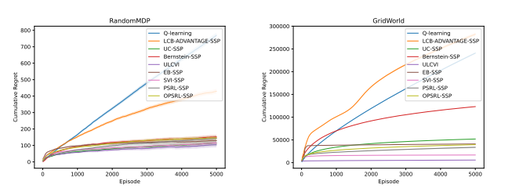
Figure 1 : Cumulative regret of SSP algorithms on RandomMDP (left) and GridWorld (right) over 5,000 episodes. Curves are averaged over 500 runs; shaded areas show 95% confidence intervals.
出典 · CC BY 4.0 · Yiming Xu, Xian Wei, Cheng Chen · OPSRL-SSP: Optimistic Posterior Sampling for Stochastic Shortest Path with Minimax-Optimal Regret · 論文の図を引用 · 元のPDFの9ページ目から図の部分を抽出しています。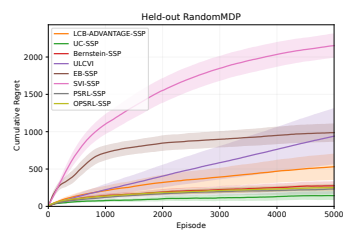
Figure 2 : Cumulative regret on 20 independently generated held-out RandomMDP instances over 5,000 episodes. Curves average 20 rollouts within each instance; shaded areas show pointwise 95% confidence intervals across instances.
出典 · CC BY 4.0 · Yiming Xu, Xian Wei, Cheng Chen · OPSRL-SSP: Optimistic Posterior Sampling for Stochastic Shortest Path with Minimax-Optimal Regret · 論文の図を引用 · 元のPDFの9ページ目から図の部分を抽出しています。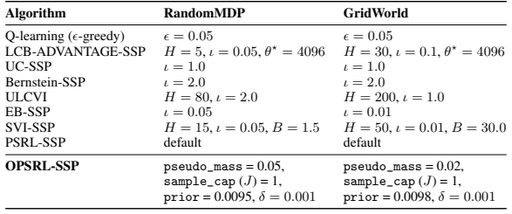
Table 3 : Hyper-parameters used in the fixed-instance RandomMDP and GridWorld experiments.
出典 · CC BY 4.0 · Yiming Xu, Xian Wei, Cheng Chen · OPSRL-SSP: Optimistic Posterior Sampling for Stochastic Shortest Path with Minimax-Optimal Regret · 論文の図を引用 · 元のPDFの39ページ目から図の部分を抽出しています。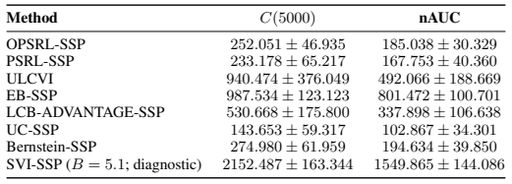
Table 5 : Held-out RandomMDP endpoint regret and nAUC across 20 independently generated instances. Intervals are environment-level 95% Student-thalf-widths.
出典 · CC BY 4.0 · Yiming Xu, Xian Wei, Cheng Chen · OPSRL-SSP: Optimistic Posterior Sampling for Stochastic Shortest Path with Minimax-Optimal Regret · 論文の図を引用 · 元のPDFの40ページ目から図の部分を抽出しています。限界と実用的実装の違い
論文は、ミニマックス最適な主項を達成する一方で、アルゴリズムは最適コストの上界B⋆を知っている必要があるという制約を明記しています。これを取り除く方法は、今後の課題として残されています。また、付録の実験では、実用的な実装のために候補数をJ=1に固定し、pseudo_massやpriorなどを定数に設定しました。論文では、この実装は理論的なスケジュールをそのまま使ったものではないと述べられています。実験の後悔はサンプルパスに基づいて測定されました。そのため、理論上の上界と実験設定は同じ条件でつながっていません。
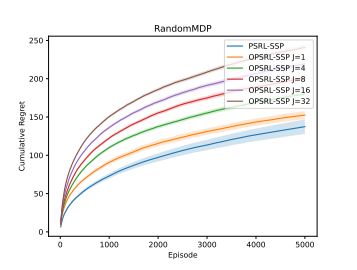
Figure 3 : Cumulative regret of OPSRL-SSP for varying numbers of posterior samples J∈ {1,4,8,16,32}.
出典 · CC BY 4.0 · Yiming Xu, Xian Wei, Cheng Chen · OPSRL-SSP: Optimistic Posterior Sampling for Stochastic Shortest Path with Minimax-Optimal Regret · 論文の図を引用 · 元のPDFの41ページ目から図の部分を抽出しています。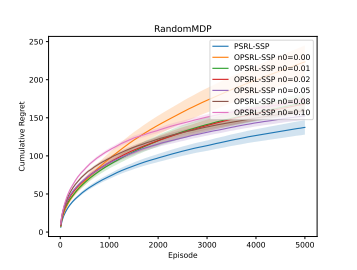
Figure 4 : Cumulative regret of OPSRL-SSP under a fixed total prior mass, varying the optimistic pseudo-massn 0.
出典 · CC BY 4.0 · Yiming Xu, Xian Wei, Cheng Chen · OPSRL-SSP: Optimistic Posterior Sampling for Stochastic Shortest Path with Minimax-Optimal Regret · 論文の図を引用 · 元のPDFの41ページ目から図の部分を抽出しています。論文情報
- 著者
- Yiming Xu, Xian Wei, Cheng Chen
- 学会・ジャーナル
- arXiv · プレプリント
- 公開日
- 2026年11月8日
- 登録日
- 2026年11月10日
- 更新日
- 2026年11月8日
- バージョン
- v1
- arXiv
- 2611.11337
- カテゴリ
- cs.LG
- ライセンス
- CC BY 4.0
- 掲載内容
- 論文情報・解説・論文の図
この解説は、Refivuの韓国語解説をAIで翻訳したものです。不正確な翻訳や誤りが含まれる可能性があります。論文と図の利用条件は各出典に従います。
アブストラクト
We study online reinforcement learning for the stochastic shortest path (SSP) problem with unknown transition dynamics. Although existing posterior-sampling methods perform well empirically on SSPs, their regret guarantees do not achieve the minimax-optimal order. We address this limitation by proposing OPSRL-SSP, an optimistic posterior-sampling algorithm for the SSP setting. The algorithm operates in epochs and uses a logarithmic, time-dependent schedule for the number of posterior samples. To induce optimism, we augment the transition model with a pseudo-state assigned an optimistic boundary value. We establish a high-probability regret bound of $\tilde{O}(B_\star \sqrt{SAK} + B_\star S^2 A)$, where $B_\star$ is an upper bound on the expected cost of the optimal policy, $S$ and $A$ are the numbers of states and actions, respectively, and $K$ is the number of episodes. In addition, we extend the analysis to general zero-cost SSPs using a universal cost-perturbation argument. The leading term matches the minimax lower bound $Ω(B_\star \sqrt{SAK})$, thereby addressing the open problem raised by Jafarnia-Jahromi et al. [19] for posterior sampling in the SSP setting.
この論文を引用
Yiming Xu, Xian Wei, Cheng Chen (2026). OPSRL-SSP: Optimistic Posterior Sampling for Stochastic Shortest Path with Minimax-Optimal Regret. arXiv:2611.11337v1. https://arxiv.org/abs/2611.11337v1
BibTeX
@misc{xu2026opsrl,
  title = {{OPSRL-SSP: Optimistic Posterior Sampling for Stochastic Shortest Path with Minimax-Optimal Regret}},
  author = {Yiming Xu and Xian Wei and Cheng Chen},
  year = {2026},
  eprint = {2611.11337},
  archivePrefix = {arXiv},
  url = {https://arxiv.org/abs/2611.11337v1}
}