論文解説
Pixels over Symbols: Sensory Realism Improves Behavioral Alignment in Models of Cognition
Pixels over Symbols:認知モデルの行動整合性を高める感覚的リアリズム
- 課題 抽象的な記号入力で学習した認知モデルが、記憶に基づく意思決定で人間の行動パターンをどの程度再現するかは不明でした。
- 手法 同じ課題で、抽象的な記号入力のモデルと、視覚エンコーダに基づく感覚的リアリズムのモデルを比べます。置換分析により、入力形式と再帰重みの寄与を切り分けます。
- 結果 感覚的リアリズムのモデルは、抽象入力のモデルより人間の応答パターンと高い一致度を示しました。Abstractモデルの再帰重みを自然入力側で再利用しても、一致度は大きく回復しました。
抽象入力モデルの限界と問い
認知モデリングでは、刺激をone-hotベクトルやスカラー値といった抽象的な記号で表すのが長く続いた慣行でした。この方法は、計算資源の制約と、感覚情報が脳の認知領域に届く前に範疇化されるという仮定に基づいてきました。しかし、抽象入力が実際の人間の行動をどの程度再現するかは、十分に検証されていません。
この論文では、抽象入力モデルと、ピクセルに基づく感覚的リアリズムのモデルを、記憶に基づく意思決定課題で直接比べます。中心となる問いは、入力形式そのものがモデルの行動を変えるのか、そして、その差は学習された再帰重みから来るのか、入力の幾何から来るのかです。
入力表現と課題構成
Naturalモデルは、HvMデータセットの画像系列を凍結した事前学習済みの視覚エンコーダで処理し、アテンションプーリングで得た画像埋め込みに、課題インデックスのone-hotベクトルを連結します。Abstractモデルは、カテゴリ、個体、位置のone-hotベクトルと、回転・大きさのスカラー値、課題インデックスを各時間ステップごとに入力します。2つの入力は、線形射影、LayerNorm、GELUを経て、同じ次元の逐次モジュールに渡されます。
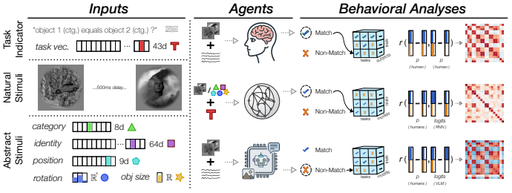
Figure 1 :Schematic of the Experimental Setup.Models receive both task and stimulus information in their inputs. Task indicator is provided in either textual or one-hot while stimuli are presented in their naturalistic or abstract formats. In the abstract format, information about the primary object in the scene is provided as a combination of one-hot (category, object identity, position) and scalar values. Three groups are studied: humans, neural network models trained on abstract or natural inputs, and pretrained vision-language models. Behavioral responses are collected from each group and used to estimate the choice probabilities for each task trial. These probabilities are then used to calculate behavioral consistency with humans using different metrics.
出典 · CC BY 4.0 · Hao Yuan Bai, Xiaoxuan Lei, Zihan Weng, Motahareh Pourrahimi, Lucas Gomez, Pouya Bashivan · Pixels over Symbols: Sensory Realism Improves Behavioral Alignment in Models of Cognition · 論文の図を引用 · 元のPDFの3ページ目から図の部分を抽出しています。課題はiWISDMで生成した43個で、遅延一致判断(DMS)、NBack、交差DMS(InterDMS)、文脈意思決定(CtxDMS)の4系統に分かれます。

Table 1 : Summary of the 43 DMS tasks.
出典 · CC BY 4.0 · Hao Yuan Bai, Xiaoxuan Lei, Zihan Weng, Motahareh Pourrahimi, Lucas Gomez, Pouya Bashivan · Pixels over Symbols: Sensory Realism Improves Behavioral Alignment in Models of Cognition · 論文の図を引用 · 元のPDFの19ページ目から図の部分を抽出しています。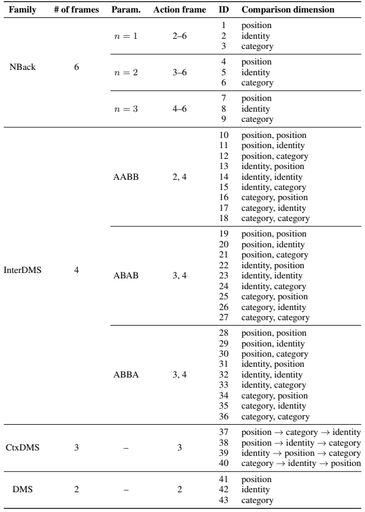
Table 6 :Complete listing of all 43 tasks.Each task is defined by a family-specific parameter (memory lag n for NBack, interleaving pattern for InterDMS) and its comparison dimension(s); for CtxDMS the arrows give the feature ordering. Raw frames are the natural sequence length; all tasks are padded to 6 frames in multi-task training. Action frames are the frames that require a response (1-based).
出典 · CC BY 4.0 · Hao Yuan Bai, Xiaoxuan Lei, Zihan Weng, Motahareh Pourrahimi, Lucas Gomez, Pouya Bashivan · Pixels over Symbols: Sensory Realism Improves Behavioral Alignment in Models of Cognition · 論文の図を引用 · 元のPDFの37ページ目から図の部分を抽出しています。人間との一致度の測定方法
モデルと人間の行動の類似性は、2つの応答ベクトル間のPearson相関で測ります。これを人間一致度と呼びます。参加者20人は2つの集団に分けて平均を比べ、モデルのシードも3つずつ分けて同じ手順を踏みます。相関はFisher z空間で平均し、人間の内部一貫性は上限として示されます。
この測定は、最終的な精度とは別に、モデルの応答パターンが人間の誤りの構造とどれだけ同じかを評価します。著者らは、Abstractモデルでは最終チェックポイントが決定的すぎるロジットを出すため、検証精度が約80%のチェックポイントを使ったと説明しています。
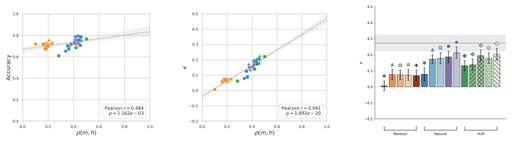
Figure 10 :Correlation of behavioral metrics.Across models, human consistency ρ(m, h)is almost linearly related to error consistency κ (Pearson r= 0.941 ) and much less to accuracy (r= 0.484 ), which motivates measuring model behavior beyond accuracy.
出典 · CC BY 4.0 · Hao Yuan Bai, Xiaoxuan Lei, Zihan Weng, Motahareh Pourrahimi, Lucas Gomez, Pouya Bashivan · Pixels over Symbols: Sensory Realism Improves Behavioral Alignment in Models of Cognition · 論文の図を引用 · 元のPDFの22ページ目から図の部分を抽出しています。Naturalモデルの行動一致度での優位
Naturalモデルは、比べた5つの逐次構造すべてで、Abstractモデルより人間一致度が高くなりました。平均差は0.199で、18個の課題条件すべてで同じ方向に現れました。この差は、画像ベースの視覚的識別可能性を回帰で取り除いても、最大0.019しか減りませんでした。

Table 3 : Natural minus Abstract difference in ρ(m, h)(mean over the five sequence models; Abstract models at the 80%-matched checkpoint) before and after regressing out visual discrim- inability. Null: mean ± SD over 10 within-condition permutations of the covariate. Effect: residual- ized minus null.
出典 · CC BY 4.0 · Hao Yuan Bai, Xiaoxuan Lei, Zihan Weng, Motahareh Pourrahimi, Lucas Gomez, Pouya Bashivan · Pixels over Symbols: Sensory Realism Improves Behavioral Alignment in Models of Cognition · 論文の図を引用 · 元のPDFの28ページ目から図の部分を抽出しています。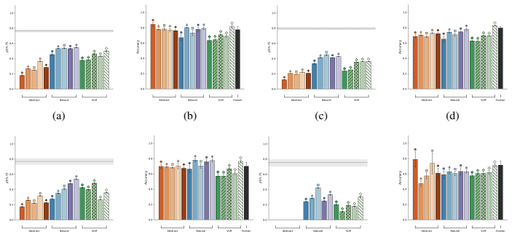
Figure 19 :Task-family human consistency and accuracy by sequence architecture.(a, b) NBack, (c, d) InterDMS, (e, f) CtxDMS and (g, h) DMS; left of each pair ρ(m, h), right MTurk accuracy. For every architecture, the Natural model is more human-consistent than the Abstract in every task family. Among Natural models, the LSTM leads on InterDMS and DMS, and the Transformer on CtxDMS, while four architectures are within 0.015 of each other on NBack. Among Abstract models, BERT leads in every family. On DMS trials (the DMS-position task only) everyAbstract model has zero correlation with humans. Abstract models are evaluated at the 80%-matched checkpoint; markers, error bars and the human reference follow Fig. 2.
出典 · CC BY 4.0 · Hao Yuan Bai, Xiaoxuan Lei, Zihan Weng, Motahareh Pourrahimi, Lucas Gomez, Pouya Bashivan · Pixels over Symbols: Sensory Realism Improves Behavioral Alignment in Models of Cognition · 論文の図を引用 · 元のPDFの30ページ目から図の部分を抽出しています。特徴別に見ると、Naturalモデルはカテゴリ、個体、位置のすべての特徴で、より高い一致度を示しました。この数値は、ResNet-CLIPバックボーンとその実験設定で得られた結果です。
入力形式と再帰重みの寄与の切り分け
著者らは、入力形式の効果を切り分けるために置換分析を行いました。ある形式で学習されたモジュールを凍結し、別の形式で残りのモジュールを再学習します。Abstractの再帰重みθを凍結したうえで、自然入力から入出力の射影だけを学習したモデルは、人間一致度0.446を示しました。本来のNaturalモデルの0.452とほぼ同じです。これは、ランダム初期化θの0.274よりずっと高い値です。
逆方向のθNat→Absは、本来のAbstractモデルより少しだけ高い程度にとどまりました。したがって、この結果は、人間の行動との一致度が再帰重みの出所よりも入力形式に強く依存するという解釈を支持します。
隠れ状態のダイナミクスの比較
ダイナミクスの比較にはDSAを使います。各課題とモデルシードの隠れ状態を上位主成分へ射影し、HAVOKで1ステップ先へ進める演算子を学習したうえで、Procrustes距離を計算します。置換したモデルのダイナミクスが、ネイティブモデルのシード間の変動の範囲に収まるかどうかで判断します。
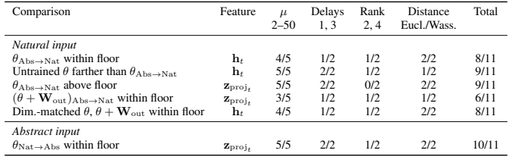
Table 4 :DSA sensitivity, number of configurations in which each comparison holds.Each column varies one setting around the default setting of the main text ( µ= 10 , 2 delays, rank 3, angular distance), which is counted once, in the µ column. The floor is the mean distance between seeds of the native model of the input modality; “within” means not significantly above it (one-sided paired Wilcoxon signed-rank test over the 12 tasks, p <0.05). The 8 optimizer and seed configurations give the default outcome in every row and are not shown.
出典 · CC BY 4.0 · Hao Yuan Bai, Xiaoxuan Lei, Zihan Weng, Motahareh Pourrahimi, Lucas Gomez, Pouya Bashivan · Pixels over Symbols: Sensory Realism Improves Behavioral Alignment in Models of Cognition · 論文の図を引用 · 元のPDFの35ページ目から図の部分を抽出しています。自然入力でAbstractのθを凍結したモデルは、同じシード変動の範囲に収まるダイナミクスを示しました。一方、出力射影まで凍結した(θ+Wout)Abs→Natモデルは、その範囲の外にとどまりました。この結果は、再帰ダイナミクスが自然入力と組み合わさって働くときの類似性を示しますが、重みが同じという意味ではありません。
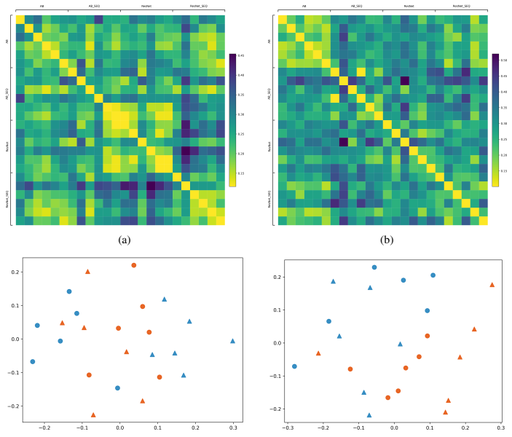
Figure 24 :Pairwise DSA distances between native and substituted models.(a) DSA pairwise distance heatmap on zprojt. (b) DSA pairwise distance heatmap on ht. (c) MDS [113] applied to thepre-computed pairwise distance matrix of zprojt. (d) MDS applied to the pairwise distance matrix ofht.
出典 · CC BY 4.0 · Hao Yuan Bai, Xiaoxuan Lei, Zihan Weng, Motahareh Pourrahimi, Lucas Gomez, Pouya Bashivan · Pixels over Symbols: Sensory Realism Improves Behavioral Alignment in Models of Cognition · 論文の図を引用 · 元のPDFの34ページ目から図の部分を抽出しています。解釈の限界と残された差
論文では、最良のモデルが人間の内部一貫性の64%しか説明しないと報告されています。著者らは、残りの差は、報酬履歴への適応、メタ認知、個人差、言語的な事前知識など、この枠組みに含まれない要因から来る可能性があると解釈しています。また、人間の参加者は課題ごとに20人に限られているため、個人差の分析にはより大きな集団が必要です。
Naturalモデルは事前学習済みの視覚エンコーダを使うため、事前学習の寄与と画像入力の寄与を完全には切り分けられません。ランダムに凍結したエンコーダは、課題をほとんど学習できませんでした。したがって、この結果は、この研究の課題集合とモデル構成の中で解釈する必要があります。

Table 2 : Natural LSTM with a frozen pretrained or a frozen randomly initialized ResNet-CLIP encoder (6 seeds). Accuracy: mean±SD over seeds;ρ(m, h): mean over 20 split-halves.
出典 · CC BY 4.0 · Hao Yuan Bai, Xiaoxuan Lei, Zihan Weng, Motahareh Pourrahimi, Lucas Gomez, Pouya Bashivan · Pixels over Symbols: Sensory Realism Improves Behavioral Alignment in Models of Cognition · 論文の図を引用 · 元のPDFの28ページ目から図の部分を抽出しています。論文情報
- 著者
- Hao Yuan Bai, Xiaoxuan Lei, Zihan Weng, Motahareh Pourrahimi, Lucas Gomez, Pouya Bashivan
- 学会・ジャーナル
- arXiv · プレプリント
- 公開日
- 2026年11月7日
- 登録日
- 2026年11月10日
- 更新日
- 2026年11月7日
- バージョン
- v1
- arXiv
- 2611.10565
- カテゴリ
- q-bio.NC · cs.AI
- ライセンス
- CC BY 4.0
- 掲載内容
- 論文情報・解説・論文の図
この解説は、Refivuの韓国語解説をAIで翻訳したものです。不正確な翻訳や誤りが含まれる可能性があります。論文と図の利用条件は各出典に従います。
アブストラクト
Computational models of cognition have traditionally relied on abstract symbolic inputs that approximate sensory experiences with simplified vector representations. This simplification reflects historical computational constraints and a long-held assumption that the details of sensory realism are incidental to the study of cognitive processes. Recent advances have enabled the development of sensory-realistic models capable of performing diverse cognitive tasks, yet whether sensory realism meaningfully shapes cognition has not been formally established. We address this gap through a large-scale empirical comparison of abstract and sensory-realistic neural network models trained on a battery of memory-dependent decision-making tasks. Our results show that sensory-realistic models mirror human behavioral response patterns significantly more than their abstract counterparts, though a substantial gap to human internal behavioral consistency remains even for the best tested models. By analyzing the internal dynamics of these systems, we find that the learned recurrent weights are not the main source of this divergence. In fact, frozen abstract-trained weights driven by sensory-realistic inputs recover the human consistency of sensory-realistic models. The resulting dynamics are also within the seed-to-seed variability of sensory-realistic models. Together, our findings argue that across a broad set of visual working-memory tasks, sensory realism accounts for a substantial portion of the model-human behavioral agreement, more than the choice of sequence architecture and comparable to the choice of vision encoder. These results suggest that findings obtained from abstract task models in neuroscience should be more carefully interpreted in light of their potential behavioral limitations.
この論文を引用
Hao Yuan Bai, Xiaoxuan Lei, Zihan Weng, Motahareh Pourrahimi, Lucas Gomez, Pouya Bashivan (2026). Pixels over Symbols: Sensory Realism Improves Behavioral Alignment in Models of Cognition. arXiv:2611.10565v1. https://arxiv.org/abs/2611.10565v1
BibTeX
@misc{bai2026pixels,
  title = {{Pixels over Symbols: Sensory Realism Improves Behavioral Alignment in Models of Cognition}},
  author = {Hao Yuan Bai and Xiaoxuan Lei and Zihan Weng and Motahareh Pourrahimi and Lucas Gomez and Pouya Bashivan},
  year = {2026},
  eprint = {2611.10565},
  archivePrefix = {arXiv},
  url = {https://arxiv.org/abs/2611.10565v1}
}