論文解説
Identifiable alignment of unpaired representations
対応のない表現の識別可能な整合
- 課題 二つの表現モデルをペアなしで整列するには、共有される距離と識別条件が必要です。
- 手法 データメトリックのプルバックを共有距離として使い、結合を計算してから、ニューラルネットワークの写像を学習します。
- 結果 Tabula Sapiens肺細胞の実験では、NGMAがペアもラベルもない状態で、ベースラインより高いR@1を報告しています。
二つの表現空間をペアなしで整列する問題
二つのモデルが同じデータ生成過程で学習されていても、ペアがなければ、各表現そのものは絶対的な意味を持ちません。残るのは、点どうしの相対的な距離と表現の分布だけです。既存の非ペア整列手法はユークリッド幾何または球面幾何を仮定しますが、この幾何はデータが決めるものではなく、任意に選ばれたものか、損失関数が課したものです。論文は、二つのモデルが共有すべき距離は何か、整列写像は一意に定まるのか、復元が適切に定義されるかを問うています。
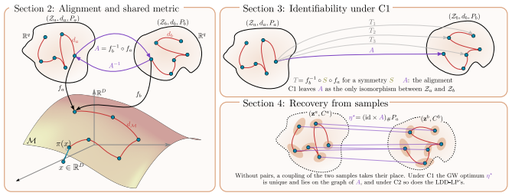
Figure 1 :Outline of Sections 2–4:the setting, identifiability and recovery from samples.
出典 · CC BY 4.0 · Stas Syrota, Albert Lopez I Serrano, Johanne Franck, Søren Hauberg · Identifiable alignment of unpaired representations · 論文の図を引用 · 元のPDFの2ページ目から図の部分を抽出しています。論文はこの問いに対し、整列写像をデータ多様体上の座標変換とみなします。そのうえで、二つのモデルが同じデータメトリックを共有するときにのみ、整列が適切に定義されると主張しています。このメトリックは各モデルのヤコビアンを通じて引き戻したプルバックメトリックであり、損失関数や構造には依存しません。
プルバックメトリックと対称性の破れの条件
論文は、データが近くに置かれた滑らかなコンパクト連結部分多様体上にあると仮定する、メトリック多様体仮説を立てます。各モデルはこの多様体のパラメータ化を与え、整列写像は二つのパラメータ化の合成として定義されます。各モデルは自身のヤコビアンを通じてデータメトリックを引き戻したプルバックメトリックを持ち、この二つのプルバックメトリックを持つ潜在空間は、等長写像で結ばれます。
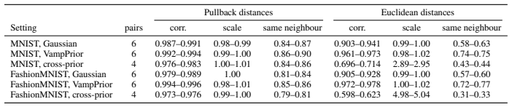
Table 6 : Pairwise distances in one model against the same pairs in the other, under the true corre- spondence, on the samples with 100% overlap (one draw, 1500 representations). Pullback distances are segment lengths under the decoder ensemble (Equation 15).corr.is the Pearson correlation of the two distance matrices,scalethe factor by which one exceeds the other, andsame neighbourthe share of images whose nearest neighbour is the same image in both models. Ranges are over pairings. Pullback distances agree across all 32 pairs (corr. 0.973–0.996, scale 0.98–1.01). Euclidean distances do not on the cross-prior pairs, with corr. 0.71, 0.61 and scale 2.92, 5.01 (MNIST, FashionMNIST). A random pairing gives|corr.| ≤0.01.
出典 · CC BY 4.0 · Stas Syrota, Albert Lopez I Serrano, Johanne Franck, Søren Hauberg · Identifiable alignment of unpaired representations · 論文の図を引用 · 元のPDFの44ページ目から図の部分を抽出しています。識別性は対称性の破れの条件C1によって整理されます。C1は、データ測度空間の恒等写像だけが距離と分布を保存する対称である、という条件です。論文は、この条件が密度の稠密な開集合で成り立つことを示しています。したがって、整列写像はC1のもとでのみ識別可能です。

Figure 2 : Three data mm-spaces on the round sphere, with the symmetries S that preserve each distribution (olive), the vMF centres (teal, area proportional to weight) and iso-density contours. O(3) consists of all isometries of the sphere, and O(2) of those that fix the vMF centre.
出典 · CC BY 4.0 · Stas Syrota, Albert Lopez I Serrano, Johanne Franck, Søren Hauberg · Identifiable alignment of unpaired representations · 論文の図を引用 · 元のPDFの4ページ目から図の部分を抽出しています。結合の計算とLDDに基づく最適化
整列写像を復元するため、論文は二つの標本間の結合をGromov–Wasserstein問題として推定します。この問題は非凸なので、点ごとの局所距離分布LDDを比較する線形計画LDD-LPも併用します。LDD-LPは凸問題ですが、より粗い情報を使います。区別可能な点の条件C2のもとでは、LDD-LPの最適結合は一意です。二つの目的を重み付けして結合した融合GWは、C1のもとでβ<1のとき、一意の最小点を保ちます。
論文は、置換設定では共有された距離行列のおかげで整列結合を正確に復元できると述べています。一方、独立標本では、有限標本では結合が正確ではないものの、一致性は得られると説明しています。
ニューラルネットワーク写像の学習による整列の推定
提案手法NGMAは、エントロピーGW結合をβを1から0まで下げる4段階で計算します。その後、この結合を目標として、二つのニューラルネットワーク写像ϕとψを学習します。二つの写像はそれぞれ整列写像とその逆に対応します。アフィン部分は直交Procrustes解で初期化され、残差ネットワークが加えられます。
学習損失は、プルバックメトリック整合項、結合目標に従うフィット項、循環一貫性項で構成されます。論文によると、ペアを使わず、相互最近傍を用いて一定回数目標を更新し、検証集合の相互最近傍の比率でチェックポイントを選びます。
Tabula Sapiens肺細胞実験の結果
論文は、Tabula Sapiensの肺細胞データで、異なる細胞で学習された二つのscVIモデルを、別々の標本どうしで整列します。評価指標は、テストセット内で、もう一方のモデルにおける自身の表現を最も近い候補として見つけるR@1です。この実験で、NGMAはペアもラベルもない状態で、ベースラインより高いR@1を報告しています。
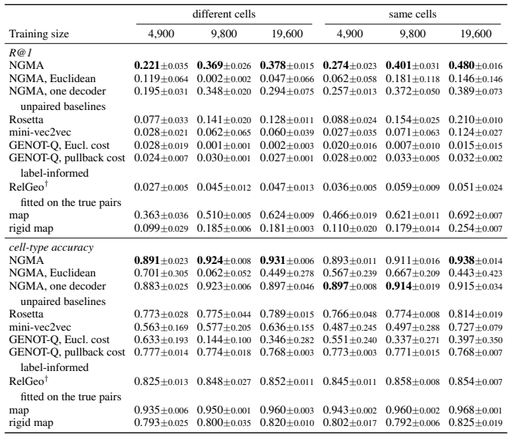
Table 9 : scVI models of Tabula Sapiens lung cells (Appendix E.6): NGMA against the unpaired baselines, on the disjoint samples (n= 3000 cells per side) of two models trained on different cells or on the same cells with different seeds, by training size. Retrieval of the true partner among the 10,000 evaluation cells (R@1, chance 10−4) and cell-type accuracy of the nearest cell (chance 0.124), scored as in Table 1. GENOT-Q runs on its own GW coupling with the Euclidean cost or with the pullback cost NGMA uses. NGMA, one decoder, reads the pullback metric of the scVI decoder alone instead of the ensemble of eight. The last two rows of each block are not methods. They are NGMA’s map class and the rigid map, both fitted on the true pairs and scored a→b . Mean ± s.d. over two pairings and three draws; the best method in each column is in bold. †RelGeo builds its anchors from the cell-type labels of both models.
出典 · CC BY 4.0 · Stas Syrota, Albert Lopez I Serrano, Johanne Franck, Søren Hauberg · Identifiable alignment of unpaired representations · 論文の図を引用 · 元のPDFの47ページ目から図の部分を抽出しています。この結果は、特定の単一細胞データセット、scVIモデル、学習細胞数という条件で得られたものです。論文は、学習細胞数によって結果が変わることも示しています。他のデータやモデルへの一般化は、この論文の直接の範囲ではありません。
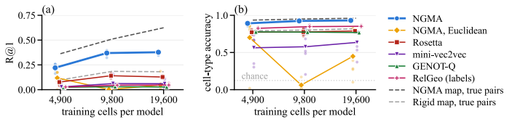
Figure 4 : scVI models of lung cells trained on different cells, aligned on disjoint samples of 3000 cells per side, against the number of training cells per model.(a)R@1 among 10,000 held-out cells (chance 10−4).(b)Cell-type accuracy of the nearest cell. Lines are means over two model pairings and three draws, faint markers are single draws, and dashed lines are maps fitted on the true pairs.
出典 · CC BY 4.0 · Stas Syrota, Albert Lopez I Serrano, Johanne Franck, Søren Hauberg · Identifiable alignment of unpaired representations · 論文の図を引用 · 元のPDFの10ページ目から図の部分を抽出しています。限界と適用範囲
論文の再帰的復元の保証は、大域最適解に対してのみ成り立ちます。NGMAのソルバーは非凸問題を扱うため、大域最適解に到達できない場合があります。また、NGMAの写像は同じ次元の潜在空間全体に作用します。潜在次元はモデリング上の選択なので、二つのモデルが異なる次元を選ぶこともあります。
識別性の条件C1はデータ生成過程に依存しており、対称性がほぼ存在する場合は、整列が失敗することがあります。論文では、左右反転に近い顔データでこのような失敗が現れたと報告されています。
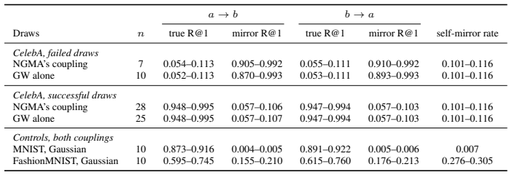
Table 8 : The mirror test. Every test image is flipped left to right and encoded by both models. True R@1 scores the image of a representation under a map against the representations of the unflipped images, and mirror R@1 against those of the flipped images, with the image’s own mirror as the partner. The self-mirror rate is the fraction of images whose own mirror is the nearest flipped representation in the same model. Ranges are over draws. The 70 CelebA alignments are the seven pairings with draws 1–5, each from NGMA’s coupling and from GW alone, and a draw fails when its R@1 is below0.3. The controls are MNIST and FashionMNIST, Gaussian pairingab, draws 1–5.
出典 · CC BY 4.0 · Stas Syrota, Albert Lopez I Serrano, Johanne Franck, Søren Hauberg · Identifiable alignment of unpaired representations · 論文の図を引用 · 元のPDFの46ページ目から図の部分を抽出しています。論文情報
- 著者
- Stas Syrota, Albert Lopez I Serrano, Johanne Franck, Søren Hauberg
- 学会・ジャーナル
- arXiv · プレプリント
- 公開日
- 2026年11月8日
- 登録日
- 2026年11月10日
- 更新日
- 2026年11月8日
- バージョン
- v1
- arXiv
- 2611.11460
- カテゴリ
- stat.ML · cs.AI · cs.LG · stat.ME
- ライセンス
- CC BY 4.0
- 掲載内容
- 論文情報・解説・論文の図
この解説は、Refivuの韓国語解説をAIで翻訳したものです。不正確な翻訳や誤りが含まれる可能性があります。論文と図の利用条件は各出典に従います。
アブストラクト
Aligning two models without paired data requires a distance that both share, yet existing methods use Euclidean or spherical geometry. This is either an arbitrary choice or imposed by their loss function. We show that, under a precise form of the manifold hypothesis, the pullback of the data metric gives such a distance for any two models of one data-generating process. This holds whether the models are encoders, decoders or both, and whatever their architecture, loss, prior or training data. The alignment map preserves this distance and the distribution of representations, and is identifiable if and only if the data distribution breaks every symmetry of the data manifold. We show that this symmetry breaking holds generically. Identifiability makes the alignment coupling the unique optimum of Gromov--Wasserstein and of its weighted combinations with a linear program. The linear program alone has the same optimum if almost every data point has a distinct distribution of distances. The coupling, and with it the alignment map, is recovered exactly from permuted samples, even without identifiability, and consistently from independent ones. Our method, Neural Gromov--Monge Alignment (NGMA), uses no pairs or labels and outperforms every unpaired and label-informed baseline. It relies on pullback distances to align image models with different priors and single-cell models trained on disjoint cells, where Euclidean distances fail.
この論文を引用
Stas Syrota, Albert Lopez I Serrano, Johanne Franck, Søren Hauberg (2026). Identifiable alignment of unpaired representations. arXiv:2611.11460v1. https://arxiv.org/abs/2611.11460v1
BibTeX
@misc{syrota2026identifiable,
  title = {{Identifiable alignment of unpaired representations}},
  author = {Stas Syrota and Albert Lopez I Serrano and Johanne Franck and Søren Hauberg},
  year = {2026},
  eprint = {2611.11460},
  archivePrefix = {arXiv},
  url = {https://arxiv.org/abs/2611.11460v1}
}