논문 해설
Identifiable alignment of unpaired representations
짝지어지지 않은 표현의 식별 가능한 정렬
- 연구 문제 두 표현 모델을 쌍 없이 정렬하려면 공유되는 거리와 식별 조건이 필요합니다.
- 연구 방법 데이터 메트릭의 풀백을 공유 거리로 쓰고, 결합을 계산한 뒤 신경망 사상을 학습합니다.
- 주요 결과 Tabula Sapiens 폐 세포 실험에서 NGMA는 쌍이나 레이블 없이 기준선보다 높은 R@1을 보고합니다.
두 표현 공간을 쌍 없이 정렬하는 문제
두 모델이 같은 데이터 생성 과정에서 학습되었더라도, 쌍이 없으면 각 표현 자체는 절대적 의미를 갖지 않습니다. 남는 정보는 점들 사이의 상대적 거리와 표현의 분포뿐입니다. 기존 비쌍 정렬 방법은 유클리드 또는 구면 기하를 가정하지만, 이 기하는 데이터가 결정하지 않는 임의의 선택이거나 손실 함수가 부과한 것입니다. 논문은 두 모델이 공유할 거리가 무엇인지, 그리고 정렬 사상이 유일하게 정해지는지와 복원이 잘 정의되는지를 묻습니다.
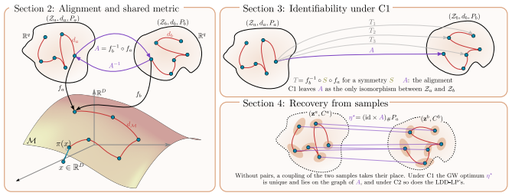
Figure 1 :Outline of Sections 2–4:the setting, identifiability and recovery from samples.
원문 · CC BY 4.0 · Stas Syrota, Albert Lopez I Serrano, Johanne Franck, Søren Hauberg · Identifiable alignment of unpaired representations · 원문 그림 인용 · 원본 PDF 2쪽에서 그림 영역을 추출했습니다.논문은 이 질문에 대해 정렬 사상을 데이터 다양체 위의 좌표 변환으로 보고, 두 모델이 같은 데이터 메트릭을 공유할 때에만 정렬이 잘 정의된다고 주장합니다. 이 메트릭은 각 모델의 자코비안을 통해 끌어올린 풀백 메트릭이며, 손실 함수나 구조에 의존하지 않습니다.
풀백 메트릭과 대칭 깨짐 조건
논문은 데이터가 가까이 놓인 매끄러운 콤팩트 연결 부분다양체 위에 있다고 가정하는 메트릭 다양체 가설을 세웁니다. 각 모델은 이 다양체의 매개화를 제공하며, 정렬 사상은 두 매개화의 합성으로 정의됩니다. 각 모델은 자신의 자코비안을 통해 데이터 메트릭을 끌어올린 풀백 메트릭을 가지며, 이 두 풀백 메트릭을 가진 잠재 공간은 서로 등거리 사상으로 연결됩니다.
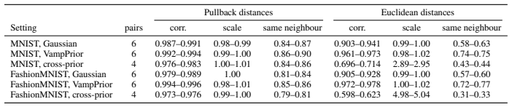
Table 6 : Pairwise distances in one model against the same pairs in the other, under the true corre- spondence, on the samples with 100% overlap (one draw, 1500 representations). Pullback distances are segment lengths under the decoder ensemble (Equation 15).corr.is the Pearson correlation of the two distance matrices,scalethe factor by which one exceeds the other, andsame neighbourthe share of images whose nearest neighbour is the same image in both models. Ranges are over pairings. Pullback distances agree across all 32 pairs (corr. 0.973–0.996, scale 0.98–1.01). Euclidean distances do not on the cross-prior pairs, with corr. 0.71, 0.61 and scale 2.92, 5.01 (MNIST, FashionMNIST). A random pairing gives|corr.| ≤0.01.
원문 · CC BY 4.0 · Stas Syrota, Albert Lopez I Serrano, Johanne Franck, Søren Hauberg · Identifiable alignment of unpaired representations · 원문 그림 인용 · 원본 PDF 44쪽에서 그림 영역을 추출했습니다.식별성은 대칭 깨짐 조건 C1로 정리됩니다. C1은 데이터 측도 공간의 항등 사상만이 거리와 분포를 보존하는 대칭이라는 조건입니다. 논문은 이 조건이 밀도의 열린 조밀 집합에서 성립함을 보입니다. 따라서 정렬 사상은 C1 아래에서만 식별 가능합니다.

Figure 2 : Three data mm-spaces on the round sphere, with the symmetries S that preserve each distribution (olive), the vMF centres (teal, area proportional to weight) and iso-density contours. O(3) consists of all isometries of the sphere, and O(2) of those that fix the vMF centre.
원문 · CC BY 4.0 · Stas Syrota, Albert Lopez I Serrano, Johanne Franck, Søren Hauberg · Identifiable alignment of unpaired representations · 원문 그림 인용 · 원본 PDF 4쪽에서 그림 영역을 추출했습니다.결합 계산과 LDD 기반 최적화
정렬 사상을 복원하기 위해 논문은 두 표본 사이의 결합을 Gromov–Wasserstein 문제로 추정합니다. 이 문제는 비볼록이므로, 점마다의 국소 거리 분포 LDD를 비교하는 선형 계획 LDD-LP를 함께 사용합니다. LDD-LP는 볼록 문제이지만 더 거친 정보를 사용합니다. 구별 가능한 점 조건 C2 아래에서 LDD-LP의 최적 결합은 유일하며, 두 목적을 가중 결합한 융합 GW는 C1 아래에서 β<1일 때 유일한 최소점을 유지합니다.
논문은 순열 설정에서는 공유된 거리 행렬 덕분에 정렬 결합을 정확히 복원할 수 있고, 독립 표본에서는 결합이 유한 표본에서 정확하지 않지만 일치성을 얻을 수 있다고 설명합니다.
신경망 사상 학습으로 정렬 추정하기
제안 방법 NGMA는 엔트로피 GW 결합을 β를 1에서 0까지 낮추는 네 단계로 계산한 뒤, 이 결합을 목표로 두 신경망 사상 ϕ와 ψ를 학습합니다. 두 사상은 각각 정렬 사상과 그 역에 대응하며, 아핀 부분은 직교 Procrustes 해로 초기화되고 잔차 네트워크가 더해집니다.
학습 손실은 풀백 메트릭 정합 항, 결합 목표를 따르는 적합 항, 순환 일관성 항으로 구성됩니다. 원문에 따르면 쌍을 사용하지 않고 상호 최근접 이웃을 이용해 일정 횟수 목표를 갱신하며, 검증 집합의 상호 최근접 이웃 비율로 체크포인트를 고릅니다.
Tabula Sapiens 폐 세포 실험 결과
논문은 Tabula Sapiens 폐 세포 데이터에서 서로 다른 세포로 학습된 두 scVI 모델을 분리된 표본으로 정렬합니다. 평가 지표는 테스트 셋 내에서 다른 모델의 자신의 표현을 가장 가까운 후보로 찾는 R@1입니다. 이 실험에서 NGMA는 쌍이나 레이블 없이 기준선보다 높은 R@1을 보고합니다.
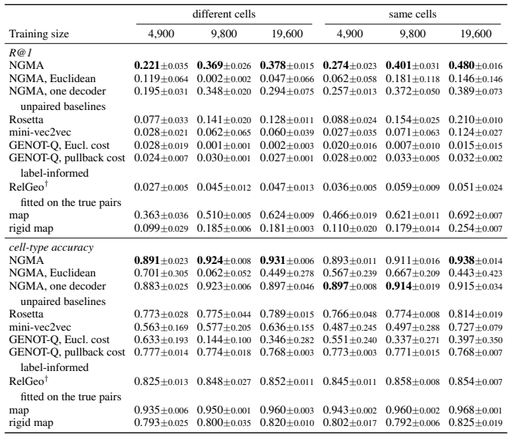
Table 9 : scVI models of Tabula Sapiens lung cells (Appendix E.6): NGMA against the unpaired baselines, on the disjoint samples (n= 3000 cells per side) of two models trained on different cells or on the same cells with different seeds, by training size. Retrieval of the true partner among the 10,000 evaluation cells (R@1, chance 10−4) and cell-type accuracy of the nearest cell (chance 0.124), scored as in Table 1. GENOT-Q runs on its own GW coupling with the Euclidean cost or with the pullback cost NGMA uses. NGMA, one decoder, reads the pullback metric of the scVI decoder alone instead of the ensemble of eight. The last two rows of each block are not methods. They are NGMA’s map class and the rigid map, both fitted on the true pairs and scored a→b . Mean ± s.d. over two pairings and three draws; the best method in each column is in bold. †RelGeo builds its anchors from the cell-type labels of both models.
원문 · CC BY 4.0 · Stas Syrota, Albert Lopez I Serrano, Johanne Franck, Søren Hauberg · Identifiable alignment of unpaired representations · 원문 그림 인용 · 원본 PDF 47쪽에서 그림 영역을 추출했습니다.이 결과는 특정 단일세포 데이터셋, scVI 모델, 학습 세포 수 조건에서 얻은 것입니다. 원문은 학습 세포 수에 따라 결과가 달라지는 것도 함께 보여 줍니다. 다른 데이터나 모델에 대한 일반화는 본 논문의 직접 범위가 아닙니다.
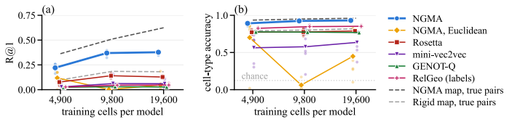
Figure 4 : scVI models of lung cells trained on different cells, aligned on disjoint samples of 3000 cells per side, against the number of training cells per model.(a)R@1 among 10,000 held-out cells (chance 10−4).(b)Cell-type accuracy of the nearest cell. Lines are means over two model pairings and three draws, faint markers are single draws, and dashed lines are maps fitted on the true pairs.
원문 · CC BY 4.0 · Stas Syrota, Albert Lopez I Serrano, Johanne Franck, Søren Hauberg · Identifiable alignment of unpaired representations · 원문 그림 인용 · 원본 PDF 10쪽에서 그림 영역을 추출했습니다.한계와 적용 범위
논문의 재귀 복원 보장은 전역 최적해에만 성립합니다. NGMA의 솔버는 비볼록 문제를 다루므로 전역 최적해에 도달하지 못할 수 있습니다. 또한 NGMA의 사상은 같은 차원의 잠재 공간 전체에 작용하며, 잠재 차원은 모델링 선택이므로 두 모델이 서로 다른 차원을 선택할 수 있습니다.
식별성 조건 C1은 데이터 생성 과정에 의존하며, 대칭이 거의 존재하는 경우 정렬이 실패할 수 있습니다. 원문은 좌우 반전에 가까운 얼굴 데이터에서 이런 실패가 나타났다고 보고합니다.
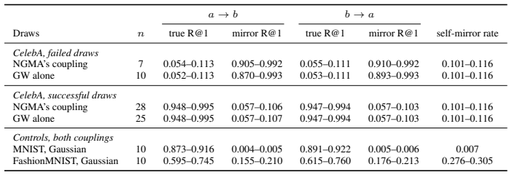
Table 8 : The mirror test. Every test image is flipped left to right and encoded by both models. True R@1 scores the image of a representation under a map against the representations of the unflipped images, and mirror R@1 against those of the flipped images, with the image’s own mirror as the partner. The self-mirror rate is the fraction of images whose own mirror is the nearest flipped representation in the same model. Ranges are over draws. The 70 CelebA alignments are the seven pairings with draws 1–5, each from NGMA’s coupling and from GW alone, and a draw fails when its R@1 is below0.3. The controls are MNIST and FashionMNIST, Gaussian pairingab, draws 1–5.
원문 · CC BY 4.0 · Stas Syrota, Albert Lopez I Serrano, Johanne Franck, Søren Hauberg · Identifiable alignment of unpaired representations · 원문 그림 인용 · 원본 PDF 46쪽에서 그림 영역을 추출했습니다.논문 정보
- 저자
- Stas Syrota, Albert Lopez I Serrano, Johanne Franck, Søren Hauberg
- 학회·저널
- arXiv · 프리프린트
- 최초 공개일
- 2026년 11월 8일
- 등록일
- 2026년 11월 10일
- 수정일
- 2026년 11월 8일
- 버전
- v1
- arXiv
- 2611.11460
- 분류
- stat.ML · cs.AI · cs.LG · stat.ME
- 원문 이용 조건
- CC BY 4.0
- 제공 범위
- 논문 정보, 해설, 허용된 원문 그림
AI 해설은 논문 원문과 별개의 설명이며 오류가 있을 수 있습니다. 원문과 그림은 각 출처의 이용 조건과 따로 표시된 권리를 따릅니다.
초록
Aligning two models without paired data requires a distance that both share, yet existing methods use Euclidean or spherical geometry. This is either an arbitrary choice or imposed by their loss function. We show that, under a precise form of the manifold hypothesis, the pullback of the data metric gives such a distance for any two models of one data-generating process. This holds whether the models are encoders, decoders or both, and whatever their architecture, loss, prior or training data. The alignment map preserves this distance and the distribution of representations, and is identifiable if and only if the data distribution breaks every symmetry of the data manifold. We show that this symmetry breaking holds generically. Identifiability makes the alignment coupling the unique optimum of Gromov--Wasserstein and of its weighted combinations with a linear program. The linear program alone has the same optimum if almost every data point has a distinct distribution of distances. The coupling, and with it the alignment map, is recovered exactly from permuted samples, even without identifiability, and consistently from independent ones. Our method, Neural Gromov--Monge Alignment (NGMA), uses no pairs or labels and outperforms every unpaired and label-informed baseline. It relies on pullback distances to align image models with different priors and single-cell models trained on disjoint cells, where Euclidean distances fail.
원문 인용
Stas Syrota, Albert Lopez I Serrano, Johanne Franck, Søren Hauberg (2026). Identifiable alignment of unpaired representations. arXiv:2611.11460v1. https://arxiv.org/abs/2611.11460v1
BibTeX
@misc{syrota2026identifiable,
  title = {{Identifiable alignment of unpaired representations}},
  author = {Stas Syrota and Albert Lopez I Serrano and Johanne Franck and Søren Hauberg},
  year = {2026},
  eprint = {2611.11460},
  archivePrefix = {arXiv},
  url = {https://arxiv.org/abs/2611.11460v1}
}