論文解説
PORT: Preference Optimization via Robust Token-Level Reweighting
PORT:頑健性のあるトークン単位の再重み付けによる選好最適化
- 課題 ノイズを含む選好データに対して、シーケンス単位で頑健化する既存の方法は、応答内のトークンごとの信頼度の違いを反映できません。
- 手法 PORTは、バッチ内のトークン対数確率の経験的CDFの差からトークンごとの重みを計算し、DPO型の損失を再重み付けします。
- 結果 AlpacaFarmとAnthropic HHの設定では、PORTは比較したベースラインより高いスコアを報告しています。
ノイズのある選好データの問題
選好最適化は、大規模言語モデルを人の選好に合わせるために広く使われていますが、その効果は選好アノテーションの品質に大きく左右されます。アノテーター間の不一致、曖昧なペア、ラベルの誤りは学習信号にノイズを入れ、勾配推定を偏らせます。既存の頑健な選好最適化手法は、応答全体を一つの単位として扱い、シーケンス単位でノイズに対処するため、拒否された応答の中にある有用な推論ステップや、選択された応答の中の局所的な誤りを区別できません。この論文は、この限界をトークン単位の再重み付けで扱います。
トークン単位CDF重みの仕組み
PORTは、ノイズのある選好データの損失を、トークンごとの対数比δ_tに重みw_tを掛けた形に変えます。理論的には、勾配バイアスの上界を最小化することで、w*(z,t) ∝ exp(-λ η(z) ||∇δ_t(z;θ)||)が得られます。ただし、ノイズ確率と勾配ノルムは学習中に観測できず、計算コストも大きいです。そこでPORTは、バッチ内の選択・拒否トークンの対数確率を集めて経験的CDF Fを作り、選択トークンのパーセンタイルF_w,tと拒否トークンのパーセンタイルF_l,tの差Δ = F_l,t − F_w,tを用いて、w_t = γ exp(−ρ Δ)を計算します。重みは勾配計算では固定係数として扱われ、正規化制約は設けられていません。
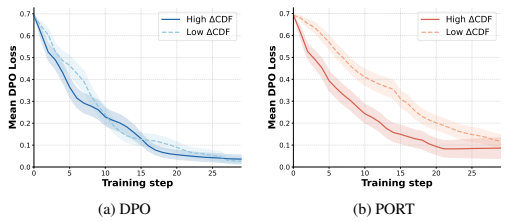
Figure 3 : Comparison of per-sample training loss trajectories between standard DPO and our proposed PORT method across 30 gradient steps. The training samples are partitioned into High ∆CDF (more reliable) and Low∆CDF (more noisy) groups.
出典 · CC BY 4.0 · Ding Zhu, Xiukun Wei, Tian Xie, Zhihui Zhu, Xueru Zhang, Mohammad Mahdi Khalili · PORT: Preference Optimization via Robust Token-Level Reweighting · 論文の図を引用 · 元のPDFの9ページ目から図の部分を抽出しています。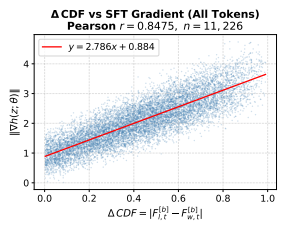
Figure 4 : Scatter plot of ∆CDF versus token-level gradient discrepancy. Since ∥∇h(z;θ)∥=∥∇ θπθ(yw|x)− ∇θπθ(yl|x)∥, we compute this quantity by taking the SFT gradients of the chosen and rejected responses separately and evaluating the norm of their dif- ference. Across a large population of tokens, an implicit linear trend emerges between the two quantities, suggesting that ∆CDF may serve as a lightweight proxy for the noise- induced gradient magnitude η(z)∥∇h(z;θ)∥ in Theorem 1, without requiring access to the unobservable statistics.
出典 · CC BY 4.0 · Ding Zhu, Xiukun Wei, Tian Xie, Zhihui Zhu, Xueru Zhang, Mohammad Mahdi Khalili · PORT: Preference Optimization via Robust Token-Level Reweighting · 論文の図を引用 · 元のPDFの19ページ目から図の部分を抽出しています。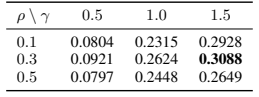
Table 5 : Sensitivity analysis of γ and ρ on LLaMA2-7B. Performance is measured by the mean ground-truth log-probability margin between chosen and rejected responses on a held-out validation set. Higher is better.
出典 · CC BY 4.0 · Ding Zhu, Xiukun Wei, Tian Xie, Zhihui Zhu, Xueru Zhang, Mohammad Mahdi Khalili · PORT: Preference Optimization via Robust Token-Level Reweighting · 論文の図を引用 · 元のPDFの21ページ目から図の部分を抽出しています。理論的根拠と適用条件
論文では、ノイズラベルが生む勾配バイアスをB = E[η(z)(∇ℓ(−z;θ) − ∇ℓ(z;θ))]と定義し、重み付き目的関数のバイアス上界を最小化する問題を立てています。定理1では、この上界の最適な重みが指数型の関数で与えられることが示されています。命題1では、η(z)と勾配の共分散に関する条件が成り立つとき、小さなλで重み付き目的関数がバイアスを減らすという十分条件が説明されています。論文では、この条件は十分条件にすぎず、必要条件ではないと述べられています。α-uncertainノイズでは、αが1より小さいときに条件が成り立つと説明されており、ε-mislabeledノイズでは、εが学習初期の基準値より大きくなければならない、という形で整理されています。
AlpacaFarmとAnthropic HHでの実験
AlpacaFarmの実験では、選好ラベルを0.3の確率で反転させ、LLaMA2-7BとQwen3-4Bを使いました。Qwen3-4Bでは、Gold RM Scoreが2.98、GPT Win Rateが53.6%でした。Anthropic HHでは、harmlessness分割で学習し、PKU-Beaver分類器で安全性の割合を評価しました。PORTのSRは0.55、GPT Win Rateは67.6%でした。これらの値は、特定のモデルとノイズ設定の結果です。
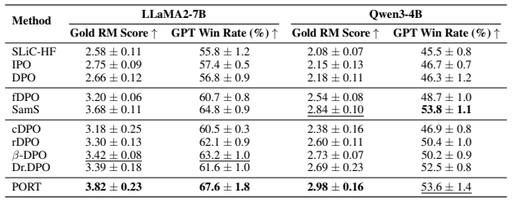
Table 1 : Evaluation results on the AlpacaFarm dataset under two model settings.Boldindicates the best performance, and underline denotes the second-best performance. The results is reported under 3 different seed and as the format of mean±standard deviation.
出典 · CC BY 4.0 · Ding Zhu, Xiukun Wei, Tian Xie, Zhihui Zhu, Xueru Zhang, Mohammad Mahdi Khalili · PORT: Preference Optimization via Robust Token-Level Reweighting · 論文の図を引用 · 元のPDFの8ページ目から図の部分を抽出しています。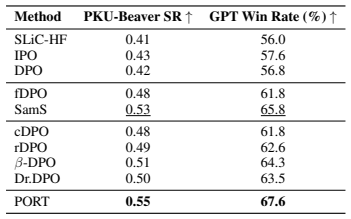
Table 2 : Results on Anthropic HH dataset (Harm- less split).Bolddenotes the best performance, underline indicates the second-best performance.
出典 · CC BY 4.0 · Ding Zhu, Xiukun Wei, Tian Xie, Zhihui Zhu, Xueru Zhang, Mohammad Mahdi Khalili · PORT: Preference Optimization via Robust Token-Level Reweighting · 論文の図を引用 · 元のPDFの8ページ目から図の部分を抽出しています。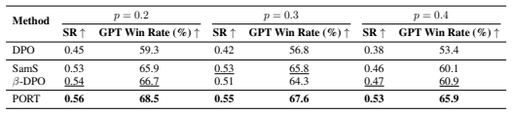
Table 3 : Ablation of Noise Intensity on Anthropic HH (evaluated by PKU- Beaver SR ↑).Bolddenotes the best performance, underline indicates the second-best performance.
出典 · CC BY 4.0 · Ding Zhu, Xiukun Wei, Tian Xie, Zhihui Zhu, Xueru Zhang, Mohammad Mahdi Khalili · PORT: Preference Optimization via Robust Token-Level Reweighting · 論文の図を引用 · 元のPDFの8ページ目から図の部分を抽出しています。適用範囲と限界
論文では、PORTのCDFに基づくproxyはバッチ単位の統計量に依存するため、バッチサイズが極端に小さい場合は信頼性が下がる可能性があると述べられています。理論的な保証も特定の十分条件の下でのみ成り立ち、実際の学習でこの条件を常に検証できるわけではありません。論文はノイズモデルをε-mislabeledとα-uncertainの2つに限定しているため、ほかの形式のノイズに対する結果は、この実験の範囲外です。
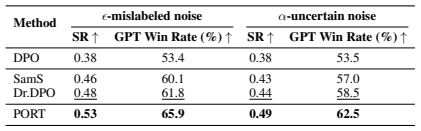
Table 4 : Impact of Noise Type on Model Performance (evaluated by PKU-Beaver SR ↑) on Anthropic HH with p= 0.4 noise level. Bolddenotes the best performance, underline indicates the second-best performance. PORT achieves consistent gains of ∼4% WR and 0.05 SR over the strongest baseline across both noise types.
出典 · CC BY 4.0 · Ding Zhu, Xiukun Wei, Tian Xie, Zhihui Zhu, Xueru Zhang, Mohammad Mahdi Khalili · PORT: Preference Optimization via Robust Token-Level Reweighting · 論文の図を引用 · 元のPDFの9ページ目から図の部分を抽出しています。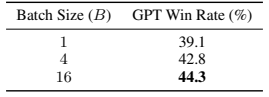
Table 6 : Effect of batch size on GPT win rate using Qwen2.5-0.5B. The reference set R pools all non-padding chosen and rejected token logits across the batch. Higher is better.
出典 · CC BY 4.0 · Ding Zhu, Xiukun Wei, Tian Xie, Zhihui Zhu, Xueru Zhang, Mohammad Mahdi Khalili · PORT: Preference Optimization via Robust Token-Level Reweighting · 論文の図を引用 · 元のPDFの21ページ目から図の部分を抽出しています。論文情報
- 著者
- Ding Zhu, Xiukun Wei, Tian Xie, Zhihui Zhu, Xueru Zhang, Mohammad Mahdi Khalili
- 学会・ジャーナル
- arXiv · プレプリント
- 公開日
- 2026年11月9日
- 登録日
- 2026年11月11日
- 更新日
- 2026年11月9日
- バージョン
- v1
- arXiv
- 2611.12763
- カテゴリ
- cs.CL · cs.AI
- ライセンス
- CC BY 4.0
- 掲載内容
- 論文情報・解説・論文の図
この解説は、Refivuの韓国語解説をAIで翻訳したものです。不正確な翻訳や誤りが含まれる可能性があります。論文と図の利用条件は各出典に従います。
アブストラクト
Preference optimization has become a central approach for aligning large language models with human values, but its effectiveness depends heavily on the quality of preference annotations. In practice, preference data is often noisy due to annotation errors and ambiguity. Existing robust preference optimization methods primarily operate at the sequence level, implicitly treating entire responses as uniformly correct or incorrect. However, rejected responses may still contain informative reasoning steps, while preferred responses can include subtle errors. In this work, we propose \textbf{P}reference \textbf{O}ptimization via \textbf{R}obust \textbf{T}oken-level reweighting \textbf{(PORT)}, a fine-grained framework for robust alignment under noisy preferences. PORT performs token-level reweighting using the empirical cumulative distribution function (CDF) of token log-probabilities, yielding an efficient forward-pass-only proxy to gradient-norm penalization that selectively suppresses corrupted tokens without additional backward-pass computation. We provide theoretical analysis showing that PORT reduces the gradient bias from noisy preference labels by minimizing an upper bound on the bias term. Extensive experiments across diverse noise settings demonstrate that PORT consistently improves robustness and outperforms existing sequence-level baselines. The code is available at https://github.com/osu-srml/PORT
この論文を引用
Ding Zhu, Xiukun Wei, Tian Xie, Zhihui Zhu, Xueru Zhang, Mohammad Mahdi Khalili (2026). PORT: Preference Optimization via Robust Token-Level Reweighting. arXiv:2611.12763v1. https://arxiv.org/abs/2611.12763v1
BibTeX
@misc{zhu2026port,
  title = {{PORT: Preference Optimization via Robust Token-Level Reweighting}},
  author = {Ding Zhu and Xiukun Wei and Tian Xie and Zhihui Zhu and Xueru Zhang and Mohammad Mahdi Khalili},
  year = {2026},
  eprint = {2611.12763},
  archivePrefix = {arXiv},
  url = {https://arxiv.org/abs/2611.12763v1}
}