論文解説
When Self-Consistency Hurts: The Hidden Cost of Majority Voting in Small Language Models
自己整合性が逆効果になるとき:小規模言語モデルにおける多数決投票の隠れたコスト
- 課題 小規模言語モデルで、プロンプトの難易度に関係なく常にSCを実行する基本方針が、実際に効果があるのかを問います。
常にSCを実行する基本方針の問題
小規模言語モデルでは、プロンプトごとの計算予算が限られています。一方で、大規模モデルから受け継いだ自己整合性(SC)は、プロンプトの難易度に関係なく固定数のサンプルを使います。この論文は、この基本方針、つまりすべての質問にSCを常に適用するalways-SCが、小規模モデルでも実際に価値があるのかを問います。既存の効率的なテスト時計算の研究では、N>1のSCを実行する価値があることが前提とされており、著者らはこの前提には検証が必要だと考えています。研究の範囲は、N=5、1B以下の2つのモデル系列、FP16とMLX-Q4の2つの精度、GSM8KとMATH-500の2つの数学ベンチマークに限られています。
役立ちと害の分解とオラクルゲート
これにより、greedyの精度はE[g]、SCの精度はE[g]+E[y]−E[h]、プロンプトごとに両者のうち良い答えを選ぶオラクルの精度はE[g]+E[y]と表せます。したがって、オラクルのSCに対する利得はちょうどE[h]に等しく、E[h]が0より大きければ、SCは常にオラクルに支配されます。ここでのオラクルは、正解をあらかじめ知っている仮想の上限であり、実際の運用で使うゲートではありません。
greedyのシグナルに基づくTTCゲート
実際に運用できる方法として、著者らはgreedyパスのシグナルでSCを呼び出すかどうかを決めるTTC-Gateを提案しています。ゲートは、スコアσ(x)が閾値τ以上であればSC@5を呼び出し、そうでなければgreedyの答えを使います。3つのゲートのうち、conf_onlyは平均トークンマージンの信頼度だけを使い、学習は行いません。logisticは、greedyの統計量とプロンプトのテキスト統計量を合わせた12個の特徴量に対するL2正則化ロジスティック回帰です。MLPは32×16の隠れ層を持つ2つの隠れ層のニューラルネットワークで、同じ特徴量を入力とし、重み付けなしの交差エントロピーで学習します。
閾値は5-foldのクロスバリデーションにおけるout-of-foldスコアから、R(τ)≥0.98の条件のもとでSC呼び出しが最小になるように選びます。
オラクルによる支配とゲートの削減効果
最も大きな差はQwen-Q4のMATH-500のセルで見られ、このセルではSCのharm比率がhelp比率を上回るため、always-SCはalways-greedyより3pt低くなります。また、この運用点のτ*は同じout-of-foldの集合から選ばれているため、retentionはやや楽観的になる可能性があります。
特徴量の数と容量によるゲートの比較
プール化したn=400では、logisticが4つのセルのうち3つでconf_onlyを上回り、残る1つのセルではconf_onlyが最良です。MLPはプール規模では最良になれず、12個の特徴量の設定では線形ゲートより性能が下がります。ただし、MLPが早期に崩壊したのか、学習予算や終了条件の影響なのかは本文で区別されていないため、この結果はその設定での比較として読むべきです。
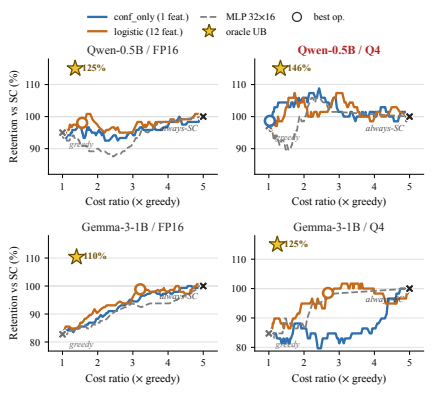
Fig. 2 .TTC-gate Pareto curves on the four pooled cells (n=400per cell). Each curve traces τ across the( C, R)plane. Gold star: oracle upper bound (annotated value is the true retention, plot is clipped at 115% for readability). Hollow circle: best operating point at R≥ 0.98. Italic labels mark always-greedy (C=1) and always-SC (C=5). Logisticbeatsconf_onlyon 3/4 pooled cells, andmlpis best on none.
出典 · CC BY 4.0 · Wanrong Yang, Lingfang Li, Jun Zhang, Dominik Wojtczak · When Self-Consistency Hurts: The Hidden Cost of Majority Voting in Small Language Models · 論文の図を引用 · 元のPDFの10ページ目から図の部分を抽出しています。適用範囲と統計上の限界
結果は、N=5、2つのモデル系列、2つの精度、2つの数学ベンチマークという狭い条件の組み合わせから得られたものです。コード生成、常識推論、より大型のモデル、推論蒸留モデル、より大きなNについては検証していません。各セルの生成シードは1つだけなので、サンプリングの分散は信頼区間に含まれていません。信頼区間は、プロンプトを再標本化する条件でのみ計算されました。計算量は生成パスの数だけで数えており、遅延、エネルギー、メモリは測定していません。また、既存の適応型SC手法とは直接比較していません。
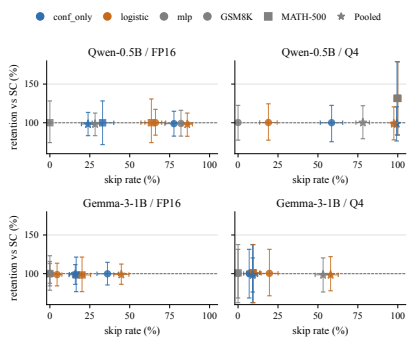
Fig. 3 .Operating points in the (skip rate, retention) plane with1 000× bootstrap95% CI bars on both axes, one panel per model-precision cell. Shape marks GSM8K (circles), MATH-500 (squares) and pooled (stars) evaluations, colour marks the gate, and the dashed line marks always-SC parity. Pooled points carry the tightest intervals; the per-task ones overlap between methods.
出典 · CC BY 4.0 · Wanrong Yang, Lingfang Li, Jun Zhang, Dominik Wojtczak · When Self-Consistency Hurts: The Hidden Cost of Majority Voting in Small Language Models · 論文の図を引用 · 元のPDFの11ページ目から図の部分を抽出しています。論文情報
- 著者
- Wanrong Yang, Lingfang Li, Jun Zhang, Dominik Wojtczak
- 学会・ジャーナル
- arXiv · プレプリント
- 公開日
- 2026年11月8日
- 登録日
- 2026年11月10日
- 更新日
- 2026年11月8日
- バージョン
- v1
- arXiv
- 2611.11201
- カテゴリ
- cs.AI
- ライセンス
- CC BY 4.0
- 掲載内容
- 論文情報・解説・論文の図
この解説は、Refivuの韓国語解説をAIで翻訳したものです。不正確な翻訳や誤りが含まれる可能性があります。論文と図の利用条件は各出典に従います。
アブストラクト
We study prompted chain-of-thought (CoT) with self-consistency (SC), i.e. sampling N traces and plurality-voting, on small language models, a regime where per-query compute budgets are tight yet SC is commonly applied with a fixed sample budget inherited from large-model practice, regardless of instance difficulty. Across two model families (Qwen-2.5-0.5B, Gemma-3-1B) at FP16 and MLX-Q4 (4-bit quantisation in Apple's MLX framework), on GSM8K and MATH-500, we run 8 per-task and 4 task-pooled experiments at n=200-400 with 1,000x paired-bootstrap confidence intervals (CIs). Our first result is an upper bound: an oracle gate deciding per prompt whether to invoke SC reaches 109-174% of always-SC's accuracy at 23-30% of its compute in all 12/12 cases, so at N=5 always-SC is dominated everywhere on our grid. That margin is exactly the rate at which SC flips correct greedy answers to wrong, here 3-10.5% of prompts, which on Qwen-Q4 x MATH-500 exceeds the wrong-to-right rate and leaves always-SC 3 pt worse than always-greedy. Our second result is a deployable approximation: a gate over greedy-pass signals skips 45-99% of SC calls, with bootstrap CI half-widths under 5 pt, removing 36-79% of always-SC compute. Accuracy retention at those operating points has point estimates of 98.1-98.8%, which we report as point estimates because their CIs are wide (lower bounds 76-86%) over an SC accuracy of only 15-36%. The evidence covers N=5 on two <=1B families and two math benchmarks, which is the scope we claim. Code is available at https://github.com/heywanrong/SiftSC.
この論文を引用
Wanrong Yang, Lingfang Li, Jun Zhang, Dominik Wojtczak (2026). When Self-Consistency Hurts: The Hidden Cost of Majority Voting in Small Language Models. arXiv:2611.11201v1. https://arxiv.org/abs/2611.11201v1
BibTeX
@misc{yang2026when,
  title = {{When Self-Consistency Hurts: The Hidden Cost of Majority Voting in Small Language Models}},
  author = {Wanrong Yang and Lingfang Li and Jun Zhang and Dominik Wojtczak},
  year = {2026},
  eprint = {2611.11201},
  archivePrefix = {arXiv},
  url = {https://arxiv.org/abs/2611.11201v1}
}