論文解説
How Should Planning Agents ReSHAPE Their Search Space?
計画エージェントは探索空間をどのようにReSHAPEすべきか
- 課題 利用者が最初に書いた仕様は、実際に受け入れる計画を取りこぼします。仕様を修正する段階は、これまで測定されていませんでした。
- 手法 プランナーの前の修正段階をReSHAPE課題として定義し、シミュレーションユーザーと対話するエージェントが仕様を修正できるかを評価します。
- 結果 ReSHAPE Travelでは、参照仕様の受容率は55%でした。現在のエージェントの最高F1,wは14.0にとどまりました。
初期仕様が見落とす計画
利用者が最初に書いた要求は、利用者が受け入れる計画をすべては含みません。利用者は具体的な選択肢を見るまで、どのトレードオフを受け入れられるかを判断しにくいからです。たとえば評価3.8以上のレストランを求めた旅行者は、価格が半分以下で評価3.3のレストランなら実際には受け入れられるかもしれませんが、その条件を事前に伝えることはできません。本論文は、この修正段階をプランナーの前にある別の課題としてReSHAPEと定義し、修正後の仕様が許す探索空間が利用者の受け入れる計画とどれだけ一致するかを測定しようとしています。
ReSHAPE課題とシミュレーションユーザー
ReSHAPEでは、エージェントがプランナーの前で利用者と対話し、初期仕様C0を修正後の仕様C′に変えます。探索空間S(C′)は、適法な計画のうちC′を満たす計画の集合です。受容可能な計画Aは、隠れた利用者効用がしきい値τ以上の計画です。利用者は隠れたプロファイルですべての計画を受容するかどうか判断し、エージェントには言語モデルが言葉にした判断のみが伝えられます。対話は質問や計画の提示で行われ、フィードバック予算Bを超えません。トレードオフの形式ci ∨ (c−i ∧ cj)は、ある属性の弱点を別の属性の強みで補う条件を表すために使われます。
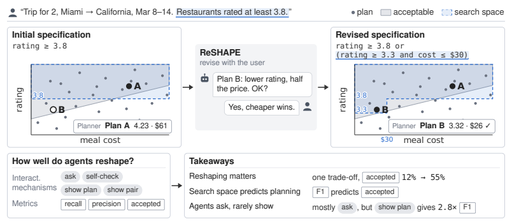
Figure 1 : ReSHAPE scores the revision step before planning.Top left:the request’s specification excludes Plan B, which the user would accept.Top:an agent revises the specification with the user, and the planner, searching the revised space, finds Plan B.Bottom left:the kinds of interaction found in agents’ logs, which we compare under a fixed feedback budget, and the metrics that score a revision: the recall and precision of its search space against the acceptable plans, and whether a fixed planner delivers an accepted plan.Bottom right:our main findings.
出典 · CC BY 4.0 · Yilin Zhang, Xinran Zhao, Tong Chen, Ziming Yuan, Tongshuang Wu · How Should Planning Agents ReSHAPE Their Search Space? · 論文の図を引用 · 元のPDFの2ページ目から図の部分を抽出しています。探索空間の指標と受容率
修正後の仕様の品質は、重み付き再現率と重み付き適合率で測定します。重み付き再現率は、受容可能な計画のうちどれだけを許容しているかを表します。重み付き適合率は、許容した計画のうちどれだけが受容可能かを表します。どちらも計画としきい値の距離で重み付けして計算します。この二つの調和平均が重み付きF1です。プランナーの結果は、固定プランナーが渡した計画が受容可能かどうかで評価します。計画を渡さなかったインスタンスは、受容されなかったものとして集計します。
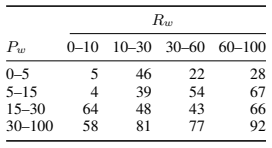
Table 24 :Acceptance by precision and recall.Accep- tance rate (%) of the planner’s delivered plans by the Pw and Rw of the specification, over all 5,368 specifica- tions. Cells hold between 35 and 2,920 specifications.
出典 · CC BY 4.0 · Yilin Zhang, Xinran Zhao, Tong Chen, Ziming Yuan, Tongshuang Wu · How Should Planning Agents ReSHAPE Their Search Space? · 論文の図を引用 · 元のPDFの23ページ目から図の部分を抽出しています。ReSHAPE Travelにおける仕様修正の結果
ReSHAPE Travelでは、参照仕様Crefの受容率が55%でした。初期仕様C0は12%にとどまりました。空の仕様では、プランナーがほぼ常に計画を渡しましたが、受容されたのは8%だけでした。現在のエージェントシステムの受容率は10~47%の範囲でした。最高システムのF1,wは14.0で、Crefの21.5を下回りました。
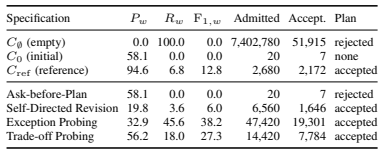
Table 7 :Specifications on travel:50.Weighted preci- sion, recall, and F1,w (×100); the number of legal plans each admits and how many of those the user accepts; and whether the plan Gemini 3.6 Flash delivers under it is accepted. Ask-before-Plan submittedC 0 unchanged, so its planner row is a second run on the same specifica- tion.
出典 · CC BY 4.0 · Yilin Zhang, Xinran Zhao, Tong Chen, Ziming Yuan, Tongshuang Wu · How Should Planning Agents ReSHAPE Their Search Space? · 論文の図を引用 · 元のPDFの13ページ目から図の部分を抽出しています。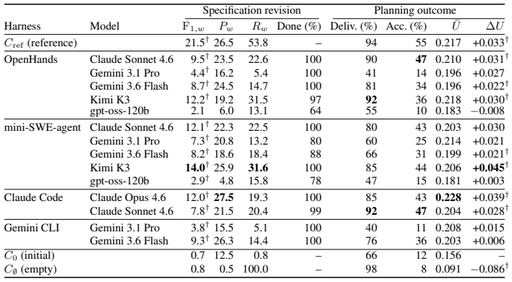
Table 20 :Full results of Table 1, with completion and utility, on 88 instances with B= 10 . Done: runs ending with the agent’s own submission. Deliv./Acc.: instances where the fixed planner delivers a plan / an acceptable plan; ¯U: mean utility of delivered plans; ∆U: paired difference from C0 on instances where both deliver. †: the 95% bootstrap CI of the difference fromC 0 excludes zero. Bold: best system per column.
出典 · CC BY 4.0 · Yilin Zhang, Xinran Zhao, Tong Chen, Ziming Yuan, Tongshuang Wu · How Should Planning Agents ReSHAPE Their Search Space? · 論文の図を引用 · 元のPDFの22ページ目から図の部分を抽出しています。ショッピング領域とシステムの順位
ReSHAPE Shoppingでも同じ傾向が見られました。両ドメインで実行された8つのシステムは、適合率と受容率の順位がおおむね同じでしたが、再現率の順位は異なりました。このことから、上位システムの判断と再現率の解釈は、ドメインごとに区別する必要があることがわかります。
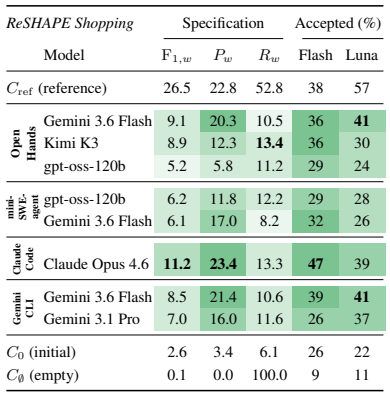
Table 2 :The same on ReSHAPE Shopping, for the eight systems run there. Columns, ordering, and shading are as in Table 1.
出典 · CC BY 4.0 · Yilin Zhang, Xinran Zhao, Tong Chen, Ziming Yuan, Tongshuang Wu · How Should Planning Agents ReSHAPE Their Search Space? · 論文の図を引用 · 元のPDFの6ページ目から図の部分を抽出しています。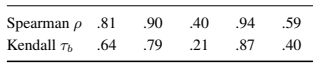
Table 3 :The two domains order the systems alike. Rank correlation between the travel and the shopping values of the 8 systems run in both (Tables 1 and 2).
出典 · CC BY 4.0 · Yilin Zhang, Xinran Zhao, Tong Chen, Ziming Yuan, Tongshuang Wu · How Should Planning Agents ReSHAPE Their Search Space? · 論文の図を引用 · 元のPDFの6ページ目から図の部分を抽出しています。対話プロトコルの比較
同じモデルと同じフィードバック予算で、4種類の対話プロトコルを比較しました。Ask-before-Planは選好に関する質問のみを行います。Self-Directed Revisionは利用者と対話せず、自分で計画を確認します。Exception Probingは、現在の仕様が除外している計画を1つ提示します。Trade-off Probingはトレードオフの仮説を、計画の2つの組で検証します。計画を提示する2つのプロトコルは、Gemini 3.6 Flashでは質問方式よりF1,wを高めました。この差は、Ask-before-Planと比べて9.7点と報告されています。
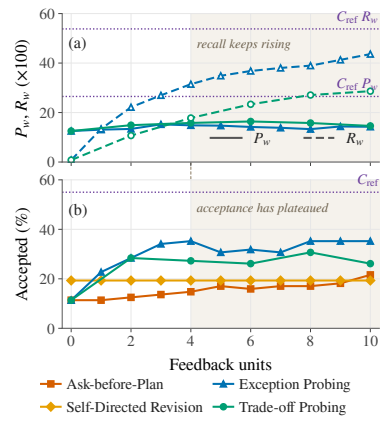
Figure 2 :(a)Precision (solid) and recall (dashed) of the probing protocols’ specifications and(b)the acceptance rate of all four protocols, after each unit of feedback. Unit 0 is C0, and Trade-off Probing spends two units per pair. In the shaded region past the fourth unit, recall keeps rising while acceptance has plateaued. Dotted lines markC ref.
出典 · CC BY 4.0 · Yilin Zhang, Xinran Zhao, Tong Chen, Ziming Yuan, Tongshuang Wu · How Should Planning Agents ReSHAPE Their Search Space? · 論文の図を引用 · 元のPDFの7ページ目から図の部分を抽出しています。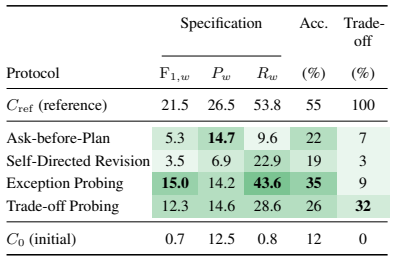
Table 4 :Interaction protocols with Gemini 3.6 Flash on 88 instances. Trade-off: runs ending with a mean- ingful trade-off (Appendix G.5). Shading as in Table 1. Bold: best per column.
出典 · CC BY 4.0 · Yilin Zhang, Xinran Zhao, Tong Chen, Ziming Yuan, Tongshuang Wu · How Should Planning Agents ReSHAPE Their Search Space? · 論文の図を引用 · 元のPDFの8ページ目から図の部分を抽出しています。限界
シミュレーションユーザーは固定された効用を持つため、対話の途中で選好が変わる実際の利用者は扱っていません。各インスタンスには1つの選択肢カテゴリのトレードオフだけを埋め込んだため、複数のトレードオフが絡み合う要求は検証していません。探索空間の品質はインスタンスの選択肢の中でのみ測定されたため、その選択肢の外への転移は確認していません。
論文情報
- 著者
- Yilin Zhang, Xinran Zhao, Tong Chen, Ziming Yuan, Tongshuang Wu
- 学会・ジャーナル
- arXiv · プレプリント
- 公開日
- 2026年11月12日
- 登録日
- 2026年11月13日
- 更新日
- 2026年11月12日
- バージョン
- v1
- arXiv
- 2611.16466
- カテゴリ
- cs.AI · cs.CL
- ライセンス
- CC BY 4.0
- 掲載内容
- 論文情報・解説・論文の図
この解説は、Refivuの韓国語解説をAIで翻訳したものです。不正確な翻訳や誤りが含まれる可能性があります。論文と図の利用条件は各出典に従います。
アブストラクト
Planning agents and benchmarks treat a user's initial specification as fixed. Yet the requests users write exclude plans they would gladly take, since they rarely discover the possible trade-offs they would accept until seeing the options. Agents already revise requests through interaction, but whether this helps planning is unknown. We formalize this step as the ReSHAPE task, which judges a revision by whether its search space matches the acceptable plans and a planner finds one there. Using ReSHAPE Planter, which builds instances from planning benchmarks with a human-validated simulated user, we analyze 5,800 agent-revised specifications in travel and shopping. We find that reshaping matters: one correct trade-off makes the same planner reach an acceptable plan up to 4.6x as often, and search space quality predicts what the planner finds. Current agents, however, admit at most 32% of the acceptable plans, where that trade-off alone admits over 52%, because they ask about preferences instead of showing plans; in travel, showing plans raises F1 by 9.7 points over asking, with two model families. Planning agents should thus treat a request as a hypothesis to test against the user's reactions to concrete plans to recognize user trade-offs.
この論文を引用
Yilin Zhang, Xinran Zhao, Tong Chen, Ziming Yuan, Tongshuang Wu (2026). How Should Planning Agents ReSHAPE Their Search Space?. arXiv:2611.16466v1. https://arxiv.org/abs/2611.16466v1
BibTeX
@misc{zhang2026should,
  title = {{How Should Planning Agents ReSHAPE Their Search Space?}},
  author = {Yilin Zhang and Xinran Zhao and Tong Chen and Ziming Yuan and Tongshuang Wu},
  year = {2026},
  eprint = {2611.16466},
  archivePrefix = {arXiv},
  url = {https://arxiv.org/abs/2611.16466v1}
}