論文解説
Shared Item-Level Error Limits the Aggregation of Small Language Models in Fermi Estimation
Fermi推定における小規模言語モデルの集約を制限する項目レベルの共有誤差
- 課題 複数のエージェントの回答を平均すると誤差が1/√Nに減るという理屈が、実際のモデルのチームでも成り立つかは不明です。
- 手法 ログ誤差をバイアス、項目共通の誤差、残差に分けて測定し、実際のチームを項目条件付きの再抽出とバイアスのないベースラインと比べます。
- 結果 N=30のチームは単一エージェントの誤差を中央値で1.7%減らしましたが、バイアスのないベースラインでの減少のうち2.2%しか実現していません。
複数エージェントの平均化の前提
複数の言語モデルをサンプリング投票、討論、モデル委員会でまとめるシステムは、平均化の理屈に頼ることが多いです。エージェントの誤差にバイアスがなく互いに独立であれば、N個の回答の集約誤差は1/√Nに減り、より大きなチームがより優れた単一エージェントの代わりになりえます。この論文は、この理屈が前提を実際に満たすかを、Fermi推定で直接検証しています。Fermi推定は、正解をすぐに見つけにくい量を桁単位で推定する課題です。答えは連続的で対数スケールで平均を取りやすいため、誤差をOOM単位で測って分解するのに適しています。モデルの大きさは3Bから72Bまでです。
誤差の分解とチームでの集約基準
著者らは対数誤差を\(e_{jk}=\mu+c_j+u_{jk}\)と書きます。ここでμはモデルの全体的なバイアスで、\(\mu+c_j\)は項目jについて、そのモデルのすべてのdrawが共有する平均誤差です。\(u_{jk}\)は1回のdrawに残る残差です。項目平均誤差の項目間分散をA、項目内残差分散の平均をBとします。\(\rho=A/(A+B)\)は、同じモデルのdraw間での項目間相関です。チームは幾何平均のルールで回答をまとめます。対数スケールで平均を取るため、チームの符号付き誤差は構成員の誤差の平均になり、式(1)がそのまま適用されます。このとき項目レベルの誤差\(\mu+c_j\)は集約後も残り、残差だけが集約されます。
比較基準は2つです。1つは同じ項目のdrawを独立に再抽出したチーム、もう1つは同じdrawに独立な乱数の符号を付けて項目ごとのバイアスを取り除いたチームです。後者は、バイアスのないdrawで集約により得られる減少を示します。このベースラインでも、項目間の難易度の差は残ります。
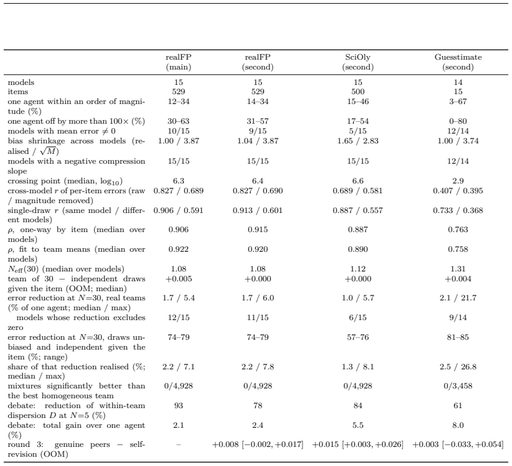
Table 2 : Principal statistics on the four data sets, computed by the same code with the same error, team rule (geometric mean) and thresholds. “Main”: the main sweep; “second”: the second corpus, which uses the revised prompt pair throughout. Counts of models are descriptive and unadjusted. SciOly errors carry the offset of its answer key; with 15 items, the slopes, correlations andρof Guesstimate are imprecise. Per-model results: Appendices C–H.
出典 · CC BY 4.0 · Carolina Fortuna, Blaz Bertalanic · Shared Item-Level Error Limits the Aggregation of Small Language Models in Fermi Estimation · 論文の図を引用 · 元のPDFの6ページ目から図の部分を抽出しています。実際のチームは独立再抽出チームとどれだけ似ているか
N=30では、実際のチームの誤差は項目条件付きの独立再抽出チームとほぼ同じでした。中央値の差は+0.005 OOMです。著者らは、この差をメンバー同士の依存ではなく、項目ごとにすべての構成員にかかる誤差によるものと解釈しています。実際のチームの減少は、単一エージェントと比べて中央値1.7%、最大5.4%でした。15モデルのうち12モデルでは、減少が0と区別できました。同じN=30で、バイアスのない項目条件付きベースラインは74–79%を減らしました。実際のチームはそのうち中央値2.2%しか実現しませんでした。同じモデルdrawのρは0.906で、項目レベルの成分が誤差分散の中央値0.906を占めました。
この値は、N=30のチームを約1.10個の独立エージェントとして見ることと同じです。
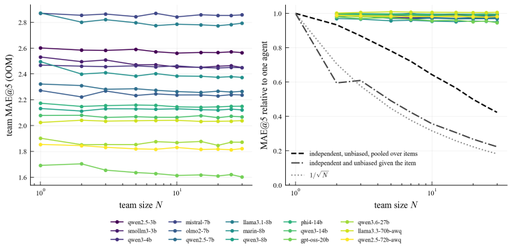
Figure 2 : Left: team MAE@5 againstN(realFP, main sweep). Right: the same relative to one agent, with the median over models of three references: draws independent and unbiased given the item (dash-dot; the kink atN= 2arises because identical draws with opposite signs cancel exactly), draws independent and unbiased across items (dashed), and the1/ √ Nrate (dotted).
出典 · CC BY 4.0 · Carolina Fortuna, Blaz Bertalanic · Shared Item-Level Error Limits the Aggregation of Small Language Models in Fermi Estimation · 論文の図を引用 · 元のPDFの7ページ目から図の部分を抽出しています。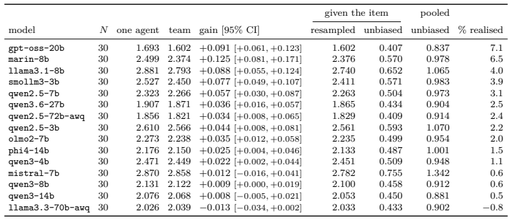
Table D.1 : Teams at the largestNeach model ran (geometric mean). “Gain”: one agent minus team, with an item-clustered interval. References (Section 3.2): MAE@5 of teams whose members are resampled from the same item’s draws, with their signs (“resampled”) or random signs (“unbiased”), and of teams whose members are drawn across items with random signs (“pooled”). “% realised”: gain as a share of the gain of the unbiased per-item reference.
出典 · CC BY 4.0 · Carolina Fortuna, Blaz Bertalanic · Shared Item-Level Error Limits the Aggregation of Small Language Models in Fermi Estimation · 論文の図を引用 · 元のPDFの17ページ目から図の部分を抽出しています。討論と自己修正は項目レベルの誤差を変えるか
ラウンド2と3では、エージェントが仲間の回答を見て自分の回答を修正します。15モデルのうち12モデルでDは0になりました。5人を集約したチームの誤差は2.281から2.251 OOMに減り、討論後は2.233 OOMとなって、全体で2.1%を得ました。生成コストは約15倍です。仲間を見ず、自分の前の回答だけを見て修正する対照群でも、似た小さな改善が見られました。realFPでは、ラウンド3の差は+0.008 [−0.002, +0.017]で、自己修正の方がわずかに良い方向ですが、0を含んでいます。この結果は、討論が分散は減らすものの項目レベルの誤差は変えないという解釈と整合します。
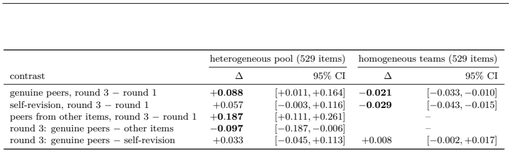
Table 3 : Change in team MAE@5 (OOM), paired by item, with 95% item-clustered intervals; positive values indicate degradation, bold an interval that excludes zero. Left: baseline arm of the heterogeneous pool. Right: second corpus, pooled over 15 models with equal weight and over all team sizes; it ran no placebo arm.
出典 · CC BY 4.0 · Carolina Fortuna, Blaz Bertalanic · Shared Item-Level Error Limits the Aggregation of Small Language Models in Fermi Estimation · 論文の図を引用 · 元のPDFの8ページ目から図の部分を抽出しています。モデルの混合とプロンプト・温度への介入
精度が近い5モデルを1つのチームに混ぜると、同じモデルだけで組んだ同質チームより誤差が6.6%減りました(0.142 OOM、95%区間0.095–0.191)。ただし、最も正確なモデルの同質チームより良くなることはありませんでした。4,928通りの混合のどれも、最も正確なモデルのチームより有意に良くはありませんでした。計算機のオフロードは、チームの誤差を+0.540 OOM悪化させました。温度実験では、4モデルをT=0.4、0.8、1.0で動かしました。
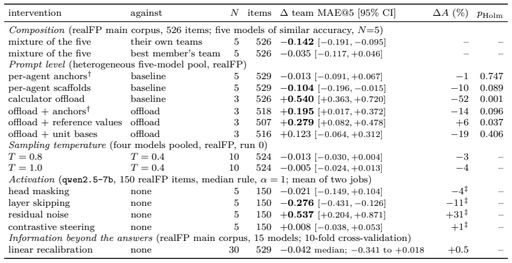
Table 4 : Interventions.∆team: paired change in team MAE@5 (OOM; negative is better) with a 95% item-clustered interval, bold if it excludes zero.∆A: relative change of the item-level component.†Anchor identity is confounded with model identity (Appendix G).‡UnwinsorizedAof the screen, comparable only within the screen. Winsorization lowersAwhenever an arm inflates the within-item spread severalfold (calculator offload,B+6.45OOM 2), so∆Ais not interpretable for those arms. Holm: adjusted over the six prompt-level arms. The recalibration row gives the median and range over models of the change for teams of 30.
出典 · CC BY 4.0 · Carolina Fortuna, Blaz Bertalanic · Shared Item-Level Error Limits the Aggregation of Small Language Models in Fermi Estimation · 論文の図を引用 · 元のPDFの9ページ目から図の部分を抽出しています。事後再較正の効果と限界
線形再較正は、項目の平均対数推定値を正解の対数値に写す直線変換です。この変換は、学習用のサンプル9/10で当てはめ、残りの1/10で評価する10分割交差検証を用いました。単一エージェントの誤差は中央値で2.7%減り、N=30のチームの誤差は中央値で4.3%減りました。再較正がない場合のチームの減少は1.5%でした。著者らは、この効果は主に全体のバイアスµを取り除くことから来ていると見ています。傾きbは1より小さく、過大評価の圧縮も残ります。再較正は推定値と正解の大きさしか使わないため、項目特有の誤差を見分けることはできません。
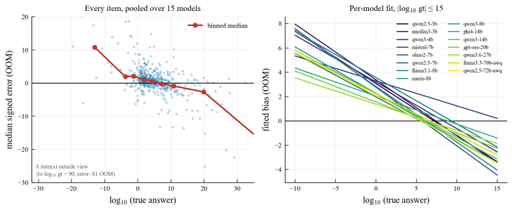
Figure 1 : Round-1 estimates compress toward a central magnitude. Left: per-item median signed error against the true answer, pooled over 15 models, with the binned median. Right: per-model linear fits on |log 10y|≤15.
出典 · CC BY 4.0 · Carolina Fortuna, Blaz Bertalanic · Shared Item-Level Error Limits the Aggregation of Small Language Models in Fermi Estimation · 論文の図を引用 · 元のPDFの5ページ目から図の部分を抽出しています。適用範囲と検証していない条件
著者らは、ρとAはベンチマーク項目の分布の性質であり、エージェント間の条件付き依存性は測っていないと述べています。ただし、この値が項目レベルの相関の原因を明らかにするわけではありません。ラウンド2と3では、パーサーが混合表記を誤って読み、異種チームに誤った仲間の値を見せていました。そのため、異種討論に関する決定的な検定は示せていません。温度スイープは4モデル、1回のrun、T≤1のみを扱いました。活性化スクリーンは1モデルと150項目でした。SciOlyは正解キーのオフセットを、Guesstimateは15項目のみを持ちます。大型モデルやクローズドなモデルは検証していません。

Table 1 : Corpora. All sample atT= 0.4(the temperature sweep also at 0.8 and 1.0) with top-p= 0.95, 1024 new tokens (512 in the activation screen) and thinking modes disabled. “Both pairs”: the main sweep mixes two prompt pairs (Section 3.3). Guesstimate has answers from 14 models. Models, serving and coverage: Appendix B.
出典 · CC BY 4.0 · Carolina Fortuna, Blaz Bertalanic · Shared Item-Level Error Limits the Aggregation of Small Language Models in Fermi Estimation · 論文の図を引用 · 元のPDFの4ページ目から図の部分を抽出しています。論文情報
- 著者
- Carolina Fortuna, Blaz Bertalanic
- 学会・ジャーナル
- arXiv · プレプリント
- 公開日
- 2026年11月12日
- 登録日
- 2026年11月13日
- 更新日
- 2026年11月12日
- バージョン
- v1
- arXiv
- 2611.16315
- カテゴリ
- cs.MA · cs.AI
- ライセンス
- CC BY 4.0
- 掲載内容
- 論文情報・解説・論文の図
この解説は、Refivuの韓国語解説をAIで翻訳したものです。不正確な翻訳や誤りが含まれる可能性があります。論文と図の利用条件は各出典に従います。
アブストラクト
Multi-agent systems of language models are often motivated by an averaging argument: if the agents' errors are unbiased and independent, the error of an aggregate of N answers falls as 1/sqrt(N). Fermi estimation, whose continuous answers are aggregated on the logarithmic scale, permits a direct test. We decompose the log10 error of each answer into the mean error of its model on the item, common to all its draws on the item, and a residual, and estimate both from 2.51M answers given before any communication by 15 open-weight models (3B-72B) on realFP, with replication under a single prompt pair on realFP, Science Olympiad Fermi questions and a guesstimation set. Given the item, teammates' errors are uncorrelated and teams behave as independent draws, but the item-level component accounts for a median 0.906 of the error variance over items. Teams of thirty therefore reduce a single agent's error by a median 1.7% (at most 5.4%), whereas draws that were also unbiased on each item would reduce it by 74-79%. All models compress their estimates toward about 10^6; this trend explains a median 17% of the item-level component, and a cross-validated linear recalibration on labelled items removes the overall bias but not that component. Three rounds of debate reduce within-team dispersion by 93% and leave the item-level component unchanged; revision without peers attains the same small gain. Mixing five models of similar accuracy reduces error by 6.6% relative to their own homogeneous teams, but no mixture improves on the most accurate model. Higher sampling temperature changes team error by about 1% at most, and contrastive activation steering not detectably; per-agent scaffold prompts (not significant after multiplicity correction) and skipping one layer in a single-model screen improve it. The results are conditional on the models, benchmarks, prompts and settings tested.
この論文を引用
Carolina Fortuna, Blaz Bertalanic (2026). Shared Item-Level Error Limits the Aggregation of Small Language Models in Fermi Estimation. arXiv:2611.16315v1. https://arxiv.org/abs/2611.16315v1
BibTeX
@misc{fortuna2026shared,
  title = {{Shared Item-Level Error Limits the Aggregation of Small Language Models in Fermi Estimation}},
  author = {Carolina Fortuna and Blaz Bertalanic},
  year = {2026},
  eprint = {2611.16315},
  archivePrefix = {arXiv},
  url = {https://arxiv.org/abs/2611.16315v1}
}