論文解説
Detection Is Not Early Warning: Evaluating Token-Level Alarms on Language Model Failures
検出は早期警告ではない:言語モデルの失敗を対象としたトークン単位のアラーム評価
- 課題 応答完了後のAUROCでは、モニターが失敗の前に警告するかどうかはわかりません。
- 手法 注釈されたonsetを基準に検証閾値を固定し、テストアラームの時点を採点します。
- 結果 APERTUSとLLAMAでは、プローブの多くがonsetより前に警告しました。適応によって警告カバレッジは2倍を超えて高まりました。
応答レベル評価が見落とす早期警告
言語モデルの失敗は、特定のトークンから始まることがよくあります。この開始点をonsetと呼び、反復的な劣化では最初のループの最初のトークンとして定義されます。生成中にモデルを読み取るモニターは、完成した応答を分類したり、失敗の進行中に検出したり、失敗が始まる前に警告したりできます。このうち警告だけが、生成を止めたり調整したりする時間を残します。しかしAUROCのような応答レベルの指標は、モニターがいつアラームを鳴らすかを見ません。この論文はこの評価上の空白を問題とし、反復的な劣化を事例として、onsetを基準にアラームの時点を採点する方法を扱っています。
PREWARNの3段階の評価手順
PREWARNは、注釈されたonsetを持つどの失敗にも適用できる評価プロトコルです。まず検証分割で、健全な応答のうちアラームを鳴らす割合が予算β以下になる最も低い閾値を選びます。この閾値は式 τ*(β)=min{τ: |{r∈H: α_r<∞}| ≤ β|H|} で定義され、テスト分割ではこの値を固定したままモニターを実行します。各応答の最初のアラームα_rは、最初のフラグの位置です。最後に、最初のアラームをonsetと比較します。早期警告タスクでは、onsetの直前のW=256個の位置からなる警告ウィンドウを数え、早期警告率は、最初のアラームがonsetより前にある失敗応答の割合です。ランダムなアラームと比べて読めるように設計されています。
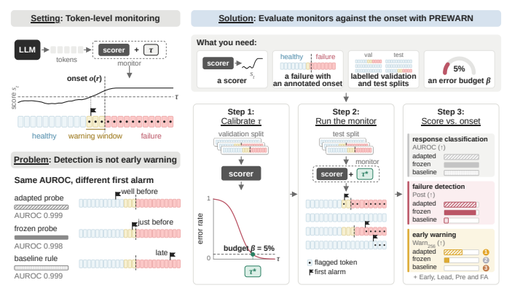
Figure 1 : Overview of PREWARN. Left: a monitor runs a scorer over the generated tokens and alarms where the score crosses τ (dots mark flagged tokens, the flag the first alarm); AUROC rates three such monitors as equal although their first alarms fall well before, just before and after the onset o(r). Right: what PREWARNneeds and its three steps: calibrate the threshold on validation to the budget β, run the monitor on the test split, and score the alarms against the onset on the three tasks.
出典 · CC BY 4.0 · Marco De Negri, Luca Sartori, Lorenzo Baggi, Moritz Reihs, Eduard Frank Ďurech, Mennatallah El-Assady, Valentina Pyatkin, Anna Hedström · Detection Is Not Early Warning: Evaluating Token-Level Alarms on Language Model Failures · 論文の図を引用 · 元のPDFの2ページ目から図の部分を抽出しています。固定プローブと適応型プローブ
プローブは、1つのレイヤーの残差ストリームを読み取る線形モデルです。固定プローブは重みとバイアス、そして層正規化のアフィンパラメータだけを学習し、生成器のアクティベーションをそのまま使います。適応型プローブは、これに加えて0からℓレイヤーまでのrank-16 LoRAアダプターも学習するため、適応されたレイヤーを通る2回目の順伝播が必要です。学習目標は、onsetよりK=256トークン前から陽性になる二値目標で、失敗がテキストに現れる前にプローブが発火するよう設計されています。レイヤーとチェックポイントは、検証でβ=1%のときにWarn256が最も高い設定を選びますが、事後カバレッジが0.3以上のものだけを候補にします。
応答レベル指標とonset基準指標の違い
APERTUSのレイヤー15で、トークン長ルール、適応型プローブ、2つの固定プローブを比較しました。応答分類では、4つのscorerのAUROCがいずれも0.998以上でほぼ同じで、token-capルールのbest accuracyが最も高くなりました。一方で、事後カバレッジと警告カバレッジはscorerごとに大きく異なりました。適応型プローブの警告カバレッジは、2つの固定プローブより3倍以上高く記録されました。応答レベルの指標は応答の最大値トークンだけを見るため、アラームの位置を区別できません。同じAUROCを持つscorerでも、フラグを警告区間に移すと早期警告の指標は大きく変わりました。
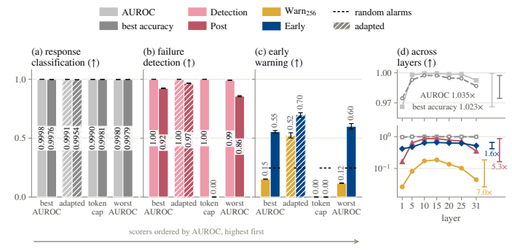
Figure 2 : Response-level metrics rate four scorers as equal, while only the onset-aligned metrics show how differently they perform. Scorers on APERTUSat layer 15: the frozen probes with the highest and lowest validation AUROC (Section A.5), the adapted probe (hatched) and the token-cap rule, which flags only the last token of a capped response. Panels (a)–(c) group the metrics by task (Section 3); dashed lines in (c) are random alarms. (d) The frozen probe with the selected strategy across layers, with each metric’s best-to-worst ratio; lower plot on a log scale. β= 5% , human-verified in-domain test split; error bars and bands are one standard deviation over three seeds.
出典 · CC BY 4.0 · Marco De Negri, Luca Sartori, Lorenzo Baggi, Moritz Reihs, Eduard Frank Ďurech, Mennatallah El-Assady, Valentina Pyatkin, Anna Hedström · Detection Is Not Early Warning: Evaluating Token-Level Alarms on Language Model Failures · 論文の図を引用 · 元のPDFの6ページ目から図の部分を抽出しています。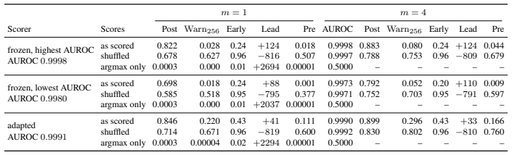
Table 4 : Scorers with the same AUROC range from one that almost never warns to one that warns before almost every loop. From each probe of Figure 2, two transforms keep the highest score of every response, and with it the AUROC and the calibrated threshold at m= 1, but move its other flags. Shuffled: the token scores of each response permuted at random, which spreads the flags over the whole response. Argmax only: every score except the highest set to the minimum, which leaves at most one flag per response. As scored: the original scores. m: number of consecutive flagged tokens needed for an alarm (Equation (3)); at m= 4 the threshold is recalibrated. AUROC is given once per scorer for m= 1. –: no alarm. Lead in tokens, negative for warnings. APERTUS, layer 15, human-verified in-domain test split,β= 1%, mean over three seeds
出典 · CC BY 4.0 · Marco De Negri, Luca Sartori, Lorenzo Baggi, Moritz Reihs, Eduard Frank Ďurech, Mennatallah El-Assady, Valentina Pyatkin, Anna Hedström · Detection Is Not Early Warning: Evaluating Token-Level Alarms on Language Model Failures · 論文の図を引用 · 元のPDFの19ページ目から図の部分を抽出しています。3つのモデルでのプローブ警告
APERTUSとLLAMAでは、固定プローブと適応型プローブの早期警告率が0.5を超え、ランダムなアラームより高くなりました。中央値の最初のアラームは、onsetより137から232トークン前にありました。一方、MISTRALではすべてのプローブの早期警告率が0.5を下回り、中央値の最初のアラームはonsetの後にありました。MISTRALの検出率は0.99でした。そのため、このモデルではプローブは検出に使える一方、早期警告には使いにくいものでした。この結果は、β=5%で、人手で検証されたドメイン内テスト分割から得られたものです。
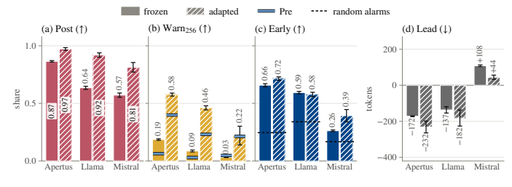
Figure 3 : Probes warn before most loops on APERTUSand LLAMAbut not on MISTRAL. Frozen (solid) and adapted (hatched) probe of each model at its selected layer (Table 1). (a) Post-onset and (b) warning coverage, with pre-window coverage (Pre) as a light-blue tick. (c) Early-warning rate; dashed lines are random alarms. (d) Lead, the median first alarm minus the onset in tokens; negative values are warnings. β= 5% , human-verified in-domain test split; error bars are one standard deviation over three seeds.
出典 · CC BY 4.0 · Marco De Negri, Luca Sartori, Lorenzo Baggi, Moritz Reihs, Eduard Frank Ďurech, Mennatallah El-Assady, Valentina Pyatkin, Anna Hedström · Detection Is Not Early Warning: Evaluating Token-Level Alarms on Language Model Failures · 論文の図を引用 · 元のPDFの7ページ目から図の部分を抽出しています。低ランク適応が加えるフラグ
同じレイヤーで固定プローブと適応型プローブを比べると、違いはLoRAアダプターだけです。すべてのモデルで、適応によって警告カバレッジは2倍を超えて上がりましたが、早期警告率は大きくは増えませんでした。早期警告率は応答ごとに最初のアラームを1回だけ数えるため、すでにonset前にアラームが出ている応答にフラグを足しても、この指標は上がりません。APERTUSとLLAMAでは、適応型プローブはonsetよりかなり前から、健全な応答より多くのトークンにフラグを立てていました。この解釈は著者らが示したものであり、MISTRALでは適応によってonsetに向かう上昇はなく、全体のフラグ率だけが高まりました。
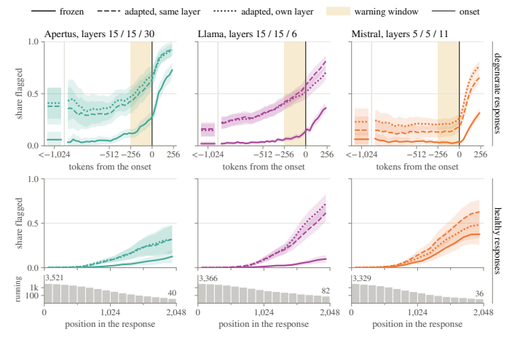
Figure 4 : On APERTUSand LLAMA, probes flag more tokens as the onset approaches, and adaptation adds flags long before it; on MISTRAL, flags rise only after the onset. Top: share of flagged tokens on degenerate responses by distance from the onset (bins of 32 tokens; positions more than 1,024 tokens before the onset pooled on the left). Bottom: the same on healthy responses by position (bins of 128 tokens), where flags also rise with length; the strip below gives the number of responses still running, on a log scale. Panel titles give the layers of the three probes. β= 5%, human-verified in-domain test split; mean over three seeds with95%intervals from leaving out one prompt at a time.
出典 · CC BY 4.0 · Marco De Negri, Luca Sartori, Lorenzo Baggi, Moritz Reihs, Eduard Frank Ďurech, Mennatallah El-Assady, Valentina Pyatkin, Anna Hedström · Detection Is Not Early Warning: Evaluating Token-Level Alarms on Language Model Failures · 論文の図を引用 · 元のPDFの8ページ目から図の部分を抽出しています。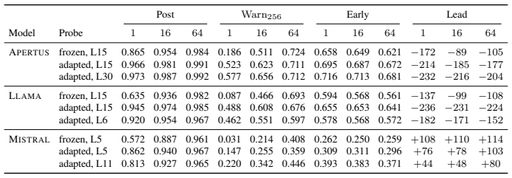
Table 16 : Requiring consecutive flags raises coverage but does not move the first alarm earlier. Probes at persistence m∈ {1,16,64}, the number of consecutive flagged tokens needed for an alarm (Equation (3)), with the threshold recalibrated at each m for β= 5%. Coverage counts every token at or above the threshold, while the first alarm is the token that completes the run. Lead in tokens, negative for warnings. Human-verified in-domain test split, mean over three seeds.
出典 · CC BY 4.0 · Marco De Negri, Luca Sartori, Lorenzo Baggi, Moritz Reihs, Eduard Frank Ďurech, Mennatallah El-Assady, Valentina Pyatkin, Anna Hedström · Detection Is Not Early Warning: Evaluating Token-Level Alarms on Language Model Failures · 論文の図を引用 · 元のPDFの29ページ目から図の部分を抽出しています。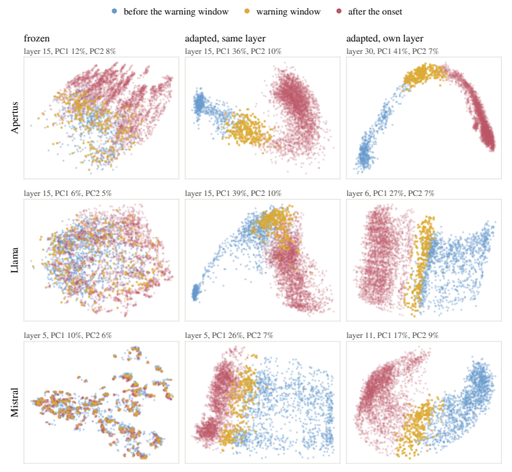
Figure 6 : In the frozen model, the tokens before the warning window, in it and after the on- set overlap; after adaptation they fall in largely separate regions. Residual-stream activations of the tokens of one degenerate response per model (APERTUS: numinamath_1_5_00388, LLAMA: numinamath_1_5_00044, MISTRAL: numinamath_1_5_00517, all from the in-domain test split, projected onto their first two principal components (x: PC1, y: PC2). Columns: the layer read by the frozen probe (left), the adapted probe at the same layer (middle) and the adapted probe at its own selected layer (right). Each panel has its own projection, and its title gives the share of variance each component explains. Blue: before the warning window. Yellow: warning window. Red: after the onset. The adapted panels use the seed with the highest validation warning coverage.
出典 · CC BY 4.0 · Marco De Negri, Luca Sartori, Lorenzo Baggi, Moritz Reihs, Eduard Frank Ďurech, Mennatallah El-Assady, Valentina Pyatkin, Anna Hedström · Detection Is Not Early Warning: Evaluating Token-Level Alarms on Language Model Failures · 論文の図を引用 · 元のPDFの30ページ目から図の部分を抽出しています。学習を必要としないベースラインとの比較
学習を必要としないベースラインは、トークン長、出力されたトークン、生成器の確信度などの情報だけを読みます。反復に基づく規則とエントロピー規則は、大半がonsetの後にアラームを鳴らしました。どのベースラインも、ランダムなアラームよりはるかに頻繁に警告することはありませんでした。プローブは、すべてのモデルで最も高い早期警告率と、最も早い中央値の最初のアラームを記録しました。ただしMISTRALでは、長いウィンドウのseq-rep-nとrep/ℓが、事後カバレッジでプローブより高くなりました。
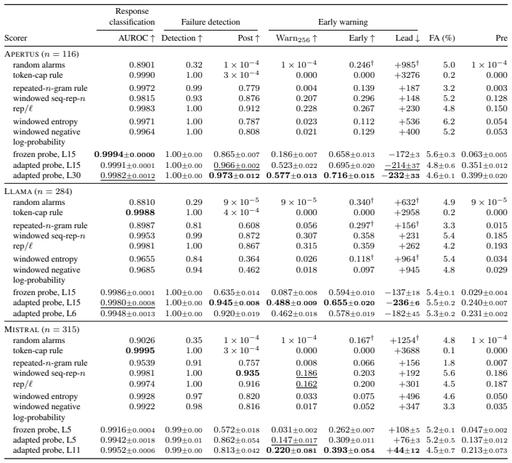
Table 1 : Probes against the baselines on the human-verified in-domain test split at β= 5%. Scorers are grouped, from top to bottom, by what they read: nothing (random alarms, the chance reference), only the length of the response, the emitted tokens, the generator’s confidence in them, or the activations. Each baseline is read at the setting chosen on validation (Section A.6). Probes are labelled with the layer they read; adapted probes also train rank- 16 LoRA adapters in the layers up to it. Metrics as defined in Section 3; Lead is in tokens, negative when the first alarm precedes the onset. n: number of degenerate responses. †: raises an alarm on fewer than 90% of degenerate responses, so its Early and Lead describe only part of them and are left out of the comparison. FA and Pre are not ranked. Best value in each other column and model in bold, values within one standard deviation of it underlined. Mean ± one standard deviation over three seeds for probes; the baselines are deterministic, and random alarms are given in closed form.
出典 · CC BY 4.0 · Marco De Negri, Luca Sartori, Lorenzo Baggi, Moritz Reihs, Eduard Frank Ďurech, Mennatallah El-Assady, Valentina Pyatkin, Anna Hedström · Detection Is Not Early Warning: Evaluating Token-Level Alarms on Language Model Failures · 論文の図を引用 · 元のPDFの9ページ目から図の部分を抽出しています。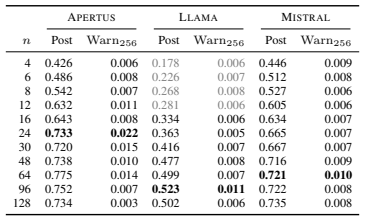
Table 7 : N-gram size n of the repeated-n-gram rule. Validation split, β= 1% . Bold: the setting selected for that model (Section A.6). Grey: below the post-onset floor of 0.3. A coverage near 0 marks a setting on which healthy responses already reach the top of the score range, so the calibrated threshold sits at that top and almost no token is flagged.
出典 · CC BY 4.0 · Marco De Negri, Luca Sartori, Lorenzo Baggi, Moritz Reihs, Eduard Frank Ďurech, Mennatallah El-Assady, Valentina Pyatkin, Anna Hedström · Detection Is Not Early Warning: Evaluating Token-Level Alarms on Language Model Failures · 論文の図を引用 · 元のPDFの21ページ目から図の部分を抽出しています。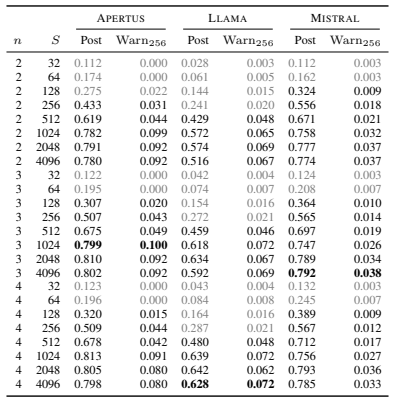
Table 8 : N-gram order n and window S of windowed seq-rep-n. Validation split, β= 1%. Bold: the setting selected for that model (Section A.6). Grey: below the post-onset floor of 0.3. A coverage near 0 marks a setting on which healthy responses already reach the top of the score range, so the calibrated threshold sits at that top and almost no token is flagged.
出典 · CC BY 4.0 · Marco De Negri, Luca Sartori, Lorenzo Baggi, Moritz Reihs, Eduard Frank Ďurech, Mennatallah El-Assady, Valentina Pyatkin, Anna Hedström · Detection Is Not Early Warning: Evaluating Token-Level Alarms on Language Model Failures · 論文の図を引用 · 元のPDFの22ページ目から図の部分を抽出しています。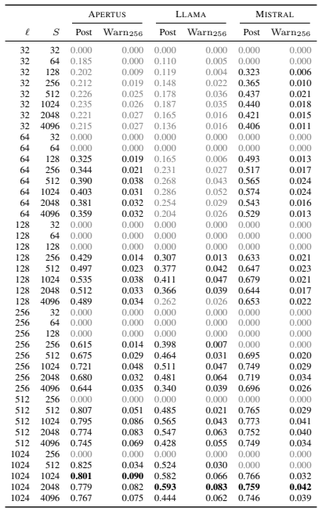
Table 9 : Look-back ℓ and window S of rep/ℓ. Validation split, β= 1%. Bold: the setting selected for that model (Section A.6). Grey: below the post-onset floor of 0.3. A coverage near 0 marks a setting on which healthy responses already reach the top of the score range, so the calibrated threshold sits at that top and almost no token is flagged.
出典 · CC BY 4.0 · Marco De Negri, Luca Sartori, Lorenzo Baggi, Moritz Reihs, Eduard Frank Ďurech, Mennatallah El-Assady, Valentina Pyatkin, Anna Hedström · Detection Is Not Early Warning: Evaluating Token-Level Alarms on Language Model Failures · 論文の図を引用 · 元のPDFの23ページ目から図の部分を抽出しています。onsetの定義と応答長の限界
第一に、リードタイムはonsetの定義によって変わります。この論文では、onsetを反復がテキストに現れる前の、最初のループの最初のトークンに置いています。第二に、ループの後に終了トークンを出す応答は健全な応答として分類されるため、誤警報率は保守的に計算されています。第三に、要求された反復や列挙のような正当な反復と劣化を区別する実験は行っていません。第四に、APERTUSとLLAMAではonsetが健全な応答の終了後に来ることが多いため、プローブがフラグを立てる一部は応答の長さを反映している可能性があります。第五に、学習戦略と選択規則は、反復的な劣化だけを対象に選びました。
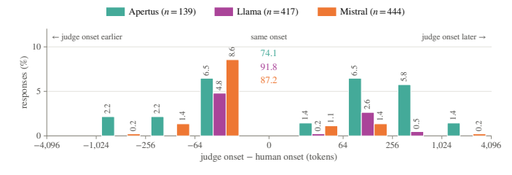
Figure 5 : Signed distance between the judge’s onset and the reviewer’s onset on the capped test responses that both call degenerate, pooled over the two test splits, in log-spaced bins. Negative values mean the judge places the onset earlier than the reviewer. Every number is a percentage of the model’s responses. The bars give the responses whose onset moved and the middle column those whose onset the reviewer kept, so the numbers of one model add up to100.
出典 · CC BY 4.0 · Marco De Negri, Luca Sartori, Lorenzo Baggi, Moritz Reihs, Eduard Frank Ďurech, Mennatallah El-Assady, Valentina Pyatkin, Anna Hedström · Detection Is Not Early Warning: Evaluating Token-Level Alarms on Language Model Failures · 論文の図を引用 · 元のPDFの17ページ目から図の部分を抽出しています。論文情報
- 著者
- Marco De Negri, Luca Sartori, Lorenzo Baggi, Moritz Reihs, Eduard Frank Ďurech, Mennatallah El-Assady, Valentina Pyatkin, Anna Hedström
- 学会・ジャーナル
- arXiv · プレプリント
- 公開日
- 2026年11月12日
- 登録日
- 2026年11月13日
- 更新日
- 2026年11月12日
- バージョン
- v1
- arXiv
- 2611.16803
- カテゴリ
- cs.LG · cs.CL
- ライセンス
- CC BY 4.0
- 掲載内容
- 論文情報・解説・論文の図
この解説は、Refivuの韓国語解説をAIで翻訳したものです。不正確な翻訳や誤りが含まれる可能性があります。論文と図の利用条件は各出典に従います。
アブストラクト
Many failures of language models begin at a specific token, the onset. A monitor that reads the model during generation can classify the finished response, detect the failure once it is under way, or warn before it begins, and only a warning leaves time to stop or steer the generation. Monitors are usually evaluated with response-level metrics such as AUROC, which ignore when the monitor fires. We introduce PREWARN, an evaluation protocol for any failure with an annotated onset. It calibrates each monitor's threshold on validation data to an error rate chosen for the application, runs the monitor, and scores its alarms relative to the onset on all three tasks. As a case study we apply it to repetitive degeneration in three open language models, with early warning as the main task, using linear probes on activations and six untrained baselines. Response-level metrics saturate on this failure, and a rule that reads only the response length scores almost perfectly, while probes that AUROC ranks as equal warn very differently under PREWARN. Probes warn before the onset on most degenerate responses of two of the three models, low-rank adapters below the probe more than double the share of tokens just before the onset that it flags, largely by flagging degenerate responses long before the onset, and no untrained baseline warns much more often than random alarms. We release the probes with calibrated thresholds at https://huggingface.co/collections/marcodene/prewarn-degeneration-probes
この論文を引用
Marco De Negri, Luca Sartori, Lorenzo Baggi, Moritz Reihs, Eduard Frank Ďurech, Mennatallah El-Assady, Valentina Pyatkin, Anna Hedström (2026). Detection Is Not Early Warning: Evaluating Token-Level Alarms on Language Model Failures. arXiv:2611.16803v1. https://arxiv.org/abs/2611.16803v1
BibTeX
@misc{negri2026detection,
  title = {{Detection Is Not Early Warning: Evaluating Token-Level Alarms on Language Model Failures}},
  author = {Marco De Negri and Luca Sartori and Lorenzo Baggi and Moritz Reihs and Eduard Frank Ďurech and Mennatallah El-Assady and Valentina Pyatkin and Anna Hedström},
  year = {2026},
  eprint = {2611.16803},
  archivePrefix = {arXiv},
  url = {https://arxiv.org/abs/2611.16803v1}
}