論文解説
On Differentially Private Mechanisms for Linear Regression
線形回帰のための差分プライバシー機構
- 課題 連続観測の設定で制約のない最小二乗線形回帰を差分プライバシーで解く機構が必要ですが、既存研究は制約のある場合と多項式時間の更新にとどまっていました。
- 手法 ADASSPを連続設定に拡張し、X^T XとX^T yは二分木機構で、λ_minはスパースベクトル法で推定します。適応的リッジ正則化を用いて出力します。
- 結果 CONTINUAL ADASSPは、√d polylog(n)程度の誤差と、時点あたりO(d² log n + d^ω)の更新時間を報告しています。実世界データでは、ベースライン手法より低い損失となりました。
連続観測設定の線形回帰問題
本論文は、最小二乗線形回帰を差分プライバシーで解きます。ただし、データは一点ずつ到着し、毎時点で推定値を出す必要がある連続観測(continual observation)の設定を扱います。既存研究は主にバッチ設定で検討されており、連続設定では制約つき線形回帰と、時点あたり多項式時間の更新だけが知られていました。本論文は、連続設定で制約のない線形回帰を扱う最初の機構を示すことを目標としています。目的関数はF(θ)=½∥y−Xθ∥²₂であり、連続設定での隣接性は、1つのデータ点だけが変わる置換隣接性として定義されます。
CONTINUAL ADASSPの構成
まず、X^T XとX^T yを二分木機構で時点ごとに差分プライベートに推定します。λ_min(X^T X)はスパースベクトル法で、しきい値を2倍ずつ上げながら推定します。この差分プライベートなλ_min推定値から適応的リッジ正則化パラメータλを計算し、最終出力はθ̃_λ = (X̃^T X̃ + λI)^{-1} X̃^T yです。二分木機構は各ノードの区間和にガウスノイズを加えて保存するため、時点ごとに使うのはO(log n)個のノードだけです。この構成により、時点あたりの更新時間はO(d² log n + d^ω)、空間計算量はO(d² log n)です。
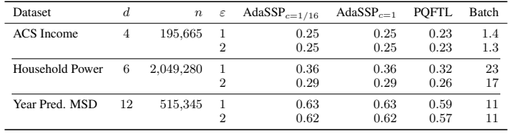
Table 4 :Per-time-step running time (ms) on the real-world datasets.
出典 · CC BY 4.0 · Bardiya Aryanfard, Monika Henzinger, Farhood Rostamkhani · On Differentially Private Mechanisms for Linear Regression · 論文の図を引用 · 元のPDFの41ページ目から図の部分を抽出しています。ADASSPの精度証明の修正
本論文はまず、バッチ設定のADASSPを再検討します。著者らは、Wang [2018]の精度証明に誤りがあることを反例で示し、その反例から既存の誤差上界と矛盾する下界を提示しています。これを受けて、修正版のADASSP-REVISEDを提案します。修正された機構では、λ_minの差分プライベート推定値から2ln(3.75/δ)/(ε/3)·∥X∥²を引く補正と、定数を変えた正則化の上限を用います。定理1.1は(ε,δ)-DPを保証し、XᵀXが可逆であるとき、高い確率でF(θ̃)−F(θ*)が∥Y∥²+∥X∥²∥θ*∥²の項と、min形式の(d+ln(1/ϱ))·ln(3.75/δ)/εの項で上から抑えられると述べています。
ボックス制約回帰の下界
本論文は、ボックス制約つき最小二乗回帰問題について、差分プライバシー機構の多項式下界を提示します。証明では、Peter et al. [2024]のPTU-FPC問題からの帰着(reduction)を用います。[2014]の上界とdについて漸近的に一致すると主張しています。この下界はボックス制約の設定に関するもので、制約のない設定と連続設定における対数多項式依存性の下界は、本論文の範囲外です。
実世界データでの実験とベースライン
実験は、Year、Household、ACS Incomeの3つのデータセットで、ε∈{1,2}、δ=1/nの条件のもとで行われます。比較対象は、CONTINUAL ADASSP(c=1)、ヒューリスティックな変種であるc=1/16、オンラインリッジ回帰アルゴリズムのPQFTL、毎時点でバッチアルゴリズムを再実行し、プライバシー予算を高度な合成で再配分したBatch、非プライベートのOLS、ゼロベクトル予測器です。表1の報告値は10回の独立実行の中央値で、Yearでε=1のとき、AdaSSP c=1/16の平均損失は2.7×10⁻⁴、PQFTLは7.1×10⁻⁴です。著者らは、c=1/16が合成データで選ばれたヒューリスティックであることを明らかにしており、この値は理論保証のあるc=1の結果と区別して解釈すべきだとしています。
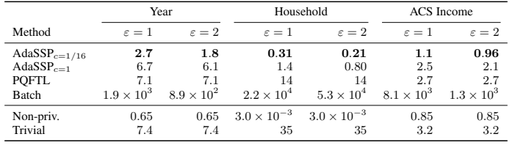
Table 1 :Average lossF(θ)/10 4 on real-world datasets, reported as median of 10 independent runs. Bold indicates the best private method. For standard deviations see Table 3.
出典 · CC BY 4.0 · Bardiya Aryanfard, Monika Henzinger, Farhood Rostamkhani · On Differentially Private Mechanisms for Linear Regression · 論文の図を引用 · 元のPDFの9ページ目から図の部分を抽出しています。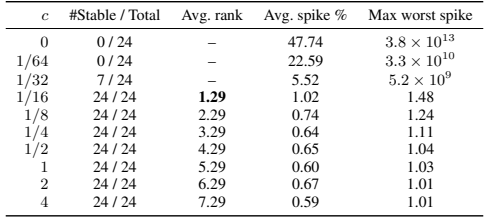
Table 2 :Selection ofcon the synthetic benchmark. Each cell aggregates 24 experiments.
出典 · CC BY 4.0 · Bardiya Aryanfard, Monika Henzinger, Farhood Rostamkhani · On Differentially Private Mechanisms for Linear Regression · 論文の図を引用 · 元のPDFの40ページ目から図の部分を抽出しています。
Table 3 :Average lossF(θ)/10 4 on real-world datasets, reported as median with standard deviation in parenthesis of 10 independent runs. Bold indicates the best private method.
出典 · CC BY 4.0 · Bardiya Aryanfard, Monika Henzinger, Farhood Rostamkhani · On Differentially Private Mechanisms for Linear Regression · 論文の図を引用 · 元のPDFの41ページ目から図の部分を抽出しています。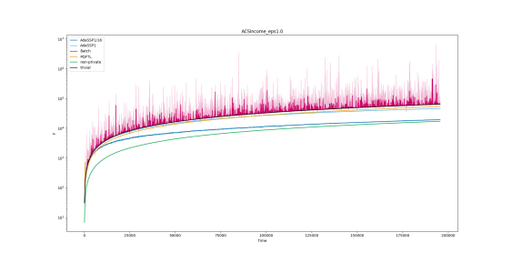
Figure 3 :Results of the experiment for different algorithms forACSIncomedataset withε= 1. They-axis is the lossF(·)(in logarithmic scale) of different algorithms and thex-axis is time. Solid lines show the median over 10 random seeds and shaded regions show the 25-75th percentile range. AdaSSP1(in light blue) is our mechanism according to our theoretical guarantees,AdaSSP1/16(in dark blue) is a heuristic improvement of it, andNon-private(in green) is the non-private optimal answer
出典 · CC BY 4.0 · Bardiya Aryanfard, Monika Henzinger, Farhood Rostamkhani · On Differentially Private Mechanisms for Linear Regression · 論文の図を引用 · 元のPDFの42ページ目から図の部分を抽出しています。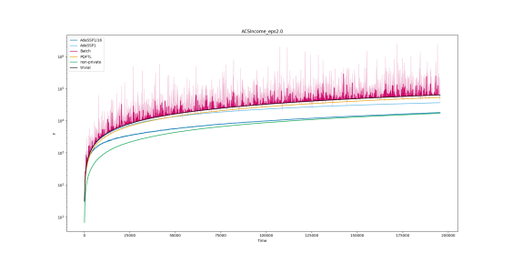
Figure 4 :Results of the experiment for different algorithms forACSIncomedataset withε= 2. They-axis is the lossF(·)(in logarithmic scale) of different algorithms and thex-axis is time. Solid lines show the median over 10 random seeds and shaded regions show the 25-75th percentile range. AdaSSP1(in light blue) is our mechanism according to our theoretical guarantees,AdaSSP1/16(in dark blue) is a heuristic improvement of it, andNon-private(in green) is the non-private optimal answer.
出典 · CC BY 4.0 · Bardiya Aryanfard, Monika Henzinger, Farhood Rostamkhani · On Differentially Private Mechanisms for Linear Regression · 論文の図を引用 · 元のPDFの42ページ目から図の部分を抽出しています。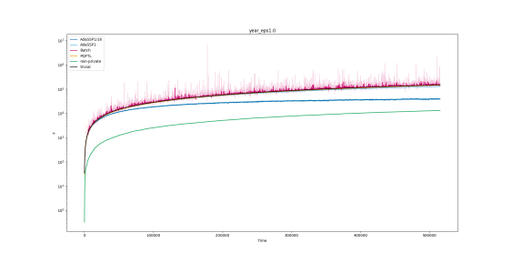
Figure 7 :Results of the experiment for different algorithms foryeardataset withε= 1. They-axis is the lossF(·)(in logarithmic scale) of different algorithms and thex-axis is time. Solid lines show the median over 10 random seeds and shaded regions show the 25-75th percentile range.AdaSSP1 (in light blue) is our mechanism according to our theoretical guarantees,AdaSSP1/16(in dark blue) is a heuristic improvement of it, andNon-private(in green) is the non-private optimal answer.
出典 · CC BY 4.0 · Bardiya Aryanfard, Monika Henzinger, Farhood Rostamkhani · On Differentially Private Mechanisms for Linear Regression · 論文の図を引用 · 元のPDFの44ページ目から図の部分を抽出しています。限界と今後の課題
著者らは、連続設定で制約のない問題に対する下界と、対数多項式依存性を持つ下界は、まだ扱っていないと述べています。また、完全動的設定への拡張と、データ適応的な正則化係数cの選択は、今後の課題として挙げられています。精度分析が要求する最悪ケースの正則化が、実際には必要ないかもしれないという観察は著者らの解釈であり、理論的に確立したものではありません。
論文情報
- 著者
- Bardiya Aryanfard, Monika Henzinger, Farhood Rostamkhani
- 学会・ジャーナル
- arXiv · プレプリント
- 公開日
- 2026年11月5日
- 登録日
- 2026年11月9日
- 更新日
- 2026年11月5日
- バージョン
- v1
- arXiv
- 2611.08737
- カテゴリ
- cs.LG · cs.CR · cs.DS
- ライセンス
- CC BY 4.0
- 掲載内容
- 論文情報・解説・論文の図
この解説は、Refivuの韓国語解説をAIで翻訳したものです。不正確な翻訳や誤りが含まれる可能性があります。論文と図の利用条件は各出典に従います。
アブストラクト
We study the classic least-squares linear regression problem under differential privacy (DP) in the batch and the continual observation setting. In the latter setting, the mechanism receives a stream of $n$ data points $(x_i,y_i)$ ($x_i\in\mathbb{R}^d$ and $y_i\in\mathbb{R}$) and must output an estimate of the optimal parameters at each time step $i$. Although differentially private linear regression has been extensively studied in the batch setting, the problem remains underexplored for the continual setting, with prior work being restricted to constrained linear regression and update time polynomial in $n$. In this work, we introduce ContinualAdaSSP, the first mechanism for unconstrained linear regression under continual differential privacy. Our mechanism's suboptimality gap is proportional to $\sqrt{d}\operatorname{polylog}(n)$. It requires $O(d^2\log{n})$ space and $O(d^2\log{n}+d^ω)$ update time, where $d$ is the dimension of the input space. We also study fundamental limits of differentially private linear regression by showing the first lower bounds for the box-constrained least-squares linear regression problem. Our lower bounds are proportional to $\min(n,\frac{\sqrt{d}}{\log^{1.5}d})$ for $(1,O(\frac{1}{n}))$-DP, and $\min(n,\frac{d}ε)$ for $ε$-DP, and are derived using a reduction from a fingerprinting code problem from [Peter et al., 2024], providing new insights into the inherent hardness of this canonical task. Our experimental evaluation on real-world datasets shows that the accuracy of our continual observation mechanism clearly outperforms any other known differentially private mechanism for this problem such as rerunning the batch algorithm at each time step.
この論文を引用
Bardiya Aryanfard, Monika Henzinger, Farhood Rostamkhani (2026). On Differentially Private Mechanisms for Linear Regression. arXiv:2611.08737v1. https://arxiv.org/abs/2611.08737v1
BibTeX
@misc{aryanfard2026differentially,
  title = {{On Differentially Private Mechanisms for Linear Regression}},
  author = {Bardiya Aryanfard and Monika Henzinger and Farhood Rostamkhani},
  year = {2026},
  eprint = {2611.08737},
  archivePrefix = {arXiv},
  url = {https://arxiv.org/abs/2611.08737v1}
}