論文解説
Locating and Repairing Domain Shift in VLM Trajectory Planning
VLM軌道計画におけるドメインシフトの位置特定と修正
- 課題 VLMを用いた軌道計画器は都市間の配備で大きなドメインシフトを受けますが、既存の適応法はこれを単一の量として扱います。
- 手法 MoLaRxは、アクティベーションパッチングに基づくCISでモダリティ-レイヤーの領域を特定し、CISRで領域ごとにMMD、LoRA、凍結を適用します。
- 結果 論文では、3つのVLMと2つのベンチマークによる6つの主要設定で、MoLaRxが適応法のうち都市間の差が最も小さいと報告されています。一様なMMDだけの適応は崩壊すると報告されています。
都市間ドメインシフトの課題
VLMをエンドツーエンドの運転計画器として使うと、学習都市と配備都市が異なるときに軌道誤差が大きく増えます。既存の適応法は、ドメインシフトを単一の量とみなし、すべてのレイヤーに同じ整列か単一地点の編集を適用します。この論文は、その前提は構造を持つシフトに合わないと主張し、シフトがモダリティとレイヤーの2つの軸に分かれるのかを問うています。
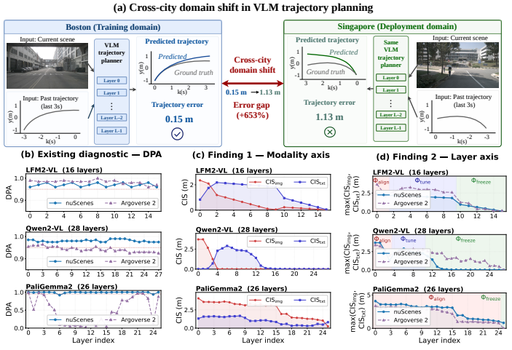
Figure 1 : Domain shift in VLM trajectory planners is structured along modality and layer.(a)VLMs fine-tuned as trajectory planners suffer cross-city domain shift;(b)the existing diagnostic — DPA: saturates near 1 at every layer of every VLM;(c) F1 (modality axis): image and text shifts differ within every VLM;(d) F2 (layer axis): zone partition is architecture-dependent and dataset-stable.
出典 · CC BY 4.0 · Zhihong Cui, Hengyu Liu, Michael Alexander Riegler, Guandong Xu, Amir Taherkordi, Tor Skeie · Locating and Repairing Domain Shift in VLM Trajectory Planning · 論文の図を引用 · 元のPDFの2ページ目から図の部分を抽出しています。CISで位置を特定しCISRで領域ごとに修正する方法
MoLaRxは2段階で動作します。まず、Causal Importance Score(CIS)がアクティベーションパッチングによって、各(モダリティ, レイヤー)のスライスを評価します。ソース入力の該当モダリティの行をターゲットの順伝播に上書きし、その結果として軌道が元のターゲット予測からどれだけ動くかを、ウェイポイントのℓ2距離で測定します。N=100のシーンのマッチングペアでこの値を平均して2×Lのテンソルを作り、モダリティごとの閾値でレイヤーをΦalign、Φtune、Φfreezeの3つの領域に分けます。その後CISRが領域ごとにMMDによる整列、LoRAの再学習、凍結を割り当てます。
Φalignでは画像トークンの平均表現に対するマルチスケールRBF MMDを使い、Φtuneではタスク損失でLoRAを学習し、Φfreezeでは更新を行いません。論文では、PaliGemma2のようにΦtuneが空の場合は、MMDと凍結だけが残ると説明されています。
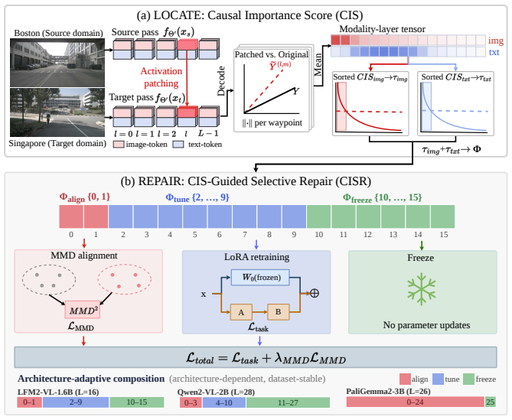
Figure 2 :MoLaRx overview.CIS locates cross-city shift by modality and layer; CISR applies matched repair operators to the diagnosed zones.
出典 · CC BY 4.0 · Zhihong Cui, Hengyu Liu, Michael Alexander Riegler, Guandong Xu, Amir Taherkordi, Tor Skeie · Locating and Repairing Domain Shift in VLM Trajectory Planning · 論文の図を引用 · 元のPDFの5ページ目から図の部分を抽出しています。モダリティ-レイヤーのテンソルと都市間の差
ドメインシフトの差G(f)は、ソースとターゲットの入力のペアについて、予測軌道の差をK個のウェイポイントで平均した値です。Ψ[m,l]は、モダリティmのレイヤーlのブロックをソースのペアに置き換えたときに、ターゲットの予測がどれだけ動くかを期待値として定義します。したがって、Ψの値が大きいほど、そのスライスが差の因果的な原因であることを意味し、0に近い値は、そのスライスがドメイン不変に近いことを意味します。
主要な都市間比較の結果
論文では、MoLaRxが3つのVLMと、nuScenesおよびArgoverse 2の6つの主要設定において、適応法のうち都市間の軌道誤差の差が最も小さいと報告されています。同じ実験では、一様なMMDだけの適応は6つの設定すべてで崩壊したとされています。たとえばLFM2/nuScenesでは、MMD-onlyのADEが9.657 mで、Full LoRAの4.275 mより大きく高くなっています。この結果は、ソースで学習した後にターゲット都市の都市間格差を定量化した設定で得られたもので、他のタスクやモデルにそのまま一般化できる結果ではありません。表の一部のセルでは、MoLaRxとFull LoRAの差は小さく現れています。
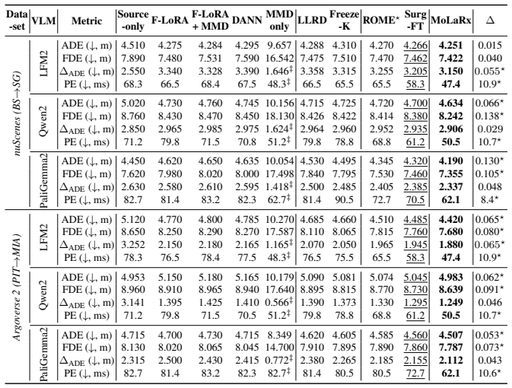
Table 1 : Performance across 2 datasets of 3 VLMs on four metrics.Boldmarks the best result per rowamong the adaptation methods; underline marks the runner-up. Source-only is reported as the no-adaptation reference and is excluded from the bold/underline ranking. The rightmost column ∆ is MoLaRx’s lead over the underlined runner-up. The marker ⋆ flags margins exceeding the 2σ significance threshold. MMD-only is marked with ‡ because the model has collapsed.
出典 · CC BY 4.0 · Zhihong Cui, Hengyu Liu, Michael Alexander Riegler, Guandong Xu, Amir Taherkordi, Tor Skeie · Locating and Repairing Domain Shift in VLM Trajectory Planning · 論文の図を引用 · 元のPDFの8ページ目から図の部分を抽出しています。領域分割の安定性と効率
Partition Consistency Score(PCS)は、2つの分割の間の領域ごとのJaccard類似度です。同じVLMでnuScenesとArgoverse 2の分割を比べると、LFM2-VLとPaliGemma2はPCSが1.0、Qwen2-VLは平均0.92で、ランダム分割の基準は0.18です。この結果は、分割がデータセットよりモデル構造に強く依存するという著者らの解釈を裏付けています。効率面では、論文はMoLaRxが学習可能パラメータを50–60%減らし、推論遅延を8.4–10.9 ms下げると報告しています。この効率の数値はFull LoRAと比較した設定の結果であり、精度の向上と同じ測定条件で得られたものとは解釈しません。
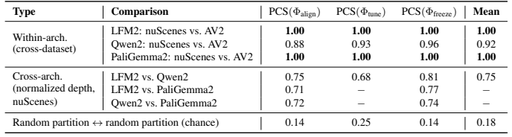
Table 2 : Partition Consistency Score.
出典 · CC BY 4.0 · Zhihong Cui, Hengyu Liu, Michael Alexander Riegler, Guandong Xu, Amir Taherkordi, Tor Skeie · Locating and Repairing Domain Shift in VLM Trajectory Planning · 論文の図を引用 · 元のPDFの9ページ目から図の部分を抽出しています。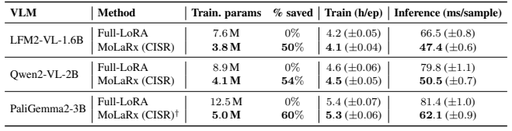
Table 10 : Compute footprint per VLM. “% saved” is the parameter saving over each VLM’s Full- LoRA baseline.Not shown: a one-time CIS-diagnosis cost of ∼0.65 h per architecture (App. C.2.4), reused zero-shot across the two benchmarks (Table 3). † On PaliGemma2 the prefix-LM attention yields Φtune=∅, so the recipe collapses to MMD-driven attention-only LoRA on Φalign + freeze on Φfreeze. MoLaRx saves 50–60% of trainable parameters across all three architectures; the largest absolute saving (7.5 M, 60%) is on PaliGemma2, where attention-only LoRA on Φalign avoids the MLP-projection bulk that Full-LoRA pays.
出典 · CC BY 4.0 · Zhihong Cui, Hengyu Liu, Michael Alexander Riegler, Guandong Xu, Amir Taherkordi, Tor Skeie · Locating and Repairing Domain Shift in VLM Trajectory Planning · 論文の図を引用 · 元のPDFの24ページ目から図の部分を抽出しています。アブレーション実験と代替分割の影響
アブレーション実験では、CISによる分割をランダム分割またはDPA誘導分割に置き換えると、∆ADEが0.2–0.4 m増えると報告されています。論文は、これを確率的な相関診断は因果的な位置特定の代わりにはならないという根拠として示しています。演算子の削除では、MMDまたはLoRAを外すとコストが0.2–0.4 m増え、凍結領域を除いた場合は効果がほとんどないと報告されています。演算子を入れ替える実験では最も大きな単独の低下が見られるため、どの演算子がどの領域を担当するかは、分割そのものと同じくらい重要だという解釈が示されています。
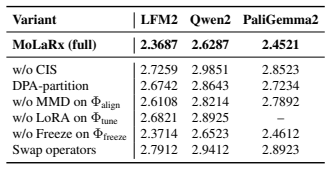
Table 4 : Ablation∆ ADE ↓(m) on nuScenes.
出典 · CC BY 4.0 · Zhihong Cui, Hengyu Liu, Michael Alexander Riegler, Guandong Xu, Amir Taherkordi, Tor Skeie · Locating and Repairing Domain Shift in VLM Trajectory Planning · 論文の図を引用 · 元のPDFの10ページ目から図の部分を抽出しています。適用範囲と限界
著者らは、CISはシーンをマッチさせたソースとターゲットのペアを必要とし、推定値はペアの品質によって変わると明らかにしています。ペアは主によくあるシーンから選ばれるため、まれなシーンでしか現れないシフト成分は見逃す可能性があります。また、主要な評価は公称の走行条件と変位指標に焦点を当てており、公式の計画指標による評価は今後の課題として残っています。3領域の構造は経験的に得られた結果であり、理論的な普遍性の保証はありません。論文は、エンコーダ・デコーダ型VLMや他のタスク、天候のような非地理的なシフトへの一般化は検証していないと述べています。
論文情報
- 著者
- Zhihong Cui, Hengyu Liu, Michael Alexander Riegler, Guandong Xu, Amir Taherkordi, Tor Skeie
- 学会・ジャーナル
- arXiv · プレプリント
- 公開日
- 2026年11月7日
- 登録日
- 2026年11月10日
- 更新日
- 2026年11月7日
- バージョン
- v1
- arXiv
- 2611.10720
- カテゴリ
- cs.CV · cs.RO
- ライセンス
- CC BY 4.0
- 掲載内容
- 論文情報・解説・論文の図
この解説は、Refivuの韓国語解説をAIで翻訳したものです。不正確な翻訳や誤りが含まれる可能性があります。論文と図の利用条件は各出典に従います。
アブストラクト
Vision-Language Models (VLMs) are increasingly adopted as end-to-end driving planners, yet they suffer from cross-city domain shift. Existing methods treat this shift as a single quantity addressed by uniform alignment or single-site editing. We challenge this view on two counts: (i) domain shift in VLM trajectory planners is inherently structured across modality and layer, and (ii) a locate-then-repair recipe matched to this structure outperforms every uniform-objective baseline. We analyse domain shift via activation patching and uncover two regularities. (F1) Modality axis. Image and text tokens exhibit distinct shift patterns in each VLM. (F2) Layer axis. The layer-wise shift partition is architecture-dependent and dataset-stable. These findings recast domain shift as a two-dimensional tensor indexed by modality (image vs. text tokens) and layer, motivating a simple principle: locate where shift occurs, and repair only there. We instantiate this principle in MoLaRx (Modality-Layer Repair), a locate-then-repair framework. The Causal Importance Score (CIS) estimates the domain shift as a modality-layer tensor and partitions the layers into functional zones. CIS-Guided Selective Repair (CISR) then applies a matched operator (Maximum Mean Discrepancy (MMD) / low-rank adaptation (LoRA) / freezing) to repair each zone, with the composition adapting automatically to each architecture. We evaluate MoLaRx on three architecturally distinct VLMs (LFM2-VL-1.6B, Qwen2-VL-2B, and PaliGemma2-3B) across two cross-city benchmarks (nuScenes and Argoverse 2). MoLaRx attains the lowest cross-city trajectory-error gap among adaptation methods in all six main-table settings, while using 50-60% fewer trainable parameters and 8.4-10.9 ms lower inference latency. In contrast, uniform MMD-only adaptation collapses in all six settings, highlighting the importance of structure-guided repair.
この論文を引用
Zhihong Cui, Hengyu Liu, Michael Alexander Riegler, Guandong Xu, Amir Taherkordi, Tor Skeie (2026). Locating and Repairing Domain Shift in VLM Trajectory Planning. arXiv:2611.10720v1. https://arxiv.org/abs/2611.10720v1
BibTeX
@misc{cui2026locating,
  title = {{Locating and Repairing Domain Shift in VLM Trajectory Planning}},
  author = {Zhihong Cui and Hengyu Liu and Michael Alexander Riegler and Guandong Xu and Amir Taherkordi and Tor Skeie},
  year = {2026},
  eprint = {2611.10720},
  archivePrefix = {arXiv},
  url = {https://arxiv.org/abs/2611.10720v1}
}