論文解説
Same Contacts, Different Rooms:Meeting Format Shapes LLM Group Influence Beyond Pairwise Contact Counts
同じ接触、異なる部屋:ペア接触数を超えてLLM集団の影響力を形づくる会議形式
- 課題 ペア接触ネットワークは、同じ接触をどの会議形式に分けたかを表せないため、LLM集団の支持度の変化を説明するのに十分かどうかを検証します。
- 手法 ペア接触数、構成員、初期の立場を固定し、会議形式だけをRegroupとResizeで変えたうえで、会議ごとのペア規則と静的ネットワーク規則を比較します。
- 結果 Resizeは、Regroupよりも支持度を大きく動かし、初期の多数派の側へ増幅します。会議ごとのSize規則はRegroupの効果の一部を説明しますが、静的ネットワークは0と予測します。
ペア接触ネットワークでは集団の相互作用の形式を説明しにくい
LLMエージェント集団のシミュレーションは、通常、相互作用をペア接触ネットワークにまとめます。2つのエージェントが何回出会ったかだけを残すと、小さな集まりで出会ったのか大きな集まりで出会ったのか、同じ部屋に他に誰がいたのかは消えてしまいます。本論文は、このまとめ方で十分かを問い、同じペア接触を保ったまま会議形式だけを変えたときに集団の支持度が変わるかを検証します。
中心となる問いは2つです。1つ目は、ペア接触数、構成員、初期の立場を固定しても、会議形式によって集団の支持度が変わるかどうかです。2つ目は、ペア単位の予測規則を会議ごとに計算する方法と、接触ネットワークの段階で先に集計する方法のどちらが、その差をよく説明するかです。
接触一致の介入は同じペア接触を異なる会議構成に分けます
研究チームは、6人の構成員とその初期の立場を固定し、3つの会議日程を作ります。Baseには、構成員1–5のすべての三角形の2つのコピーと、4つの追加三角形が含まれます。Regroupでは、追加三角形の集合を、同じペアを覆う別の三角形の集合に置き換えます。Resizeでは、構成員1–5の三角形の2つのコピーを、6つの5人会議に置き換えます。Resizeは会議数が40から26に減るため、この設計は会議数を固定したものではなく、ペア接触の総量を固定したうえでの形式の介入です。
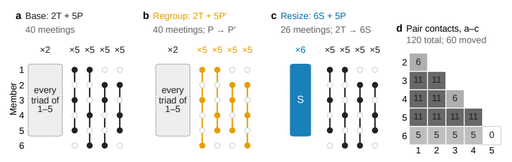
Figure1 :Contact-matchedschedulesforsixmembers(rows).Filleddotsmarkthemembersofonetriad;“×k”isitsnumberof copies.(a)Base:twocopiesofeverytriadamongmembers1–5(2T)plusfivecopiesofeachoffourfurthertriadsP.(b)Regroup replaces P with four other triads P′ (orange). (c) Resize replaces 2T with six five-person meetings S of members 1–5. (d) All threeschedulessharethispair-contactmatrix(120dyadiccontacts);eachinterventionremovesandadds60.Meetingcountsare 40, 40 and 26; members 1–5 attend 22 meetings in base and regroup and 16 in resize, and member 6 attends 10 in all three.
出典 · CC BY 4.0 · Zhexi Gu, Shusheng Cao, Runping Zhu · Same Contacts, Different Rooms:Meeting Format Shapes LLM Group Influence Beyond Pairwise Contact Counts · 論文の図を引用 · 元のPDFの2ページ目から図の部分を抽出しています。各会議で構成員は、参加者の論証を読んだうえで賛成か反対かを答えます。ロジットの差をシグモイドに通して得た確率を、構成員ごとに会議の平均としてまとめ、構成員数で正規化して集団の支持度Q(M)を計算します。この値は、初期の立場を出発点とした1段階の応答です。
Resizeは支持度をRegroupより大きく動かし、初期の多数派の側へ増幅します
84個のモデル–主題セルのうち81個で、Resizeによる変化のほうが大きいです。
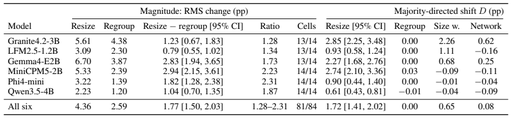
Table 1 : Meeting-format effects on one-step support with pair contacts fixed (14 topics, 1,920 configurations each, person weighting). Cells: model–topic cells in which resize has the larger RMS. The last two columns give the majority-directed shift that the meeting-wise Size-weight rule and the static network rule predict for resize. All-six row: equal-weight model average with jointly resampled topics; Ratio there gives the range across models.
出典 · CC BY 4.0 · Zhexi Gu, Shusheng Cao, Runping Zhu · Same Contacts, Different Rooms:Meeting Format Shapes LLM Group Influence Beyond Pairwise Contact Counts · 論文の図を引用 · 元のPDFの4ページ目から図の部分を抽出しています。方向性が見られるのはResizeの場合だけです。Resizeでは、統合された構成員の初期の多数派の側へ、平均1.72pp支持度が押し出されます。一方、Regroupによる多数派方向への移動は、すべてのモデルで最大0.03ppです。
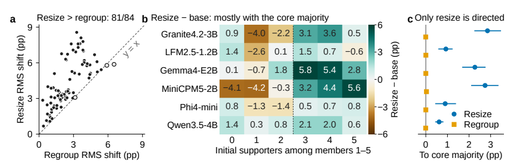
Figure2 :Meetingformatchangesone-stepgroupsupportatfixedpaircontacts.(a)RMSchangepermodel–topiccell(n= 84; 1,920configurationspercell);filledpoints:resizelarger,openpoints:regrouplarger.(b)Signedresizeeffect(pp),averagedover topics, by the number of initial supporters among members 1–5; the dashed line marks where the core majority switches from oppose to support. (c) Majority-directed shiftDwith 95% topic-cluster intervals, rows as in (b). Regroup estimates are at most 0.03ppineverymodel(itssignedeffectsbycorecompositionallliewithin±0.11pp),soonlyresizehasasystematicdirection.
出典 · CC BY 4.0 · Zhexi Gu, Shusheng Cao, Runping Zhu · Same Contacts, Different Rooms:Meeting Format Shapes LLM Group Influence Beyond Pairwise Contact Counts · 論文の図を引用 · 元のPDFの4ページ目から図の部分を抽出しています。会議ごとのペア規則と静的ネットワークは異なる効果を説明します
研究チームは、独立した微小実験から転移させた、5つの低パラメータのペア予測器を比較します。Sizeの重みは相対的な人数に応じたpeer影響を表し、Stanceの重みは反対のpeerと賛成のpeerに異なる重みを与えます。元のグループ実験の結果は、これらの重みの調整には使われていません。
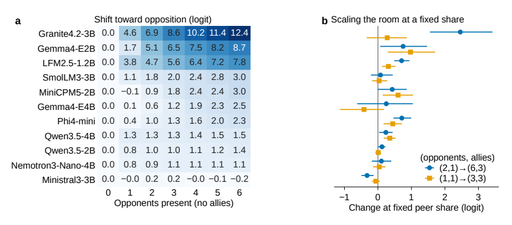
Figure 5 : Micro-experiment (64 items, 19 topics, 11 models). (a) Mean change in opposition-directed logit withkopponents andnoallies.(b)Changewhenpeersarescaledatfixedopponent:allyratios(95%topic-clusterintervals);rowsfollowtheorder in (a).
出典 · CC BY 4.0 · Zhexi Gu, Shusheng Cao, Runping Zhu · Same Contacts, Different Rooms:Meeting Format Shapes LLM Group Influence Beyond Pairwise Contact Counts · 論文の図を引用 · 元のPDFの10ページ目から図の部分を抽出しています。静的ネットワークの予測では、まず各構成員の会議ごとのロジットを平均し、その後にシグモイドを1回適用します。この方法は、BaseとRegroupが同じネットワークを共有するため、Regroupの効果を正確に0と予測します。一方、会議ごとのSize規則は、Granite4.2-3BのRegroup効果のうち62%を、LFM2.5-1.2Bでは76%を説明します。Resizeでは、Granite4.2-3Bの最良の規則がStance重みでR²=0.49に達し、LFM2.5-1.2BではMean規則が0.34に達します。Sum規則は複数のモデルで説明力が負になっており、大きな会議の影響がペア効果の和としては現れないことを示しています。
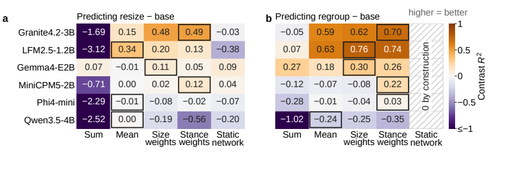
Figure 3 : ContrastR2 of five pairwise predictors for (a) resize and (b) regroup effects (14 topics per model).R2 = 0equals predicting no change; colours are clipped at−1. Boxes mark each model’s best predictor. Sum, Mean, Size and Stance are meeting-wise (Eq. 2); Static network applies Size weights to the aggregated contact network (Eq. 3) and predicts exactly zero regroup effect.
出典 · CC BY 4.0 · Zhexi Gu, Shusheng Cao, Runping Zhu · Same Contacts, Different Rooms:Meeting Format Shapes LLM Group Influence Beyond Pairwise Contact Counts · 論文の図を引用 · 元のPDFの5ページ目から図の部分を抽出しています。同じ重みでも集計の位置によって予測は変わり、その差はJensen gapです
会議ごとの予測とネットワーク予測の差は、各構成員について、会議ごとのシグモイド平均と平均ロジットのシグモイドとの差を合計した値です。この差はJensen gapと呼ばれ、シグモイドは凸でも凹でもないため符号は定まりません。テイラーの定理によれば、この差の絶対値は会議間のロジット分散で上から抑えられます。したがって、会議間のロジットの変動が小さければ、接触ネットワークは正確な要約に近くなります。
補助設計では、5人は5人会議3つ、またはすべての三角形十個のいずれかに参加します。この実験では、会議間のロジット分散とJensen gapのRMS大きさの間に、対数-対数相関0.97が見られました。モデルごとに見ると、Granite4.2-3B、LFM2.5-1.2B、Gemma4-E2Bでは平均ロジット分散が7から14で、MiniCPM5-2B、Phi4-mini、Qwen3.5-4Bでは0.25から0.88です。この差が、本実験で3つのモデルにバッチ効果がほとんど見られなかった理由として説明されています。1/n重みでも、ネットワークは差を0と予測しますが、会議ごとの予測では最大8.46pp RMSの差が見られました。
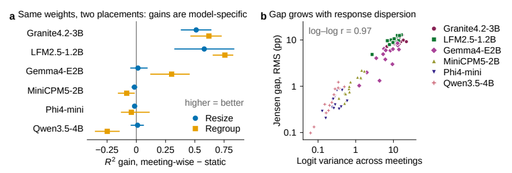
Figure 4 : Aggregation placement and its mechanism. (a) PairedR2 gain of meeting-wise Size weights over the same weights on the static contact network, for resize and regroup effects (95% topic-cluster intervals, 14 topics). (b) Auxiliary five-person design (three five-person meetings versus all ten triads; every pair meets three times in both): RMS Jensen gap of the Size rule against the mean variance of each member’s predicted logits across its meetings (one point per model–topic,n= 84).
出典 · CC BY 4.0 · Zhexi Gu, Shusheng Cao, Runping Zhu · Same Contacts, Different Rooms:Meeting Format Shapes LLM Group Influence Beyond Pairwise Contact Counts · 論文の図を引用 · 元のPDFの6ページ目から図の部分を抽出しています。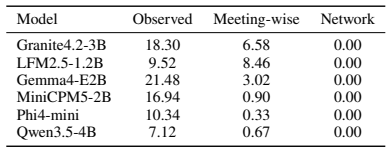
Table8 :Auxiliarydesignwith1/nweights,main-studytop- ics (1,344 conditions per model): RMS of the five-versus- triads difference (pp). The network column gives the maxi- mum absolute value, which is zero to machine precision.
出典 · CC BY 4.0 · Zhexi Gu, Shusheng Cao, Runping Zhu · Same Contacts, Different Rooms:Meeting Format Shapes LLM Group Influence Beyond Pairwise Contact Counts · 論文の図を引用 · 元のPDFの10ページ目から図の部分を抽出しています。結果は小規模なLLM集団と1段階の支持度測定に限られます
会議日程はペア接触を揃えていますが、会議数やトークン数は揃えていません。論証は人が作成しましたが、参加者はすべてLLMです。そのため、結果はLLM集団についての説明であり、人間集団の推定として読むべきではありません。逐次的な会議や状態更新を反映した集団の結果は、本論文では測定しておらず、これは著者らが示した次の段階です。
また、Resizeの方がRegroupより大きいという結果は、主指標である集団の支持度についてのものであり、集団現象のすべてを直接測定したものではありません。補助実験と追加の主題での結果も、同じ設計の範囲内で確認されました。
論文情報
- 著者
- Zhexi Gu, Shusheng Cao, Runping Zhu
- 学会・ジャーナル
- arXiv · プレプリント
- 公開日
- 2026年11月7日
- 登録日
- 2026年11月10日
- 更新日
- 2026年11月7日
- バージョン
- v1
- arXiv
- 2611.10641
- カテゴリ
- physics.soc-ph · cs.CL
- ライセンス
- CC BY 4.0
- 掲載内容
- 論文情報・解説・論文の図
この解説は、Refivuの韓国語解説をAIで翻訳したものです。不正確な翻訳や誤りが含まれる可能性があります。論文と図の利用条件は各出典に従います。
アブストラクト
Simulations of LLM agent collectives usually summarise interaction as a pairwise contact network. We test that summary with a contact-matched intervention: the members, their initial stances and every pairwise contact count stay fixed while the meetings are reorganised, and each member gives a one-step support readout after reading the arguments of everyone present. Across six open-weight LLMs and 14 debate topics, merging triads into five-person meetings (resize) moves group support more than reshuffling who meets in triads (regroup), although both move the same 60 dyadic exposures. The root-mean-square change is 4.36 versus 2.59 percentage points (pp), larger for resize in all six models and in 81 of 84 model-topic cells. Resizing also has a consistent direction: it amplifies the initial majority of the merged members by 1.72 pp, in every model, whereas regrouping has no direction (<= 0.03 pp). A contact network cannot represent regrouping at all, yet pairwise rules applied meeting by meeting explain up to 76% of its effect, and with identical weights they raise resize R^2 by 0.51-0.58 for two models. We show that the gap between the two placements is an exact Jensen gap of the sigmoid readout, bounded by how much a member's predicted logits vary across meetings; this dispersion tracks the gap with log-log r=0.97 and tells a modeller when contact counts are a safe summary. Meeting format is a first-class variable for LLM social simulation.
この論文を引用
Zhexi Gu, Shusheng Cao, Runping Zhu (2026). Same Contacts, Different Rooms:Meeting Format Shapes LLM Group Influence Beyond Pairwise Contact Counts. arXiv:2611.10641v1. https://arxiv.org/abs/2611.10641v1
BibTeX
@misc{gu2026same,
  title = {{Same Contacts, Different Rooms:Meeting Format Shapes LLM Group Influence Beyond Pairwise Contact Counts}},
  author = {Zhexi Gu and Shusheng Cao and Runping Zhu},
  year = {2026},
  eprint = {2611.10641},
  archivePrefix = {arXiv},
  url = {https://arxiv.org/abs/2611.10641v1}
}