論文解説
HaiRuo: Forecasting Ocean Eddies as Fields and Objects with a Satellite-Altimetry Foundation Model
HaiRuo:衛星高度計基盤モデルによる海洋渦の場と物体としての予測
- 課題 中規模渦の15日後の位置を、場の予測と物体の軌跡予測の両方で扱う問題です。
- 手法 衛星高度計で事前学習したHaiRuo-1Bバックボーンと、共同移動極座標に基づくXuanJi物体デコーダを組み合わせます。
- 結果 全球テスト期間のD15は25.2 kmで、最良のベースラインの30.6 kmより約18%低い誤差だと報告しています。
中規模渦予測の課題
中規模渦は海洋の運動エネルギーの大部分を持ち、熱や塩分、栄養塩を広い海域に運びます。しかし、二週間後にある渦がどこにあるかは、これまで海洋モデルの結果に後追いの追跡ヒューリスティックを適用して読み取る方法に頼ってきました。HaiRuoは、この問題を場と物体を一緒に予測する方向で扱います。30日分の衛星海面高度マップを入力として受け取り、1回の順伝播で15日後の海面高度と地衡流速、日別の渦マスク、そして現在存在する各渦の軌跡を出力します。既存のAI海洋予報モデルは場を予測し、渦は後から固定トラッカーで処理するため、予測の過程の中で渦を追う仕組みがない点が、この研究の出発点です。
HaiRuo-1Bバックボーンと事前学習
空間ブロックには、渦の回転方向に応じてゲートされるchirality-gated attentionが使われます。事前学習の目的は3つで、15リード先の予測、空間トークンと日付単位をマスクする多軸マスク復元、そして1日分のトークンを地衡流に沿って翌日のトークンと合わせるInfoNCE対照損失です。予測場は\(\hat F_l = F_0 + \delta_l \odot r_l\)の形で書かれ、ここで\(F_0\)は最後の観測場、\(\delta_l\)はl日変化量の学習済みRMS、\(r_l\)は0で初期化された残差です。したがって、学習前の予測は持続性(persistence)と同じになります。
XuanJi物体デコーダの動作
XuanJiは、バックボーンと基本の場の予測を読み込み、各渦の軌跡を補正するデコーダです。各リングは方位角フーリエモードm=0, 1, 2に縮約されます。これは平均、自己移流を生む双極子、変形率を表す四重極子に対応します。これらのモードは、GRU状態、渦のメタデータ、リード符号化とともにリードごとのトークンになります。2層のTransformerが15個のリードトークンの間をアテンションで結び、あるリードの補正が他のリードの状況に依存できるようにします。この処理は3回のlook-aheadラウンドで繰り返され、ラウンドごとに更新された位置から再サンプリングします。4つの精製器は、学習中に1つを主要なものとして選ぶ方法で協調し、推論では平均で統合されます。
累積変位は式(2)の形で初期経路に加えられます。
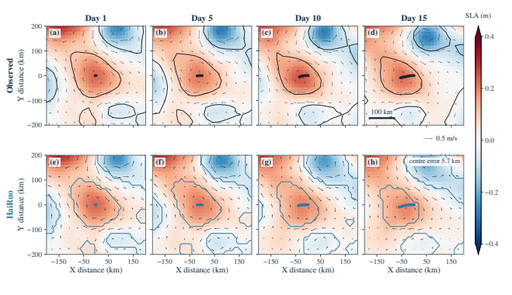
Figure 4 . HaiRuo follows an anticyclone through its own forecast. A window of the global evaluation issued on 12 August 2022 in the Kuroshio Extension: observed (top) and forecast (bottom, seed 42) sea-level anomaly with geostrophic velocity (arrows), eddy contours (atlas above, forecast mask below) and the centre track (dots) at leads 1, 5, 10 and 15, in a fixed 400 km frame centred on the eddy’s day-0 position. The eddy drifts 56 km in 15 days; the forecast centre ends 5.7 km from the observed one (PredRNN-V2: 8.4 km; Figure 8); over the global evaluation the median eddy forecast of HaiRuo ends 17 km from the observed centre (PredRNN-V2: 22 km).
出典 · CC BY 4.0 · Xukun Qin, Haochen Sun, Yuyang Tian, Ge Chen · HaiRuo: Forecasting Ocean Eddies as Fields and Objects with a Satellite-Altimetry Foundation Model · 論文の図を引用 · 元のPDFの5ページ目から図の部分を抽出しています。全球評価の結果
HaiRuoは、2020年から2022年までの独立した試験期間に、全海域の評価で14個のベースラインと比較されます。評価指標D15は、リード15においてt0に存在するすべてのatlas渦中心の大円距離誤差(km)です。この設定でのHaiRuoのD15は25.2 kmで、最強のベースラインであるPredRNN-V2の30.6 kmより約18%低くなっています。学習領域の外でも、TAUなど強いベースラインより低い誤差を報告しています。場の技術スコアとmIoUも併せて報告されており、この結果は3シードの平均と、ペア・ブートストラップ区間を用いたものです。これらのスコアは同じプロトコルで測定されたもので、別のデータセットや別の予算で得られた結果にまで広げて解釈すべきではありません。
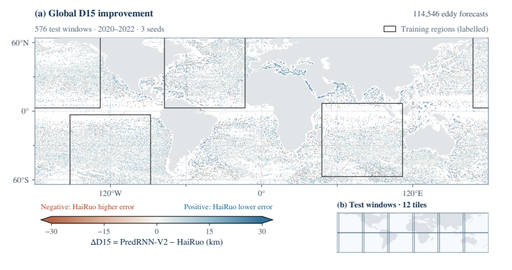
Figure 3 .HaiRuo lowers the 15-day centre error across the whole ocean, including the regions never seen in labelled training.(a) Day-0 position of every evaluated eddy, coloured by the 15-day centre error (D15) of PredRNN-V2 minus that of HaiRuo (three-seed mean; blue favours HaiRuo), with the four labelled training regions outlined. (b) The 12 evaluation tiles.
出典 · CC BY 4.0 · Xukun Qin, Haochen Sun, Yuyang Tian, Ge Chen · HaiRuo: Forecasting Ocean Eddies as Fields and Objects with a Satellite-Altimetry Foundation Model · 論文の図を引用 · 元のPDFの4ページ目から図の部分を抽出しています。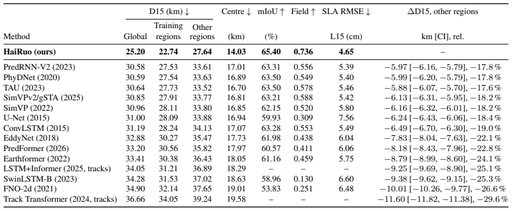
Table 1 . Global evaluation on the independent 2020–2022 period: 48 dates on 12 tiles covering all longitudes between 64◦S and 64◦N, every model scored once. Training regions: the four regions whose labelled windows are used for training; other regions: the rest of the ocean, never seen in labelled training. Three-seed means (seed s.d. of D15: 0.03 km for HaiRuo, 0.11–0.80 km for the field baselines, 0.02 and 0.80 km for LSTM+Informer and Track Transformer); trajectory-only models have no masks or fields. Field: field skill; L15: lead 15. Bold: best in the column.∆: HaiRuo minus the method in the other regions, with its 95 % interval and the relative change.
出典 · CC BY 4.0 · Xukun Qin, Haochen Sun, Yuyang Tian, Ge Chen · HaiRuo: Forecasting Ocean Eddies as Fields and Objects with a Satellite-Altimetry Foundation Model · 論文の図を引用 · 元のPDFの6ページ目から図の部分を抽出しています。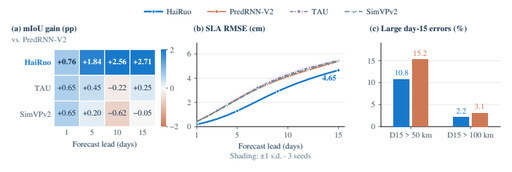
Figure 5 .Skill by lead and reliability on the global evaluation.(a) Three-class mIoU of the lead- l mask relative to PredRNN-V2 (difference of three-seed means, percentage points). (b) Sea-level-anomaly RMSE by lead (three-seed means; shading one standard deviation across seeds). (c) Share of the 114 546 evaluated eddies whose day-15 centre error, averaged over three seeds, exceeds 50 and 100 km.
出典 · CC BY 4.0 · Xukun Qin, Haochen Sun, Yuyang Tian, Ge Chen · HaiRuo: Forecasting Ocean Eddies as Fields and Objects with a Satellite-Altimetry Foundation Model · 論文の図を引用 · 元のPDFの7ページ目から図の部分を抽出しています。バックボーンと物体デコーダの寄与
Dev48でXuanJiデコーダを同じ方式で読み込む条件のもと、バックボーンを固定して比較すると、バックボーンがない場合のD15は25.07 kmで、固定したHaiRuo-1Bを読み込んだ場合は23.85 kmとなり、1.19 km低くなります。同じ条件で、場の技術スコアは0.63から0.77に、mIoUは1.09点高くなります。事前学習なしで同じ1B構造を学習した場合、D15は24.22 kmと報告されており、事前学習済みバックボーンより悪い結果です。XuanJiの2ラウンドの物体アテンションは、固定したHaiRuo-1BのD15を25.76 kmから23.85 kmに1.91 km下げ、6つの公開バックボーンではそれぞれ2.49から3.34 km下げると報告されています。
基本ヘッドだけを使った固定HaiRuo-1Bも、D15 25.76 km、mIoU 67.10%、場の技術スコア0.771を記録し、14個のベースラインを上回ります。このアブレーション実験の結果は、各構成要素を残したときの効果を示すもので、取り除いた構成要素の影響を他の条件にまで一般化するものではありません。
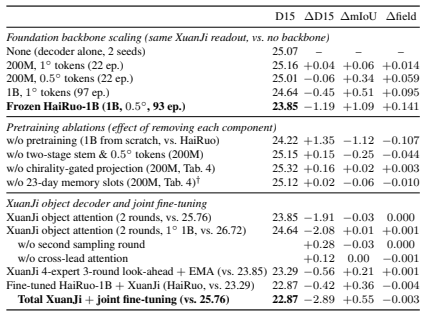
Table 3 . Ablation study on Dev48 (D15 in km, mIoU in points). Top: frozen backbones read out by XuanJi ( ∆ paired on shared seeds vs. no backbone). Middle: representative pretraining ab- lations (all 14 variants in Table 4; †memory masked at readout). Bottom: XuanJi components and joint fine-tuning. 95 % intervals in Table 14. Bold: best backbone, full system.
出典 · CC BY 4.0 · Xukun Qin, Haochen Sun, Yuyang Tian, Ge Chen · HaiRuo: Forecasting Ocean Eddies as Fields and Objects with a Satellite-Altimetry Foundation Model · 論文の図を引用 · 元のPDFの8ページ目から図の部分を抽出しています。固定トラッカーと既存の海洋予報モデルの比較
システム比較では、WenHaiとXiHeの予測場に同じ固定トラッカーを渦中心に適用し、HaiRuoの場の予測と比べます。Test48でのHaiRuoの場ベースの結果は29.5 kmと報告されており、WenHaiの47.1 kmとXiHeの51.6 kmより37から43%低くなっています。物体軌跡の比較では、HaiRuoの軌跡はTest48で10.1 km、全球で11.2 kmと報告されています。この比較は、固定トラッカーと物体軌跡を同じ基準で読む条件に限られるため、2つの方式の差をモデル構造だけの効果と断定すべきではありません。
適用範囲と限界
評価データは、遅延時間(delayed-time)のDUACS日別マップとMETA4.0アトラスのラベルです。論文では、運用予報には準リアルタイムのデータフローが必要だと述べられているため、この結果をリアルタイム予報の性能としてそのまま当てはめるのは難しいです。ラベル付きの学習は、4つの固定領域ウィンドウと1,024個のウィンドウに限られ、ベースラインは同じラベル予算と3シードをそろえた条件で比較されます。ENSOの位相別の結果でも、エルニーニョ期のサンプル数はラニーニャ期より少なくなっています。したがって、この論文の結論は、示されたデータ分割と評価プロトコルの範囲内で読む必要があります。
論文情報
- 著者
- Xukun Qin, Haochen Sun, Yuyang Tian, Ge Chen
- 学会・ジャーナル
- arXiv · プレプリント
- 公開日
- 2026年11月10日
- 登録日
- 2026年11月11日
- 更新日
- 2026年11月10日
- バージョン
- v1
- arXiv
- 2611.14136
- カテゴリ
- cs.LG · cs.CV
- ライセンス
- CC BY 4.0
- 掲載内容
- 論文情報・解説・論文の図
この解説は、Refivuの韓国語解説をAIで翻訳したものです。不正確な翻訳や誤りが含まれる可能性があります。論文と図の利用条件は各出典に従います。
アブストラクト
Mesoscale eddies carry most of the ocean's kinetic energy and move heat, salt and nutrients across basins, yet where an eddy will be two weeks ahead is still read off ocean models with post-hoc tracking heuristics. We introduce HaiRuo, which forecasts eddies as fields and as objects at once: from 30 days of satellite sea-level maps, one forward pass returns 15 days of sea level and geostrophic velocity, daily eddy masks and the trajectory of every eddy alive today. HaiRuo pairs two components with a clear division of labour: (1) HaiRuo-1B, an open-weight 1.05-billion-parameter foundation model pretrained without labels on 24 years of global satellite-altimetry observations, which supplies the 15-day physical fields and masks (+0.14 field skill and +1.1 mIoU points under the same decoder) and further lowers 15-day centre error by 1.2 km frozen (1.35 km over training from scratch); and (2) XuanJi, a Lagrangian object decoder that samples the evolving forecast in each eddy's co-moving polar frame and refines the 15-day path across three look-ahead rounds, removing 2.5 km on HaiRuo-1B (2.9 km with joint fine-tuning) and 2.5-3.3 km via its object attention across six published backbones. Under one pre-registered global evaluation over the whole ocean, HaiRuo improves on fourteen methods on every endpoint (25.2 vs. 30.6 km 15-day centre error, -18%), holding its margin outside the labelled regions and through both phases of the El Nino-Southern Oscillation (ENSO), while reproducing westward drift, 50-60 deg S eastward reversal and poleward cyclone-anticyclone deflection. Over ten days through one fixed tracker, HaiRuo's forecast field cuts the eddy-centre error of WenHai and XiHe by 37-43% (-2.8 km vs. day 0 while they degrade +4.3-8.7 km), and its object trajectories cut pipeline error by 77-78% globally. Open-weight checkpoints, code and project page: https://github.com/xkqin/HaiRuo
この論文を引用
Xukun Qin, Haochen Sun, Yuyang Tian, Ge Chen (2026). HaiRuo: Forecasting Ocean Eddies as Fields and Objects with a Satellite-Altimetry Foundation Model. arXiv:2611.14136v1. https://arxiv.org/abs/2611.14136v1
BibTeX
@misc{qin2026hairuo,
  title = {{HaiRuo: Forecasting Ocean Eddies as Fields and Objects with a Satellite-Altimetry Foundation Model}},
  author = {Xukun Qin and Haochen Sun and Yuyang Tian and Ge Chen},
  year = {2026},
  eprint = {2611.14136},
  archivePrefix = {arXiv},
  url = {https://arxiv.org/abs/2611.14136v1}
}