論文解説
Multi-Future Drafting: Mixture Block Drafters for Tree-Verified Speculative Decoding
Multi-Future Drafting:Tree-Verified Speculative Decodingに向けたMixture Block Drafters
- 課題 ブロックドラフターの位置ごとの積分布は、異なる未来を混ぜたchimerasにも予算を配分するため、ツリーの受理を下げます。
- 手法 MFDは、K個の学習済みモード埋め込みによって1回の順伝播でK個のブロックをドラフトし、最高モードスコアに基づく混合DDTreeで検証します。
ブロックドラフターの積分布が未来を混ぜる問題
投機的デコーディングでは、DFlashのように1回の順伝播で未来のトークンブロックをドラフトするブロックドラフターが、位置ごとの分布を掛け合わせてプレフィックスを順位付けするDDTreeと組み合わせて使われます。ツリー検証のもとでは、期待される受理トークン数は、ツリーがカバーする目標連続の確率質量に等しくなります。しかし連続が複数の未来をたどりうるとき、積分布は異なる未来のトークンをつないだchimerasを生み、それらにも未来そのものに近い予算を与えてしまいます。実際、Qwen3-4BとQwen3-8Bの628プロンプトでは、64ノードの積ツリーの27–33%がchimerasでした。この問題の中心は、積の構造では位置間の結合を表現できないことです。
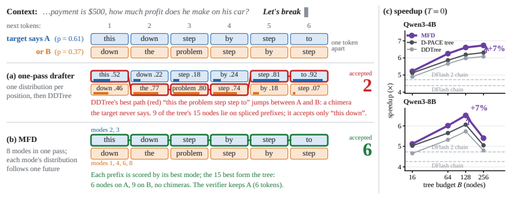
Figure 1 .Why a one-pass drafter needs several futures.(a, b) A real GSM8K context for Qwen3-4B: afterLet’s break, the target says future A (p=0.61) or future B (p=0.37). (a) A one-pass drafter (DFlash fine-tuned with D-PACE) gives one distribution per position, each mixing A’s token and B’s; DDTree’s best path jumps between the futures, a chimera. 9 of the tree’s 15 nodes lie on prefixes that splice A and B, and it accepts 2 tokens. (b) MFD’s 8 modes run in the same pass; six follow A or B, two neither. Every prefix is scored by its best mode and the 15 best form the tree: 6 nodes on A, 9 on B, none a chimera; the verifier keeps A, 6 tokens. (c) Speedup ( T=0 , 5-task mean) against the tree budget B: MFD leads the strongest D-PACE tree under the same recipe at every budget, by about 2% at B=16and 6–7% fromB=64on. DDTree uses the released drafter; dashed: chain drafters.
出典 · CC BY 4.0 · Haoyu Huang, Jialiang Kang, Linlin Yang, Xiao Yang, Baochang Zhang · Multi-Future Drafting: Mixture Block Drafters for Tree-Verified Speculative Decoding · 論文の図を引用 · 元のPDFの2ページ目から図の部分を抽出しています。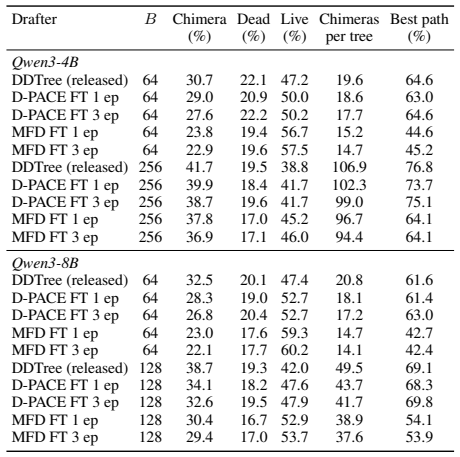
Table 17 .Chimeras in product and mixture trees (628 prompts, T=0 contexts, T=1 target probabilities): share of a tree’s nodes that are chimeras, dead or live, chimeras per tree, and share of rounds whose best path passes through a chimera. FT: fine-tuned under our recipe.
出典 · CC BY 4.0 · Haoyu Huang, Jialiang Kang, Linlin Yang, Xiao Yang, Baochang Zhang · Multi-Future Drafting: Mixture Block Drafters for Tree-Verified Speculative Decoding · 論文の図を引用 · 元のPDFの25ページ目から図の部分を抽出しています。モード埋め込みと勝者総取り学習
MFDは、DFlashドラフターの入力にK個の学習済みモード埋め込みe_kを加えます。モードkのブロックは、ブロックのすべての位置にe_kを加えたコピーとして、同じ順伝播でまとめてドラフトされ、各モードは自身の積分布Q_kを持ちます。学習では、ブロックyについてモードkのsoft coverage C_k(y)を計算し、最も大きなcoverageを持つモードには1−ε、残りのモードにはε/(K−1)の重みを与えます。これは、複数の仮説のうち1つに入力を割り当てるmultiple-choice learningを緩和した形です。論文の式では、C_k(y)はQ_k(y_1:d)の和として定義されており、この値はドラフターがモードkの分布で目標ブロックをどの程度たどれるかを表します。
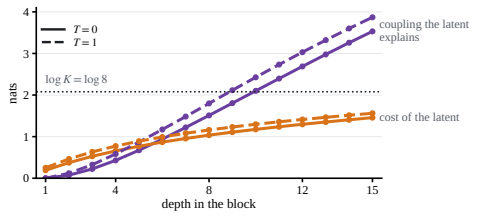
Figure 4 .Coupling the latent explains on the target’s continuations, and its cost against the best mode, by depth in the block (Qwen3-4B, three-epoch MFD drafter, K=8, 5 tasks). The explained coupling grows with depth and passes logK , the largest possible cost, at depth 9–10.
出典 · CC BY 4.0 · Haoyu Huang, Jialiang Kang, Linlin Yang, Xiao Yang, Baochang Zhang · Multi-Future Drafting: Mixture Block Drafters for Tree-Verified Speculative Decoding · 論文の図を引用 · 元のPDFの22ページ目から図の部分を抽出しています。混合DDTreeの最高モードスコア
推論の段階では、プレフィックスvは、すべてのモードのうち最も高いスコアs(v)=max_k(log π_k + log Q_k(v))で評価されます。このスコアで上位B個のプレフィックスを選ぶとツリーになり、論文はそれが各モードのツリーの和集合に等しいことを証明しています。モードどうしが同じ未来をたどる場合はノードを共有でき、予算を節約できます。検証はDDTreeと同じ方法で、目標モデルの順伝播1回で行われます。論文ではlog-sum-expのスコアも評価していますが、本実装ではmax規則を使っています。
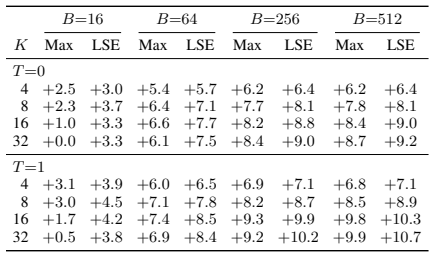
Table 5 .Max and log-sum-exp scoring of the mixture tree: change in τ relative to single-mode D-PACE (5-task means; the quarter-epoch drafters of Table 3, scored with the gate’s prior as there). Max: the rule of Equation (2), whose T=0 columns at B∈ {16,64,512} are those of Table 3; LSE: log-sum-exp (Equation (6)).
出典 · CC BY 4.0 · Haoyu Huang, Jialiang Kang, Linlin Yang, Xiao Yang, Baochang Zhang · Multi-Future Drafting: Mixture Block Drafters for Tree-Verified Speculative Decoding · 論文の図を引用 · 元のPDFの15ページ目から図の部分を抽出しています。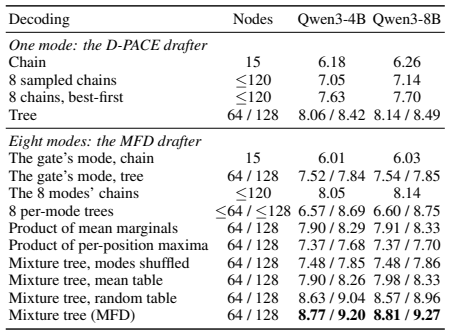
Table 11 .Ways to decode the same drafters: simulated τ (T=0 , 5-task means over 128 prompts per task, 80 for MT-Bench) of the three-epoch drafters of Table 1 (uniform prior), with the nodes verified per round. Chains are verified side by side; best-first: the argmax chain and the seven single-token deviations with the largest expected gain. Per-mode trees: one tree of B/8 nodes per mode. Product of mean marginals: the DDTree tree of the average of the eight modes’ per-position distributions, the same drafter without coupling. Product of per-position maxima: the DDTree tree of Qi maxk qk,i(vi), each position scored by its best mode. Modes shuffled: the mixture tree after permuting the eight modes’ distributions independently at each position, which keeps each position’s distributions but not their coupling (mean of two seeds, which differ by at most 0.02). Mean / random table: every mode embedding replaced by the table’s mean, or by the mean plus a random direction with that mode’s norm about it.T=1in Table 12.
出典 · CC BY 4.0 · Haoyu Huang, Jialiang Kang, Linlin Yang, Xiao Yang, Baochang Zhang · Multi-Future Drafting: Mixture Block Drafters for Tree-Verified Speculative Decoding · 論文の図を引用 · 元のPDFの21ページ目から図の部分を抽出しています。速度と受理長の主要な比較
MFDは、Qwen3-4B、Qwen3-8B、Qwen3.5-4B、Qwen3.6-27Bの5つのタスクの平均で、最も速い手法として報告されています。論文のTable 1で比べると、最も強いベースラインであるD-PACE+DDTreeより、T=0では4.8–7.4%、T=1では5.7–7.6%速くなっています。同じ実行でDARTreeと比べると、同じデータでファインチューニングしたMFDは、5つのタスクの平均で9–16%速いと報告されています。SGLangのバッチサイズ1では、最も速い公開ドラフターより45–46%速くなりました。これらの数値は、それぞれの表における特定の目標モデル、ノード予算、ファインチューニングデータの条件での結果です。
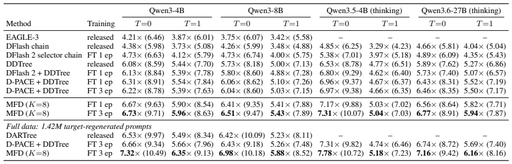
Table 1 .Speedup over autoregressive decoding and acceptance length τ (5-task means). Each tree method except DARTree is at its best budget, B∈ {16,64,128,256} on Qwen3-4B and Qwen3-8B and {16,64,256} on the thinking-mode targets (Section H). DFlash 2 + DDTree: DFlash 2’s distributions in the same tree; its selector chain at T=1 is the faster of its greedy and sampled chains. FT: fine-tuned under our recipe for 1 or 3 epochs (on Qwen3.6-27B, the 1-epoch rows are the first-epoch checkpoints of the 3-epoch runs). Bottom block: fine-tuned on the 1.42M target-regenerated prompts of Domino (Huang et al., 2026), the data of DARTree’s drafter; DARTree verifies 64 nodes with its released drafter and code. Bold: best within each block.
出典 · CC BY 4.0 · Haoyu Huang, Jialiang Kang, Linlin Yang, Xiao Yang, Baochang Zhang · Multi-Future Drafting: Mixture Block Drafters for Tree-Verified Speculative Decoding · 論文の図を引用 · 元のPDFの7ページ目から図の部分を抽出しています。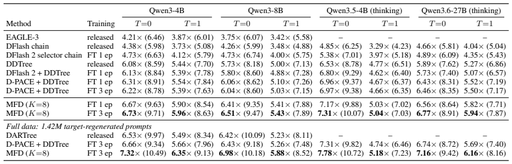
Table 2 .Batch size 1 in SGLang 0.5.22 on one RTX PRO 6000 GPU: decode speedup over SGLang’s autoregressive decoding (prefill excluded), with τ in parentheses, 5-task means. Top: re- leased drafters as distributed, each at its best setting on SGLang’s own engine paths (Section I). Bottom: our tree engine: DDTree with the released DFlash drafter, and D-PACE, MFD and MFD-D (with a single-mode default path) fine-tuned from it on the full data of Table 1, atB=63. Bold: fastest per column.
出典 · CC BY 4.0 · Haoyu Huang, Jialiang Kang, Linlin Yang, Xiao Yang, Baochang Zhang · Multi-Future Drafting: Mixture Block Drafters for Tree-Verified Speculative Decoding · 論文の図を引用 · 元のPDFの7ページ目から図の部分を抽出しています。アブレーション実験が示す条件
論文では、ドラフターがモードをどのように使っているかを確かめるため、複数のアブレーション実験が行われています。同じモードを連鎖(chain)でたどらせると、MFDは単一モードのドラフターより悪くなり、ツリーで検証したときに効果が現れます。入力段階にモードを入れるほどτの向上が大きくなり、出力側への展開では向上は見られませんでした。これは、分岐を扱える検証器がある場合に混合ドラフトが効果的であるという条件を示しています。ただし、この結果は単一モデル系列と設定で得られたものであり、すべてのドラフターに一般化した結論として読み取ることはできません。
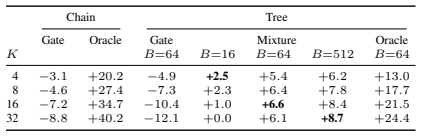
Table 3 .One drafter, several ways to decode it ( T=0 ; change in τ relative to single-mode D-PACE decoded the same way, as a chain or as a tree with the same B). Gate: the mode the gate picks before verification. Oracle: each block’s best mode, known only after verification. Mixture: the tree of Equation (2), with the gate’s prior. The multi-mode drafters train on 1024 draft blocks per sequence against 512 for D-PACE; at a matched 512, K=4 gains 5.0% / 5.6% atB=64(T=0/T=1). Bold: the bestKat each budget.
出典 · CC BY 4.0 · Haoyu Huang, Jialiang Kang, Linlin Yang, Xiao Yang, Baochang Zhang · Multi-Future Drafting: Mixture Block Drafters for Tree-Verified Speculative Decoding · 論文の図を引用 · 元のPDFの8ページ目から図の部分を抽出しています。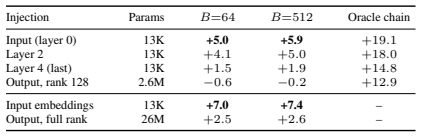
Table 4 .Where the modes enter ( K=4, T=0 ; change in τ relative to D-PACE). Top: mode embeddings added at different depths of the five-layer drafter, or a low-rank per-mode map of the output. Bottom: input embeddings against a full-rank per-mode output expansion with a learned prior (Karimi et al., 2026), both trained with the mixture NLL, relative to a single mode trained with plain NLL. Params: parameters added, including the gate or prior head. Oracle chain: each block’s best mode.
出典 · CC BY 4.0 · Haoyu Huang, Jialiang Kang, Linlin Yang, Xiao Yang, Baochang Zhang · Multi-Future Drafting: Mixture Block Drafters for Tree-Verified Speculative Decoding · 論文の図を引用 · 元のPDFの8ページ目から図の部分を抽出しています。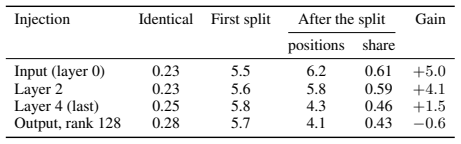
Table 14 .Where the modes’ argmax chains part (Qwen3-4B; the K=4 quarter-epoch drafters of Table 4; 8 held-out conversations per task, every fourth anchor, 4330 anchors, all six pairs of modes, 15-token argmax chains). Identical: share of pairs whose chains agree at every position. First split: mean position of the first differing token among the other pairs (1 is the first drafted token). After the split: mean number of differing positions from there on, and their share of the remaining positions. Gain: the mixture tree’s change in τ at B=64relative to D-PACE (%, Table 4).
出典 · CC BY 4.0 · Haoyu Huang, Jialiang Kang, Linlin Yang, Xiao Yang, Baochang Zhang · Multi-Future Drafting: Mixture Block Drafters for Tree-Verified Speculative Decoding · 論文の図を引用 · 元のPDFの23ページ目から図の部分を抽出しています。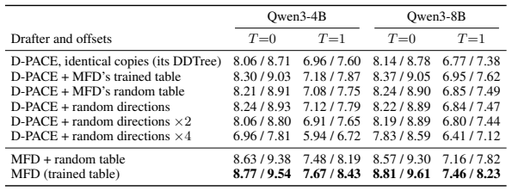
Table 15 .Mixture trees over eight offset copies of the D-PACE drafter, which was not trained with modes, against the MFD drafter (simulated τ at B=64 / 256, 5-task means, three-epoch drafters of Table 1, uniform prior). Random table: the trained table’s mean plus random directions with each mode’s norm about it, as in Table 11; random directions: the same directions without the mean, at 1, 2 and 4 times that norm.
出典 · CC BY 4.0 · Haoyu Huang, Jialiang Kang, Linlin Yang, Xiao Yang, Baochang Zhang · Multi-Future Drafting: Mixture Block Drafters for Tree-Verified Speculative Decoding · 論文の図を引用 · 元のPDFの24ページ目から図の部分を抽出しています。適用範囲と限界
バッチサイズが大きくなると、MFDの利点は小さくなります。K個のモードのブロックがドラフト段階を計算上のボトルネックにするため、バッチサイズ8以上ではDDTreeに後れを取り、バッチサイズ16以上ではSGLang独自の経路にも後れを取ると報告されています。また、ドラフターが分岐をすでに条件付けしている場合、モードは追加の利点を与えませんでした。したがって、この手法は遅延が重要となる小さいバッチのデコーディングに向いていると解釈すべきで、大きなバッチのサービングや、すでに逐次補正を使っているドラフターで同じ効果が得られるとは限りません。
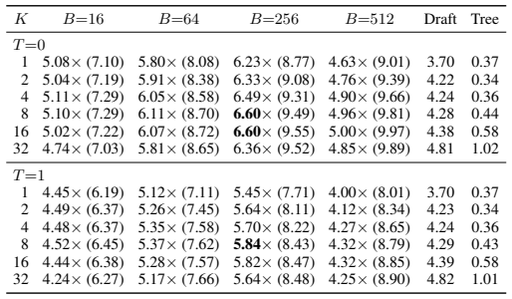
Table 16 .Speedup and τ (in parentheses) of the quarter-epoch drafters with K modes on Qwen3-4B (5-task means, the harness of Table 1); K=1 is the single-mode D-PACE drafter (512 draft blocks per sequence). Draft and tree: drafting and tree-building time per round atB=256(ms; drafting time hardly changes withB). Bold: fastest at each temperature.
出典 · CC BY 4.0 · Haoyu Huang, Jialiang Kang, Linlin Yang, Xiao Yang, Baochang Zhang · Multi-Future Drafting: Mixture Block Drafters for Tree-Verified Speculative Decoding · 論文の図を引用 · 元のPDFの24ページ目から図の部分を抽出しています。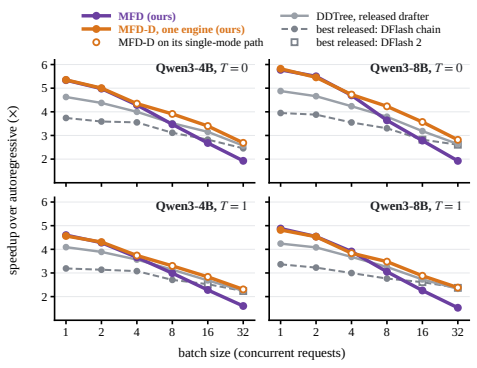
Figure 5 .Speedup over SGLang’s autoregressive decoding at the same batch size (top: T=0 , bottom: T=1 ). Closed loop: 320 requests from the five tasks with as many in flight as the batch size, at most 2048 new tokens, steady-state output throughput (prefills of new requests included, so batch-1 values lie below those of Table 2), one RTX PRO 6000 GPU. MFD and MFD-D run their drafter’s linear layers in FP8 (SGLang’s online option: per-channel weights, per-token activations, no new checkpoint; the acceptance length is unchanged). Every released option is tuned for each batch size and shown at the better of its bf16 and FP8 timings: trees over two or three budgets in {7,15,31,63} , the DFlash chain over 16-token and, from batch 4, 8-token blocks, EAGLE-3 over 6–10 tree shapes in bf16 and the best of them in FP8. Dashed: the fastest released option on SGLang’s own engine paths (DFlash chain, DFlash 2, EAGLE-3) at each batch size, which is the DFlash chain except where DFlash 2 is faster (open squares). DDTree: the released DFlash drafter in our tree engine. MFD-D is one engine with a fixed schedule: its eight-mode mixture for one or two requests, its single-mode default path (open circles) from three, with the budget falling from 63 to 7 as the batch grows. Every configuration is timed against the autoregressive reference of its own session; the references of different sessions agree within 0.8%, and a configuration re-timed in bf16 within 2.8%.
出典 · CC BY 4.0 · Haoyu Huang, Jialiang Kang, Linlin Yang, Xiao Yang, Baochang Zhang · Multi-Future Drafting: Mixture Block Drafters for Tree-Verified Speculative Decoding · 論文の図を引用 · 元のPDFの29ページ目から図の部分を抽出しています。論文情報
- 著者
- Haoyu Huang, Jialiang Kang, Linlin Yang, Xiao Yang, Baochang Zhang
- 学会・ジャーナル
- arXiv · プレプリント
- 公開日
- 2026年11月9日
- 登録日
- 2026年11月11日
- 更新日
- 2026年11月9日
- バージョン
- v1
- arXiv
- 2611.13017
- カテゴリ
- cs.AI · cs.LG
- ライセンス
- CC BY 4.0
- 掲載内容
- 論文情報・解説・論文の図
この解説は、Refivuの韓国語解説をAIで翻訳したものです。不正確な翻訳や誤りが含まれる可能性があります。論文と図の利用条件は各出典に従います。
アブストラクト
Block drafters such as DFlash draft a block of future tokens in one forward pass, and draft trees such as DDTree verify the prefixes ranked highest by the product of the drafter's per-position distributions. Under tree verification, the expected number of accepted tokens is the probability mass the tree covers. We show that a product misallocates it: when the continuation can follow several futures, it splices them into chimeras, prefixes stitched together from different futures that the target never produces, and gives them as much budget as the futures themselves. Barring ties, no product-ranked tree can hold two futures that disagree in $m$ positions without $2^{m-1}-1$ chimeras, however well the drafter is trained, and in practice chimeras make up 27-33% of a 64-node tree. We propose Multi-Future Drafting (MFD), which restores the coupling with a latent variable instead of the chain rule: $K$ learned mode embeddings at the drafter's input draft $K$ coherent blocks in the same pass, and a mixture DDTree lets the verifier pick the future the target takes, losslessly and with $K+1$ extra vectors. On four Qwen targets from 4B to 27B parameters, at batch size 1, MFD reaches up to 7.8$\times$ speedup, 5-8% faster than the best single-mode tree trained identically and, on Qwen3-4B and Qwen3-8B, 9-16% faster than the released DARTree trained on the same prompts.
この論文を引用
Haoyu Huang, Jialiang Kang, Linlin Yang, Xiao Yang, Baochang Zhang (2026). Multi-Future Drafting: Mixture Block Drafters for Tree-Verified Speculative Decoding. arXiv:2611.13017v1. https://arxiv.org/abs/2611.13017v1
BibTeX
@misc{huang2026multi,
  title = {{Multi-Future Drafting: Mixture Block Drafters for Tree-Verified Speculative Decoding}},
  author = {Haoyu Huang and Jialiang Kang and Linlin Yang and Xiao Yang and Baochang Zhang},
  year = {2026},
  eprint = {2611.13017},
  archivePrefix = {arXiv},
  url = {https://arxiv.org/abs/2611.13017v1}
}