論文解説
Classification with Large-Step Gradient Descent: Unifying Self-Stabilization and Convergence Rates
Large-Step Gradient Descentを用いた分類:Self-Stabilizationと収束率の統合
- 課題 大きな学習率での勾配降下法は、従来の安定性理論では説明できない振動領域で速く収束しますが、これを自己安定化と収束率の両方から説明するのは難しいです。
- 手法 最大マージン方向と曲率で定めた部分空間で反復値を平行成分と直交成分に分け、両成分の結合ダイナミクスから直交振動の減衰と収束の境界を導きます。
- 結果 指数テール損失では不安定段階と3段階の安定減衰を定量的に示しました。サポートベクトルが直交部分空間を生成しない場合、大きなステップは最大マージン方向への有限時間での整列に偏りを残すことを実験で示しました。
大きなステップ勾配降下法の問題
ニューラルネットワークは、古典的な安定性の閾値を超える大きなステップサイズで勾配降下法を実行することが多く、この領域は損失が単調でなく振動する edge of stability と呼ばれています。それでも、この領域はより速い収束とより良い汎化を示すことが多いため、既存の収束理論が当てはまらない現象を説明する必要があります。先行研究は自己安定化の仕組みを明らかにしましたが収束率は示さず、別の研究は収束率を示しましたが仕組みは説明しませんでした。また、最小値多様体に依存する統一的な見方は、分類損失では最小値が有限のパラメータで達成されないため、適用が難しいです。

Table 1 : High-level comparison of related theoretical analyses of GD at the edge of stability.
出典 · CC BY 4.0 · Salma Tarmoun, Lachlan Ewen MacDonald, Konstantinos Emmanouilidis, Ziqing Xu, René Vidal · Classification with Large-Step Gradient Descent: Unifying Self-Stabilization and Convergence Rates · 論文の図を引用 · 元のPDFの3ページ目から図の部分を抽出しています。部分空間分解と結合ダイナミクス
この論文は、最小値多様体の代わりに曲率で定めた部分空間を基準に反復値を分解します。最大マージン方向vに平行な成分θ∥と直交成分θ⊥に分け、直交成分の更新は、制限されたHessian H(θ∥)によってI−ηH(θ∥)で近似されます。平行成分の更新は、損失の平行勾配項と、直交振動エネルギーに比例する結合項から成ります。この結合項が直交振動を前進運動に変え、曲率を下げることが自己安定化の源です。この式が成り立つには、部分空間の整列や相対曲率比較可能性といった正則性の仮定が必要です。
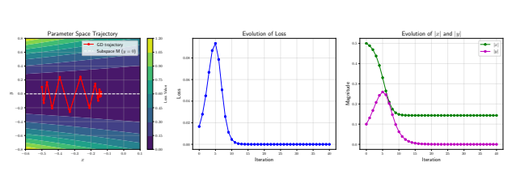
Figure 1 : GD dynamics illustrating the flat subspace M, orthogonal oscillations, evolution of the loss, and parameter magnitudes.
出典 · CC BY 4.0 · Salma Tarmoun, Lachlan Ewen MacDonald, Konstantinos Emmanouilidis, Ziqing Xu, René Vidal · Classification with Large-Step Gradient Descent: Unifying Self-Stabilization and Convergence Rates · 論文の図を引用 · 元のPDFの4ページ目から図の部分を抽出しています。安定段階の3段階減衰
定理1は、不安定段階では平行座標が線形に増加し、制限されたシャープネスが指数関数的に減少することを示しています。安定閾値を超えた後、直交成分は非拡大的な遷移区間、線形収縮区間、多項式減衰区間の3段階に分かれます。この境界は元のシャープネスではなく、η(1+δ_r)λ1で定義される補正シャープネスによって決まります。したがって、この3区間は、相対曲率比較可能性の許容誤差δ_rとテール条件の下で成り立つ結果です。

Table 2 : Summary of the structural assumptions used in the convergence analysis.
出典 · CC BY 4.0 · Salma Tarmoun, Lachlan Ewen MacDonald, Konstantinos Emmanouilidis, Ziqing Xu, René Vidal · Classification with Large-Step Gradient Descent: Unifying Self-Stabilization and Convergence Rates · 論文の図を引用 · 元のPDFの6ページ目から図の部分を抽出しています。サポートベクトル空間と過度な暗黙的バイアス
ロジスティック損失の双対対称モデルでは、サポートベクトルの直交成分が全体Uを生成すると、制限されたHessianの条件数の比が1付近にとどまり、直交成分はすべて減少します。逆に、サポートベクトルがUを生成できない場合、比は時間とともに0に減少し、累積収縮の予算が有限となるため、一部の直交成分が残ることがあります。著者らは、この場合、大きなステップが不安定段階で直交成分を増幅し、安定段階の収縮はその残差を部分的にしか減らさないと解釈しています。その結果、漸近的には最大マージン方向に収束しても、有限時間での整列はステップサイズによって変わることがあります。
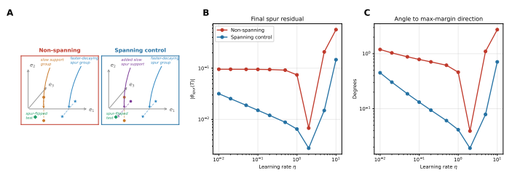
Figure 7 : Non-spanning support geometry produces learning-rate-dependent residuals in pair- symmetric logistic regression (R3, T= 20,000 steps).(A)Signed-feature schematics. Reflected pairs zi,± =a ie1 ±u i are connected by dashed lines. The slow support group (orange, a= 1 ) spans only e2; the fast spur group (blue, a= 4 ) spans e3. In the spanning control, an additional slow group (purple) adds support in e3. Both geometries share the same max-margin line e1.(B)Final spur residual |⟨θT , e3⟩| versus learning rate. The non-spanning geometry retains a systematically larger residual, with the gap widening at large η where unstable amplification is strongest.(C)Angle be- tween θT and the max-margin direction. The non-spanning residual translates into a larger finite-time deviation from the asymptotic classifier, confirming that top-eigenvalue stabilization alone does not guarantee uniform contraction of all orthogonal components.
出典 · CC BY 4.0 · Salma Tarmoun, Lachlan Ewen MacDonald, Konstantinos Emmanouilidis, Ziqing Xu, René Vidal · Classification with Large-Step Gradient Descent: Unifying Self-Stabilization and Convergence Rates · 論文の図を引用 · 元のPDFの64ページ目から図の部分を抽出しています。低次元合成実験の範囲
スパニングロジスティックモデルのR3実験(N=24, dim U=2)では、軌道は予測された3段階の構造に従い、多項式減衰指数はγr=0.84と報告されています。非スパニング設定では、η/ηcを1から3まで変えながら、弱い直交成分|cwk|が大きいηでより大きくなる結果を観察しました。これらの実験は制御された低次元の合成設定であり、大規模な深層ネットワークでの検証は行っていません。また、現代のニューラルネットワークで適切な基準部分空間を特定する問題は、未解決の課題として残っています。
論文情報
- 著者
- Salma Tarmoun, Lachlan Ewen MacDonald, Konstantinos Emmanouilidis, Ziqing Xu, René Vidal
- 学会・ジャーナル
- arXiv · プレプリント
- 公開日
- 2026年11月12日
- 登録日
- 2026年11月16日
- 更新日
- 2026年11月12日
- バージョン
- v1
- arXiv
- 2611.17459
- カテゴリ
- cs.LG · math.OC
- ライセンス
- CC BY 4.0
- 掲載内容
- 論文情報・解説・論文の図
この解説は、Refivuの韓国語解説をAIで翻訳したものです。不正確な翻訳や誤りが含まれる可能性があります。論文と図の利用条件は各出典に従います。
アブストラクト
Neural networks are often trained with gradient descent (GD) using step sizes that exceed classical stability thresholds, a regime where standard convergence theory no longer applies. Despite exhibiting non-monotonic loss and oscillatory dynamics, this regime frequently leads to faster convergence and better generalization. Existing theoretical perspectives offer complementary but incomplete insights: one identifies a self-stabilization mechanism that drives GD toward flat regions but does not yield convergence rates; another derives rigorous rates for specific losses but does not explain the underlying stabilization mechanism; and a third unifies these views for overparameterized least squares, but relies on the existence of a minimizer manifold, which is absent in classification settings. In this work, we extend this unified geometric perspective to exponential-tail losses, including logistic and cross-entropy losses in separable linear classification, where the loss infimum is not attained at any finite parameter. We identify a curvature-defined reference subspace that replaces the role of the minimizer manifold, yielding a coupled dynamical system in which orthogonal oscillations are damped by parallel progress along directions of decreasing sharpness. Under regularity conditions, which we verify for logistic and multiclass cross-entropy losses on symmetric data models, we derive explicit bounds for the iterates, not just the loss, covering both the unstable and stable regimes, and revealing a three-phase damping structure in the latter. Our analysis further uncovers a transient implicit bias induced by large step sizes: although GD converges asymptotically to the max-margin direction, large steps can leave persistent orthogonal residuals and, in certain geometries, amplify them, affecting finite-time alignment with the max-margin direction.
この論文を引用
Salma Tarmoun, Lachlan Ewen MacDonald, Konstantinos Emmanouilidis, Ziqing Xu, René Vidal (2026). Classification with Large-Step Gradient Descent: Unifying Self-Stabilization and Convergence Rates. arXiv:2611.17459v1. https://arxiv.org/abs/2611.17459v1
BibTeX
@misc{tarmoun2026classification,
  title = {{Classification with Large-Step Gradient Descent: Unifying Self-Stabilization and Convergence Rates}},
  author = {Salma Tarmoun and Lachlan Ewen MacDonald and Konstantinos Emmanouilidis and Ziqing Xu and René Vidal},
  year = {2026},
  eprint = {2611.17459},
  archivePrefix = {arXiv},
  url = {https://arxiv.org/abs/2611.17459v1}
}