論文解説
Delayed Effects of Temporary Weight Decay in Muon Pretraining
Muon事前学習における一時的な重み減衰の遅延効果
- 課題 一時的な最適化の介入を、除去した時点の損失だけで評価すると、最終的な効果を誤って判断することがあります。
- 手法 Muonで学習したTransformerに区間限定の重み減衰を適用し、除去後のノルムと相対ステップを追跡しています。
一時的な減衰の除去時点での評価の問題
一時的な最適化の介入は、除去される時点の検証損失だけでは評価しにくいです。この論文のMuon事前学習の実験では、1.4Bモデルに重み減衰を最初の44%の区間にだけλ=0.15で適用すると、除去時点では減衰なしより0.26 nats悪くなりました。しかし、学習が73%の地点を過ぎると結果が逆転し、最終予算では0.0275 nats良くなりました。そのため、除去時点の値は最終的な効果をうまく予測できないことがあります。2つの実行は、除去後に同じ更新規則を使いますが、パラメータとオプティマイザの状態が異なるため、その差は変化し続けます。
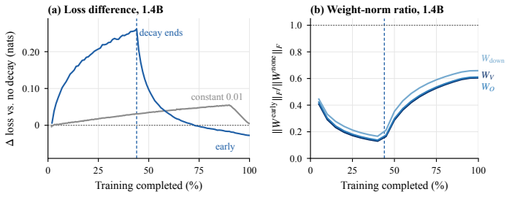
Figure 1 A temporary intervention can be harmful at removal and beneficial much later.1.4B, FineWeb100B, 28,000 updates. Decay (λ = 0.15) is applied for the first 44% of training; the schedule was selected at 162M and transferred without retuning. (a) Validation-loss difference from no decay; constant decay0.01is shown for comparison. Temporary decay is 0.26 nats worse at removal, crosses no decay at73%of training, and finishes 0.0275 nats better. (b) Layer-averaged weight norms relative to no decay. The dashed line marks removal; the norm deficit persists afterward.
出典 · CC BY 4.0 · Md Rifat Arefin, Ravid Shwartz-Ziv, Ernie Chang, Chinnadhurai Sankar, Rylan Conway, Aristide Baratin, Irina Rish, Adithya Sagar, Patrick Huber · Delayed Effects of Temporary Weight Decay in Muon Pretraining · 論文の図を引用 · 元のPDFの2ページ目から図の部分を抽出しています。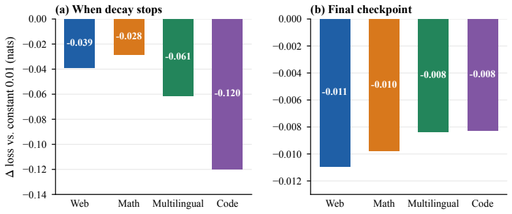
Figure 6 The domain ranking changes between removal and the final checkpoint.Validation-loss differences from constant0 .01when decay is removed and at the final checkpoint; negative values favor temporary decay. Each comparison uses a 162M model; temporary decay usesλ = 0.3for the first 10% of training. The vertical scales differ.
出典 · CC BY 4.0 · Md Rifat Arefin, Ravid Shwartz-Ziv, Ernie Chang, Chinnadhurai Sankar, Rylan Conway, Aristide Baratin, Irina Rish, Adithya Sagar, Patrick Huber · Delayed Effects of Temporary Weight Decay in Muon Pretraining · 論文の図を引用 · 元のPDFの16ページ目から図の部分を抽出しています。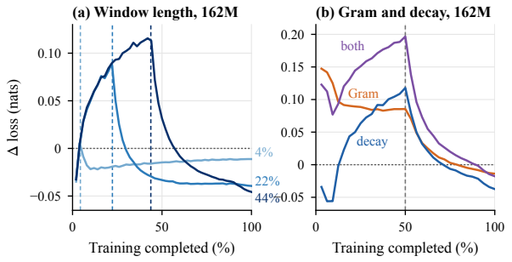
Figure 7 Loss differences evolve after removal.(a) Three 162M decay windows at λ = 0.15(FineWeb100B). (b) Gram regularization, weight decay, and their combination over the first 50% at 162M (FineWeb-Edu). Dashed lines mark removal. References use no regularization; vertical scales differ.
出典 · CC BY 4.0 · Md Rifat Arefin, Ravid Shwartz-Ziv, Ernie Chang, Chinnadhurai Sankar, Rylan Conway, Aristide Baratin, Irina Rish, Adithya Sagar, Patrick Huber · Delayed Effects of Temporary Weight Decay in Muon Pretraining · 論文の図を引用 · 元のPDFの17ページ目から図の部分を抽出しています。Muonと区間重み減衰の設定
主な設定は、Muonで学習するデコーダ専用のTransformerです。隠れ層の行列それぞれに分離型の重み減衰を適用し、更新式はWt+1=(1−ηtλt)Wt−ηtUtと書き、λt=λ·1{s≤t<e}とします。ここでUtは学習率を掛ける前のMuonの更新量で、[s,e)が減衰の区間です。区間の外では減衰は0で、埋め込みと出力ヘッドには減衰を適用していません。除去時点は区間の終端eとし、Δtは介入実行と基準実行の検証損失の差です。
開始時点と評価時点による効果
162M、405M、1.4Bの3つの規模で、長さ10%の窓を初期化時点から始めると、2つの基準より良くなりました。同じ長さと係数で60%の時点から始めると、2つの基準より悪くなりました。この差は総収縮量が同じ条件で現れたため、符号の反転は開始時点による効果と解釈されます。つまり、初期に始めることの優位性は評価期間によって変わります。同じ実験では、窓の長さも損失を変えており、係数よりも長さの影響が大きくなりました。
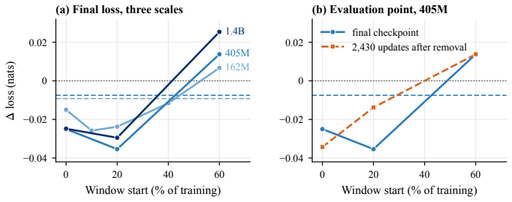
Figure 2 Start time changes the sign; evaluation horizon changes the ranking.(a) Final loss difference for 10% windows by start time; dashed lines show the best sampled constant. (b) At 405M, the ranking of early starts reverses when evaluated after equal post-removal training.
出典 · CC BY 4.0 · Md Rifat Arefin, Ravid Shwartz-Ziv, Ernie Chang, Chinnadhurai Sankar, Rylan Conway, Aristide Baratin, Irina Rish, Adithya Sagar, Patrick Huber · Delayed Effects of Temporary Weight Decay in Muon Pretraining · 論文の図を引用 · 元のPDFの4ページ目から図の部分を抽出しています。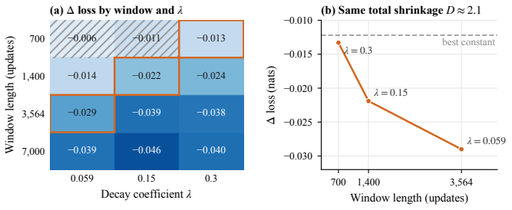
Figure 3 Duration affects loss beyond total shrinkage.162M, FineWeb100B, 16,000 updates. (a) Final loss difference across duration and decay coefficient; hatching marks schedules that do not beat the best sampled constant. (b) At matchedD≈2.1, longer, weaker decay performs better.
出典 · CC BY 4.0 · Md Rifat Arefin, Ravid Shwartz-Ziv, Ernie Chang, Chinnadhurai Sankar, Rylan Conway, Aristide Baratin, Irina Rish, Adithya Sagar, Patrick Huber · Delayed Effects of Temporary Weight Decay in Muon Pretraining · 論文の図を引用 · 元のPDFの5ページ目から図の部分を抽出しています。重みノルムの欠損と相対ステップ
相対ステップの大きさαtは、重みの変化のうち重みに垂直な成分を、重みのFrobeniusノルムで割った値です。そのため、同じ射影された更新ノルムでは、重みのノルムが小さいほどαtが大きくなります。162Mでは、更新2,800で逆ノルム比は1.17でしたが、相対ステップ比は1.07でした。つまり、射影された更新ノルムの変化が、ノルムの差の一部を相殺しました。
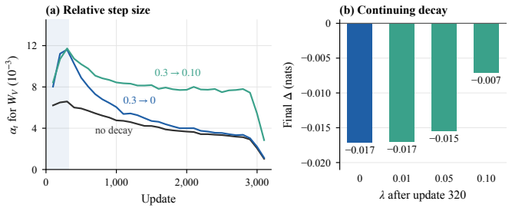
Figure 4 Early decay increases relative step size, but larger relative steps do not always improve loss.(a) Layer- averaged relative step sizeαt for WV; the shaded band is the decay window. (b) Final loss differences from no decay after usingλ= 0.3for the first 320 updates and then the indicated coefficient. 162M, FineWeb-Edu, 3,200 updates.
出典 · CC BY 4.0 · Md Rifat Arefin, Ravid Shwartz-Ziv, Ernie Chang, Chinnadhurai Sankar, Rylan Conway, Aristide Baratin, Irina Rish, Adithya Sagar, Patrick Huber · Delayed Effects of Temporary Weight Decay in Muon Pretraining · 論文の図を引用 · 元のPDFの7ページ目から図の部分を抽出しています。固定ノルムでのリプレイ検証
重みのノルムを初期値に固定し、測定した相対ステップの軌跡だけを規定するHyperball変種でリプレイを行いました。更新320で軌跡を分けた結果、0.0221 natsのうち0.0181 natsは窓の後のステップから得られました。窓の期間中の軌跡だけを使い、その後はMuonに戻した場合、改善は0.0003 natsにとどまりました。これは、この制御された設定では、相対ステップの軌跡が順序と大きさを再現するのに十分であることを意味します。ただし、相対ステップだけが唯一の状態だという証明ではありません。
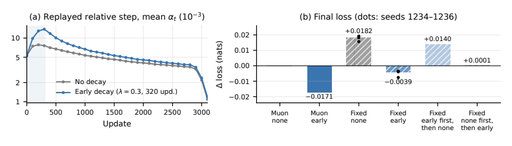
Figure 5 Fixed-norm replay reproduces the post-removal gain.162M, FineWeb-Edu, 3,200 updates. (a) Relative-step trajectories measured from the source Muon runs and replayed at fixed weight norms. (b) Final loss relative to Muon without decay; dots show three replay seeds and the last two bars switch trajectory at update 320.
出典 · CC BY 4.0 · Md Rifat Arefin, Ravid Shwartz-Ziv, Ernie Chang, Chinnadhurai Sankar, Rylan Conway, Aristide Baratin, Irina Rish, Adithya Sagar, Patrick Huber · Delayed Effects of Temporary Weight Decay in Muon Pretraining · 論文の図を引用 · 元のPDFの7ページ目から図の部分を抽出しています。限界
相対ステップが徐々に収束することを説明する再帰式は近似であり、著者らはこの式が正確な法則ではないと考えています。連続する増分が2つの実行で似ているという仮定に依るため、実験でもアテンション行列のずれは残りました。連続減衰係数0.10を使った場合、相対ステップは大きいまま保たれましたが、最終的な改善は0.0071 natsで、0.0171 natsより小さくなりました。そのため、相対ステップが大きいほど常に良いとは限りません。この研究は、ノルムが唯一の持続的な状態であることを実証しておらず、特定の相対ステップの軌跡がなぜ有益なのかも説明していません。ほとんどの設定は単一シードで実行されており、減衰係数は一般的ではありません。
規模の拡大とGramペナルティ
初期のGramペナルティは、同じ原因に対する対照として扱われました。162Mで5つのペア実行により評価したところ、Gramペナルティは正規化なしと比べて最終損失を0.0142 nats下げました。3.4Bの実験では、テストしたすべての初期スケジュールが、検証損失と平均精度を3つの基準すべてより改善しました。ただし、3.4Bの実験の減衰係数と区間は1.4Bの条件で選んだ値に従っており、これは細かい条件として見るべきです。
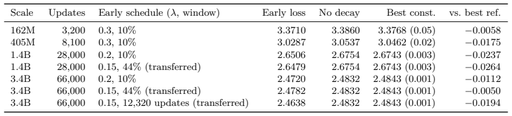
Table 1 Early decay across scale.FineWeb100B, compute-optimal budgets, no warmup. “Best const.” is the best sampled constant coefficient; full sweeps are in Appendix C and the 3.4B configurations are in Appendix K.
出典 · CC BY 4.0 · Md Rifat Arefin, Ravid Shwartz-Ziv, Ernie Chang, Chinnadhurai Sankar, Rylan Conway, Aristide Baratin, Irina Rish, Adithya Sagar, Patrick Huber · Delayed Effects of Temporary Weight Decay in Muon Pretraining · 論文の図を引用 · 元のPDFの8ページ目から図の部分を抽出しています。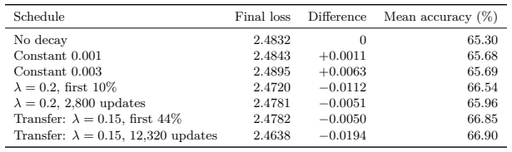
Table 17 Final validation loss and mean zero-shot accuracy at 3.4B.Differences are from no decay. Accuracy averages the same five tasks used below.
出典 · CC BY 4.0 · Md Rifat Arefin, Ravid Shwartz-Ziv, Ernie Chang, Chinnadhurai Sankar, Rylan Conway, Aristide Baratin, Irina Rish, Adithya Sagar, Patrick Huber · Delayed Effects of Temporary Weight Decay in Muon Pretraining · 論文の図を引用 · 元のPDFの24ページ目から図の部分を抽出しています。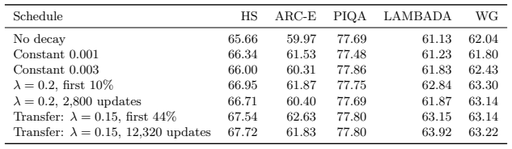
Table 18 Zero-shot accuracy (%) at 3.4B.HS: HellaSwag; ARC-E: ARC-Easy; WG: WinoGrande. Means are reported in Table 17.
出典 · CC BY 4.0 · Md Rifat Arefin, Ravid Shwartz-Ziv, Ernie Chang, Chinnadhurai Sankar, Rylan Conway, Aristide Baratin, Irina Rish, Adithya Sagar, Patrick Huber · Delayed Effects of Temporary Weight Decay in Muon Pretraining · 論文の図を引用 · 元のPDFの24ページ目から図の部分を抽出しています。論文情報
- 著者
- Md Rifat Arefin, Ravid Shwartz-Ziv, Ernie Chang, Chinnadhurai Sankar, Rylan Conway, Aristide Baratin, Irina Rish, Adithya Sagar, Patrick Huber
- 学会・ジャーナル
- arXiv · プレプリント
- 公開日
- 2026年11月13日
- 登録日
- 2026年11月16日
- 更新日
- 2026年11月13日
- バージョン
- v1
- arXiv
- 2611.17876
- カテゴリ
- cs.LG · cs.CL
- ライセンス
- CC BY 4.0
- 掲載内容
- 論文情報・解説・論文の図
この解説は、Refivuの韓国語解説をAIで翻訳したものです。不正確な翻訳や誤りが含まれる可能性があります。論文と図の利用条件は各出典に従います。
アブストラクト
A temporary optimization intervention can increase validation loss when it ends yet reduce it at the final training budget. We demonstrate this with temporary weight decay in Muon-trained decoder-only Transformers with 162M, 405M, 1.4B, and 3.4B parameters. For models up to 1.4B parameters, moving a fixed-duration decay window from early to late training reverses its final effect. At 162M, changing window duration alters final loss even at approximately matched total shrinkage. Most strikingly, a schedule selected at 162M and transferred without retuning to 1.4B is 0.26 nats worse than no decay when removed, overtakes it only after 73% of training, and ultimately finishes 0.028 nats better while also outperforming the best sampled constant-decay baseline. Early decay leaves a persistent weight-norm deficit, which keeps relative steps larger after the intervention ends. An approximate norm-dynamics recurrence captures the slow convergence of these relative steps, and fixed-norm replays of the measured trajectories reproduce the performance ordering and a similar loss difference. At 162M and 405M, norm-reset experiments show that smaller weight norms at the end of the decay window explain most of the final loss improvement. A separate Gram intervention exhibits related post-removal norm and relative-step dynamics. These results show that temporary optimization schedules can have delayed effects long after removal and should therefore be evaluated at the intended final training budget, not only at removal.
この論文を引用
Md Rifat Arefin, Ravid Shwartz-Ziv, Ernie Chang, Chinnadhurai Sankar, Rylan Conway, Aristide Baratin, Irina Rish, Adithya Sagar, Patrick Huber (2026). Delayed Effects of Temporary Weight Decay in Muon Pretraining. arXiv:2611.17876v1. https://arxiv.org/abs/2611.17876v1
BibTeX
@misc{arefin2026delayed,
  title = {{Delayed Effects of Temporary Weight Decay in Muon Pretraining}},
  author = {Md Rifat Arefin and Ravid Shwartz-Ziv and Ernie Chang and Chinnadhurai Sankar and Rylan Conway and Aristide Baratin and Irina Rish and Adithya Sagar and Patrick Huber},
  year = {2026},
  eprint = {2611.17876},
  archivePrefix = {arXiv},
  url = {https://arxiv.org/abs/2611.17876v1}
}