논문 해설
Delayed Effects of Temporary Weight Decay in Muon Pretraining
Muon pre-training에서 일시적 가중치 감쇠의 지연된 효과
- 연구 문제 임시 최적화 개입은 제거 시점의 손실만으로 평가하면 최종 효과를 잘못 판단할 수 있습니다.
- 연구 방법 Muon으로 학습한 Transformer에 구간 가중치 감쇠를 적용하고, 제거 후 노름과 상대 스텝을 추적합니다.
임시 감쇠의 제거 시점 평가 문제
임시 최적화 개입은 제거되는 시점의 검증 손실만으로 평가하기 어렵습니다. 이 논문의 Muon pre-training 실험에서 1.4B 모델에 가중치 감쇠를 처음 44% 구간에만 λ=0.15로 적용하면, 제거 시점에는 감쇠 없음보다 0.26 nats 나빠졌습니다. 그러나 학습이 73% 지점을 지나면서 역전되어 최종 예산에서는 0.0275 nats 더 좋아졌습니다. 따라서 제거 시점의 값은 최종 효과를 잘 예측하지 못할 수 있습니다. 두 실행은 제거 이후 같은 업데이트 규칙을 쓰지만 파라미터와 옵티마이저 상태가 달라, 그 차이가 계속 변합니다.
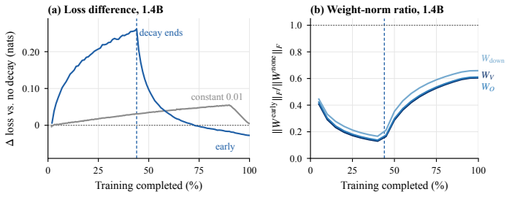
Figure 1 A temporary intervention can be harmful at removal and beneficial much later.1.4B, FineWeb100B, 28,000 updates. Decay (λ = 0.15) is applied for the first 44% of training; the schedule was selected at 162M and transferred without retuning. (a) Validation-loss difference from no decay; constant decay0.01is shown for comparison. Temporary decay is 0.26 nats worse at removal, crosses no decay at73%of training, and finishes 0.0275 nats better. (b) Layer-averaged weight norms relative to no decay. The dashed line marks removal; the norm deficit persists afterward.
원문 · CC BY 4.0 · Md Rifat Arefin, Ravid Shwartz-Ziv, Ernie Chang, Chinnadhurai Sankar, Rylan Conway, Aristide Baratin, Irina Rish, Adithya Sagar, Patrick Huber · Delayed Effects of Temporary Weight Decay in Muon Pretraining · 원문 그림 인용 · 원본 PDF 2쪽에서 그림 영역을 추출했습니다.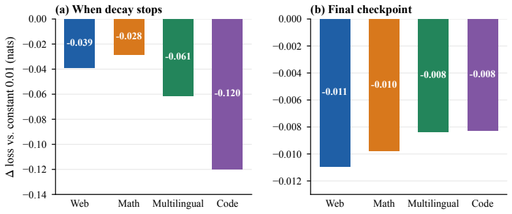
Figure 6 The domain ranking changes between removal and the final checkpoint.Validation-loss differences from constant0 .01when decay is removed and at the final checkpoint; negative values favor temporary decay. Each comparison uses a 162M model; temporary decay usesλ = 0.3for the first 10% of training. The vertical scales differ.
원문 · CC BY 4.0 · Md Rifat Arefin, Ravid Shwartz-Ziv, Ernie Chang, Chinnadhurai Sankar, Rylan Conway, Aristide Baratin, Irina Rish, Adithya Sagar, Patrick Huber · Delayed Effects of Temporary Weight Decay in Muon Pretraining · 원문 그림 인용 · 원본 PDF 16쪽에서 그림 영역을 추출했습니다.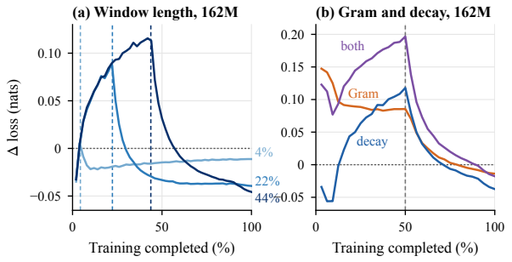
Figure 7 Loss differences evolve after removal.(a) Three 162M decay windows at λ = 0.15(FineWeb100B). (b) Gram regularization, weight decay, and their combination over the first 50% at 162M (FineWeb-Edu). Dashed lines mark removal. References use no regularization; vertical scales differ.
원문 · CC BY 4.0 · Md Rifat Arefin, Ravid Shwartz-Ziv, Ernie Chang, Chinnadhurai Sankar, Rylan Conway, Aristide Baratin, Irina Rish, Adithya Sagar, Patrick Huber · Delayed Effects of Temporary Weight Decay in Muon Pretraining · 원문 그림 인용 · 원본 PDF 17쪽에서 그림 영역을 추출했습니다.Muon과 구간 감쇠 설정
주요 설정은 Muon으로 학습하는 디코더 전용 Transformer입니다. 은닉층 행렬마다 분리형 가중치 감쇠를 적용하며, 업데이트는 Wt+1=(1−ηtλt)Wt−ηtUt로 쓰고 λt=λ·1{s≤t<e}입니다. 여기서 Ut는 학습률을 곱하기 전의 Muon 업데이트이고 [s,e)가 감쇠 구간입니다. 구간 밖에서는 감쇠가 0이며, 임베딩과 출력 헤드에는 감쇠를 주지 않았습니다. 제거 시점은 구간의 끝 e로 정의하고, Δt는 중재 실행과 기준 실행의 검증 손실 차이입니다.
시작 시점과 평가 시점의 효과
162M, 405M, 1.4B 세 규모에서 10% 길이의 창을 초기화 시점에 시작하면 두 기준보다 나았고, 같은 길이와 계수로 60% 시점에 시작하면 두 기준보다 나빴습니다. 이 차이는 총 수축량이 같은 조건에서 나타났으므로 부호 반전은 시점의 효과로 해석됩니다. 즉 초기 시작의 우위는 평가 기간에 따라 달라집니다. 같은 실험에서 창의 길이도 손실을 바꾸었고, 계수보다 길이의 영향이 더 컸습니다.
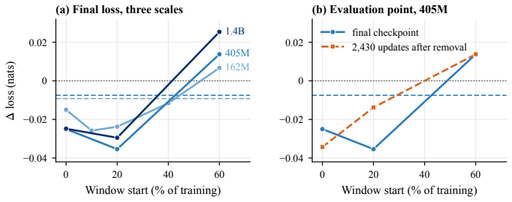
Figure 2 Start time changes the sign; evaluation horizon changes the ranking.(a) Final loss difference for 10% windows by start time; dashed lines show the best sampled constant. (b) At 405M, the ranking of early starts reverses when evaluated after equal post-removal training.
원문 · CC BY 4.0 · Md Rifat Arefin, Ravid Shwartz-Ziv, Ernie Chang, Chinnadhurai Sankar, Rylan Conway, Aristide Baratin, Irina Rish, Adithya Sagar, Patrick Huber · Delayed Effects of Temporary Weight Decay in Muon Pretraining · 원문 그림 인용 · 원본 PDF 4쪽에서 그림 영역을 추출했습니다.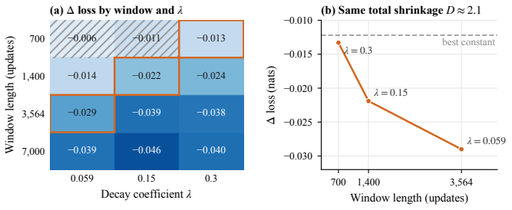
Figure 3 Duration affects loss beyond total shrinkage.162M, FineWeb100B, 16,000 updates. (a) Final loss difference across duration and decay coefficient; hatching marks schedules that do not beat the best sampled constant. (b) At matchedD≈2.1, longer, weaker decay performs better.
원문 · CC BY 4.0 · Md Rifat Arefin, Ravid Shwartz-Ziv, Ernie Chang, Chinnadhurai Sankar, Rylan Conway, Aristide Baratin, Irina Rish, Adithya Sagar, Patrick Huber · Delayed Effects of Temporary Weight Decay in Muon Pretraining · 원문 그림 인용 · 원본 PDF 5쪽에서 그림 영역을 추출했습니다.가중치 노름 결손과 상대 스텝
상대 스텝 크기 αt는 가중치 변화의 가중치에 수직인 성분을 가중치 Frobenius 노름으로 나눈 값입니다. 따라서 같은 투영 업데이트 노름에서는 가중치 노름이 작을수록 αt가 커집니다. 162M에서는 업데이트 2,800에서 역노름 비율이 1.17이었지만 상대 스텝 비율은 1.07이었으므로, 투영 업데이트 노름의 변화가 노름 차이를 일부 상쇄했습니다.
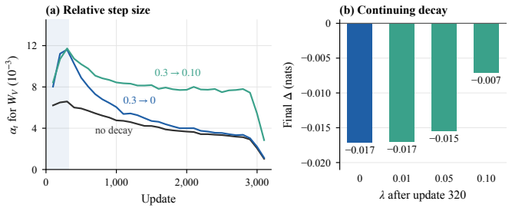
Figure 4 Early decay increases relative step size, but larger relative steps do not always improve loss.(a) Layer- averaged relative step sizeαt for WV; the shaded band is the decay window. (b) Final loss differences from no decay after usingλ= 0.3for the first 320 updates and then the indicated coefficient. 162M, FineWeb-Edu, 3,200 updates.
원문 · CC BY 4.0 · Md Rifat Arefin, Ravid Shwartz-Ziv, Ernie Chang, Chinnadhurai Sankar, Rylan Conway, Aristide Baratin, Irina Rish, Adithya Sagar, Patrick Huber · Delayed Effects of Temporary Weight Decay in Muon Pretraining · 원문 그림 인용 · 원본 PDF 7쪽에서 그림 영역을 추출했습니다.고정 노름 리플레이 검증
가중치 노름을 초기값에 고정하고, 측정한 상대 스텝 궤적만 처방하는 Hyperball 변형으로 리플레이를 수행했습니다. 업데이트 320에서 궤적을 나눈 결과, 0.0221 nats 중 0.0181 nats가 창 이후 스텝에서 나왔습니다. 창 동안의 궤적만 쓰고 이후 Muon으로 돌아간 경우 개선은 0.0003 nats에 그쳤습니다. 이는 상대 스텝 궤적이 이 제어된 설정에서 순서와 크기를 재현하기에 충분하다는 뜻이며, 상대 스텝만이 유일한 상태라는 증명은 아닙니다.
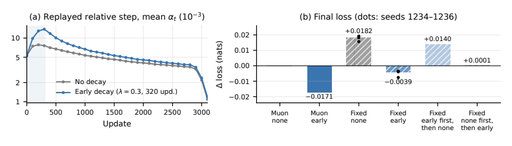
Figure 5 Fixed-norm replay reproduces the post-removal gain.162M, FineWeb-Edu, 3,200 updates. (a) Relative-step trajectories measured from the source Muon runs and replayed at fixed weight norms. (b) Final loss relative to Muon without decay; dots show three replay seeds and the last two bars switch trajectory at update 320.
원문 · CC BY 4.0 · Md Rifat Arefin, Ravid Shwartz-Ziv, Ernie Chang, Chinnadhurai Sankar, Rylan Conway, Aristide Baratin, Irina Rish, Adithya Sagar, Patrick Huber · Delayed Effects of Temporary Weight Decay in Muon Pretraining · 원문 그림 인용 · 원본 PDF 7쪽에서 그림 영역을 추출했습니다.한계
상대 스텝의 점진적 수렴을 설명하는 재귀식은 근사이며, 저자들은 이 식이 정확한 법칙이 아니라고 봅니다. 연속 증가폭이 두 실행에서 비슷하다는 가정에 기대므로, 실험에서도 어텐션 행렬의 편차는 남았습니다. 연속 감쇠 계수 0.10을 쓴 경우 상대 스텝은 더 크게 유지되었지만 최종 개선은 0.0071 nats로 0.0171 nats보다 작았습니다. 따라서 더 큰 상대 스텝이 항상 낫다고 할 수 없습니다. 본 연구는 노름이 유일한 지속 상태임을 입증하지 않으며, 왜 특정 상대 스텝 궤적이 유익한지도 설명하지 않습니다. 대부분의 설정은 단일 시드로 실행되었고, 감쇠 계수는 보편적이지 않습니다.
규모 확장과 Gram 벌점
초기 Gram 벌점은 같은 원인의 대조로 다뤄졌습니다. 162M에서 5개의 쌍 실행으로 평가했을 때 Gram 벌점은 정규화 없음보다 최종 손실을 0.0142 nats 낮췄습니다. 3.4B 실험에서는 모든 테스트된 초기 스케줄이 검증 손실과 평균 정확도를 세 기준보다 모두 개선했습니다. 다만 3.4B 실험의 감쇠 계수와 구간은 1.4B 조건에서 고른 값을 따랐고, 이는 세부 조건으로만 봐야 합니다.
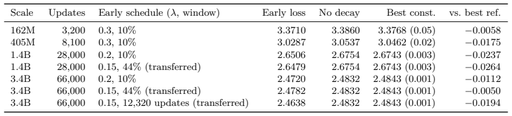
Table 1 Early decay across scale.FineWeb100B, compute-optimal budgets, no warmup. “Best const.” is the best sampled constant coefficient; full sweeps are in Appendix C and the 3.4B configurations are in Appendix K.
원문 · CC BY 4.0 · Md Rifat Arefin, Ravid Shwartz-Ziv, Ernie Chang, Chinnadhurai Sankar, Rylan Conway, Aristide Baratin, Irina Rish, Adithya Sagar, Patrick Huber · Delayed Effects of Temporary Weight Decay in Muon Pretraining · 원문 그림 인용 · 원본 PDF 8쪽에서 그림 영역을 추출했습니다.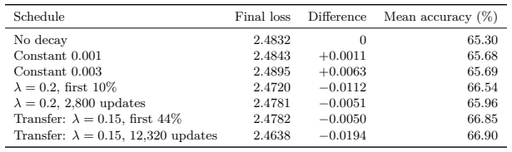
Table 17 Final validation loss and mean zero-shot accuracy at 3.4B.Differences are from no decay. Accuracy averages the same five tasks used below.
원문 · CC BY 4.0 · Md Rifat Arefin, Ravid Shwartz-Ziv, Ernie Chang, Chinnadhurai Sankar, Rylan Conway, Aristide Baratin, Irina Rish, Adithya Sagar, Patrick Huber · Delayed Effects of Temporary Weight Decay in Muon Pretraining · 원문 그림 인용 · 원본 PDF 24쪽에서 그림 영역을 추출했습니다.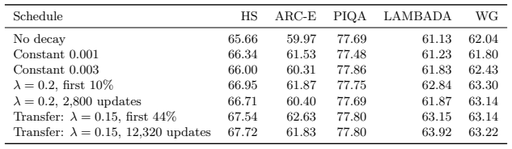
Table 18 Zero-shot accuracy (%) at 3.4B.HS: HellaSwag; ARC-E: ARC-Easy; WG: WinoGrande. Means are reported in Table 17.
원문 · CC BY 4.0 · Md Rifat Arefin, Ravid Shwartz-Ziv, Ernie Chang, Chinnadhurai Sankar, Rylan Conway, Aristide Baratin, Irina Rish, Adithya Sagar, Patrick Huber · Delayed Effects of Temporary Weight Decay in Muon Pretraining · 원문 그림 인용 · 원본 PDF 24쪽에서 그림 영역을 추출했습니다.논문 정보
- 저자
- Md Rifat Arefin, Ravid Shwartz-Ziv, Ernie Chang, Chinnadhurai Sankar, Rylan Conway, Aristide Baratin, Irina Rish, Adithya Sagar, Patrick Huber
- 학회·저널
- arXiv · 프리프린트
- 최초 공개일
- 2026년 11월 13일
- 등록일
- 2026년 11월 16일
- 수정일
- 2026년 11월 13일
- 버전
- v1
- arXiv
- 2611.17876
- 분류
- cs.LG · cs.CL
- 원문 이용 조건
- CC BY 4.0
- 제공 범위
- 논문 정보, 해설, 허용된 원문 그림
AI 해설은 논문 원문과 별개의 설명이며 오류가 있을 수 있습니다. 원문과 그림은 각 출처의 이용 조건과 따로 표시된 권리를 따릅니다.
초록
A temporary optimization intervention can increase validation loss when it ends yet reduce it at the final training budget. We demonstrate this with temporary weight decay in Muon-trained decoder-only Transformers with 162M, 405M, 1.4B, and 3.4B parameters. For models up to 1.4B parameters, moving a fixed-duration decay window from early to late training reverses its final effect. At 162M, changing window duration alters final loss even at approximately matched total shrinkage. Most strikingly, a schedule selected at 162M and transferred without retuning to 1.4B is 0.26 nats worse than no decay when removed, overtakes it only after 73% of training, and ultimately finishes 0.028 nats better while also outperforming the best sampled constant-decay baseline. Early decay leaves a persistent weight-norm deficit, which keeps relative steps larger after the intervention ends. An approximate norm-dynamics recurrence captures the slow convergence of these relative steps, and fixed-norm replays of the measured trajectories reproduce the performance ordering and a similar loss difference. At 162M and 405M, norm-reset experiments show that smaller weight norms at the end of the decay window explain most of the final loss improvement. A separate Gram intervention exhibits related post-removal norm and relative-step dynamics. These results show that temporary optimization schedules can have delayed effects long after removal and should therefore be evaluated at the intended final training budget, not only at removal.
원문 인용
Md Rifat Arefin, Ravid Shwartz-Ziv, Ernie Chang, Chinnadhurai Sankar, Rylan Conway, Aristide Baratin, Irina Rish, Adithya Sagar, Patrick Huber (2026). Delayed Effects of Temporary Weight Decay in Muon Pretraining. arXiv:2611.17876v1. https://arxiv.org/abs/2611.17876v1
BibTeX
@misc{arefin2026delayed,
  title = {{Delayed Effects of Temporary Weight Decay in Muon Pretraining}},
  author = {Md Rifat Arefin and Ravid Shwartz-Ziv and Ernie Chang and Chinnadhurai Sankar and Rylan Conway and Aristide Baratin and Irina Rish and Adithya Sagar and Patrick Huber},
  year = {2026},
  eprint = {2611.17876},
  archivePrefix = {arXiv},
  url = {https://arxiv.org/abs/2611.17876v1}
}