論文解説
Unbundling Multimodal Vision Encoding
マルチモーダル視覚エンコーディングの分離
- 課題 マルチモーダル視覚エンコーダがまとめて提供する、視覚の事前知識、専用の視覚容量、融合前の配置を分けられないため、既存の比較では各効果がわかりにくくなっています。
- 手法 すべてのモデルを共通データで最初から学習し、生涯の総計算量をそろえたうえで、エンコーダ設計と視覚専用容量の配置を変えて比較します。
- 結果 encoder-freeモデルは、1.7Bと4Bのバックボーンで視覚専用容量が0.4Bの条件では、scratch encoderよりAvg. VQAが低い値になりました。
マルチモーダル視覚エンコーダの3つの設計上の選択
マルチモーダル言語モデルが画像をどのようにエンコードすべきかについては、まだ合意がありません。多くのモデルは事前学習済みの視覚エンコーダを使いますが、一部の最近の手法は、エンコーダを言語モデルとともに最初から学習するか、エンコーダを取り除いています。この論文は、視覚エンコーダがまとめて提供する3つの設計上の選択を分けて検討します。1つ目は上流の事前学習で得られる視覚の事前知識(visual prior)、2つ目は視覚トークンだけが使う専用の視覚容量(dedicated vision capacity)、3つ目はその容量をマルチモーダル融合の前段(pre-fusion)に置く配置です。既存の公開モデルはデータ、アーキテクチャ、計算量がそれぞれ異なるため、これらの選択の効果を個別に比べるのは困難です。
著者らは、すべてのモデルを共通データで最初から学習し、生涯の総計算量(lifetime compute)をそろえた統制実験でこの問題に取り組んでいます。
生涯の総計算量をそろえた比較の枠組み
この研究の比較単位は、すべての学習段階を合計した生涯の総計算量です。式(1)では、生涯の計算量は最終モデルを作るすべての学習段階の計算量の合計として定義され、エンコーダの事前学習とテキストのみの事前学習を含み、instruction tuningは除かれます。バックボーンはQwen3を模したdense decoder-only Transformerで、主な比較には1.7Bと4Bの構成を使います。視覚専用の容量は、主な比較では0.4Bパラメータに固定されます。エンコーダの設計では、224×224の画像を14×14のパッチに分けて、256個の視覚トークンを作ります。学習には同じデータと同じオプティマイザ設定を使い、1つのチェックポイントから複数の学習長の結果を得るために、warmup-stable-decayスケジュールを使います。
この枠組みでは、学習率はバックボーンのサイズごとに1つのピーク値を共有します。
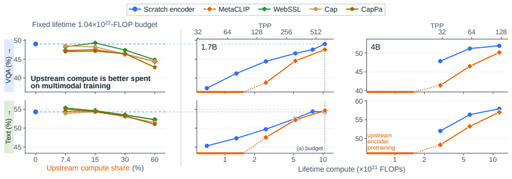
Figure 2 Encoder pretraining is not beneficial at matched lifetime compute. (a)At 1.7B and1 .04×1022-FLOP lifetime budget, spending a larger share of compute on encoder pretraining is comparable to the from-scratch encoder (horizontal dashed blue) up to 15% and lowers performance beyond it.(b)MetaCLIP pretraining uses1.54× 1021 FLOPs at every backbone size (orange floor); the from-scratch encoder matches or exceeds MetaCLIP at every budget. The vertical dashed grayline at 1.7B marks the budget of(a)and the top axis gives the from-scratch encoder’s TPP.
出典 · CC BY 4.0 · Ellis Brown, Chris Hoang, Shengyi Qian, Shang-Wen Li, Mike Lewis, Marjan Ghazvininejad, Luke Zettlemoyer, Lucas Beyer, Mengye Ren, Jakob Verbeek, Saining Xie, Hu Xu · Unbundling Multimodal Vision Encoding · 論文の図を引用 · 元のPDFの6ページ目から図の部分を抽出しています。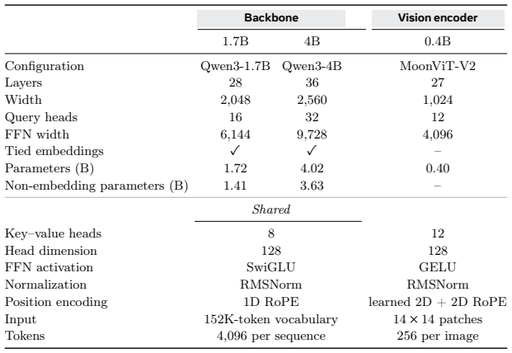
Table 4 Every multimodal recipe shares one backbone configuration per scale, and the encoder adds a 0.4B ViT.Parameter counts exclude the linear projection from the encoder into the backbone.
出典 · CC BY 4.0 · Ellis Brown, Chris Hoang, Shengyi Qian, Shang-Wen Li, Mike Lewis, Marjan Ghazvininejad, Luke Zettlemoyer, Lucas Beyer, Mengye Ren, Jakob Verbeek, Saining Xie, Hu Xu · Unbundling Multimodal Vision Encoding · 論文の図を引用 · 元のPDFの22ページ目から図の部分を抽出しています。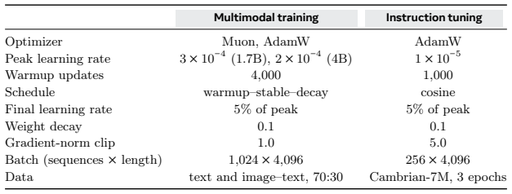
Table 8 The 1.7B and 4B backbones share one optimization recipe, with the peak learning rate scaled to backbone size.Muon and AdamW use the same peak learning rate.
出典 · CC BY 4.0 · Ellis Brown, Chris Hoang, Shengyi Qian, Shang-Wen Li, Mike Lewis, Marjan Ghazvininejad, Luke Zettlemoyer, Lucas Beyer, Mengye Ren, Jakob Verbeek, Saining Xie, Hu Xu · Unbundling Multimodal Vision Encoding · 論文の図を引用 · 元のPDFの24ページ目から図の部分を抽出しています。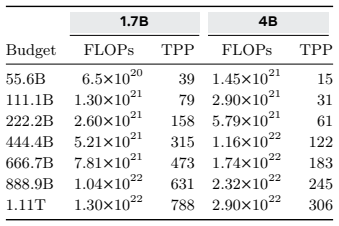
Table 12 Compute budgets can be expressed as token-equivalents, FLOPs, or TPP.TPP divides by each backbone’s non-embedding parameter count.
出典 · CC BY 4.0 · Ellis Brown, Chris Hoang, Shengyi Qian, Shang-Wen Li, Mike Lewis, Marjan Ghazvininejad, Luke Zettlemoyer, Lucas Beyer, Mengye Ren, Jakob Verbeek, Saining Xie, Hu Xu · Unbundling Multimodal Vision Encoding · 論文の図を引用 · 元のPDFの26ページ目から図の部分を抽出しています。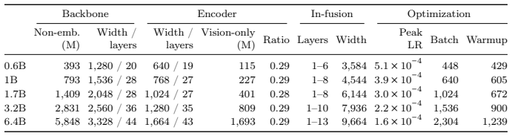
Table 28 Architectures and optimization settings of the scaling ladder.The vision module grows with the backbone size. Ratio is the vision-only parameter count over the backbone’s non-embedding count, which stays at around 0.29. The in-fusion columns describe the FFN+QKVO variant (Section 5.1). Batch counts sequences of 4,096 tokens, and warmup counts updates. Backbones are named by total parameters, including the tied embedding.
出典 · CC BY 4.0 · Ellis Brown, Chris Hoang, Shengyi Qian, Shang-Wen Li, Mike Lewis, Marjan Ghazvininejad, Luke Zettlemoyer, Lucas Beyer, Mengye Ren, Jakob Verbeek, Saining Xie, Hu Xu · Unbundling Multimodal Vision Encoding · 論文の図を引用 · 元のPDFの41ページ目から図の部分を抽出しています。専用の視覚容量とencoder-freeの比較
1つ目の検証は、視覚の事前知識と専用の視覚容量を分けて見ます。著者らは、最初から学習したscratch encoderと、エンコーダを使わずパッチをそのままバックボーンに入れるencoder-freeモデルを、同じ生涯計算量で比較しました。評価指標のAvg. VQAは、Cambrian視覚理解スイートの16個のVQAベンチマークを4つのカテゴリで平均した値です。評価の前に、各チェックポイントをCambrian-7Mで3 epochのinstruction tuningにかけました。その結果、encoder-freeモデルは同じ条件のscratch encoderよりAvg. VQAが低く、差はOCRおよびチャートの質問で最も大きくなりました。
一方、Avg. Textは2つのモデルでほぼ同じに保たれました。バックボーンをエンコーダのパラメータ数に相当する分だけ広くしたり深くしたりしても、Avg. VQAの差はあまり縮まりませんでした。この観察は、視覚理解には専用の視覚容量が必要だという主張を支持しています。
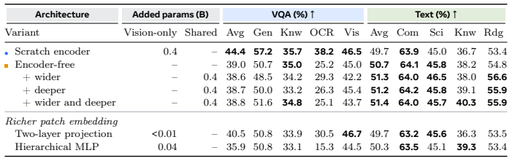
Table 2 Matching total parameters does not close the encoder-free gap.All rows use a 1.7B backbone and2.6× 1021 lifetime FLOPs. Indented rows (+) add the encoder’s 0.4B parameters to the backbone. Bold: within one point of the best.
出典 · CC BY 4.0 · Ellis Brown, Chris Hoang, Shengyi Qian, Shang-Wen Li, Mike Lewis, Marjan Ghazvininejad, Luke Zettlemoyer, Lucas Beyer, Mengye Ren, Jakob Verbeek, Saining Xie, Hu Xu · Unbundling Multimodal Vision Encoding · 論文の図を引用 · 元のPDFの7ページ目から図の部分を抽出しています。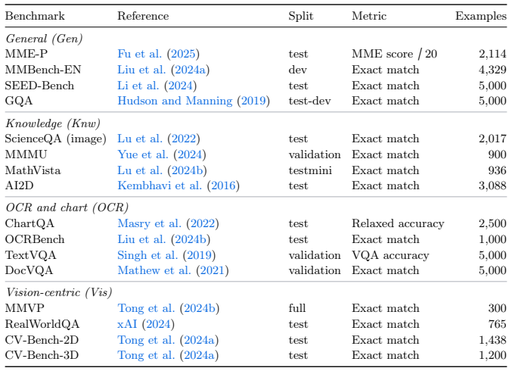
Table 13 Avg. VQA weights four categories of visual understanding benchmarks,Each category contains four tasks. MME-P is normalized to[0,100]before averaging. Examples counts the questions evaluated.
出典 · CC BY 4.0 · Ellis Brown, Chris Hoang, Shengyi Qian, Shang-Wen Li, Mike Lewis, Marjan Ghazvininejad, Luke Zettlemoyer, Lucas Beyer, Mengye Ren, Jakob Verbeek, Saining Xie, Hu Xu · Unbundling Multimodal Vision Encoding · 論文の図を引用 · 元のPDFの27ページ目から図の部分を抽出しています。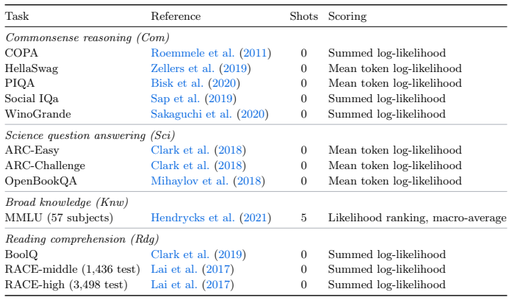
Table 14 Avg. Text averages four categories of text benchmarks.
出典 · CC BY 4.0 · Ellis Brown, Chris Hoang, Shengyi Qian, Shang-Wen Li, Mike Lewis, Marjan Ghazvininejad, Luke Zettlemoyer, Lucas Beyer, Mengye Ren, Jakob Verbeek, Saining Xie, Hu Xu · Unbundling Multimodal Vision Encoding · 論文の図を引用 · 元のPDFの28ページ目から図の部分を抽出しています。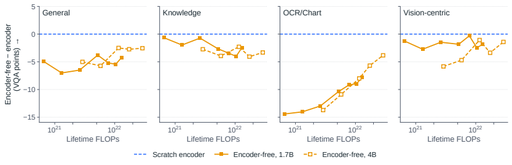
Figure 14 The encoder’s advantage over encoder-free is primarily in OCR and chart questions.Each point compares encoder- free with the encoder at one budget of
出典 · CC BY 4.0 · Ellis Brown, Chris Hoang, Shengyi Qian, Shang-Wen Li, Mike Lewis, Marjan Ghazvininejad, Luke Zettlemoyer, Lucas Beyer, Mengye Ren, Jakob Verbeek, Saining Xie, Hu Xu · Unbundling Multimodal Vision Encoding · 論文の図を引用 · 元のPDFの33ページ目から図の部分を抽出しています。
Table 19 At 4B, a wider encoder-free backbone still trails the encoder on VQA.All variants are trained to 122 TPP, i.e., 1.16×10 22 FLOPs. Bold: within one point of the best.
出典 · CC BY 4.0 · Ellis Brown, Chris Hoang, Shengyi Qian, Shang-Wen Li, Mike Lewis, Marjan Ghazvininejad, Luke Zettlemoyer, Lucas Beyer, Mengye Ren, Jakob Verbeek, Saining Xie, Hu Xu · Unbundling Multimodal Vision Encoding · 論文の図を引用 · 元のPDFの33ページ目から図の部分を抽出しています。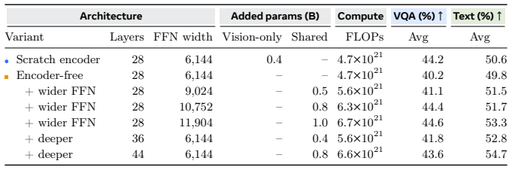
Table 20 Shared capacity needs about twice the encoder’s parameters to match it on VQA.All variants use a 1.7B backbone, train on the encoder’s token count, and use a constant learning rate.
出典 · CC BY 4.0 · Ellis Brown, Chris Hoang, Shengyi Qian, Shang-Wen Li, Mike Lewis, Marjan Ghazvininejad, Luke Zettlemoyer, Lucas Beyer, Mengye Ren, Jakob Verbeek, Saining Xie, Hu Xu · Unbundling Multimodal Vision Encoding · 論文の図を引用 · 元のPDFの34ページ目から図の部分を抽出しています。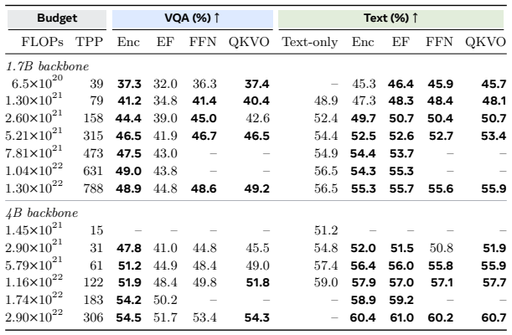
Table 27 Encoder-free trails the encoder at every compute budget, while in-fusion is comparable to it.Enc is the from-scratch encoder, EF encoder-free, and FFN and QKVO mark in-fusion (FFN-only) and in-fusion. All models in a row share the same lifetime compute. Dashes mark models not trained to that budget. Bold: within one point of the best in each row, excluding the text-only reference.
出典 · CC BY 4.0 · Ellis Brown, Chris Hoang, Shengyi Qian, Shang-Wen Li, Mike Lewis, Marjan Ghazvininejad, Luke Zettlemoyer, Lucas Beyer, Mengye Ren, Jakob Verbeek, Saining Xie, Hu Xu · Unbundling Multimodal Vision Encoding · 論文の図を引用 · 元のPDFの39ページ目から図の部分を抽出しています。融合後のin-fusion視覚容量
2つ目の検証は、専用の容量を融合の前に置く必要があるのかを問います。著者らは、0.4Bの視覚専用モジュールをバックボーンの最初の8層に入れるin-fusion設計を作りました。各モジュールは共有の残差ストリームに加算され、視覚トークンだけがこの分岐を使い、テキストトークンは共有の重みだけを通ります。同じパラメータ予算で配置を変えた実験では、最初の8層に置いた場合だけがscratch encoderと同程度のAvg. VQAを示しました。後ろの層やすべての層に分散させた場合は、encoder-freeと同程度か、それより低い値でした。これは、専用の容量は融合の前になければ効果がないのではなく、初期の層にあれば足りるという著者らの観察です。
ただし、この比較は同じ予算と最初の8層という配置に限ったものなので、別の配置や別の容量サイズで同じ結論が成り立つかは、この実験の範囲外です。

Figure 4 In-fusion vision capacity adds to the shared backbone instead of replacing it. (a)All text and vision tokens are processed by shared modules (gray); vision tokensalsopass through vision-only modules (bluewithpinkoutline) that add to the shared outputs; in-fusion (FFN-only) omits the vision attention projections (∆QKV,∆O).(b)MoT uses entirely separate modules for text and vision, so the modality streams interact only through attention.
出典 · CC BY 4.0 · Ellis Brown, Chris Hoang, Shengyi Qian, Shang-Wen Li, Mike Lewis, Marjan Ghazvininejad, Luke Zettlemoyer, Lucas Beyer, Mengye Ren, Jakob Verbeek, Saining Xie, Hu Xu · Unbundling Multimodal Vision Encoding · 論文の図を引用 · 元のPDFの8ページ目から図の部分を抽出しています。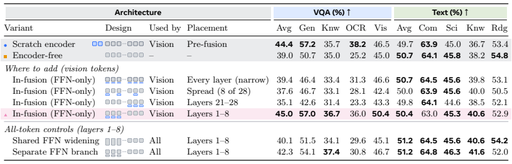
Table 3 Added in-fusion capacity is most effective when placed early and reserved for vision tokens.Every variant adds 0.4B parameters to the 1.7B backbone. Schematics show backbone layers from early to late; gray serves all tokens, blue only vision tokens, and wider layers are taller.Highlighted: our default placement. Bold: within one point of the best.
出典 · CC BY 4.0 · Ellis Brown, Chris Hoang, Shengyi Qian, Shang-Wen Li, Mike Lewis, Marjan Ghazvininejad, Luke Zettlemoyer, Lucas Beyer, Mengye Ren, Jakob Verbeek, Saining Xie, Hu Xu · Unbundling Multimodal Vision Encoding · 論文の図を引用 · 元のPDFの9ページ目から図の部分を抽出しています。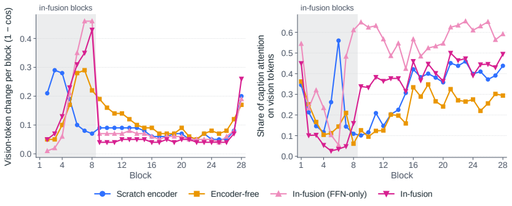
Figure 16 In-fusion capacity confines vision processing to the earliest blocks, while encoder-free spreads it across shared layers. Vision-token change is defined as1−cos(h L, hL−1) between consecutive blocks. The shaded band marks blocks 1–8, where the in-fusion modules sit. All models use the 1.7B backbone at1.30×1022 FLOPs of lifetime compute.
出典 · CC BY 4.0 · Ellis Brown, Chris Hoang, Shengyi Qian, Shang-Wen Li, Mike Lewis, Marjan Ghazvininejad, Luke Zettlemoyer, Lucas Beyer, Mengye Ren, Jakob Verbeek, Saining Xie, Hu Xu · Unbundling Multimodal Vision Encoding · 論文の図を引用 · 元のPDFの38ページ目から図の部分を抽出しています。バックボーン規模とsparse構造の限界
この結果の適用範囲には明確な限界があります。著者らは、実験を最大6.4Bパラメータのdenseバックボーンで行い、sparse mixture-of-expertsバックボーンは評価しませんでした。また、マルチモーダル学習には224×224のMetaCLIP画像を使ったため、より高い解像度での学習やテキストの多いデータに対する結果は、この研究では確認していません。エンコーダの事前学習にも同じ画像を使ったので、追加データで学習された公開エンコーダの利点をこの研究が排除するわけではありません。
論文情報
- 著者
- Ellis Brown, Chris Hoang, Shengyi Qian, Shang-Wen Li, Mike Lewis, Marjan Ghazvininejad, Luke Zettlemoyer, Lucas Beyer, Mengye Ren, Jakob Verbeek, Saining Xie, Hu Xu
- 学会・ジャーナル
- arXiv · プレプリント
- 公開日
- 2026年11月12日
- 登録日
- 2026年11月14日
- 更新日
- 2026年11月12日
- バージョン
- v1
- arXiv
- 2611.17334
- カテゴリ
- cs.CV · cs.LG
- ライセンス
- CC BY 4.0
- 掲載内容
- 論文情報・解説・論文の図
この解説は、Refivuの韓国語解説をAIで翻訳したものです。不正確な翻訳や誤りが含まれる可能性があります。論文と図の利用条件は各出典に従います。
アブストラクト
How multimodal language models should encode visual input remains up for debate. Most models use a pretrained vision encoder, while some recent recipes train the encoder from scratch with the language model or remove it entirely. Vision encoders bundle together three design choices: a visual prior from upstream pretraining, dedicated vision capacity, and pre-fusion placement of that capacity (i.e., before the multimodal backbone). Because published models also differ in data, architecture, and compute, comparing them cannot isolate the effect of each choice. We disentangle these choices via a controlled framework where we pretrain all models from scratch on common data and compare them on visual question answering and language benchmarks at matched lifetime compute. We find that the visual prior is not necessary; an encoder trained jointly from scratch is on par with a pretrained one, without a separate training stage. What matters instead is dedicated vision capacity: an encoder-free model trails on visual understanding even when its backbone is enlarged by the encoder's parameter count. Yet that capacity need not precede multimodal fusion, as vision-only modules added in-fusion to early backbone layers perform comparably to a pre-fusion encoder and can lower time to first token. These results also hold across backbone sizes, when encoder pretraining is treated as free, and when starting from a pretrained language model. Overall, our findings favor dedicated vision capacity trained jointly with the backbone and placed early within it.
この論文を引用
Ellis Brown, Chris Hoang, Shengyi Qian, Shang-Wen Li, Mike Lewis, Marjan Ghazvininejad, Luke Zettlemoyer, Lucas Beyer, Mengye Ren, Jakob Verbeek, Saining Xie, Hu Xu (2026). Unbundling Multimodal Vision Encoding. arXiv:2611.17334v1. https://arxiv.org/abs/2611.17334v1
BibTeX
@misc{brown2026unbundling,
  title = {{Unbundling Multimodal Vision Encoding}},
  author = {Ellis Brown and Chris Hoang and Shengyi Qian and Shang-Wen Li and Mike Lewis and Marjan Ghazvininejad and Luke Zettlemoyer and Lucas Beyer and Mengye Ren and Jakob Verbeek and Saining Xie and Hu Xu},
  year = {2026},
  eprint = {2611.17334},
  archivePrefix = {arXiv},
  url = {https://arxiv.org/abs/2611.17334v1}
}