論文解説
KLEAR: Knowledge-Matched LLM Evaluation in Korean across Application Requirements via Controlled Benchmark Transformation
KLEAR:制御されたベンチマーク変換による応用要件別の韓国語LLM評価
- 課題 既存の韓国語ベンチマークの精度では、知識の不足と知識の適用の失敗を区別できません。KLEARは必要な知識を固定し、応用の要求だけを変えた対照質問でこの二つを分けようとしています。
- 手法 KLEARはsilver reasoningでアンカー知識バンドルを作り、同じバンドル内でA2とA3の質問を生成します。その後、LLM監査、プロキシ選別、人手検証を経て287問を構成します。
- 結果 応用の要求が高まるほど失敗は知識から応用へ移ります。知識を与えてもA3では誤りが残りますが、応用の記述を加えると改善します。
既存の精度スコアで見えにくい知識と適用の混在
既存の韓国語ベンチマークの精度では、誤答が必要な知識の不足によるものか、知っている知識を誤って適用したことによるものかを区別できません。著者らは、CLIcK、KMMLU-Pro、KMMLU-Reduxの3つの韓国語ベンチマークにある7,340問の選択式質問を、知識(K)と応用(A)の水準に分けて調べました。この分布では、応用の要求による効果を個別に見ることが難しくなります。応用水準の高い質問では、知識の内容も一緒に変わるためです。そのため、この研究の問いは、必要な知識を固定したまま応用の要求だけを変えた対照質問をどのように作り、検証するかにあります。
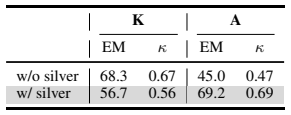
Table 1 :Validation of knowledge (K) and application (A) labels.LLM–human agreement on 60 questions, av- eraged across two human annotators: exact match (EM; %) and linearly weighted Cohen’s κ, which penalizes disagreements in proportion to the distance between lev- els.w/o silverandw/ silverdenote the LLM annotation without and with silver reasoning.
出典 · CC BY 4.0 · Seoyeon Kim, Jeonghyun Kang, Hamin Koo, Barom Kang, Heondeuk Lee, Jaehyung Kim · KLEAR: Knowledge-Matched LLM Evaluation in Korean across Application Requirements via Controlled Benchmark Transformation · 論文の図を引用 · 元のPDFの3ページ目から図の部分を抽出しています。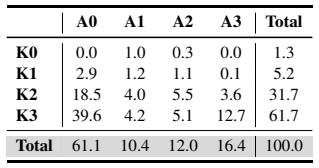
Table 2 :Distribution of knowledge (K) and applica- tion (A) demands.Percentage of the 7,340 questions across K and A levels in three Korean benchmarks.
出典 · CC BY 4.0 · Seoyeon Kim, Jeonghyun Kang, Hamin Koo, Barom Kang, Heondeuk Lee, Jaehyung Kim · KLEAR: Knowledge-Matched LLM Evaluation in Korean across Application Requirements via Controlled Benchmark Transformation · 論文の図を引用 · 元のPDFの3ページ目から図の部分を抽出しています。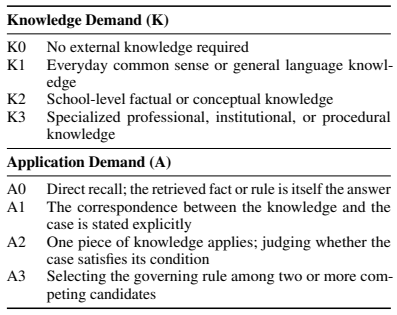
Table 7 :Knowledge and application taxonomy.Defi- nitions of the four levels in each dimension.
出典 · CC BY 4.0 · Seoyeon Kim, Jeonghyun Kang, Hamin Koo, Barom Kang, Heondeuk Lee, Jaehyung Kim · KLEAR: Knowledge-Matched LLM Evaluation in Korean across Application Requirements via Controlled Benchmark Transformation · 論文の図を引用 · 元のPDFの12ページ目から図の部分を抽出しています。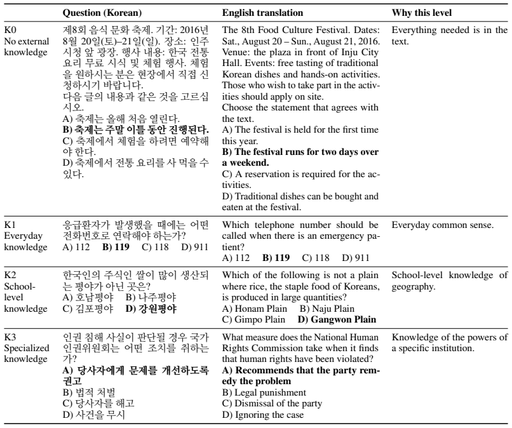
Table 8 :Examples of knowledge (K) levels.One question from CLIcK per level, with our English translation and the reason for its label. The gold answer is inbold.
出典 · CC BY 4.0 · Seoyeon Kim, Jeonghyun Kang, Hamin Koo, Barom Kang, Heondeuk Lee, Jaehyung Kim · KLEAR: Knowledge-Matched LLM Evaluation in Korean across Application Requirements via Controlled Benchmark Transformation · 論文の図を引用 · 元のPDFの14ページ目から図の部分を抽出しています。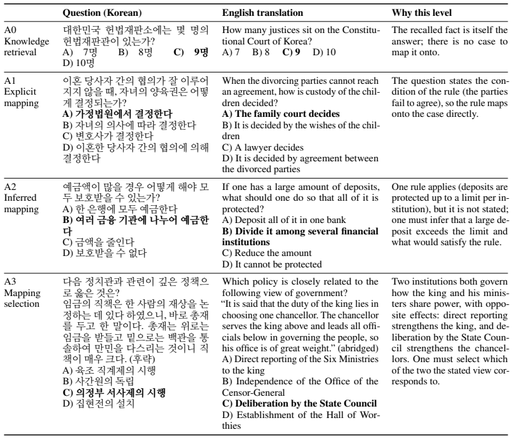
Table 9 :Examples of application (A) levels.One question from CLIcK per level, with our English translation and the reason for its label. The gold answer is inbold.
出典 · CC BY 4.0 · Seoyeon Kim, Jeonghyun Kang, Hamin Koo, Barom Kang, Heondeuk Lee, Jaehyung Kim · KLEAR: Knowledge-Matched LLM Evaluation in Korean across Application Requirements via Controlled Benchmark Transformation · 論文の図を引用 · 元のPDFの15ページ目から図の部分を抽出しています。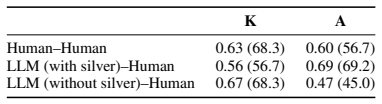
Table 10 :Reliability of K/A annotations.Linearly weighted Cohen’s κ on 60 questions, with exact agree- ment (%) in parentheses. LLM–human values are aver- aged over the two human annotators.
出典 · CC BY 4.0 · Seoyeon Kim, Jeonghyun Kang, Hamin Koo, Barom Kang, Heondeuk Lee, Jaehyung Kim · KLEAR: Knowledge-Matched LLM Evaluation in Korean across Application Requirements via Controlled Benchmark Transformation · 論文の図を引用 · 元のPDFの15ページ目から図の部分を抽出しています。アンカー知識バンドルで知識を固定するKLEARの構成
KLEARはシード質問から始めます。まず、正解と質問を条件にして生成したsilver reasoningを補助資料として使い、アンカー知識バンドルを作ります。バンドルは知識単位、単位同士の関係、バンドルの外を明示する範囲ノートで構成されます。新しい質問は、この閉じた集合の中だけで生成されます。A2の目標は、ちょうど一つの知識単位が適用されるものの、その条件が満たされるかどうかを事例の事実から推論しなければならない質問です。A3の目標は、バンドル内の二つ以上の知識単位が同じ事例について競合し、どちらが優先されるかを判断しなければならない質問です。生成された候補はLLM評価基準L1–L11で監査されます。
弱いプロキシモデルが正解した場合は簡単な候補とみなし、自己修正を行います。最後に、人がH1–H3をバンドルなしで、H4–H5をバンドルを公開した後に判定します。この手順の鍵は、知識を生成前に明示し、生成後にその保持を確認することです。
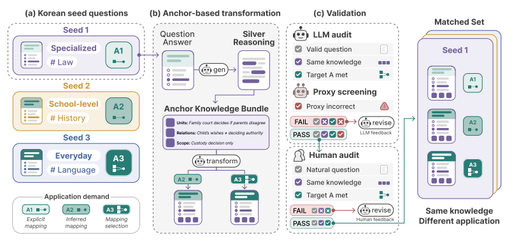
Figure 1 :Overview of KLEAR. (a)Seed questions from Korean benchmarks are labeled by knowledge (K) and application (A) demands.(b)Silver reasoning is generated from the seed question and gold answer, then used to derive an anchor knowledge bundle for generating higher-A questions.(c)Generated questions undergo LLM auditing, proxy screening, and human validation, with failed candidates revised using LLM or human feedback. The result is a matched set of questions that share the same knowledge but differ in application demand.
出典 · CC BY 4.0 · Seoyeon Kim, Jeonghyun Kang, Hamin Koo, Barom Kang, Heondeuk Lee, Jaehyung Kim · KLEAR: Knowledge-Matched LLM Evaluation in Korean across Application Requirements via Controlled Benchmark Transformation · 論文の図を引用 · 元のPDFの4ページ目から図の部分を抽出しています。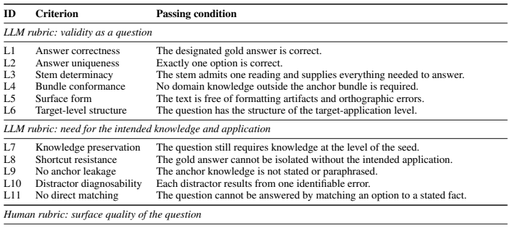
Table 13 :Automated and human validation rubrics.A candidate must satisfy every criterion of the LLM rubric (L1–L11) and the human rubric (H1–H5). Annotators judge H1–H3 before the anchor bundle is revealed and H4–H5 after.
出典 · CC BY 4.0 · Seoyeon Kim, Jeonghyun Kang, Hamin Koo, Barom Kang, Heondeuk Lee, Jaehyung Kim · KLEAR: Knowledge-Matched LLM Evaluation in Korean across Application Requirements via Controlled Benchmark Transformation · 論文の図を引用 · 元のPDFの18ページ目から図の部分を抽出しています。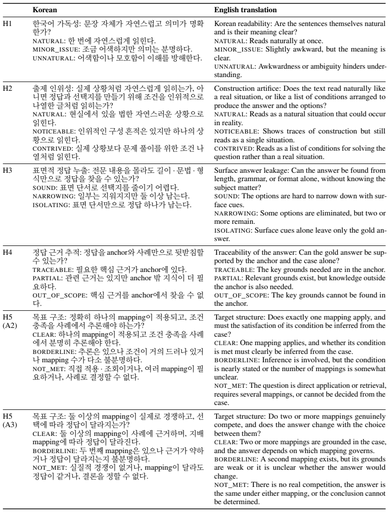
Table 33 :Instructions for human validation.Question and rating levels shown to annotators for each criterion, with our English translation. The first level of each criterion is the passing level. H5 is worded differently for A2 and A3 targets.
出典 · CC BY 4.0 · Seoyeon Kim, Jeonghyun Kang, Hamin Koo, Barom Kang, Heondeuk Lee, Jaehyung Kim · KLEAR: Knowledge-Matched LLM Evaluation in Korean across Application Requirements via Controlled Benchmark Transformation · 論文の図を引用 · 元のPDFの34ページ目から図の部分を抽出しています。対照構成の歩留まりとアンカーバンドルの効果
KLEARは295個のシード・目標ペアから1,964個の候補を生成しました。アンカーバンドルがある場合とない場合の比較も、同じペアで行われました。バンドルを取り除くと、外部知識が必要な候補の割合(L4)は1.9%から20.4%に上がりました。これは、知識を保持せよという指示だけでは不十分であり、知識を明示する必要があるという著者らの解釈と結びつきます。自動段階の失敗基準は、修正後も一部が残りました。自動監査だけでは十分ではなく、人手による検証が必要だと報告されています。
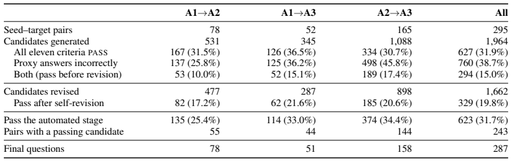
Table 15 :Yield of the automated stage by transformation type.Percentages for the first three candidate rows and the last are shares of the candidates generated; the percentage for self-revision is a share of the candidates revised.
出典 · CC BY 4.0 · Seoyeon Kim, Jeonghyun Kang, Hamin Koo, Barom Kang, Heondeuk Lee, Jaehyung Kim · KLEAR: Knowledge-Matched LLM Evaluation in Korean across Application Requirements via Controlled Benchmark Transformation · 論文の図を引用 · 元のPDFの20ページ目から図の部分を抽出しています。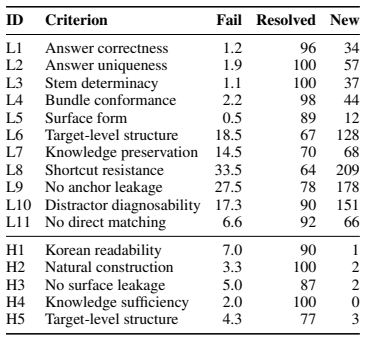
Table 17 :Failures by criterion.Failis the share (%) of candidates that do not pass the criterion: before revision for the LLM rubric (1,964 candidates) and at first vali- dation for the human rubric (301 candidates).Resolved is the share (%) of these failures that revision fixes, and Newis the number of failures that revision introduces, with self-revision for the LLM rubric and human-guided revision for the human rubric.
出典 · CC BY 4.0 · Seoyeon Kim, Jeonghyun Kang, Hamin Koo, Barom Kang, Heondeuk Lee, Jaehyung Kim · KLEAR: Knowledge-Matched LLM Evaluation in Korean across Application Requirements via Controlled Benchmark Transformation · 論文の図を引用 · 元のPDFの20ページ目から図の部分を抽出しています。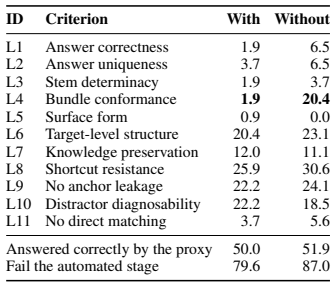
Table 18 :Effect of the anchor bundle.Share (%) of candidates that fail each criterion before revision, when generated with and without the anchor bundle for the same 36 pairs (108 candidates each). Only L4 differs significantly (Fisher’s exact test,p <0.001).
出典 · CC BY 4.0 · Seoyeon Kim, Jeonghyun Kang, Hamin Koo, Barom Kang, Heondeuk Lee, Jaehyung Kim · KLEAR: Knowledge-Matched LLM Evaluation in Korean across Application Requirements via Controlled Benchmark Transformation · 論文の図を引用 · 元のPDFの21ページ目から図の部分を抽出しています。応用水準による失敗構成の変化
構成された質問で8つのモデルを、closed-book、知識提供(+K)、知識と応用提供(+K+A)の条件で評価しました。全質問では、8モデルのうち7モデルでA3の精度がA2より低くなりました。同じ知識を共有する30個のシードによるA1–A2–A3の段階では、8モデルすべてでA3がA2を上回ることはありませんでした。3つの韓国語LLMでは、応用の失敗の割合がA1で37.3%、A2で60.0%、A3で76.9%へと上がり、知識の失敗の割合は41.8%から14.3%へ下がりました。知識を与えるとA2の誤りはほぼ解消されますが、A3では誤りがより多く残ります。その後、応用の記述を加えると、すべてのモデルでA3の精度が上がります。
この結果は、知識が十分であっても、応用の要求が高いと適用の失敗が残ることを裏付けています。
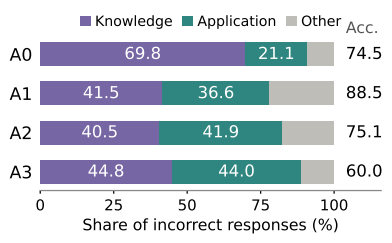
Figure 2 :Failure composition by application demand. Distribution of incorrect responses by failure type across three Korean LLMs, with accuracy (%) on the right.
出典 · CC BY 4.0 · Seoyeon Kim, Jeonghyun Kang, Hamin Koo, Barom Kang, Heondeuk Lee, Jaehyung Kim · KLEAR: Knowledge-Matched LLM Evaluation in Korean across Application Requirements via Controlled Benchmark Transformation · 論文の図を引用 · 元のPDFの4ページ目から図の部分を抽出しています。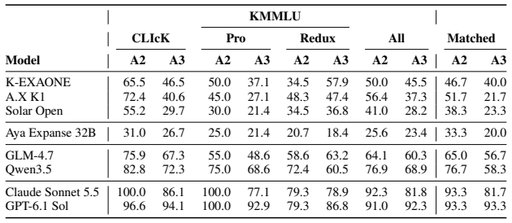
Table 5 :Closed-book accuracy (%) by application level.Matchedcovers the 30 seeds that have both an A2 and an A3 contrast (40 and 43 questions), averaged over seeds. The numbers of A2 and A3 questions are 29 and 101 for CLIcK, 20 and 70 for KMMLU-Pro, and 29 and 38 for KMMLU-Redux.
出典 · CC BY 4.0 · Seoyeon Kim, Jeonghyun Kang, Hamin Koo, Barom Kang, Heondeuk Lee, Jaehyung Kim · KLEAR: Knowledge-Matched LLM Evaluation in Korean across Application Requirements via Controlled Benchmark Transformation · 論文の図を引用 · 元のPDFの7ページ目から図の部分を抽出しています。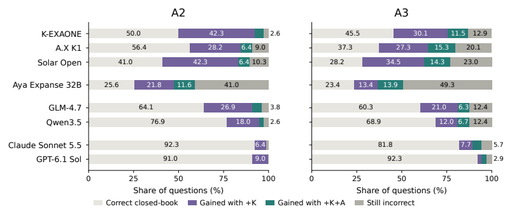
Figure 4 :Effects of knowledge and application interventions.Accuracy changes across closed-book, knowledge (+K), and knowledge and application (+K+A) conditions for A2 (78 questions) and A3 (209 questions). Each bar shows closed-book accuracy, the additional gains from +K and +K+A, and the remaining error rate.
出典 · CC BY 4.0 · Seoyeon Kim, Jeonghyun Kang, Hamin Koo, Barom Kang, Heondeuk Lee, Jaehyung Kim · KLEAR: Knowledge-Matched LLM Evaluation in Korean across Application Requirements via Controlled Benchmark Transformation · 論文の図を引用 · 元のPDFの8ページ目から図の部分を抽出しています。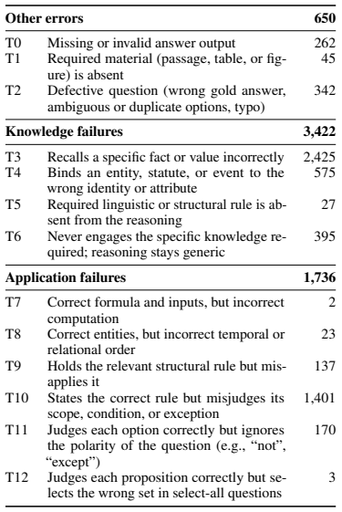
Table 11 :Failure taxonomy.Definitions of the 13 fail- ure types and the number of incorrect responses with each primary type (n= 5,808). One response fits none of the types and is counted under other errors.
出典 · CC BY 4.0 · Seoyeon Kim, Jeonghyun Kang, Hamin Koo, Barom Kang, Heondeuk Lee, Jaehyung Kim · KLEAR: Knowledge-Matched LLM Evaluation in Korean across Application Requirements via Controlled Benchmark Transformation · 論文の図を引用 · 元のPDFの16ページ目から図の部分を抽出しています。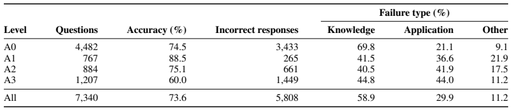
Table 12 :Failure composition by application level.Share of incorrect responses (%) by primary failure type. Accuracy is averaged over the three models.
出典 · CC BY 4.0 · Seoyeon Kim, Jeonghyun Kang, Hamin Koo, Barom Kang, Heondeuk Lee, Jaehyung Kim · KLEAR: Knowledge-Matched LLM Evaluation in Korean across Application Requirements via Controlled Benchmark Transformation · 論文の図を引用 · 元のPDFの17ページ目から図の部分を抽出しています。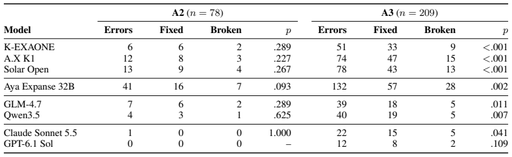
Table 25 :Effect of adding application statements.Errorsis the number of incorrect responses under+K;Fixed andBrokenare the numbers of responses that become correct and incorrect under+K+A; p is from the exact McNemar test.
出典 · CC BY 4.0 · Seoyeon Kim, Jeonghyun Kang, Hamin Koo, Barom Kang, Heondeuk Lee, Jaehyung Kim · KLEAR: Knowledge-Matched LLM Evaluation in Korean across Application Requirements via Controlled Benchmark Transformation · 論文の図を引用 · 元のPDFの26ページ目から図の部分を抽出しています。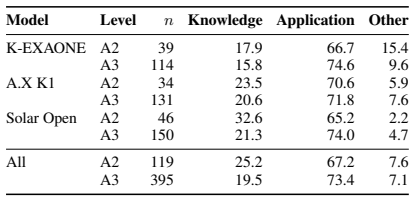
Table 27 :Failure types on KLEAR.Share (%) of each primary failure type among the incorrectClosed responses;nis the number of incorrect responses.
出典 · CC BY 4.0 · Seoyeon Kim, Jeonghyun Kang, Hamin Koo, Barom Kang, Heondeuk Lee, Jaehyung Kim · KLEAR: Knowledge-Matched LLM Evaluation in Korean across Application Requirements via Controlled Benchmark Transformation · 論文の図を引用 · 元のPDFの26ページ目から図の部分を抽出しています。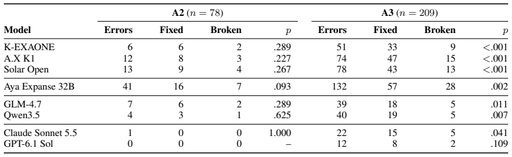
Table 28 :Matched comparison of A2 and A3 in the Closedcondition.Accuracy (%) averaged over the 30 seeds with both contrasts, the number of seeds on which each level is more accurate, and the p-value of a two- sided sign test.
出典 · CC BY 4.0 · Seoyeon Kim, Jeonghyun Kang, Hamin Koo, Barom Kang, Heondeuk Lee, Jaehyung Kim · KLEAR: Knowledge-Matched LLM Evaluation in Korean across Application Requirements via Controlled Benchmark Transformation · 論文の図を引用 · 元のPDFの26ページ目から図の部分を抽出しています。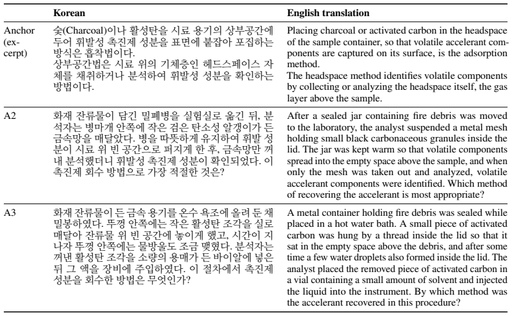
Table 29 :Example of a knowledge-matched contrast.An A2 and an A3 contrast from the same seed. The options and the gold answer (A) are the same for both: A) adsorption, B) headspace method, C) solvent extraction, D) steam distillation.
出典 · CC BY 4.0 · Seoyeon Kim, Jeonghyun Kang, Hamin Koo, Barom Kang, Heondeuk Lee, Jaehyung Kim · KLEAR: Knowledge-Matched LLM Evaluation in Korean across Application Requirements via Controlled Benchmark Transformation · 論文の図を引用 · 元のPDFの27ページ目から図の部分を抽出しています。選択式の形式とプロキシ選別の限界
KLEARは選択式の質問に合わせて設計されたため、自動での正解検証は容易ですが、記述式の課題にそのまま広げられるわけではありません。また、プロキシモデルが正解したかどうかで選別するため、残った質問が特定のモデルの弱点を反映しうるという選択バイアスが残ります。A2とA3に同じ採用基準を適用している点も、難易度調整の細かさを制限します。3つの元ベンチマークから派生した質問という範囲も、他の言語やドメインに一般化できるかという問いを残します。
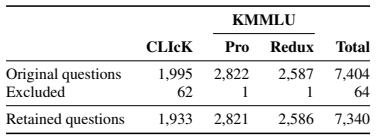
Table 6 :Source benchmark statistics.Number of ques- tions in each source benchmark and number retained for the knowledge and application analysis.
出典 · CC BY 4.0 · Seoyeon Kim, Jeonghyun Kang, Hamin Koo, Barom Kang, Heondeuk Lee, Jaehyung Kim · KLEAR: Knowledge-Matched LLM Evaluation in Korean across Application Requirements via Controlled Benchmark Transformation · 論文の図を引用 · 元のPDFの12ページ目から図の部分を抽出しています。論文情報
- 著者
- Seoyeon Kim, Jeonghyun Kang, Hamin Koo, Barom Kang, Heondeuk Lee, Jaehyung Kim
- 学会・ジャーナル
- arXiv · プレプリント
- 公開日
- 2026年11月6日
- 登録日
- 2026年11月9日
- 更新日
- 2026年11月6日
- バージョン
- v1
- arXiv
- 2611.09223
- カテゴリ
- cs.CL
- ライセンス
- CC BY 4.0
- 掲載内容
- 論文情報・解説・論文の図
この解説は、Refivuの韓国語解説をAIで翻訳したものです。不正確な翻訳や誤りが含まれる可能性があります。論文と図の利用条件は各出典に従います。
アブストラクト
Existing Korean benchmarks for Large Language Models (LLMs) evaluate performance across diverse knowledge domains, but their accuracy scores cannot distinguish whether incorrect responses arise from a lack of required knowledge or a failure to apply that knowledge correctly. Our analysis of existing Korean benchmarks reveals that most questions can be answered through factual recall alone, while those demanding greater application also differ in required knowledge, making it difficult to isolate application ability. To address this, we introduce KLEAR, a framework that constructs knowledge-matched contrasts by varying application demand while preserving the required knowledge. During construction, KLEAR identifies the knowledge underlying each source question as an explicit anchor bundle to guide generation of questions requiring more complex application. Generated candidates then undergo automated and human validation, with iterative revision based on evaluation feedback. Experiments demonstrate that the resulting knowledge-matched sets largely satisfy the intended constraints, enabling controlled evaluation across diverse LLMs. These evaluations reveal that increasing application demand exposes failures that persist even when the required knowledge is provided.
この論文を引用
Seoyeon Kim, Jeonghyun Kang, Hamin Koo, Barom Kang, Heondeuk Lee, Jaehyung Kim (2026). KLEAR: Knowledge-Matched LLM Evaluation in Korean across Application Requirements via Controlled Benchmark Transformation. arXiv:2611.09223v1. https://arxiv.org/abs/2611.09223v1
BibTeX
@misc{kim2026klear,
  title = {{KLEAR: Knowledge-Matched LLM Evaluation in Korean across Application Requirements via Controlled Benchmark Transformation}},
  author = {Seoyeon Kim and Jeonghyun Kang and Hamin Koo and Barom Kang and Heondeuk Lee and Jaehyung Kim},
  year = {2026},
  eprint = {2611.09223},
  archivePrefix = {arXiv},
  url = {https://arxiv.org/abs/2611.09223v1}
}