論文解説
PredRNN: A Recurrent Neural Network for Spatiotemporal Predictive Learning
PredRNN:時空間予測学習のための再帰型ニューラルネットワーク
- 課題 時空間予測学習では、ConvLSTMは層の間でメモリが十分に結合されず、短い時間変化と長い時間依存性を1つのメモリが同時に担うという限界があります。
- 手法 PredRNNは、時空間メモリをジグザグに伝えるST-LSTMを使います。メモリデカップリング損失とReverse Scheduled Samplingによって、2つのメモリの役割分担と長期の時間学習を改善します。
- 結果 Moving MNISTの固定学習セット実験では、ConvLSTMのMSE 103.3がPredRNN-V2で48.4まで下がりました。この結果は、その設定で報告されたものです。
時空間予測学習の問題と既存の再帰構造の限界
時空間予測学習は、過去フレームの文脈から未来フレームを生成する問題です。論文では、降水予測、交通流、ロボット操作のような応用でこの問題が使われると紹介されています。既存手法としては、畳み込みを用いるConvLSTMのような再帰型ニューラルネットワークが広く使われてきました。ただし、ConvLSTMではメモリセルCが各層の中で時間方向にのみ更新されるため、下位層と上位層の視覚的表現がメモリで十分に結合されません。また、出力の隠れ状態は1つのメモリセルと出力ゲートに依存するため、短い時間変化と長い時間依存性を1つのメモリが同時に処理しなければなりません。著者らはこの2つの限界を出発点とし、学習手順においてもエンコーダと予測器の間の不一致が長い時間依存性の学習を妨げると指摘しています。
ジグザグなメモリの流れとST-LSTMの構造
PredRNNでは、メモリの状態が時間方向にだけ流れるのではなく、下位層から上位層へ上がったあと、次の時点の最下位層へ戻るジグザグの経路をたどります。この時空間メモリMは、入力ゲート、忘却ゲート、入力変調ゲートによって更新され、前の層のMを基準に計算されます。最上位層のメモリは、次の時点の最下位層へ渡されます。この構造により、低レベルの情報は上へ伝わり、高レベルの予測は下へ戻ります。この設計を実装した基本単位がST-LSTMです。ST-LSTMでは、時間方向のメモリCと時空間メモリMを併用し、2つのメモリを連結したあと1×1の畳み込みで隠れ状態を作ります。したがって、式(4)のMの経路では、従来のConvLSTMのHadamard積ベースのゲートの代わりに畳み込み演算が使われます。
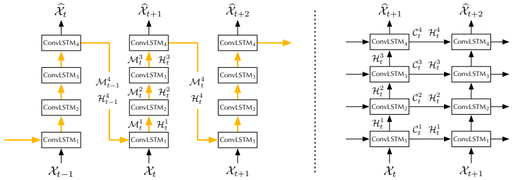
Fig. 1 : Left: the spatiotemporal memory flow architecture that uses ConvLSTM as the building block. The orange arrows show the deep-in-time path of memory state transitions. Right: the original ConvLSTM network proposed by Shi et al. [1].
出典 · CC BY 4.0 · Yunbo Wang, Haixu Wu, Jianjin Zhang, Zhifeng Gao, Jianmin Wang, Philip S. Yu, Mingsheng Long · PredRNN: A Recurrent Neural Network for Spatiotemporal Predictive Learning · 論文の図を引用 · 元のPDFの4ページ目から図の部分を抽出しています。メモリデカップリング損失
2つのメモリCとMを併用しても、著者らは学習中に2つのメモリの増分が自然には分離されないと報告しています。これを補うため、2つのメモリの増分ΔCとΔMに1×1の畳み込みW_decoupleを適用したうえで、チャネルごとのコサイン類似度の絶対値を小さくするデカップリング損失を加えます。式(5)は、この値を時間、層、チャネルにわたって合算します。この損失は学習時のみ使われ、推論時には該当パラメータをモデルから取り除くため、モデルサイズは以前のST-LSTM版と同じです。論文では、この手法によって2つのメモリがそれぞれ異なる時間スケールの変化を担うように誘導されると説明されています。t-SNEによる可視化では、学習後に2つの増分がより明確に分離されたと報告されています。
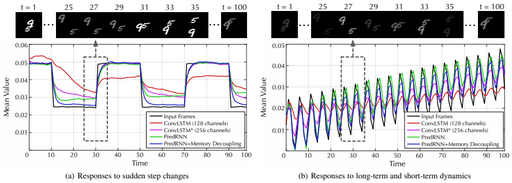
Fig. 11 : Model performance under different types of temporal dynamics, where the models take as inputs the real observations at all timesteps, and the Y axis represents the mean value of predictions averaged over 100 test samples. We show two ground-truth sequences as examples at the top of the figure for a better intuitive understanding of the two types of pixel intensity changes. For each type, we apply the same rate of changes to all test samples. With memory-decoupled ST-LSTMs, our model is shown to (a) respond more rapidly to unexpected, sudden variations, and (b) simultaneously capture temporal dynamics at different timescales.
出典 · CC BY 4.0 · Yunbo Wang, Haixu Wu, Jianjin Zhang, Zhifeng Gao, Jianmin Wang, Philip S. Yu, Mingsheng Long · PredRNN: A Recurrent Neural Network for Spatiotemporal Predictive Learning · 論文の図を引用 · 元のPDFの11ページ目から図の部分を抽出しています。Reverse Scheduled Samplingの学習手順
Reverse Scheduled Samplingは、エンコーディング段階の入力フレームに適用されるカリキュラムです。エンコーディング段階では、実際の観測X_tを使う確率ε_kを学習の反復kに応じてε_sからε_eへ増加させ、予測されたフレームを使う確率は1−ε_kです。予測段階には、従来のScheduled samplingを適用し、実際のフレームを使う確率を下げます。著者らは、エンコーダは主に1ステップ先の予測を学習する一方、予測器は観測なしで長い時間依存性を学習しなければならないという不一致を指摘しています。RSSは、この不一致を減らすために、エンコーダの入力条件を徐々に変えていきます。
論文では、線形、指数、シグモイドの形のε_kが示されています。実験では、2つの戦略のうち2つ目を支持しています。
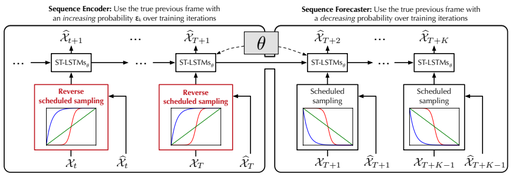
Fig. 5 : In the training phase, we apply the reverse scheduled sampling at the encoding timesteps to force the model to learn long-term dynamics from context frames. This training scheme can be easily combined with the original scheduled sampling strategy, which is used to close the training-inference gap at forecasting timesteps. Both the encoder and the forecaster are parametrized by θ.
出典 · CC BY 4.0 · Yunbo Wang, Haixu Wu, Jianjin Zhang, Zhifeng Gao, Jianmin Wang, Philip S. Yu, Mingsheng Long · PredRNN: A Recurrent Neural Network for Spatiotemporal Predictive Learning · 論文の図を引用 · 元のPDFの7ページ目から図の部分を抽出しています。Moving MNISTでの検証結果
Moving MNISTの固定学習セット実験では、著者らは10,000個のサンプルで学習し、5,000個のシーケンスで評価しました。10フレームの入力から次の10フレームを予測し、MSE、SSIM、LPIPSを測定しました。この設定では、ConvLSTMの平均MSEは103.3で、時空間メモリの流れだけを追加したPredRNN-M-Onlyは74.0です。ST-LSTMを用いたPredRNNは56.8で、メモリデカップリングとRSSを併用したPredRNN-V2は48.4でした。著者らは、より大きいConvLSTM*よりもPredRNN-V2が効率的だと報告しています。この結果は固定学習セットの設定によるものです。
動的に生成した学習データでの結果は、別の設定で報告されています。
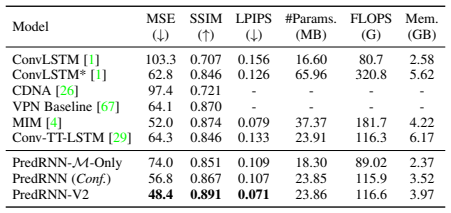
TABLE 2 : Performance on the Moving MNIST test set, averaged over 10 prediction timesteps. All models are trained with a fixed training set of 10,000 sequences. For a fair comparison, we also report the model size and computation efficiency. ConvLSTM* denotes a 4-layer network with a 256-channel hidden state each.
出典 · CC BY 4.0 · Yunbo Wang, Haixu Wu, Jianjin Zhang, Zhifeng Gao, Jianmin Wang, Philip S. Yu, Mingsheng Long · PredRNN: A Recurrent Neural Network for Spatiotemporal Predictive Learning · 論文の図を引用 · 元のPDFの8ページ目から図の部分を抽出しています。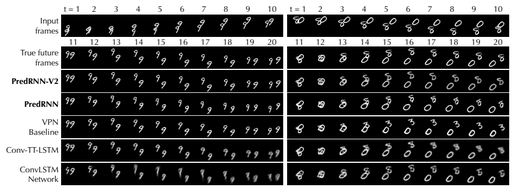
Fig. 8 : Prediction examples on the Moving MNIST test set.
出典 · CC BY 4.0 · Yunbo Wang, Haixu Wu, Jianjin Zhang, Zhifeng Gao, Jianmin Wang, Philip S. Yu, Mingsheng Long · PredRNN: A Recurrent Neural Network for Spatiotemporal Predictive Learning · 論文の図を引用 · 元のPDFの9ページ目から図の部分を抽出しています。レーダーエコーと限界の範囲
レーダーエコーの降水予測では、各シーケンスは10フレームの入力と10フレームの出力で構成され、CSIは30、40、50 dBZのしきい値で計算されます。この設定で、PredRNNはMSE 39.1、PredRNN-V2はMSE 36.4と報告されています。ただし、論文では、レーダーエコーのまれな高強度領域において、PredRNN-V2がまばらなエコーの動態を完全にはモデル化できていないと明記されています。したがって、この結果はレーダーエコー全体に対する完全な予測能力を意味するものではなく、ロングテール分布は本論文の限界として残ります。
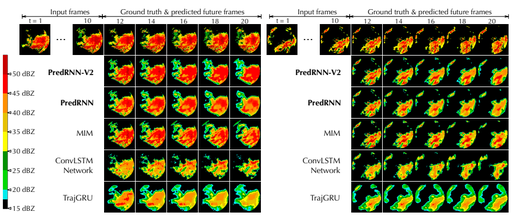
Fig. 14 : Prediction examples on the radar echo test set, in which 10 future frames are generated from the past 10 observations.
出典 · CC BY 4.0 · Yunbo Wang, Haixu Wu, Jianjin Zhang, Zhifeng Gao, Jianmin Wang, Philip S. Yu, Mingsheng Long · PredRNN: A Recurrent Neural Network for Spatiotemporal Predictive Learning · 論文の図を引用 · 元のPDFの12ページ目から図の部分を抽出しています。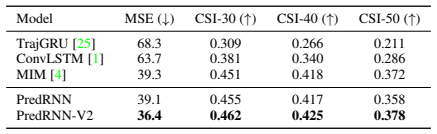
TABLE 8 : Quantitative results on the radar echo dataset.
出典 · CC BY 4.0 · Yunbo Wang, Haixu Wu, Jianjin Zhang, Zhifeng Gao, Jianmin Wang, Philip S. Yu, Mingsheng Long · PredRNN: A Recurrent Neural Network for Spatiotemporal Predictive Learning · 論文の図を引用 · 元のPDFの12ページ目から図の部分を抽出しています。論文情報
- 著者
- Yunbo Wang, Haixu Wu, Jianjin Zhang, Zhifeng Gao, Jianmin Wang, Philip S. Yu, Mingsheng Long
- 学会・ジャーナル
- arXiv · プレプリント
- 公開日
- 2021年3月17日
- 登録日
- 2026年11月6日
- 更新日
- 2022年4月9日
- バージョン
- v4
- arXiv
- 2103.09504
- カテゴリ
- cs.LG · cs.CV
- ライセンス
- CC BY 4.0
- 掲載内容
- 論文情報・解説・論文の図
この解説は、Refivuの韓国語解説をAIで翻訳したものです。不正確な翻訳や誤りが含まれる可能性があります。論文と図の利用条件は各出典に従います。
アブストラクト
The predictive learning of spatiotemporal sequences aims to generate future images by learning from the historical context, where the visual dynamics are believed to have modular structures that can be learned with compositional subsystems. This paper models these structures by presenting PredRNN, a new recurrent network, in which a pair of memory cells are explicitly decoupled, operate in nearly independent transition manners, and finally form unified representations of the complex environment. Concretely, besides the original memory cell of LSTM, this network is featured by a zigzag memory flow that propagates in both bottom-up and top-down directions across all layers, enabling the learned visual dynamics at different levels of RNNs to communicate. It also leverages a memory decoupling loss to keep the memory cells from learning redundant features. We further propose a new curriculum learning strategy to force PredRNN to learn long-term dynamics from context frames, which can be generalized to most sequence-to-sequence models. We provide detailed ablation studies to verify the effectiveness of each component. Our approach is shown to obtain highly competitive results on five datasets for both action-free and action-conditioned predictive learning scenarios.
この論文を引用
Yunbo Wang, Haixu Wu, Jianjin Zhang, Zhifeng Gao, Jianmin Wang, Philip S. Yu, Mingsheng Long (2021). PredRNN: A Recurrent Neural Network for Spatiotemporal Predictive Learning. arXiv:2103.09504v4. https://arxiv.org/abs/2103.09504v4
BibTeX
@misc{wang2021predrnn,
  title = {{PredRNN: A Recurrent Neural Network for Spatiotemporal Predictive Learning}},
  author = {Yunbo Wang and Haixu Wu and Jianjin Zhang and Zhifeng Gao and Jianmin Wang and Philip S. Yu and Mingsheng Long},
  year = {2021},
  eprint = {2103.09504},
  archivePrefix = {arXiv},
  url = {https://arxiv.org/abs/2103.09504v4}
}