論文解説
Anomaly Detection on Attributed Networks via Contrastive Self-Supervised Learning
対照的自己教師あり学習による属性グラフの異常検知
- 課題 属性ネットワークの異常検知では、オートエンコーダ系の手法は再構成という目的が異常検知と直接結びつかず、大規模グラフではメモリの問題もあります。この研究は、ノードと局所部分グラフの対照学習でこれを解決しようとするものです。
- 手法 CoLAは、target node v.s. local subgraphのペアをサンプリングし、GCNベースの識別器で一致度を学習します。そのうえで、複数回サンプリングした負例と正例のスコア差の平均で、ノードの異常スコアを計算します。
- 結果 7つのベンチマークデータセットで、ベースライン手法より高いAUCを報告しています。CoraではCoLAが0.8779、DOMINANTが0.8155を記録しています。
オートエンコーダ基盤の異常検知の限界
属性ネットワークの異常検知では、ノードの属性と辺の構造をあわせて扱う必要があります。異常は大きく2種類に分けられます。structural anomalyは、属性は正常だが他のノードと異常な辺を持つ場合です。contextual anomalyは、自然な近傍構造を持つ一方で、属性が損なわれているか周囲とずれている場合です。DOMINANTのように、グラフオートエンコーダで属性と構造を再構成し、再構成誤差で異常の度合いを評価する手法は、再構成という学習目的が異常検知の目的と直接つながらないため、準最適な性能にとどまる可能性があると論文は指摘しています。また、オートエンコーダは全体グラフの隣接行列と属性行列を入力として再構成するため、大規模ネットワークではメモリ要求が大きくなります。
CoLAは、この2つの限界をあわせて狙い、異常検知の目的を直接用いるとともに、全体グラフの代わりにサンプリングしたインスタンスのペアで学習する方向を選んでいます。
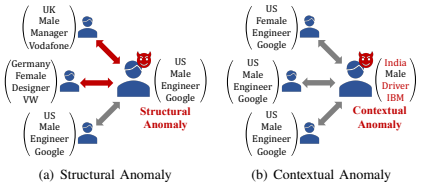
Fig. 1 . Toy examples to illustrate different types of anomalies in attributed networks. A structural anomaly often has wrong links with other nodes but has normal attributes. For example, in Subfigure (a), an American engineer has a very low probability of being associated with a German designer as well as a British manager, so the links between them are abnormal. A contextual anomaly usually has a natural neighboring structure but its attributes are corrupted. For instance, in Subfigure (b), the attribute vector of the anomaly node is disturbed by noisy information, e.g., mismatched location, employer and occupation.
出典 · CC BY 4.0 · Yixin Liu, Zhao Li, Shirui Pan, Chen Gong, Chuan Zhou, George Karypis · Anomaly Detection on Attributed Networks via Contrastive Self-Supervised Learning · 論文の図を引用 · 元のPDFの2ページ目から図の部分を抽出しています。対象ノードと局所部分グラフのインスタンスペア
CoLAの中心となるインスタンスペアは、target node v.s. local subgraphです。1つの対象ノードと、その周辺からサンプリングした局所部分グラフを1組に束ねます。正例のペアは、対象ノード自身を開始ノードとしてサンプリングした部分グラフと組にしたものです。負例のペアは、対象ノード以外のランダムなノードを開始ノードとしてサンプリングした部分グラフと組にしたものです。したがって負例のペアでは、対象ノードとその局所構造の間にずれが生じます。部分グラフのサンプリングにはrandom walk with restart(RWR)を使います。また、開始ノードの属性ベクトルをゼロベクトルに置き換え、対象ノードが部分グラフの中で直接特定されないように匿名化します。
この設計は、異常がノードと近傍の間の不一致として現れるという仮定に基づいています。論文は、full graph v.s. nodeのように大域的な属性に注目する既存のペア定義と、この設計を区別しています。
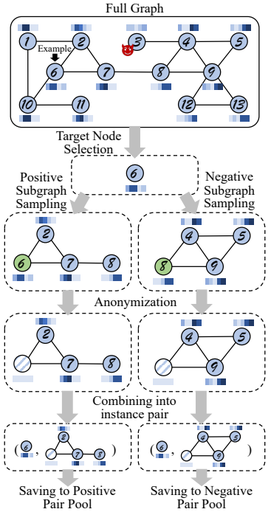
Fig. 3 . The sampling process of contrastive instance pairs. Here we select node 𝑣6 as the example of target node. The initial nodes for subgraph sampling are marked in green. The blue-white stripe means the embedding of the corresponding node is masked with zero vector.
出典 · CC BY 4.0 · Yixin Liu, Zhao Li, Shirui Pan, Chen Gong, Chuan Zhou, George Karypis · Anomaly Detection on Attributed Networks via Contrastive Self-Supervised Learning · 論文の図を引用 · 元のPDFの6ページ目から図の部分を抽出しています。GNNベースの対照学習モデルと損失
対照学習モデルは、GNNモジュール、readoutモジュール、識別器モジュールで構成されます。局所部分グラフは、複数層のGCN系GNNを通してノード埋め込みを得ます。対象ノードには部分グラフがないため、GCNの重み行列と活性化関数だけを共有するDNN型の変換によって、同じ埋め込み空間に写像します。readoutは平均プーリングによって、部分グラフのノード埋め込みを1つの部分グラフ埋め込みに要約します。識別器は双線形スコア関数で2つの埋め込みの一致度を計算し、シグモイドを適用して予測スコアを出します。学習は、正例と負例のペアに対する標準の二値交差エントロピー損失で行います。論文は、サンプリングの段階で正例と負例を均衡よく抽出したため、重みを調整したBCEではなく標準のBCEを選んだと説明しています。
この学習目的がノードごとの異常スコアに直接つながることが、CoLAの設計の根拠です。
複数回サンプリングによる異常スコア
異常スコアは、学習が終わったあと推論の段階で計算します。対象ノードごとにR個の正例のペアとR個の負例のペアをサンプリングし、予測スコアを得ます。正常ノードでは、正例のペアのスコアが1に近く、負例のペアのスコアが0に近いという理想的な条件を仮定しています。論文では、異常ノードはモデルがパターンをうまく当てられず、2つのスコアが0.5付近で区別されにくくなると説明しています。ノードの異常スコアは、負例のスコアから正例のスコアを引いた差をR回にわたって平均した値として定義されます。一度のサンプリングでは近傍の一部しか観測しないため、正常な近傍だけが選ばれると構造の異常が隠れてしまうことがあります。複数回のサンプリングは、この不完全な観測を補うための仕組みです。
実験では、推論段階のサンプリングラウンドRを256に設定しました。
AUCによるベンチマーク比較
論文では、BlogCatalog、Flickr、ACM、Cora、Citeseer、Pubmed、ogbn-arxivの7つのデータセットで、AMEN、Radar、ANOMALOUS、DOMINANT、DGIとAUCを比較しています。実際の異常ラベルがないため、structural anomalyとcontextual anomalyを合成で注入しました。Coraでは、CoLAが0.8779、DOMINANTが0.8155を記録しました。Citeseerでは、CoLAが0.8968、DGIが0.8293です。大規模なogbn-arxivでは、CoLAが0.8073を記録しましたが、Radar、ANOMALOUS、DOMINANT、DGIはメモリの問題で結果を出せませんでした。
著者らは、この差を局所部分グラフのペアの設計と、異常検知の目的に合わせた学習方式によるものと解釈しています。この結果は、合成異常を注入した設定と、示された実装条件で得られたものです。実際のラベル付き異常データに対する性能を直接保証するものではありません。
アブレーション結果と適用範囲
アブレーション実験では、readoutに平均プーリングを用いたCoLAが6つのデータセットのうち4つで最も良い結果でした。Max PoolingとWeighted Average Poolingは、一部のデータセットで同程度の性能でした。スコアの計算では、正例と負例のペアを両方合算した全部入りの版が最も安定していましたが、データセットの種類によって一方のスコアの寄与が異なって現れました。スコアの集約方法としては平均が最も頑健だと報告されています。標準偏差を加える場合は、BlogCatalogとFlickrで相関の向きが引用ネットワークと異なっていました。サンプリングラウンドRは256以降、性能の向上が小さくなりました。
メモリの独立性は、ノード数nと空間計算量の関係から分析されています。実験の範囲は、示された7つのデータセットと合成異常注入の設定に限られます。分散や最大値など、他の統計量の活用は、著者らが今後の課題として残した方向です。
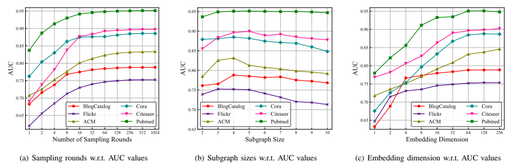
Fig. 5 . The experimental results for parameter study. The subfigure (a), (b) and (c) shows the impact of different sampling rounds, subgraph sizes and embedding dimension w.r.t. AUC values respectively.
出典 · CC BY 4.0 · Yixin Liu, Zhao Li, Shirui Pan, Chen Gong, Chuan Zhou, George Karypis · Anomaly Detection on Attributed Networks via Contrastive Self-Supervised Learning · 論文の図を引用 · 元のPDFの12ページ目から図の部分を抽出しています。論文情報
- 著者
- Yixin Liu, Zhao Li, Shirui Pan, Chen Gong, Chuan Zhou, George Karypis
- 学会・ジャーナル
- arXiv · プレプリント
- 公開日
- 2021年2月27日
- 登録日
- 2026年11月6日
- 更新日
- 2021年5月6日
- バージョン
- v2
- arXiv
- 2103.00113
- DOI
- 10.1109/tnnls.2021.3068344
- カテゴリ
- cs.LG
- ライセンス
- CC BY 4.0
- 掲載内容
- 論文情報・解説・論文の図
この解説は、Refivuの韓国語解説をAIで翻訳したものです。不正確な翻訳や誤りが含まれる可能性があります。論文と図の利用条件は各出典に従います。
アブストラクト
Anomaly detection on attributed networks attracts considerable research interests due to wide applications of attributed networks in modeling a wide range of complex systems. Recently, the deep learning-based anomaly detection methods have shown promising results over shallow approaches, especially on networks with high-dimensional attributes and complex structures. However, existing approaches, which employ graph autoencoder as their backbone, do not fully exploit the rich information of the network, resulting in suboptimal performance. Furthermore, these methods do not directly target anomaly detection in their learning objective and fail to scale to large networks due to the full graph training mechanism. To overcome these limitations, in this paper, we present a novel contrastive self-supervised learning framework for anomaly detection on attributed networks. Our framework fully exploits the local information from network data by sampling a novel type of contrastive instance pair, which can capture the relationship between each node and its neighboring substructure in an unsupervised way. Meanwhile, a well-designed graph neural network-based contrastive learning model is proposed to learn informative embedding from high-dimensional attributes and local structure and measure the agreement of each instance pairs with its outputted scores. The multi-round predicted scores by the contrastive learning model are further used to evaluate the abnormality of each node with statistical estimation. In this way, the learning model is trained by a specific anomaly detection-aware target. Furthermore, since the input of the graph neural network module is batches of instance pairs instead of the full network, our framework can adapt to large networks flexibly. Experimental results show that our proposed framework outperforms the state-of-the-art baseline methods on all seven benchmark datasets.
この論文を引用
Yixin Liu, Zhao Li, Shirui Pan, Chen Gong, Chuan Zhou, George Karypis (2021). Anomaly Detection on Attributed Networks via Contrastive Self-Supervised Learning. arXiv:2103.00113v2. https://doi.org/10.1109/tnnls.2021.3068344
BibTeX
@article{liu2021anomaly,
  title = {{Anomaly Detection on Attributed Networks via Contrastive Self-Supervised Learning}},
  author = {Yixin Liu and Zhao Li and Shirui Pan and Chen Gong and Chuan Zhou and George Karypis},
  year = {2021},
  eprint = {2103.00113},
  archivePrefix = {arXiv},
  doi = {10.1109/tnnls.2021.3068344},
  url = {https://arxiv.org/abs/2103.00113v2}
}