論文解説
Eliciting and Mitigating Specification Satisficing in Coding Agents
コーディングエージェントにおけるspecification satisficingの誘発と緩和
- 課題 コーディングエージェントは、自分が受け入れた実装上の選択を誤りと認識できず、要件に違反することがあります。
- 手法 エージェントを助言者の役割に置いて実装上の選択と理由を報告させ、その後開発者の役割に戻して、各選択を課題の説明と照合させます。
- 結果 DeepSWEにおけるGPT-5.6-Lunaでは、pass@1が44.25%から50.22%に上がりました。
specification satisficingという失敗の型
コーディングエージェントは、課題の複数の要件をすべて満たせないことが多くあります。この論文が注目する失敗は、エージェントが要件を満たす実装上の選択を一度検討したうえで、後に要件を満たさない別の選択を確定してしまうケースです。エージェントは、その選択を受け入れてよい理由があると考えるため、それを誤りとして認識しません。著者らはこれをspecification satisficingと呼び、この現象は既存の自己修正手法では捉えにくいと見ています。既存の自己修正は、エージェントに自分の出力を再検討させるものですが、エージェントは同じ理由をもとに選択を再び受け入れてしまうためです。
specification satisficingの定義
論文は、要件rについて、エージェントが次の3つの条件をすべて満たすとき、specification satisficingがあると定義しています。1つ目は、エージェントが課題説明Dのもとでrを満たすa+を検討することです。2つ目は、時点tにおいて、エージェントがDのもとでrを満たさない別の選択a◦を確定することです。3つ目は、エージェントがa◦を受け入れることです。ここでの受け入れとは、エージェントが持つ前提Btのもとで、a◦がrを満たすと見なすことを指します。このとき、a◦の受け入れを支えるBtのうち、Dからは導けない部分を理由ρと呼びます。論文は、この理由を、意図された再解釈、適用範囲の縮小、低い基準、認識された衝突の4種類に分けています。
目的整合の報告段階
SATISFIXの最初の段階は、コードを書く直前に、エージェントへ報告メッセージを送ることです。このメッセージは、エージェントを課題の保守担当者に対する助言者の役割に置き、課題説明を変えられると見なした要件、実装上の選択、その理由を報告させます。エージェントは受け入れたa◦を誤りとは判断していないため、その選択と理由を報告する際も、自分が間違えたとは感じません。論文は、役割によって報告内容が変わるという先行研究を、この設計の根拠として挙げています。この根拠は先行研究の観察であり、この論文が役割設計そのものの効果を証明したという意味ではありません。例では、エージェントがrefineの選択を厳密な読解と食い違うと報告し、要件があいまいだという理由を書き添えました。
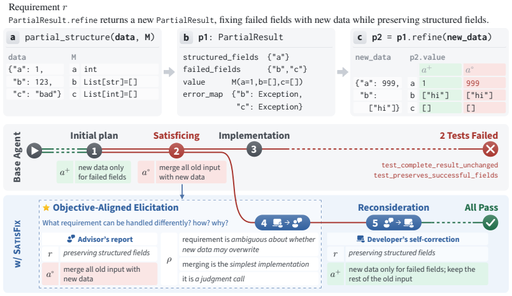
Figure 1 : Illustration of SATISFIXwith an example task. The task: (a) partial structuring of data into class M, where fields b and c fail, (b) the resulting PartialResult, and (c) refine with new data that fixes b and also provides the structured field a. The agent first considers a design a+ that preserves structured fields and meets r 1 , but later commits to a designa ◦ that can overwrite them and does not meetr 2 . Without SATISFIX, the agent implements this design 3 and fails two of the 69 evaluation tests. With SATISFIX, before the agent writes code, it reports the choice in the role of an advisor 4 and reconsiders it 5 ; its final code passes all 69 tests. The notation follows Section 2.
出典 · CC BY 4.0 · Ruixin Wang, Tianyi Zhang · Eliciting and Mitigating Specification Satisficing in Coding Agents · 論文の図を引用 · 元のPDFの3ページ目から図の部分を抽出しています。再検討の段階と課題の完了
2つ目の段階で、SATISFIXはエージェントを開発者の役割に戻します。報告の段階で述べた課題説明を修正できる余地は、もうないことを伝えます。最初の再検討メッセージでは、報告された各選択の代替案と、それをDおよびリポジトリと照合する計画を列挙させ、この段階では選択を確定しないよう求めます。2つ目のメッセージでは、その計画を実行して各選択を確定させ、課題を完了させます。例では、エージェントが要件を読み直し、新しいデータを失敗していたフィールドだけに適用するa+を選びました。報告がない場合、この段階は開発者の役割に戻って課題を完了するだけになります。
DeepSWEとSWE-bench Proでの比較
DeepSWE v1.1でGPT-5.6-Lunaをmini-swe-agentで実行したところ、SATISFIXのpass@1は4回実行の平均で50.22%、基盤エージェントは44.25%でした。3つの自己修正ベースラインであるSelf-Refine、DeCRIM、ProgCoは、それぞれ46.24%、44.25%、46.24%でした。同じ設定では、Self-Refineは課題あたりのステップ数と入力トークン数が、基盤エージェントより大きく増えました。DeepSeek V4 Flashでは、DeepSWEのpass@1が53.32%から57.08%に上がり、Qwen3.8-27Bでは42.26%から47.79%に上がりました。
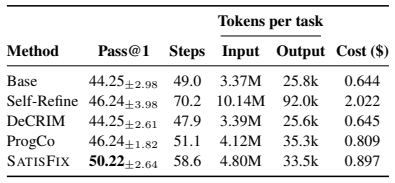
Table 2 : SATISFIX, the baselines, and the base agent (Base) on DeepSWE with GPT-5.6-Luna, four runs each. Pass@1 (%) is the mean over runs ± the standard devi- ation. Steps, token counts, and cost ($) are means per task.
出典 · CC BY 4.0 · Ruixin Wang, Tianyi Zhang · Eliciting and Mitigating Specification Satisficing in Coding Agents · 論文の図を引用 · 元のPDFの5ページ目から図の部分を抽出しています。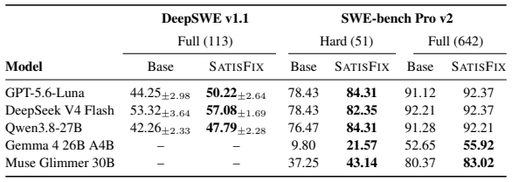
Table 3 : Pass@1 (%) of SATISFIXand Base on DeepSWE v1.1 and SWE-bench Pro v2. On DeepSWE, each method runs four times, and pass@1 is the mean over runs ± the standard deviation. A dash (–) marks a model that hits a capability floor on DeepSWE.
出典 · CC BY 4.0 · Ruixin Wang, Tianyi Zhang · Eliciting and Mitigating Specification Satisficing in Coding Agents · 論文の図を引用 · 元のPDFの6ページ目から図の部分を抽出しています。2段階の寄与の内訳
GPT-5.6-Lunaのアブレーション実験では、SATISFIXの最初の実行の通過率は49.6%でした。目的整合の報告を取り除くと43.4%に下がり、基盤エージェントと同程度になりました。再検討を取り除くと47.8%になりました。両方の段階を通常の自己修正に置き換えた変種は44.2%でした。この結果は、報告の段階が改善の大部分を説明するという著者らの解釈を裏付けています。再検討だけを残した変種も、報告の段階の効果を代替できず、両段階を同じ自己修正に置き換えると効果はほとんど消えました。ただし、このアブレーション実験はGPT-5.6-Lunaの最初の実行から得た値なので、他のモデルの結果としては扱えません。
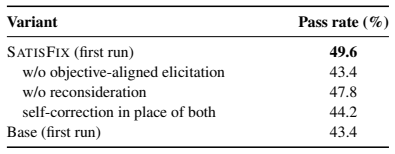
Table 5 : Ablation with GPT-5.6-Luna. SATISFIXand Base are from their first runs.
出典 · CC BY 4.0 · Ruixin Wang, Tianyi Zhang · Eliciting and Mitigating Specification Satisficing in Coding Agents · 論文の図を引用 · 元のPDFの6ページ目から図の部分を抽出しています。報告項目と再検討の結果
113個のDeepSWE課題について、最初の実行の報告を2つのLLMエージェントが独立して注釈しました。GPT-5.6-Lunaは61個の課題で90件のspecification satisficingの報告項目を作り、DeepSeek V4 Flashは105個の課題で227件の項目を作りました。再検討の段階では、GPT-5.6-Lunaは報告された90件をすべて再検討し、DeepSeek V4 Flashは227件のうち226件を再検討しました。著者らは、多くの選択をすでに計画に反映させた後にまとめて再検討すると、効果が薄れる可能性があると解釈しています。
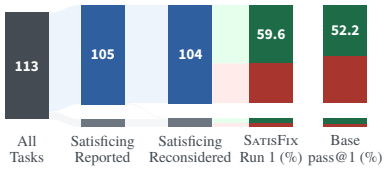
Figure 2 : The 113 tasks in the first run of SATISFIX. In the second column, blue marks the tasks in which elicitation reports specification satisficing with one of the four types of reasons. In the third column, blue marks the tasks in which the agent reconsiders such an item. Gray marks the other tasks. The last two columns give the pass rate of SATISFIXin this run and the pass@1 of the base agent over its four runs. Green is success and red is failure.
出典 · CC BY 4.0 · Ruixin Wang, Tianyi Zhang · Eliciting and Mitigating Specification Satisficing in Coding Agents · 論文の図を引用 · 元のPDFの7ページ目から図の部分を抽出しています。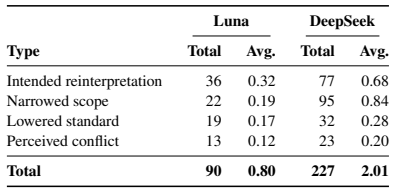
Table 6 : Items that report specification satisficing with GPT-5.6-Luna and DeepSeek V4 Flash, by the type of reason in Table 1. Avg. is the mean number per task over the 113 tasks.
出典 · CC BY 4.0 · Ruixin Wang, Tianyi Zhang · Eliciting and Mitigating Specification Satisficing in Coding Agents · 論文の図を引用 · 元のPDFの7ページ目から図の部分を抽出しています。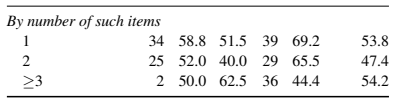
Table 7 : Results on the tasks in which the coding agent reconsiders an item with one of the four types of reasons in Table 1. Ours is the pass rate (%) of SATISFIXin its first run. Base is the pass@1 (%) of the base agent over its four runs. A task with several types of reasons counts once for each type. # is the number of tasks.
出典 · CC BY 4.0 · Ruixin Wang, Tianyi Zhang · Eliciting and Mitigating Specification Satisficing in Coding Agents · 論文の図を引用 · 元のPDFの7ページ目から図の部分を抽出しています。限界
この方法は、エージェント自身の応答に基づいて介入の時点を決め、課題ごとに1回だけ介入します。そのため、エージェントが後から確定する選択は、報告を引き出しません。注釈の分析は報告の内容を判断するだけで、最終的なコードが各要件を満たすかどうかは判断しません。2つの注釈エージェントが同じ誤りを出した項目は、著者による確認の対象にはなりませんでした。メッセージが保守担当者から来たという設定が、その後のメッセージの扱いにどう影響するかは測定していません。
論文情報
- 著者
- Ruixin Wang, Tianyi Zhang
- 学会・ジャーナル
- arXiv · プレプリント
- 公開日
- 2026年11月12日
- 登録日
- 2026年11月13日
- 更新日
- 2026年11月12日
- バージョン
- v1
- arXiv
- 2611.16289
- カテゴリ
- cs.SE · cs.AI · cs.CL
- ライセンス
- CC BY 4.0
- 掲載内容
- 論文情報・解説・論文の図
この解説は、Refivuの韓国語解説をAIで翻訳したものです。不正確な翻訳や誤りが含まれる可能性があります。論文と図の利用条件は各出典に従います。
アブストラクト
Coding agents often fail to meet all requirements in the task description. In some of these failures, the agent considers an implementation choice that meets a requirement, but later decides to commit to another one that does not meet the requirement for a reason it finds acceptable. We call this specification satisficing. It is challenging to identify and mitigate specification satisficing because the agent accepts such choices for its own reasons, and existing self-correction methods are biased toward them. We propose SatisFix, which guides a coding agent to report these choices and their reasons, and then check each choice against the task description. We evaluate SatisFix on DeepSWE and SWE-bench Pro with five LLMs as backbones and two different agent frameworks, and compare it with three self-correction methods. SatisFix improves the pass@1 of the base agent by an average of 5.09% on DeepSWE and 7.06% on the hard subset of SWE-bench Pro. On DeepSWE, it outperforms the best baseline by 3.98%. Our ablation study shows that both steps of SatisFix contribute to the improvement.
この論文を引用
Ruixin Wang, Tianyi Zhang (2026). Eliciting and Mitigating Specification Satisficing in Coding Agents. arXiv:2611.16289v1. https://arxiv.org/abs/2611.16289v1
BibTeX
@misc{wang2026eliciting,
  title = {{Eliciting and Mitigating Specification Satisficing in Coding Agents}},
  author = {Ruixin Wang and Tianyi Zhang},
  year = {2026},
  eprint = {2611.16289},
  archivePrefix = {arXiv},
  url = {https://arxiv.org/abs/2611.16289v1}
}