논문 해설
Eliciting and Mitigating Specification Satisficing in Coding Agents
코딩 에이전트에서 명세 충족화(specification satisficing) 유도와 완화
- 연구 문제 코딩 에이전트는 자신이 수용한 구현 선택을 잘못으로 알아차리지 못해 요구사항을 어기는 경우가 있습니다.
- 연구 방법 에이전트를 조언자 역할에 두고 구현 선택과 이유를 보고하게 한 뒤, 개발자 역할로 돌아와 각 선택을 과제 설명과 대조하게 합니다.
- 주요 결과 DeepSWE에서 GPT-5.6-Luna 기준 pass@1을 44.25%에서 50.22%로 높였습니다.
명세 satisficing이라는 실패 유형
코딩 에이전트는 과제의 여러 요구사항을 모두 맞추지 못하는 경우가 많습니다. 이 논문이 주목하는 실패는 에이전트가 요구사항을 충족하는 구현 선택을 한 번 고려하고도, 나중에 요구사항을 충족하지 않는 다른 선택을 확정하는 경우입니다. 에이전트는 이 선택이 자신이 수용할 만한 이유가 있다고 보기 때문에 이를 잘못으로 인식하지 않습니다. 저자들은 이를 명세 satisficing이라고 부르며, 이 현상이 기존 자기 교정 방법으로 잡히기 어렵다고 봅니다. 기존 자기 교정은 에이전트가 자신의 출력을 다시 검토하게 하는데, 에이전트는 같은 이유를 근거로 선택을 다시 수용할 수 있기 때문입니다.
명세 satisficing의 정의
논문은 요구사항 r에 대해 에이전트가 세 조건을 모두 만족할 때 명세 satisficing이 있다고 정의합니다. 첫째, 에이전트는 과제 설명 D 아래에서 r을 충족하는 a+를 고려합니다. 둘째, 시점 t에 에이전트는 D 아래에서 r을 충족하지 않는 다른 선택 a◦를 확정합니다. 셋째, 에이전트는 a◦를 수용합니다. 여기서 수용은 에이전트가 가진 전제 Bt 아래에서 a◦가 r을 충족한다고 보는 것입니다. 이때 a◦의 수용을 떠받치는 Bt 가운데 D에서 따라 나오지 않는 부분을 이유 ρ라고 부릅니다. 논문은 이 이유를 의도된 재해석, 적용 범위 축소, 낮은 기준, 인식된 충돌의 네 유형으로 나눕니다.
목적 정렬 보고 단계
SATISFIX의 첫 단계는 코드를 쓰기 직전에 에이전트에게 보고 메시지를 보내는 것입니다. 이 메시지는 에이전트를 과제 유지보수자의 조언자 역할에 두고, 과제 설명을 바꿀 수 있다고 본 요구사항과 구현 선택, 그 이유를 보고하게 합니다. 에이전트는 자신이 수용한 a◦를 잘못이라고 판단하지 않으므로, 그 선택과 이유를 보고할 때 자신이 실수했다고 느끼지 않습니다. 논문은 역할에 따라 보고 내용이 달라진다는 선행 연구를 이 설계의 근거로 듭니다. 이 근거는 선행 연구의 관찰이며, 이 논문이 역할 설계 자체의 효과를 증명했다는 뜻은 아닙니다. 예시에서 에이전트는 refine의 선택을 엄격한 독해와 어긋난다고 보고하고, 요구사항이 모호하다는 이유를 적었습니다.
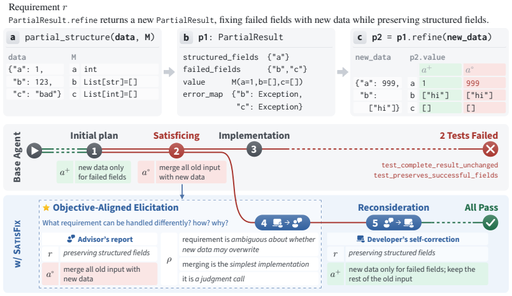
Figure 1 : Illustration of SATISFIXwith an example task. The task: (a) partial structuring of data into class M, where fields b and c fail, (b) the resulting PartialResult, and (c) refine with new data that fixes b and also provides the structured field a. The agent first considers a design a+ that preserves structured fields and meets r 1 , but later commits to a designa ◦ that can overwrite them and does not meetr 2 . Without SATISFIX, the agent implements this design 3 and fails two of the 69 evaluation tests. With SATISFIX, before the agent writes code, it reports the choice in the role of an advisor 4 and reconsiders it 5 ; its final code passes all 69 tests. The notation follows Section 2.
원문 · CC BY 4.0 · Ruixin Wang, Tianyi Zhang · Eliciting and Mitigating Specification Satisficing in Coding Agents · 원문 그림 인용 · 원본 PDF 3쪽에서 그림 영역을 추출했습니다.재검토 단계와 과제 완료
두 번째 단계에서 SATISFIX는 에이전트를 다시 개발자 역할로 되돌립니다. 보고 단계에서 말한 과제 설명의 수정 가능성은 이제 없다고 알립니다. 첫 재검토 메시지는 각 보고 선택의 대안과 그것을 D 및 저장소와 대조하는 계획을 나열하게 하며, 이 단계에서는 선택을 확정하지 않도록 요청합니다. 두 번째 메시지는 그 계획을 실행해 각 선택을 확정하고 과제를 완료하게 합니다. 예시에서 에이전트는 요구사항을 다시 읽고 새 데이터를 실패한 필드에만 적용하는 a+를 골랐습니다. 보고가 없으면 이 단계는 개발자 역할로 돌아가 과제를 완료하는 것만 남습니다.
DeepSWE와 SWE-bench Pro에서의 비교
DeepSWE v1.1에서 GPT-5.6-Luna를 쓰고 mini-swe-agent로 실행했을 때 SATISFIX의 pass@1은 네 번 실행한 평균 50.22%였고, 기반 에이전트는 44.25%였습니다. 세 자기 교정 베이스라인인 Self-Refine, DeCRIM, ProgCo는 각각 46.24%, 44.25%, 46.24%를 기록했습니다. 같은 설정에서 Self-Refine은 과제당 단계 수와 입력 토큰 수가 기반 에이전트보다 크게 늘었습니다. DeepSeek V4 Flash에서는 DeepSWE pass@1이 53.32%에서 57.08%로 올랐고, Qwen3.8-27B에서는 42.26%에서 47.79%로 올랐습니다.
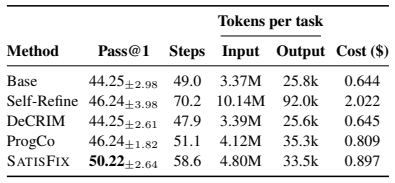
Table 2 : SATISFIX, the baselines, and the base agent (Base) on DeepSWE with GPT-5.6-Luna, four runs each. Pass@1 (%) is the mean over runs ± the standard devi- ation. Steps, token counts, and cost ($) are means per task.
원문 · CC BY 4.0 · Ruixin Wang, Tianyi Zhang · Eliciting and Mitigating Specification Satisficing in Coding Agents · 원문 그림 인용 · 원본 PDF 5쪽에서 그림 영역을 추출했습니다.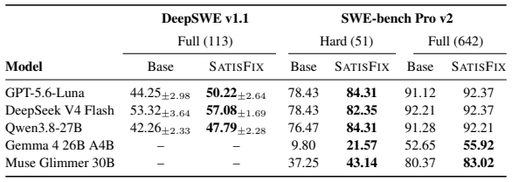
Table 3 : Pass@1 (%) of SATISFIXand Base on DeepSWE v1.1 and SWE-bench Pro v2. On DeepSWE, each method runs four times, and pass@1 is the mean over runs ± the standard deviation. A dash (–) marks a model that hits a capability floor on DeepSWE.
원문 · CC BY 4.0 · Ruixin Wang, Tianyi Zhang · Eliciting and Mitigating Specification Satisficing in Coding Agents · 원문 그림 인용 · 원본 PDF 6쪽에서 그림 영역을 추출했습니다.두 단계의 기여 분해
GPT-5.6-Luna의 ablation에서 SATISFIX의 첫 실행 통과율은 49.6%였습니다. 목적 정렬 보고를 제거하면 43.4%로 떨어져 기반 에이전트 수준이 되었고, 재검토를 제거하면 47.8%가 되었습니다. 두 단계를 모두 자기 교정으로 바꾼 변형은 44.2%였습니다. 이 결과는 보고 단계가 개선의 큰 부분을 설명한다는 저자들의 해석을 뒷받침합니다. 재검토만 남긴 변형도 보고 단계의 효과를 대체하지 못했으며, 두 단계를 같은 자기 교정으로 바꾸면 효과가 거의 사라졌습니다. 다만 이 ablation은 GPT-5.6-Luna의 첫 실행에서 얻은 값이므로, 다른 모델의 결과로 옮길 수 없습니다.
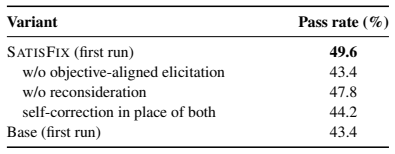
Table 5 : Ablation with GPT-5.6-Luna. SATISFIXand Base are from their first runs.
원문 · CC BY 4.0 · Ruixin Wang, Tianyi Zhang · Eliciting and Mitigating Specification Satisficing in Coding Agents · 원문 그림 인용 · 원본 PDF 6쪽에서 그림 영역을 추출했습니다.보고 항목과 재검토 결과
113개 DeepSWE 과제의 첫 실행 보고를 두 LLM 에이전트가 독립적으로 주석했습니다. GPT-5.6-Luna는 61개 과제에서 90개의 명세 satisficing 보고 항목을 만들었고, DeepSeek V4 Flash는 105개 과제에서 227개 항목을 만들었습니다. 재검토 단계에서 GPT-5.6-Luna는 보고된 90개를 모두 재검토했고, DeepSeek V4 Flash는 227개 중 226개를 재검토했습니다. 저자들은 많은 선택을 이미 계획에 반영한 뒤에는 한꺼번에 재검토하는 효과가 줄 수 있다고 해석합니다.
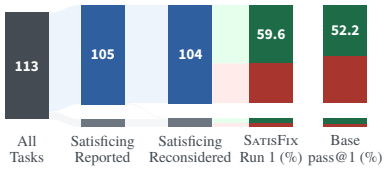
Figure 2 : The 113 tasks in the first run of SATISFIX. In the second column, blue marks the tasks in which elicitation reports specification satisficing with one of the four types of reasons. In the third column, blue marks the tasks in which the agent reconsiders such an item. Gray marks the other tasks. The last two columns give the pass rate of SATISFIXin this run and the pass@1 of the base agent over its four runs. Green is success and red is failure.
원문 · CC BY 4.0 · Ruixin Wang, Tianyi Zhang · Eliciting and Mitigating Specification Satisficing in Coding Agents · 원문 그림 인용 · 원본 PDF 7쪽에서 그림 영역을 추출했습니다.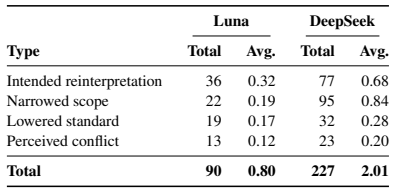
Table 6 : Items that report specification satisficing with GPT-5.6-Luna and DeepSeek V4 Flash, by the type of reason in Table 1. Avg. is the mean number per task over the 113 tasks.
원문 · CC BY 4.0 · Ruixin Wang, Tianyi Zhang · Eliciting and Mitigating Specification Satisficing in Coding Agents · 원문 그림 인용 · 원본 PDF 7쪽에서 그림 영역을 추출했습니다.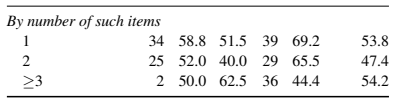
Table 7 : Results on the tasks in which the coding agent reconsiders an item with one of the four types of reasons in Table 1. Ours is the pass rate (%) of SATISFIXin its first run. Base is the pass@1 (%) of the base agent over its four runs. A task with several types of reasons counts once for each type. # is the number of tasks.
원문 · CC BY 4.0 · Ruixin Wang, Tianyi Zhang · Eliciting and Mitigating Specification Satisficing in Coding Agents · 원문 그림 인용 · 원본 PDF 7쪽에서 그림 영역을 추출했습니다.한계
이 방법은 에이전트 자신의 응답에 따라 개입 시점을 정하고, 과제당 한 번만 개입합니다. 따라서 에이전트가 나중에 확정하는 선택은 보고를 유도하지 않습니다. 주석 분석은 보고 내용을 판단할 뿐, 최종 코드가 각 요구사항을 충족하는지는 판단하지 않습니다. 두 주석 에이전트가 같은 오류를 낸 항목은 저자의 확인 대상이 아니었습니다. 메시지가 유지보수자에게서 왔다는 설정이 이후 메시지의 처리에 어떤 영향을 주는지는 측정하지 않았습니다.
논문 정보
- 저자
- Ruixin Wang, Tianyi Zhang
- 학회·저널
- arXiv · 프리프린트
- 최초 공개일
- 2026년 11월 12일
- 등록일
- 2026년 11월 13일
- 수정일
- 2026년 11월 12일
- 버전
- v1
- arXiv
- 2611.16289
- 분류
- cs.SE · cs.AI · cs.CL
- 원문 이용 조건
- CC BY 4.0
- 제공 범위
- 논문 정보, 해설, 허용된 원문 그림
AI 해설은 논문 원문과 별개의 설명이며 오류가 있을 수 있습니다. 원문과 그림은 각 출처의 이용 조건과 따로 표시된 권리를 따릅니다.
초록
Coding agents often fail to meet all requirements in the task description. In some of these failures, the agent considers an implementation choice that meets a requirement, but later decides to commit to another one that does not meet the requirement for a reason it finds acceptable. We call this specification satisficing. It is challenging to identify and mitigate specification satisficing because the agent accepts such choices for its own reasons, and existing self-correction methods are biased toward them. We propose SatisFix, which guides a coding agent to report these choices and their reasons, and then check each choice against the task description. We evaluate SatisFix on DeepSWE and SWE-bench Pro with five LLMs as backbones and two different agent frameworks, and compare it with three self-correction methods. SatisFix improves the pass@1 of the base agent by an average of 5.09% on DeepSWE and 7.06% on the hard subset of SWE-bench Pro. On DeepSWE, it outperforms the best baseline by 3.98%. Our ablation study shows that both steps of SatisFix contribute to the improvement.
원문 인용
Ruixin Wang, Tianyi Zhang (2026). Eliciting and Mitigating Specification Satisficing in Coding Agents. arXiv:2611.16289v1. https://arxiv.org/abs/2611.16289v1
BibTeX
@misc{wang2026eliciting,
  title = {{Eliciting and Mitigating Specification Satisficing in Coding Agents}},
  author = {Ruixin Wang and Tianyi Zhang},
  year = {2026},
  eprint = {2611.16289},
  archivePrefix = {arXiv},
  url = {https://arxiv.org/abs/2611.16289v1}
}