論文解説
Where Do Vision Language Models Fail at 3D Reasoning?
視覚言語モデルが立体物の色ごとの数を正しく答えられるかを試す評価基準
- 課題 視覚言語モデルは、個々の判断では正答率が高くても、色ごとのブロック数をすべて正しく答えられるとは限りません。正答率だけでは、その弱さが見えません。
- 手法 BedBenchは、同じ立体物について互いに関係する問いを複数用意し、厳密な回答と答えの一貫性を分けて測ります。
- 結果 色ごとのブロック数を全部正しく答えた割合は、微調整したQwen3.5-27Bで3.0%から68.6%に上がりました。
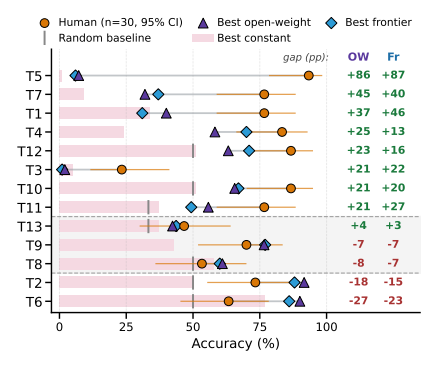
Figure 2 : Human vs. best-model accuracy per task.Shaded bars mark the best-constant baseline (always the most frequent answer); right columns give human−model gaps (pp); dashed lines group tasks by whether the best OW result falls below, within, or above the human 95% CI.Takeaway:T5: Color Distribution shows the largest gap; the best models exceed the human interval only on T2 and T6.
出典 · CC BY 4.0 · Khai Le-Duc, Nguyen Kim Hai Bui, An Ngo, Nam D. Hoang, Yueqi Song, Jiarui Liu, Thai Quoc Hoang, Fang Wu, Chris Ngo, Terry Jingchen Zhang, Mona T. Diab, Ran Xu, Silvio Savarese, Xiao-Ming Wu · Where Do Vision Language Models Fail at 3D Reasoning? · 論文の図を引用 · 元のPDFの5ページ目から図の部分を抽出しています。個別の判断の正答率では見えない失敗
VLMは、3D物体の画像からブロック数を数えたり、部分どうしの関係を読んだりする課題で評価されることが増えています。ただ、個々の判断で高い正答率が出ても、物体の性質を全部正しく答えられるとは限りません。たとえば色の種類数を数えられても、色ごとのブロック数をすべて合わせて答えられるかは別の問題です。そのため本論文は、個々の判断と、色ごとの数をすべて正しく並べた厳密な回答を分けて評価しています。さらに、関連する答えどうしが互いに矛盾しないかも確かめる設計です。
評価には12のオープンウェイト(OW)モデルと4つのフロンティアモデルを使い、人間30名を難易度の基準にしました。そのうえで、T5: Color Distributionの結果を中心に、厳密な回答がどこで崩れるかを調べています。人間はT5で93.3%に達しましたが、最良のVLMは7.2%でした。特にT5は、すべての色の数が正しくなければ正解にならない課題です。最良のVLMは、人間の信頼区間の上限を超えたのがT2: PackagingとT6: Local Structureのみでした。T6では、最良モデルの90.0%が、常に最頻出の答えを返す場合の77.0%も上回りました。一方で、T5では色ごとのカウントが合わないため、厳密な回答は大きく落ちます。
ただし、この失敗は厳密な一致の厳しさだけでは説明できません。12のOWモデルのNon-Thinkingでは、色ごとのMAEが0.80ブロックでした。これは、各色の平均カウントを常に予測する0.69より悪い値です。ただし5つのモデルは0.69より良く、そのなかには最も強い2つも含まれます。つまり、色ごとのカウントそのものが不安定であり、EMの厳しさが原因だとは言えません。この結果から、個々の判断が当たっても厳密な回答が外れる理由は、正答率の見かけでは捉えきれないと読めます。
同じ物体の答えを互いに照合するBedBench
本論文は、同じ生成物体から作った複数の問いを互いに照合する方針をとり、そのためのベンチマークとしてBedBenchを導入しています。BedBenchは13の手続き的に生成されたタスクを含み、ボクセル物体と幾何プリミティブのシーンを使います。T5の色ごとのカウントが決まれば、色の種類数(T4)や最も多い色(T7)が導けるため、答えが一致しているかを確かめられます。生成器は正解を厳密に与え、曖昧な事例は生成時に除くため、個別の判断と厳密な回答を同じ条件のもとで比べられます。既存のVQAでも回答の一貫性は調べられてきましたが、BedBenchは失敗がどこで起きるかを問い、同じ物体上の問いどうしを照合する点が異なります。
評価対象は12のOWモデルと4つのフロンティアモデルで、各タスクは100件です。T11とT13は3つの投影面を含むため、それぞれ300問になります。回答はEMで採点し、数値の誤差はMAEとRMSEで見ています。人間の基準は30人で、各参加者が1タスクにつき1問ずつ答えています。OWモデルは貪欲復号でNon-ThinkingとThinkingの両方を評価し、Thinkingの既定の思考予算は1024トークンです。
著者らは元の表示に加えて3つの介入を置きました。色ごとの単色質問を個別に行うfactorized querying、同じブロックを個別のタイルとして描く2D表示、そしてT5の学習事例800件を使ったLoRA微調整です。factorized queryingでは、12の単色質問を行い、その予測を統合しました。その平均の正解率は、joint予測の32.5%からfactorized queryingの33.2%へとほぼ変わりませんでした。後の節では、これらの対照を使って、正解が残っているか、どこで失われるかを順に見ていきます。
微調整で正答は上がるが一貫性は残る
著者らは、Qwen3.5-27Bの言語モデル側にだけLoRAを適用し、T5の学習事例800件で微調整しました。学習データは、ベンチマークと同じ色や描画の分布を持つ別の乱数種の事例であり、テスト物体とは共有しません。その結果、T5のEMは3.0%から68.6%に上がり、MAEは0.502から0.033に下がりました。
次に著者らは、色の多さを尋ねるT7を使い、学習後のモデルが判断を一貫して行えるかを調べました。T7は、正しいT5のカウントが揃えば導ける問いです。画像から直接答えたときの正答率は35.0%にとどまりました。一方、自身のT5の数を文字で与えると正答率は74.2%に上がりました。T5の答えが正しい場合に限ると、文字で与えたときは99.4%、同じ物体を画像から直接答えたときは40.8%でした。つまり、モデルは明示された数からは判断できても、画像からは同じ判断を一貫して導けていません。
文字で数を与えた場合の改善幅は+39.2ppで、95%信頼区間は[+26.8,+51.4]でした。著者らは、同じ物体と同じ条件で、直接の回答とT5のカウントから導いた答えの一致を測りました。偶然水準は、直接の回答を物体の間で並べ替えて求めました。この指標で見ると、12のOWモデルの平均でも、T7が自身のカウントの最頻色と一致したのは21.6%で、偶然水準の2.4%より高いものの低い水準でした。
文字で数を与えた場合の誤りは、10色がそれぞれ1ブロックずつ並ぶ一つの物体に集中していました。したがって、数を正しく回収しても、画像から同じ数を使って判断を一貫させるには別の工夫が必要だと考えられます。
2D表示と視覚特徴プローブが示す正解の残り方
同じブロックを個別に見えるタイルとして2D表示すると、Qwen3.5-27BのT5におけるEMは3.0%から52.4%に上がりました。色ごとのMAEも0.50から0.11に下がり、差は+49.4pp、95%信頼区間は[+39.8,+59.0]でした。黄と金の混同を統合して評価しても、2Dは89.8%、3Dは6.0%で、差は残りました。2Dの予測総数は11.5ブロック、3Dは14.9ブロックで、正解は11.4ブロックでした。つまりモデルは、主に3D側で過剰に数えていました。ただし、この対照は遮蔽、2視点の統合、配置の影響を分けられず、一つのモデルでの結果にとどまります。
次に、著者らは凍結された視覚エンコーダの特徴から正解を予測するプローブを調べました。T5では、800件の生成物体で学習したプローブを作り、ベンチマークの物体で試しました。読み出しには、平均化した特徴と、全パッチ・トークンへのアテンションの両方を使いました。言語モデルへ入るコネクタ出力に対するプローブのEMは65.0%に達しました。モデルの回答は3.0%にとどまったため、同じ情報は視覚側の特徴に残っていたことになります。そのため著者らは、問題は情報の欠落ではなく、利用可能な視覚情報を使う段階にあると見ています。
LoRAで言語モデル側だけを微調整した最良の設定でも、T5のEMは68.6%にとどまりました。この値は、人間の平均93.3%より24.7pp低い水準でした。つまり、言語モデルだけの学習は、凍結された視覚経路が持つ情報の多くを回収できた一方で、3D表示で生じる差までは埋めきれませんでした。
推論を長くしても厳密な回答は残る
Thinkingモードは、既定の思考予算1024トークンで、タスク固有の分解プロンプトと推論モードを組み合わせた設定です。Non-Thinkingは分解を含まない簡潔なプロンプトを使うため、両者の差は推論の有無と分解の指示によって生じます。既定の1024トークンのThinkingでは、T2: Packagingが+13.8pp、T4: Color Countが+13.9ppと、最も大きく改善しました。つまり、T4のEMは平均で+13.9pp上がりました。一方、T5: Color Distributionは0.7%から1.0%の床付近にとどまり、T3: Differenceも同様に低いままでした。
T1: VolumeとT9: Visible Floorsでは正答率が下がり、T8: Silhouette Symmetryの低下は95%信頼区間が0を含みました。
改善した例では、モデルは寸法を比べたり、見えている色のリストを積み上げたりしていました。これらは文章で書き出せる中間操作であり、著者らはこれを verbalizable steps と呼びました。ただし、この設定は個々の判断を助けても、厳密な回答を信頼できるものにはしませんでした。そのため、著者らは、より大きな推論予算を試しました。
T4では、思考なしの49.0%から2048トークンで59.2%まで上がり、その後は横ばいになりました。一方、T1では、予算が大きくなるほど精度が下がり、4096トークンでは19.8%になりました。T11でも、2048トークン以上の予算で、精度は51.5%から45.8%に下がりました。2048トークンから4096トークンへの増加では、どちらのタスクも精度の変化は1pp未満でした。
長いT4の推論では、色を明示的な座標格子の中で整理していました。対照的に、長いT1の推論では、二つの視点の対応づけを繰り返し検討し続けていました。つまり、推論を長くすると色の列挙は整理できても、3D構造を復元するための幾何学的な推定は確実には直りません。誤った視覚解釈は、後続の推論を通じても残りやすいことが、著者らの観察です。したがって、著者らは、中間構造を明示したうえで回答させ、関連する回答同士の不一致を罰する学習目標が必要だと述べています。
限界:どこまでの結論として読むべきか
この節が扱うのは、BedBenchの結果をどの範囲まで一般化してよいかという点です。著者らは、手続き的に生成したボクセル物体と幾何プリミティブを使いました。そのため、実世界の画像や埋め込み環境での結果は、ここでは確かめていません。ノイズのあるテクスチャ、照明の変化、複雑なシーン形状を評価するには、追加の検証が必要です。人間の基準は30人で、より多様な参加者で得れば、難易度の推定は変わり得ます。
トークン単位の分析、LMの隠れ状態へのプローブ、大規模な微調整などの深い分析は、Qwen3.5-27Bなど代表的なモデル族と選ばれたタスクに限られています。そのため、これらの内部状態に関する診断を、ほかのモデル族や学習条件、埋め込み環境へ広げることは今後の課題です。一方で、著者らは画像を取り除く対照実験を行い、正答を出せるかどうかを画像への依存と合わせて確かめました。三番目の選択肢を常に選ぶことで100%に達するモデルもあるため、回答の正しさだけでは画像を見ているかを判断できません。つまり、この論文の結論は、BedBenchという統制された設定で、厳密な回答、一貫した利用、画像への依存を見た場合の結論として読むのが妥当です。
論文情報
- 著者
- Khai Le-Duc, Nguyen Kim Hai Bui, An Ngo, Nam D. Hoang, Yueqi Song, Jiarui Liu, Thai Quoc Hoang, Fang Wu, Chris Ngo, Terry Jingchen Zhang, Mona T. Diab, Ran Xu, Silvio Savarese, Xiao-Ming Wu
- 学会・ジャーナル
- arXiv · プレプリント
- 公開日
- 2026年10月29日
- 登録日
- 2026年11月1日
- 更新日
- 2026年10月29日
- バージョン
- v1
- arXiv
- 2610.39639
- カテゴリ
- cs.CV · cs.AI
- ライセンス
- CC BY 4.0
- 掲載内容
- 論文情報・解説・論文の図
この解説は、Refivuの韓国語解説をAIで翻訳したものです。不正確な翻訳や誤りが含まれる可能性があります。論文と図の利用条件は各出典に従います。
アブストラクト
Vision-language models can get individual judgments right while struggling to recover and consistently use the exact properties of a 3D object. To characterize this gap, we introduce BedBench, a controlled benchmark of thirteen procedurally generated tasks spanning individual judgments and composite answers. Across twelve open-weight and four frontier models, per-color counting exposes a pronounced weakness: humans achieve 93.3% accuracy, compared with 7.2% for the best model. Targeted fine-tuning raises one model's accuracy from 3.0% to 68.6%, but reveals a further difficulty: its answers about the most common colors remain inconsistent with its own per-color counts. Supplying those counts as text improves its judgments, showing that recovering a property does not mean using it consistently. Reasoning, scaling, and added visual cues each improve individual judgments, but none makes exact answers reliable. To locate the difficulty, we probe Qwen3.5-27B: exact per-color counts remain recoverable at the language model's input, yet the model's answers rarely recover them (65.0% for the probe vs. 3.0% for the model). Image-removal controls further show that some apparent successes require no visual evidence. These findings motivate evaluating 3D reasoning by exact correctness, consistent use, and image dependence, rather than accuracy alone. Code and dataset are publicly available: https://github.com/leduckhai/BedBench
論文の図
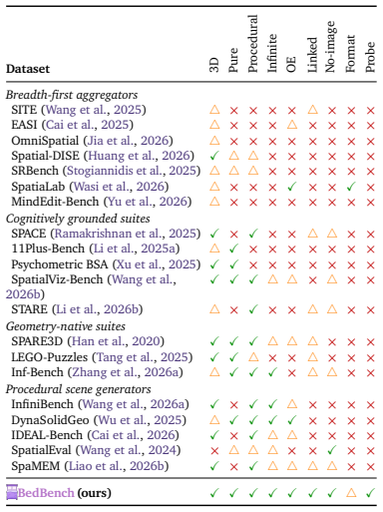
Table 1 : Comparison with representative spatial and 3D reasoning benchmarks.✓ yes, △ partial, × no. 3D: volumetric stimuli throughout;Pure: abstract geo- metric stimuli;Procedural: programmatically generated items;Infinite: generation not limited to a fixed source pool;OE: open-ended answers;Linked: questions on the same item whose answers entail one another, with their agreement evaluated (partial: linked questions without such an analysis);No-image: image-removal controls (partial: image replaced by a text descrip- tion);Format: matched answer-format comparisons; Probe: visual-feature probes against ground-truth tar- gets.Takeaway:Several benchmarks share individual properties; BedBenchuniquely combines open-ended 3D questions, linked questions checked for agreement, image-removal controls, and probes of frozen visual features, which together locate where a failure arises (Section 2).
出典 · CC BY 4.0 · Khai Le-Duc, Nguyen Kim Hai Bui, An Ngo, Nam D. Hoang, Yueqi Song, Jiarui Liu, Thai Quoc Hoang, Fang Wu, Chris Ngo, Terry Jingchen Zhang, Mona T. Diab, Ran Xu, Silvio Savarese, Xiao-Ming Wu · Where Do Vision Language Models Fail at 3D Reasoning? · 論文の図を引用 · 元のPDFの3ページ目から図の部分を抽出しています。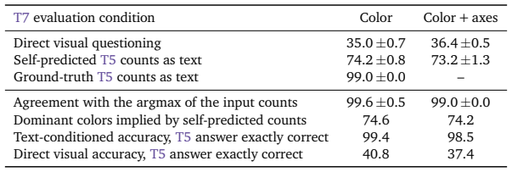
Table 8 : LoRA fine-tuning of Qwen3.5-27B on T5: Color Distribution.The adapter is trained on 800 generated T5 instances rendered with the benchmark palette, the 12-color, luminance-paired coloring of BedBench. Each cell is the 5-run mean ± std on the 100 benchmark instances.Takeaway:Training on the benchmark palette raises exact match from 3.0% to 68.6%.
出典 · CC BY 4.0 · Khai Le-Duc, Nguyen Kim Hai Bui, An Ngo, Nam D. Hoang, Yueqi Song, Jiarui Liu, Thai Quoc Hoang, Fang Wu, Chris Ngo, Terry Jingchen Zhang, Mona T. Diab, Ran Xu, Silvio Savarese, Xiao-Ming Wu · Where Do Vision Language Models Fail at 3D Reasoning? · 論文の図を引用 · 元のPDFの29ページ目から図の部分を抽出しています。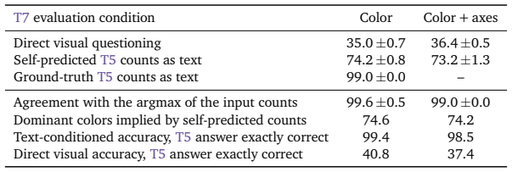
Table 9 : T7 answered from block counts given as text.Fine-tuned Qwen3.5-27B, Non-Thinking, accuracy (%) as 5-run mean ± std on the same 100 objects; the last three rows pool 5 runs× 100 objects, and the last two use only the 343 and 334 answers with an exactly correct T5 answer. The implied row scores the argmax of the model’s own T5 counts without querying T7. Ground-truth counts do not depend on the visual setting and are evaluated once (“–”). Paired object-bootstrap 95% CIs (10,000 resamples): self-predicted counts− direct +39.2pp [+26.8,+51.4] (color) and+36.8pp [+23.6,+50.0] (color+axes); ground-truth − self-predicted counts+24.8pp [+16.4,+34.0] (color).Takeaway:Given its own counts as text, the model derives the dominant colors almost perfectly whenever those counts are correct, unlike when it answers from the images.
出典 · CC BY 4.0 · Khai Le-Duc, Nguyen Kim Hai Bui, An Ngo, Nam D. Hoang, Yueqi Song, Jiarui Liu, Thai Quoc Hoang, Fang Wu, Chris Ngo, Terry Jingchen Zhang, Mona T. Diab, Ran Xu, Silvio Savarese, Xiao-Ming Wu · Where Do Vision Language Models Fail at 3D Reasoning? · 論文の図を引用 · 元のPDFの29ページ目から図の部分を抽出しています。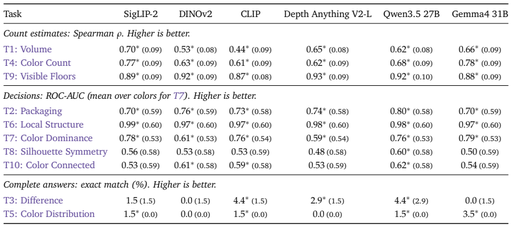
Table 19 : Probe performance on frozen visual features.Cells report score (shuffled-label 95th percentile);∗ marks scores above this empirical reference (1000 permutations); it is descriptive and not corrected for multiple comparisons.Takeaway: Counts and local-structure decisions are well recovered, while complete T3/T5 answers remain rare.
出典 · CC BY 4.0 · Khai Le-Duc, Nguyen Kim Hai Bui, An Ngo, Nam D. Hoang, Yueqi Song, Jiarui Liu, Thai Quoc Hoang, Fang Wu, Chris Ngo, Terry Jingchen Zhang, Mona T. Diab, Ran Xu, Silvio Savarese, Xiao-Ming Wu · Where Do Vision Language Models Fail at 3D Reasoning? · 論文の図を引用 · 元のPDFの41ページ目から図の部分を抽出しています。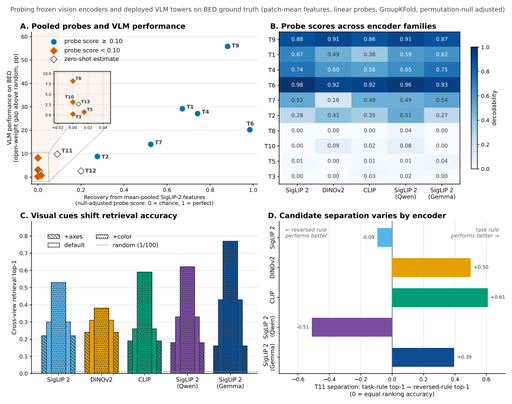
Figure 8 : Probing frozen encoders on ground-truth targets. (A)Null-adjusted probe decodability (SigLIP-2) against the per-task VLM gap above random.(B)Decodability across three encoder classes and the largest deployed tower of each family.(C)Cross-view retrieval from pooled features by cue condition.(D)T11 zero-shot candidate separation (task-rule top-1 minus reversed-rule top-1; positive values favor the task rule, negative values favor its reverse). Values in (C) and (D) depend on the representation (patch-mean features; a CLS-pooled readout of CLIP loses most of its (D) signal), and the Qwen tower is probed before its patch merger.Takeaway:With pooled probes trained on 100 objects, quantity tasks are well recovered, while the per-part and relational tasks (bottom rows of B) have low null-adjusted probe scores.
出典 · CC BY 4.0 · Khai Le-Duc, Nguyen Kim Hai Bui, An Ngo, Nam D. Hoang, Yueqi Song, Jiarui Liu, Thai Quoc Hoang, Fang Wu, Chris Ngo, Terry Jingchen Zhang, Mona T. Diab, Ran Xu, Silvio Savarese, Xiao-Ming Wu · Where Do Vision Language Models Fail at 3D Reasoning? · 論文の図を引用 · 元のPDFの42ページ目から図の部分を抽出しています。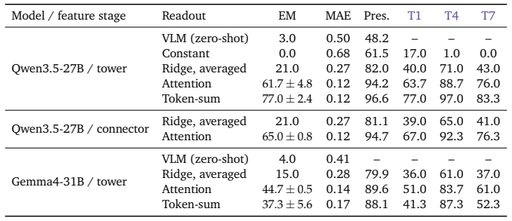
Table 20 : T5 probes on frozen tower and connector features(%, except MAE), tested on 100 benchmark objects. Neural probes train on 800 objects with 100 for validation; ridge fits on all 900. EM = exact count-vector match; Pres. = present colors counted exactly; T1/T4/T7 = answers derived from predicted counts. Neural rows report three-seed means, with EM standard deviations. Constant predicts the training mean; VLM rows are full-model Non-Thinking default-setting results. Takeaway:Exact counts are recoverable from both towers and remain recoverable at Qwen3.5-27B’s language-model input.
出典 · CC BY 4.0 · Khai Le-Duc, Nguyen Kim Hai Bui, An Ngo, Nam D. Hoang, Yueqi Song, Jiarui Liu, Thai Quoc Hoang, Fang Wu, Chris Ngo, Terry Jingchen Zhang, Mona T. Diab, Ran Xu, Silvio Savarese, Xiao-Ming Wu · Where Do Vision Language Models Fail at 3D Reasoning? · 論文の図を引用 · 元のPDFの43ページ目から図の部分を抽出しています。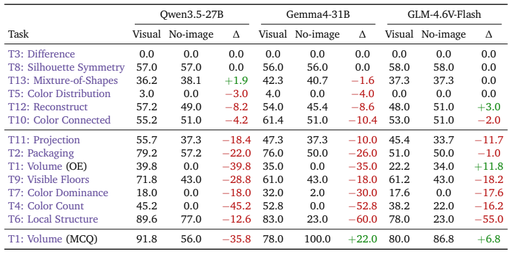
Table 21 : Accuracy with and without images (Non-Thinking).Visual vs. no-image accuracy for the three models evaluated without images (5-run means). Rows are grouped into shortcut-sensitive, visually dependent, and artifact tasks; T1 appears twice because open-ended counting and the MCQ artifact probe are interpreted separately.Takeaway:Scores on T3, T8, and T13 barely change without images, visually dependent tasks such as T4 and T6 lose up to 60pp, and Gemma4-31B reaches 100% on the fixed-layout T1 MCQ without images.
出典 · CC BY 4.0 · Khai Le-Duc, Nguyen Kim Hai Bui, An Ngo, Nam D. Hoang, Yueqi Song, Jiarui Liu, Thai Quoc Hoang, Fang Wu, Chris Ngo, Terry Jingchen Zhang, Mona T. Diab, Ran Xu, Silvio Savarese, Xiao-Ming Wu · Where Do Vision Language Models Fail at 3D Reasoning? · 論文の図を引用 · 元のPDFの46ページ目から図の部分を抽出しています。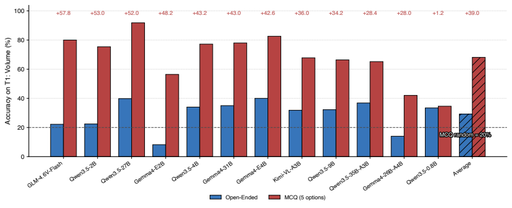
Figure 10 : Open-ended vs. multiple-choice accuracy on T1: Volume.Paired bars per model under Non-Thinking mode and the default visual setting; numbers above the bars give the MCQ−OE gain (pp); the dashed line marks the 20% random baseline of the five-option MCQ, whose correct option is always in the third position.Takeaway:The fixed-layout MCQ raises accuracy by+39.0pp on average (up to+57.8pp) without adding any visual information.
出典 · CC BY 4.0 · Khai Le-Duc, Nguyen Kim Hai Bui, An Ngo, Nam D. Hoang, Yueqi Song, Jiarui Liu, Thai Quoc Hoang, Fang Wu, Chris Ngo, Terry Jingchen Zhang, Mona T. Diab, Ran Xu, Silvio Savarese, Xiao-Ming Wu · Where Do Vision Language Models Fail at 3D Reasoning? · 論文の図を引用 · 元のPDFの47ページ目から図の部分を抽出しています。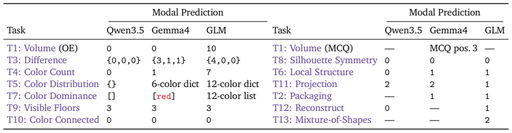
Table 22 : Constant predictions without images (Non-Thinking).Each cell shows the modal prediction; “—” means no collapse observed for that model. Qwen3.5=Qwen3.5-27B, Gemma4=Gemma4-31B, GLM=GLM-4.6V-Flash. T3 predictions abbreviated as{i,a,b} (intersection, only-a, only-b). The color abbreviations denote fixed palettes emitted regardless of input: “6-color dict”={blue, cyan, green, magenta, red, yellow} , each color mapped to count 1; “12- color dict”= the full 12-color palette, each count 1; “12-color list”= the same palette as a list of names without counts. All modal shares are 100% except Qwen3.5T8 (99.0%), Gemma4T8 (98.0%), GLMT5 (89.8%).Takeaway:Without images, all three models give one fixed answer on every T9 and T10 instance (3 and 0), which accounts for their no-image scores of 43% and 51% (Table 21, Appendix B.6.1).
出典 · CC BY 4.0 · Khai Le-Duc, Nguyen Kim Hai Bui, An Ngo, Nam D. Hoang, Yueqi Song, Jiarui Liu, Thai Quoc Hoang, Fang Wu, Chris Ngo, Terry Jingchen Zhang, Mona T. Diab, Ran Xu, Silvio Savarese, Xiao-Ming Wu · Where Do Vision Language Models Fail at 3D Reasoning? · 論文の図を引用 · 元のPDFの47ページ目から図の部分を抽出しています。この論文を引用
Khai Le-Duc, Nguyen Kim Hai Bui, An Ngo, Nam D. Hoang, Yueqi Song, Jiarui Liu, Thai Quoc Hoang, Fang Wu, Chris Ngo, Terry Jingchen Zhang, Mona T. Diab, Ran Xu, Silvio Savarese, Xiao-Ming Wu (2026). Where Do Vision Language Models Fail at 3D Reasoning?. arXiv:2610.39639v1. https://arxiv.org/abs/2610.39639v1
BibTeX
@misc{leduc2026where,
  title = {{Where Do Vision Language Models Fail at 3D Reasoning?}},
  author = {Khai Le-Duc and Nguyen Kim Hai Bui and An Ngo and Nam D. Hoang and Yueqi Song and Jiarui Liu and Thai Quoc Hoang and Fang Wu and Chris Ngo and Terry Jingchen Zhang and Mona T. Diab and Ran Xu and Silvio Savarese and Xiao-Ming Wu},
  year = {2026},
  eprint = {2610.39639},
  archivePrefix = {arXiv},
  url = {https://arxiv.org/abs/2610.39639v1}
}