논문 해설
Where Do Vision Language Models Fail at 3D Reasoning?
비전-언어 모델은 3D 추론의 어느 지점에서 실패하는가?
- 연구 문제 시각언어모델은 객체의 개별 판단은 맞히면서도 정확한 색상별 개수와 그 값의 일관된 사용에는 실패할 수 있습니다.
- 연구 방법 BedBench의 13개 3D 과제에서 개별 판단과 정확 응답, 일관성, 이미지 제거, fine-tuning, 동결 특징 프로브를 함께 사용해 실패 지점을 찾습니다.
- 주요 결과 인간은 T5에서 93.3%를 맞혔고 최고 VLM은 7.2%였습니다. Qwen3.5-27B의 LoRA fine-tuning은 T5를 68.6%로 올렸지만 T7 직접 답은 35.0%에 머물렀고, 시각 특징 프로브는 정확 개수를 더 자주 복원했습니다.
정확도만으로는 드러나지 않는 3D 추론의 간극
시각언어모델은 객체의 개별 속성을 묻는 판단에서는 맞히면서도, 객체의 여러 속성을 정확히 함께 복원하고 그 값을 일관되게 쓰는 데에는 실패할 수 있습니다. 이 논문은 이 간극을 측정하기 위해 BedBench를 제시합니다. BedBench는 단위 정육면체로 만든 복셀 객체와 기하 프리미티브 장면으로 구성된 13개 과제의 벤치마크입니다. 개별 판단은 블록 수나 크기 비교처럼 객체의 한 속성에 대한 하나의 답이고, 정확한 답은 색상과 개수의 짝처럼 여러 양과 관계가 모두 맞아야 성립합니다. 일관된 사용은 여기에 더해, 색상별 개수에서 도출되는 답과 모델의 다른 답이 서로 맞아야 한다는 요구입니다. 따라서 이 논문은 같은 객체에서 정답 생성과 얽힌 질문을 함께 두고, 실패가 속성 복원, 일관된 사용, 3D 지각 중 어디에서 생기는지 구분하려 합니다.
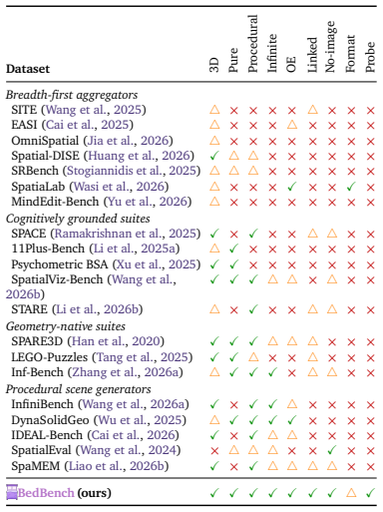
Table 1 : Comparison with representative spatial and 3D reasoning benchmarks.✓ yes, △ partial, × no. 3D: volumetric stimuli throughout;Pure: abstract geo- metric stimuli;Procedural: programmatically generated items;Infinite: generation not limited to a fixed source pool;OE: open-ended answers;Linked: questions on the same item whose answers entail one another, with their agreement evaluated (partial: linked questions without such an analysis);No-image: image-removal controls (partial: image replaced by a text descrip- tion);Format: matched answer-format comparisons; Probe: visual-feature probes against ground-truth tar- gets.Takeaway:Several benchmarks share individual properties; BedBenchuniquely combines open-ended 3D questions, linked questions checked for agreement, image-removal controls, and probes of frozen visual features, which together locate where a failure arises (Section 2).
원문 · CC BY 4.0 · Khai Le-Duc, Nguyen Kim Hai Bui, An Ngo, Nam D. Hoang, Yueqi Song, Jiarui Liu, Thai Quoc Hoang, Fang Wu, Chris Ngo, Terry Jingchen Zhang, Mona T. Diab, Ran Xu, Silvio Savarese, Xiao-Ming Wu · Where Do Vision Language Models Fail at 3D Reasoning? · 원문 그림 인용 · 원본 PDF 3쪽에서 그림 영역을 추출했습니다.BedBench의 과제 구성과 생성 검사
BedBench는 개별 판단과 정확한 답을 같은 객체 위에서 비교하도록 설계된 13개 과제를 포함합니다. T5: Color Distribution은 색상별 블록 개수를 모두 맞혀야 하는 정확 응답 과제이고, T7: Color Dominance는 가장 많이 나타나는 색상을 묻습니다. 올바른 T5 색상별 개수가 있으면 T7 답은 그로부터 정해지므로, 두 과제는 같은 객체에서 일관된 사용을 검사하는 짝이 됩니다. 생성기는 각 객체를 10~15개 블록으로 구성하고 두 개의 대비 시점에서 렌더링합니다. 두 실루엣이 다른 직교 투영을 가진 대체 객체와 거의 같거나, 블록 제거가 두 실루엣을 거의 바꾸지 않는 경우를 제거합니다.
색상은 6쌍의 대비 색을 인접 블록에 배치하는 방식을 씁니다. 이 생성 검사는 모호성을 줄이기 위한 것이며, 원문은 사후 감사에서 한 객체의 가려진 블록이 T5 개수를 복원 불가능하게 만든다는 점도 보고합니다.
T5 fine-tuning과 텍스트 조건 실험
핵심 개입 가운데 하나는 Qwen3.5-27B에 대한 LoRA fine-tuning입니다. 학습은 생성기로 만든 800개의 T5 예시로 수행하며, 어댑터는 언어 모델의 투영층에 적용하고 시각 인코더와 커넥터는 동결합니다. 이 설정은 정확 일치를 3.0%에서 68.6%로 끌어올렸지만, 이 개선이 모든 속성의 일관된 사용으로 이어지지는 않았습니다. 같은 모델에게 T7 질문을 이미지에서 직접 묻었을 때 정확도는 35.0%였고, 모델이 자신의 T5 개수를 텍스트로 받았을 때는 74.2%였습니다. 따라서 이 결과는 정답 개수가 주어졌을 때 우세 색상을 도출하는 능력과 이미지에서 같은 판단을 내리는 능력이 분리되어 있음을 보여 줍니다.
이 실험은 하나의 모델과 하나의 과제 쌍에서 얻은 결과입니다.
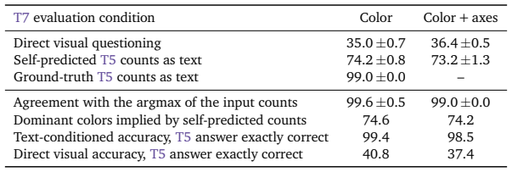
Table 8 : LoRA fine-tuning of Qwen3.5-27B on T5: Color Distribution.The adapter is trained on 800 generated T5 instances rendered with the benchmark palette, the 12-color, luminance-paired coloring of BedBench. Each cell is the 5-run mean ± std on the 100 benchmark instances.Takeaway:Training on the benchmark palette raises exact match from 3.0% to 68.6%.
원문 · CC BY 4.0 · Khai Le-Duc, Nguyen Kim Hai Bui, An Ngo, Nam D. Hoang, Yueqi Song, Jiarui Liu, Thai Quoc Hoang, Fang Wu, Chris Ngo, Terry Jingchen Zhang, Mona T. Diab, Ran Xu, Silvio Savarese, Xiao-Ming Wu · Where Do Vision Language Models Fail at 3D Reasoning? · 원문 그림 인용 · 원본 PDF 29쪽에서 그림 영역을 추출했습니다.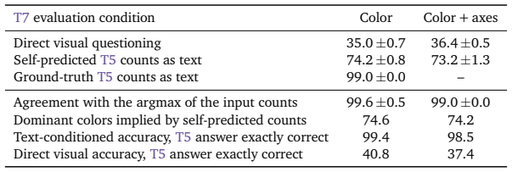
Table 9 : T7 answered from block counts given as text.Fine-tuned Qwen3.5-27B, Non-Thinking, accuracy (%) as 5-run mean ± std on the same 100 objects; the last three rows pool 5 runs× 100 objects, and the last two use only the 343 and 334 answers with an exactly correct T5 answer. The implied row scores the argmax of the model’s own T5 counts without querying T7. Ground-truth counts do not depend on the visual setting and are evaluated once (“–”). Paired object-bootstrap 95% CIs (10,000 resamples): self-predicted counts− direct +39.2pp [+26.8,+51.4] (color) and+36.8pp [+23.6,+50.0] (color+axes); ground-truth − self-predicted counts+24.8pp [+16.4,+34.0] (color).Takeaway:Given its own counts as text, the model derives the dominant colors almost perfectly whenever those counts are correct, unlike when it answers from the images.
원문 · CC BY 4.0 · Khai Le-Duc, Nguyen Kim Hai Bui, An Ngo, Nam D. Hoang, Yueqi Song, Jiarui Liu, Thai Quoc Hoang, Fang Wu, Chris Ngo, Terry Jingchen Zhang, Mona T. Diab, Ran Xu, Silvio Savarese, Xiao-Ming Wu · Where Do Vision Language Models Fail at 3D Reasoning? · 원문 그림 인용 · 원본 PDF 29쪽에서 그림 영역을 추출했습니다.동결 시각 특징 프로브와 정보 위치
모델이 틀리는 이유가 시각 특징에 정보가 없기 때문인지, 있는 정보를 언어 모델이 쓰지 못하기 때문인지를 가리기 위해 저자들은 동결된 인코더 특징 위에 프로브를 학습합니다. 평균 풀링 프로브는 객체 수준 양을 어느 정도 복원했지만, 완전한 색상별 개수는 거의 복원하지 못했습니다. 반면 800개의 학습 객체를 쓰고 토큰 수준의 어텐션 프로브를 사용하면 Qwen3.5-27B 타워 특징에서 정확 개수가 61.7%의 객체에서 복원되고, 커넥터 출력에서는 65.0%가 복원됩니다. 이는 모델의 직접 답변 정확 일치 3.0%와 대비됩니다. 셔플 라벨 기준은 프로브 점수가 우연 수준보다 높은지 판단하는 데 쓰입니다.
원문은 이 결과가 정보의 존재를 보여 주지만, 언어 모델 안의 정확한 실패 지점을 밝히지는 않는다고 명시합니다.
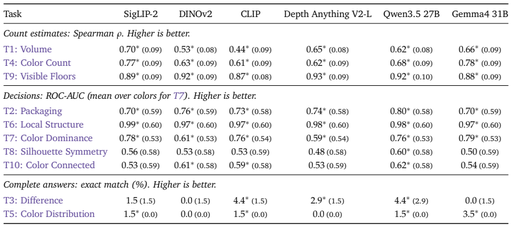
Table 19 : Probe performance on frozen visual features.Cells report score (shuffled-label 95th percentile);∗ marks scores above this empirical reference (1000 permutations); it is descriptive and not corrected for multiple comparisons.Takeaway: Counts and local-structure decisions are well recovered, while complete T3/T5 answers remain rare.
원문 · CC BY 4.0 · Khai Le-Duc, Nguyen Kim Hai Bui, An Ngo, Nam D. Hoang, Yueqi Song, Jiarui Liu, Thai Quoc Hoang, Fang Wu, Chris Ngo, Terry Jingchen Zhang, Mona T. Diab, Ran Xu, Silvio Savarese, Xiao-Ming Wu · Where Do Vision Language Models Fail at 3D Reasoning? · 원문 그림 인용 · 원본 PDF 41쪽에서 그림 영역을 추출했습니다.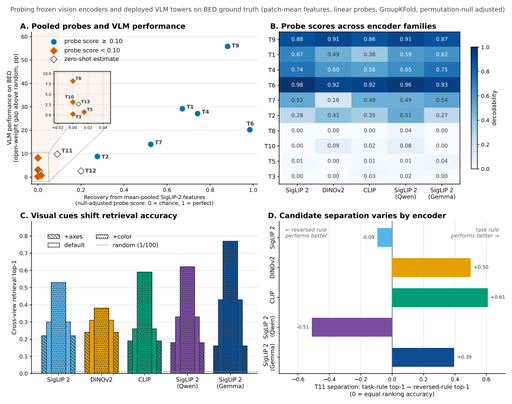
Figure 8 : Probing frozen encoders on ground-truth targets. (A)Null-adjusted probe decodability (SigLIP-2) against the per-task VLM gap above random.(B)Decodability across three encoder classes and the largest deployed tower of each family.(C)Cross-view retrieval from pooled features by cue condition.(D)T11 zero-shot candidate separation (task-rule top-1 minus reversed-rule top-1; positive values favor the task rule, negative values favor its reverse). Values in (C) and (D) depend on the representation (patch-mean features; a CLS-pooled readout of CLIP loses most of its (D) signal), and the Qwen tower is probed before its patch merger.Takeaway:With pooled probes trained on 100 objects, quantity tasks are well recovered, while the per-part and relational tasks (bottom rows of B) have low null-adjusted probe scores.
원문 · CC BY 4.0 · Khai Le-Duc, Nguyen Kim Hai Bui, An Ngo, Nam D. Hoang, Yueqi Song, Jiarui Liu, Thai Quoc Hoang, Fang Wu, Chris Ngo, Terry Jingchen Zhang, Mona T. Diab, Ran Xu, Silvio Savarese, Xiao-Ming Wu · Where Do Vision Language Models Fail at 3D Reasoning? · 원문 그림 인용 · 원본 PDF 42쪽에서 그림 영역을 추출했습니다.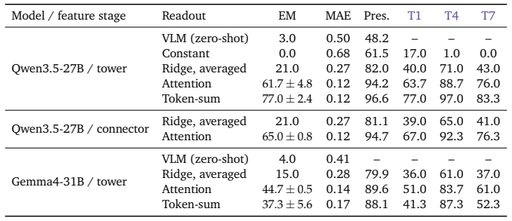
Table 20 : T5 probes on frozen tower and connector features(%, except MAE), tested on 100 benchmark objects. Neural probes train on 800 objects with 100 for validation; ridge fits on all 900. EM = exact count-vector match; Pres. = present colors counted exactly; T1/T4/T7 = answers derived from predicted counts. Neural rows report three-seed means, with EM standard deviations. Constant predicts the training mean; VLM rows are full-model Non-Thinking default-setting results. Takeaway:Exact counts are recoverable from both towers and remain recoverable at Qwen3.5-27B’s language-model input.
원문 · CC BY 4.0 · Khai Le-Duc, Nguyen Kim Hai Bui, An Ngo, Nam D. Hoang, Yueqi Song, Jiarui Liu, Thai Quoc Hoang, Fang Wu, Chris Ngo, Terry Jingchen Zhang, Mona T. Diab, Ran Xu, Silvio Savarese, Xiao-Ming Wu · Where Do Vision Language Models Fail at 3D Reasoning? · 원문 그림 인용 · 원본 PDF 43쪽에서 그림 영역을 추출했습니다.이미지 제거와 고정 레이아웃 선택지의 통제
높은 점수가 시각 증거에서 왔는지 확인하기 위해 저자들은 이미지를 제거하고 세 모델을 다시 평가했습니다. 일부 과제의 점수는 이미지 없이도 거의 변하지 않았고, 많은 점수는 모든 샘플에 같은 상수 답을 내는 정책에서 나왔습니다. 예를 들어 T10에서는 항상 0을, T9에서는 항상 3을 답하는 경우가 보고됩니다. 또 T1 부피 과제를 정답이 항상 세 번째 위치인 다섯 보기 객관식으로 바꾸면 정확도가 평균 39.0%p 오르며, 이미지가 없을 때도 Gemma4-31B는 세 번째 보기를 골라 100%에 도달합니다. 이 통제는 점수를 해석하기 전에 이미지 의존성을 확인해야 한다는 근거이며, 모든 과제에서 모델이 시각 정보를 쓰지 않는다는 결론은 아닙니다.
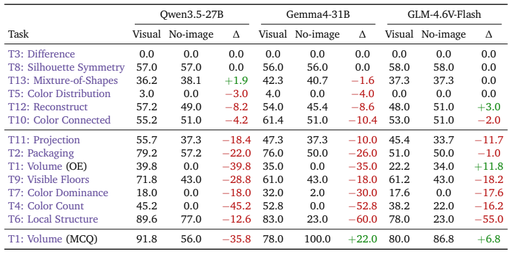
Table 21 : Accuracy with and without images (Non-Thinking).Visual vs. no-image accuracy for the three models evaluated without images (5-run means). Rows are grouped into shortcut-sensitive, visually dependent, and artifact tasks; T1 appears twice because open-ended counting and the MCQ artifact probe are interpreted separately.Takeaway:Scores on T3, T8, and T13 barely change without images, visually dependent tasks such as T4 and T6 lose up to 60pp, and Gemma4-31B reaches 100% on the fixed-layout T1 MCQ without images.
원문 · CC BY 4.0 · Khai Le-Duc, Nguyen Kim Hai Bui, An Ngo, Nam D. Hoang, Yueqi Song, Jiarui Liu, Thai Quoc Hoang, Fang Wu, Chris Ngo, Terry Jingchen Zhang, Mona T. Diab, Ran Xu, Silvio Savarese, Xiao-Ming Wu · Where Do Vision Language Models Fail at 3D Reasoning? · 원문 그림 인용 · 원본 PDF 46쪽에서 그림 영역을 추출했습니다.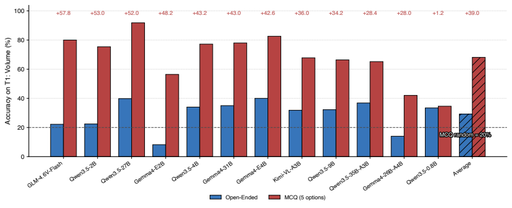
Figure 10 : Open-ended vs. multiple-choice accuracy on T1: Volume.Paired bars per model under Non-Thinking mode and the default visual setting; numbers above the bars give the MCQ−OE gain (pp); the dashed line marks the 20% random baseline of the five-option MCQ, whose correct option is always in the third position.Takeaway:The fixed-layout MCQ raises accuracy by+39.0pp on average (up to+57.8pp) without adding any visual information.
원문 · CC BY 4.0 · Khai Le-Duc, Nguyen Kim Hai Bui, An Ngo, Nam D. Hoang, Yueqi Song, Jiarui Liu, Thai Quoc Hoang, Fang Wu, Chris Ngo, Terry Jingchen Zhang, Mona T. Diab, Ran Xu, Silvio Savarese, Xiao-Ming Wu · Where Do Vision Language Models Fail at 3D Reasoning? · 원문 그림 인용 · 원본 PDF 47쪽에서 그림 영역을 추출했습니다.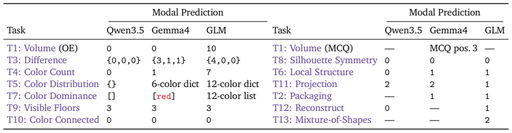
Table 22 : Constant predictions without images (Non-Thinking).Each cell shows the modal prediction; “—” means no collapse observed for that model. Qwen3.5=Qwen3.5-27B, Gemma4=Gemma4-31B, GLM=GLM-4.6V-Flash. T3 predictions abbreviated as{i,a,b} (intersection, only-a, only-b). The color abbreviations denote fixed palettes emitted regardless of input: “6-color dict”={blue, cyan, green, magenta, red, yellow} , each color mapped to count 1; “12- color dict”= the full 12-color palette, each count 1; “12-color list”= the same palette as a list of names without counts. All modal shares are 100% except Qwen3.5T8 (99.0%), Gemma4T8 (98.0%), GLMT5 (89.8%).Takeaway:Without images, all three models give one fixed answer on every T9 and T10 instance (3 and 0), which accounts for their no-image scores of 43% and 51% (Table 21, Appendix B.6.1).
원문 · CC BY 4.0 · Khai Le-Duc, Nguyen Kim Hai Bui, An Ngo, Nam D. Hoang, Yueqi Song, Jiarui Liu, Thai Quoc Hoang, Fang Wu, Chris Ngo, Terry Jingchen Zhang, Mona T. Diab, Ran Xu, Silvio Savarese, Xiao-Ming Wu · Where Do Vision Language Models Fail at 3D Reasoning? · 원문 그림 인용 · 원본 PDF 47쪽에서 그림 영역을 추출했습니다.인간 기준과 모델 성능의 격차
30명의 참가자를 기준으로 한 인간 결과에서, T5의 인간 정확도는 93.3%이고 최고 VLM은 7.2%에 그쳤습니다. 다른 과제에서도 최고 개방형 가중치 모델이 인간의 95% 신뢰구간 위에 있는 경우는 T2와 T6뿐이며, 나머지 과제에서는 격차가 나타납니다. 이 비교는 같은 과제 정의에서 인간과 모델의 한 번의 응답을 대조한 것이며, 인간 기준은 30명의 표본에 기반합니다. 따라서 원문이 밝힌 대로 더 넓은 인간 집단에서는 과제 난이도 추정이 달라질 수 있습니다. 이 결과는 색상별 정확 개수가 가장 큰 격차를 보인다는 주장을 뒷받침하지만, 모든 3D 추론 능력을 측정한 것은 아닙니다.
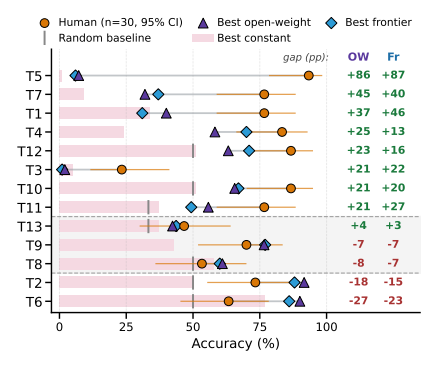
Figure 2 : Human vs. best-model accuracy per task.Shaded bars mark the best-constant baseline (always the most frequent answer); right columns give human−model gaps (pp); dashed lines group tasks by whether the best OW result falls below, within, or above the human 95% CI.Takeaway:T5: Color Distribution shows the largest gap; the best models exceed the human interval only on T2 and T6.
원문 · CC BY 4.0 · Khai Le-Duc, Nguyen Kim Hai Bui, An Ngo, Nam D. Hoang, Yueqi Song, Jiarui Liu, Thai Quoc Hoang, Fang Wu, Chris Ngo, Terry Jingchen Zhang, Mona T. Diab, Ran Xu, Silvio Savarese, Xiao-Ming Wu · Where Do Vision Language Models Fail at 3D Reasoning? · 원문 그림 인용 · 원본 PDF 5쪽에서 그림 영역을 추출했습니다.적용 범위와 해석의 한계
이 연구의 결과는 절차적으로 생성된 복셀 객체와 기하 프리미티브, 제어된 렌더링 환경에서 얻어진 것입니다. 원문은 노이즈가 있는 질감, 조명 변화, 복잡한 실제 장면으로 결과를 확장하려면 추가 평가가 필요하다고 밝힙니다. 또한 토큰 수준 프로브, 내부 언어 모델 은닉 상태 프로브, 광범위한 fine-tuning은 일부 모델 계열과 선택된 과제에서만 수행되었습니다. 사후 감사에서 확인된 가려진 블록을 가진 객체는 보고된 결과의 변화폭이 작다고 설명되지만, 이 객체의 T5 개수는 이미지로 복원할 수 없습니다. 따라서 BedBench의 실패 해석은 이 설정과 실험 범위 안에서 읽어야 합니다.
논문 정보
- 저자
- Khai Le-Duc, Nguyen Kim Hai Bui, An Ngo, Nam D. Hoang, Yueqi Song, Jiarui Liu, Thai Quoc Hoang, Fang Wu, Chris Ngo, Terry Jingchen Zhang, Mona T. Diab, Ran Xu, Silvio Savarese, Xiao-Ming Wu
- 학회·저널
- arXiv · 프리프린트
- 최초 공개일
- 2026년 10월 29일
- 등록일
- 2026년 11월 1일
- 수정일
- 2026년 10월 29일
- 버전
- v1
- arXiv
- 2610.39639
- 분류
- cs.CV · cs.AI
- 원문 이용 조건
- CC BY 4.0
- 제공 범위
- 논문 정보, 해설, 허용된 원문 그림
AI 해설은 논문 원문과 별개의 설명이며 오류가 있을 수 있습니다. 원문과 그림은 각 출처의 이용 조건과 따로 표시된 권리를 따릅니다.
초록
Vision-language models can get individual judgments right while struggling to recover and consistently use the exact properties of a 3D object. To characterize this gap, we introduce BedBench, a controlled benchmark of thirteen procedurally generated tasks spanning individual judgments and composite answers. Across twelve open-weight and four frontier models, per-color counting exposes a pronounced weakness: humans achieve 93.3% accuracy, compared with 7.2% for the best model. Targeted fine-tuning raises one model's accuracy from 3.0% to 68.6%, but reveals a further difficulty: its answers about the most common colors remain inconsistent with its own per-color counts. Supplying those counts as text improves its judgments, showing that recovering a property does not mean using it consistently. Reasoning, scaling, and added visual cues each improve individual judgments, but none makes exact answers reliable. To locate the difficulty, we probe Qwen3.5-27B: exact per-color counts remain recoverable at the language model's input, yet the model's answers rarely recover them (65.0% for the probe vs. 3.0% for the model). Image-removal controls further show that some apparent successes require no visual evidence. These findings motivate evaluating 3D reasoning by exact correctness, consistent use, and image dependence, rather than accuracy alone. Code and dataset are publicly available: https://github.com/leduckhai/BedBench
원문 인용
Khai Le-Duc, Nguyen Kim Hai Bui, An Ngo, Nam D. Hoang, Yueqi Song, Jiarui Liu, Thai Quoc Hoang, Fang Wu, Chris Ngo, Terry Jingchen Zhang, Mona T. Diab, Ran Xu, Silvio Savarese, Xiao-Ming Wu (2026). Where Do Vision Language Models Fail at 3D Reasoning?. arXiv:2610.39639v1. https://arxiv.org/abs/2610.39639v1
BibTeX
@misc{leduc2026where,
  title = {{Where Do Vision Language Models Fail at 3D Reasoning?}},
  author = {Khai Le-Duc and Nguyen Kim Hai Bui and An Ngo and Nam D. Hoang and Yueqi Song and Jiarui Liu and Thai Quoc Hoang and Fang Wu and Chris Ngo and Terry Jingchen Zhang and Mona T. Diab and Ran Xu and Silvio Savarese and Xiao-Ming Wu},
  year = {2026},
  eprint = {2610.39639},
  archivePrefix = {arXiv},
  url = {https://arxiv.org/abs/2610.39639v1}
}