논문 해설
Proving and Improving the Platonic Representation Hypothesis with JEPAs
JEPA를 이용한 플라톤 표현 가설의 증명 및 개선
- 연구 문제 여러 모달리티로 따로 학습한 모델의 표현이 같은 세계 표현으로 수렴하는지에 대한 PRH가 증명 없이 남아 있었습니다.
- 연구 방법 양의 쌍이 같은 세계 상태를 공유하는 JEPA는 하나의 회전까지 같은 표현을 학습하며, good view와 bad view의 차이가 정렬을 결정합니다.
- 주요 결과 109M good-view 텍스트 JEPA는 WIT-1024에서 DINOv2 ViT-B와의 mutual 10-NN .184로 Qwen2.5-72B의 .154보다 높게 보고됩니다.
플라톤 표현 가설을 정리로 바꾸려는 이유
여러 모달리티로 따로 학습한 모델의 표현이 같은 세계 표현으로 수렴하는지는 Platonic Representation Hypothesis(PRH)가 제기한 질문입니다. 이 가설은 규모가 커질수록 표현이 수렴한다고 관찰되지만, 증명이 없으면 언제 성립하는지 예측할 수 없고 정렬을 높이는 처방도 주기 어렵습니다. 본 연구는 Joint-Embedding Predictive Architectures(JEPAs)를 대상으로 이 질문을 답할 수 있는 조건을 찾습니다.
핵심 질문은 모달리티별 JEPA가 서로 다른 관측을 보더라도 양의 쌍이 같은 세계 상태를 공유할 때 하나의 회전 차이까지 같은 표현을 학습하는지입니다. 원문은 이 질문을 이론으로 다루고, 이후 텍스트와 이미지 인코더 실험으로 그 결과를 검증합니다.
공유된 양의 쌍에서 나오는 정렬 정리
이론의 설정은 유한한 세계 상태 집합 Z와 확률 p(z), 그리고 각 모달리티 m의 주입적 렌더링 x = g_m(z)입니다. 각 JEPA는 양의 쌍 (g_m(z), g_m(z'))에 대해 예측 항 ℓ과 반붕괴 항 Ω를 최소화합니다. 여기서 ℓ과 Ω는 임베딩 전체를 회전해도 변하지 않는 성질을 가집니다.
정리 1은 모든 모달리티가 같은 양의 쌍 분포 π를 공유하고 최소화 해가 회전 단위로 유일할 때, 각 모달리티의 최적 인코더가 하나의 세계 임베딩 h*에 대해 f*_m ∘ g_m = Q_m h*처럼 직교 행렬 Q_m 차이로 일치한다고 말합니다. 두 모달리티 사이의 차이는 Q_m Q_m'^T 하나로 줄어듭니다.
유일성을 보장하는 핵심은 명제 1입니다. 여기서 Π는 π의 행렬이고 D = diag(p), K_π = D^{-1/2} Π D^{-1/2}입니다. ℓ(a,b)가 제곱거리이고 Ω가 화이트닝을 요구할 때, 최소값은 2∑(1−μ_i)이며 μ_k > μ_{k+1}이면 최소화 해는 QΦ_π와 같은 스펙트럴 임베딩의 회전으로 한정됩니다. 이 결과는 2차 통계량 기반 반붕괴와 스펙트럼 간극이 있는 경우에만 성립합니다. 실제 LeJEPA의 SIGReg 목표는 같은 유일성 증명에 포함되지 않는다고 저자들이 밝힙니다.
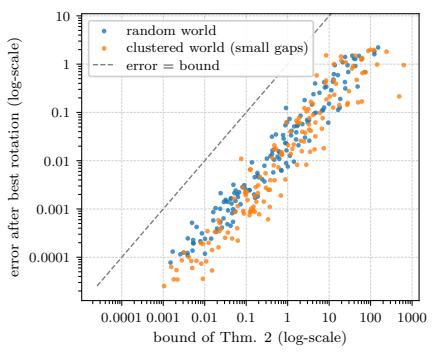
Figure 2 . Kernel mismatch bounds misalignment (Theorem 2). Each point is one randomly generated finite world (8–39 states, random marginal, embedding dimension k from 1 to 5) with a pair of kernels on it: the world’s kernel, and a second kernel of the same marginal that mixes in an unrelated kernel with weight 10−4 to 1, as if a second modality had partly different positives. For each pair we compute the two spectral embeddings (Proposition 1) and plot their distance after the best rotation (vertical) against the bound of Theorem 2 (horizontal); of the 300 worlds, half are clustered, with small spectral gaps. We clearly observe that the error lies below the bound in every world (dashed: equality), at 18% of it at most.
원문 · CC BY 4.0 · Randall Balestriero, Yann LeCun · Proving and Improving the Platonic Representation Hypothesis with JEPAs · 원문 그림 인용 · 원본 PDF 4쪽에서 그림 영역을 추출했습니다.good view와 bad view, 그리고 다음 토큰 예측
양의 쌍이 같은 장면의 두 관측이면 good-view JEPA이고, 한 관측의 손상본이면 bad-view JEPA입니다. 저자들은 관측마다 모달리티 고유의 nuisance ν를 두고, good view의 두 관측이 독립적인 nuisance를 갖도록 설정합니다. 정리 3에 따르면 인코더가 nuisance에 방향을 쓰면 그 방향은 다른 모달리티와의 정렬에서 손실이 됩니다.
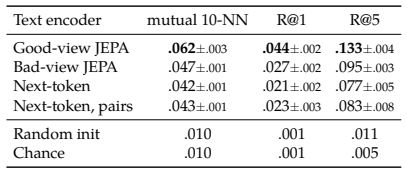
Table 1 . Good views align across modalities.Image JEPA vs. each text encoder (epoch 199) on 1,000 Flickr test pairs (backbone features; mean ±half-rangeoverthreeseeds): good-viewJEPA(captionviews), bad-view JEPA (masked spans), next-token prediction, and next-token prediction on pairs of captions of one image; R@1 and R@5 use a single rotation fitted on validation pairs. We clearly observe thatcaption views beat masked spans and next-token prediction on every metric, even when next-tokenpredictionistrainedonpairsofcaptionsofthesameimage.
원문 · CC BY 4.0 · Randall Balestriero, Yann LeCun · Proving and Improving the Platonic Representation Hypothesis with JEPAs · 원문 그림 인용 · 원본 PDF 7쪽에서 그림 영역을 추출했습니다.명제 3은 good-view JEPA의 최적 해가 세계 상태의 함수만 담는다고 설명합니다. 반면 bad-view JEPA는 nuisance를 보존하는 손상에서 임베딩 방향을 쓸 수 있습니다. 명제 4는 다음 토큰 예측의 softmax 손실을 접두사와 그 연속을 양의 쌍으로 보는 JEPA 형태로 다시 씁니다. 이 해석에 따르면 다음 토큰 예측은 bad-view JEPA에 속합니다. 이 연결은 저자들의 이론적 해석이며, 실험은 이를 간접적으로 검증합니다.
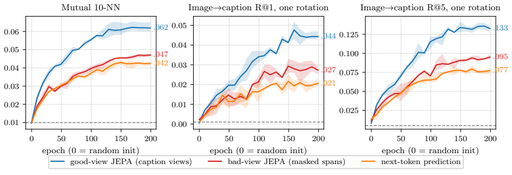
Figure 5 . Good views align, bad views and next-token prediction do not.Alignment between a separately trained image JEPA and three text encodersonFlickr,atmatchedepochs(meanofthreeseeds,band: range;dashed: chance). Allstartatchance. Weclearlyobservethatthegood-view JEPA (caption views) aligns markedly better than the bad-view JEPA (masked spans) and next-token prediction, which nearly coincide, as predicted by Theorem 2 and Proposition 4.
원문 · CC BY 4.0 · Randall Balestriero, Yann LeCun · Proving and Improving the Platonic Representation Hypothesis with JEPAs · 원문 그림 인용 · 원본 PDF 8쪽에서 그림 영역을 추출했습니다.텍스트 인코더의 정렬 결과와 샘플 효율
웹 텍스트를 사용하는 실험에서 109M 파라미터의 good-view 텍스트 JEPA는 WIT-1024 벤치마크에서 DINOv2 ViT-B와의 mutual 10-NN이 .184로 보고됩니다. 같은 조건에서 Qwen2.5-72B는 .154입니다. 이 비교는 DINOv2 ViT-B 기준 mutual 10-NN이고 WIT-1024 프로토콜에 한정됩니다.
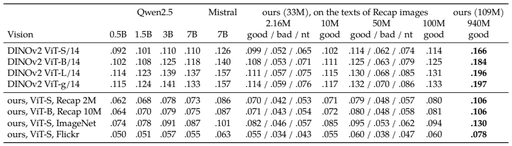
Table 15 . A 109M text JEPA beats language models on the PRH benchmark.PRH protocol of Huh et al.[22]: WIT-1024 pairs, per-layer features, clipping, normalization, maximum over layer pairs. For reference, DINOv2 ViT-B× BERT-base scores .111, all-mpnet-base-v2 .118 and CLIP’s text encoder .124 (.113–.137 across DINOv2 sizes for these two); our Flickr-trained text encoders (good / bad / next-token) score .029–.036 with every DINOv2 size and .023–.024 with our Flickr image JEPA; and our Flickr image JEPA× DINOv2 ViT-B (image vs. image) .241. nt: next-token prediction. Our 33M text JEPAs’ entries are means of three seeds, which differ by at most±.009 with DINOv2 ViT-B; the 109M column is the mean of three seeds (each above every language model). At least 43 of the 1,024 WIT captions appear among the Recap-DataComp alt-texts; on the other 981 pairs, none of the nine text models we checked with DINOv2 ViT-B (ours, Qwen2.5-3B/7B, Mistral-7B) changes by more than .002. This demonstrates thatthe 109M good-view JEPA surpasses every language model we evaluated with every vision encoder it was scored with, including our image JEPAs trained from scratch.
원문 · CC BY 4.0 · Randall Balestriero, Yann LeCun · Proving and Improving the Platonic Representation Hypothesis with JEPAs · 원문 그림 인용 · 원본 PDF 33쪽에서 그림 영역을 추출했습니다.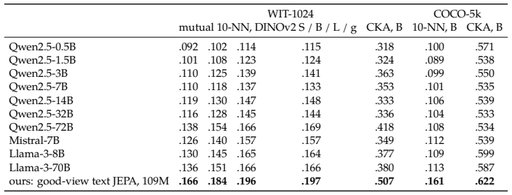
Table 16 . No language model up to 72B parameters reaches the 109M good-view JEPA.PRH protocol (per-layer features, maximum over layer pairs) on WIT-1024 and on the 5,000 COCO test pairs, for base language models from 0.5B to 72B parameters and our 109M good-view text JEPA trained on the texts of 940M images (mean of three seeds). We clearly observe thatscaling next-token prediction by 660 times in parameters does not reach the alignment that good views give.
원문 · CC BY 4.0 · Randall Balestriero, Yann LeCun · Proving and Improving the Platonic Representation Hypothesis with JEPAs · 원문 그림 인용 · 원본 PDF 34쪽에서 그림 영역을 추출했습니다.같은 코퍼스에서 샘플 효율도 보고됩니다. 109M good-view JEPA가 21.6M 학습 샘플로 달성한 WIT 정렬 .109는 next-token prediction이 900M 샘플에서 달성한 .111과 비슷합니다. 저자들은 이를 42배 적은 샘플로 같은 정렬에 도달한다고 해석합니다. 샘플 효율 비교는 같은 코퍼스와 같은 인코더 설정을 전제로 합니다.
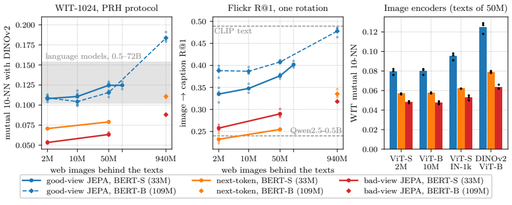
Figure 9 . Good views scale.Left and middle: text JEPAs trained on the texts of 2.16M to 940M web images (Recap-DataComp), never on a Flickr or COCO caption, against frozen DINOv2 ViT-B on WIT-1024 (PRH-paper protocol) and on Flickr (R@1 through one rotation fitted on 30k pairs). Solid lines and circles: BERT-S (33M); dashed lines and diamonds: BERT-B (109M), trained with next-token prediction and bad views on the texts of 940M images only, hence single diamonds there. Lines are means over seeds and faint dots the seeds (one seed for the bad-view JEPA at 940M). Shaded: the language models we evaluated (Qwen2.5 0.5–72B, Llama-3-8B and -70B, Mistral-7B; left); grey dashed: CLIP’s text encoder and Qwen2.5-0.5B under the same protocol (middle). Right: image JEPAs trained from scratch (ViT-S on 2.16M and ViT-B on 10M Recap images, ViT-S on ImageNet-1k) and frozen DINOv2, each against the good-view, next-token and bad-view text JEPAs trained on the same texts of 50M web images (WIT; means of three seeds, dots: seeds). We clearly observe thatgood views beat bad views and next-token prediction at every scale and with every image encoder we compared, and that a 109M good-view JEPA on the texts of 940M images surpasses every language model we evaluated.
원문 · CC BY 4.0 · Randall Balestriero, Yann LeCun · Proving and Improving the Platonic Representation Hypothesis with JEPAs · 원문 그림 인용 · 원본 PDF 10쪽에서 그림 영역을 추출했습니다.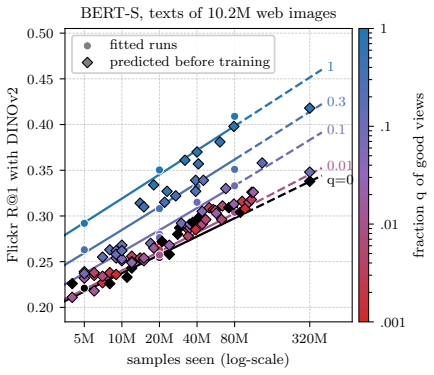
Figure 11 . A scaling law of alignment in good views and samples seen. Flickr test R@1 (DINOv2 ViT-B, 30k-pair rotation) of BERT-S text JEPAs trained on the texts of 10.2M web images, against the samples seen. Each point is a run, colored by its fraction q of training items with good views (black: q = 0, bad views only). Circles: the grid the law is fitted on; diamonds: runs predicted before training. Lines: the law at five values of q, dashed beyond the fitted range. We observe that R@1 grows linearly in the logarithm of the samples seen at every fraction of good views, faster with more of them, and that the law predicts unseen runs within seed noise up to twice its range.
원문 · CC BY 4.0 · Randall Balestriero, Yann LeCun · Proving and Improving the Platonic Representation Hypothesis with JEPAs · 원문 그림 인용 · 원본 PDF 12쪽에서 그림 영역을 추출했습니다.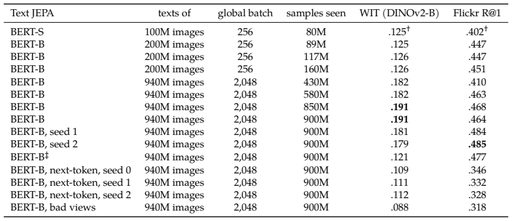
Table 14 . Alignment keeps growing with the texts of 940M images.Checkpoints of our largest good-view JEPAs (seed 0 unless named;†: mean of three seeds at the end of training;‡: another seed with twice the effective SIGReg weight, see text; next-token: the same encoder trained to predict the next token; bad views: two masked copies of one text, at the effective SIGReg weight of the first 940M run), scored on WIT-1024 with DINOv2 ViT-B and on Flickr through one rotation fitted on 30k pairs. We observe thatWIT alignment jumps between the texts of 200M and 940M images and rises again by 850M samples, while Flickr retrieval rises more slowly. Bold: best per column.
원문 · CC BY 4.0 · Randall Balestriero, Yann LeCun · Proving and Improving the Platonic Representation Hypothesis with JEPAs · 원문 그림 인용 · 원본 PDF 33쪽에서 그림 영역을 추출했습니다.양의 쌍 설계에 대한 제거 실험
Flickr 캡션 실험에서 trimming은 양의 쌍을 설계하는 핵심 설정으로 확인됩니다. whole-caption 설정은 잘라내기를 제거한 경우이며, 기본 설정 대비 R@1이 .185로 낮아져 기본값 .246에 비해 약 4분의 1의 정렬을 잃습니다. 이 결과는 Flickr에서 학습한 텍스트 JEPA와 동결된 DINOv2 기준 실험에 한정된 관찰입니다.
마스킹, 뷰 수, 배치 크기, 폭과 스케줄은 평균을 .016 이내로만 바꿉니다. 이는 기본 설정의 시드 간 범위와 비슷한 수준입니다. 그래디언트 클리핑은 붕괴를 막는 데 도움이 되었다고 보고되었습니다.
이론 가정과 실험 조건의 간극
정리는 유한 세계, 주입적 렌더링, 모집단 최적점과 같은 이상화된 가정을 둡니다. 실제 모달리티는 손실이 있을 수 있으며, 유한 샘플 학습은 네트워크의 귀납 편향에 의존합니다. 또한 LeJEPA의 전체 분포 제약은 2차 반붕괴 조건과 다르므로, 정리 1의 조건을 실험이 정확히 만족한다고 말할 수 없습니다.
실험에서 이미지 측은 주로 크롭을 양의 쌍으로 사용하며, good view의 출처는 사람이 쓴 같은 이미지의 캡션이나 captioner가 생성한 텍스트입니다. 이 점은 결과가 어떤 데이터 구성에 의존하는지 해석할 때 함께 고려해야 합니다.
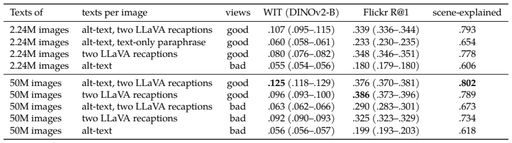
Table 7 . The views and the data both set the alignment.BERT-S text JEPAs, one recipe per scale, three seeds (mean and range), scored on WIT-1024 with DINOv2 ViT-B and on Flickr through one rotation fitted on 30k pairs; scene-explained:ρ(f) on Flickr captions (k=32 , seed 0, Table 6). The paraphrase is written from the alt-text alone by a text-only language model, so that row involves no image captioner. We observe that with the same bad views, LLaVA recaptions align far better than alt-texts, and with the same texts, good views double alignment(Theorem 4).
원문 · CC BY 4.0 · Randall Balestriero, Yann LeCun · Proving and Improving the Platonic Representation Hypothesis with JEPAs · 원문 그림 인용 · 원본 PDF 25쪽에서 그림 영역을 추출했습니다.논문 정보
- 저자
- Randall Balestriero, Yann LeCun
- 학회·저널
- arXiv · 프리프린트
- 최초 공개일
- 2026년 10월 29일
- 등록일
- 2026년 11월 1일
- 수정일
- 2026년 10월 29일
- 버전
- v1
- arXiv
- 2610.39302
- 분류
- cs.AI · cs.CV · stat.ML
- 원문 이용 조건
- CC BY 4.0
- 제공 범위
- 논문 정보, 해설, 허용된 원문 그림
AI 해설은 논문 원문과 별개의 설명이며 오류가 있을 수 있습니다. 원문과 그림은 각 출처의 이용 조건과 따로 표시된 권리를 따릅니다.
초록
Whether models trained on different modalities converge to the same representation of the world is central to AI. The Platonic Representation Hypothesis (PRH) conjectures that they do as they scale, but without a proof it offers neither a guarantee nor a recipe. We turn the hypothesis into a theorem. First, we prove a \emph{Platonic Representation Theorem}: Joint-Embedding Predictive Architectures (JEPAs) trained separately on any number of modalities learn the same representation up to one rotation whenever their positive pairs are two observations of one scene--\emph{good views}--and their misalignment is bounded otherwise. Second, we show that next-token prediction is a JEPA with \emph{bad views}, parts of a single document, which explains why language models align with vision only through scale. Third, we validate the theory from 145k captions to the texts of 940M web images, and uncover a scaling law of alignment that predicts unseen runs within seed noise. Good views need 42 times fewer training samples than next-token prediction on the same corpus to reach the same alignment, and a 109M-parameter text JEPA aligns with DINOv2 and CLIP's image encoders better than every language model we evaluated, up to 72B parameters, and than CLIP's text encoder: next-token prediction is a remarkably inefficient route to platonic representations. As a showcase, one rotation turns separately trained encoders into an image captioner (CIDEr .838 on COCO). Even that rotation needs no pair: on the latest pair-free benchmark, our text JEPA beats every zero-shot accuracy reported with language models up to 8B parameters, e.g., 64\% against at most 56\% top-5 on ImageNet-100. Positive views, and not scale alone, are thus the lever to build platonic representations.
원문 인용
Randall Balestriero, Yann LeCun (2026). Proving and Improving the Platonic Representation Hypothesis with JEPAs. arXiv:2610.39302v1. https://arxiv.org/abs/2610.39302v1
BibTeX
@misc{balestriero2026proving,
  title = {{Proving and Improving the Platonic Representation Hypothesis with JEPAs}},
  author = {Randall Balestriero and Yann LeCun},
  year = {2026},
  eprint = {2610.39302},
  archivePrefix = {arXiv},
  url = {https://arxiv.org/abs/2610.39302v1}
}