論文解説
Rethinking Pre-pretraining
合成データの前置き学習を計算量を揃えて比べ、自然言語学習を上回らないと示す
- 課題 合成データで学習する前置き段階(PPT)は、先行研究で効果が報告されてきました。しかし、自然言語学習と計算資源を分け合う場面で役立つかは確かめられていませんでした。
- 手法 本研究は、同じ総計算量をPPTと自然言語学習で分け合う条件を作り、検証損失を比べます。
- 結果 同じ計算量では、PPTに配分しても自然言語学習を上回りませんでした。自然言語データが100Mトークンに限られるときは、繰り返し学習のほうが合成データより検証損失が良くなりました。
PPTは何を狙い、効果はどこまで続くのか
PPTは、合成データで学習してから自然言語の事前学習(PT)に入る学習段階です。PPTの狙いは、自然言語を学ぶ前に有用な事前知識を初期化へ入れておくことです。k-Dyckは階層的な依存関係の追跡を、NCAは潜在的な遷移規則と長距離の依存関係を促すと説明されています。先行研究では、NCAについて最大で8.6%低いperplexityが報告されています。
ただし、これらの効果が他の学習条件や規模でも続くかは、十分に確かめられていませんでした。別の再現研究では、k-Dyckの効果がモデルサイズ、トークナイザ、言語によっては一貫して続かなかったと報告されています。そこで著者らは、NCAの再現実験と計算量を揃えた比較を組み合わせ、PPTが自然言語学習に対して価値を持つかを問いました。一方で、本研究の疑問は、PPTが自然言語学習と計算資源を競う場面でも有用かどうかにあります。
著者らはまず、先行研究のNCA結果を正の対照として再現しました。元の設定では、PPTにより5.4%のperplexity改善が得られました。しかし、埋め込みの初期化をN(0,1)からN(0,0.02)に変えると、NCAと初期化を変えないベースラインの差が縮まりました。このため、PPTの効果は初期化方式に敏感であることが示されました。
合成データの作り方と計算量の配分
NCAを用いたPPTでは、Lee et al. (2026)が格子の各セルを近傍の値から次の値へ写す更新規則を、ランダムに初期化した畳み込みニューラルネットワークに置き換えます。まずランダムな初期格子をサンプルし、そのネットワークを更新規則として固定のステップ数だけシミュレーションを進めます。得られた軌跡は低エントロピーの静的な格子から複雑な格子まで幅があるため、gzip圧縮率という複雑さの代理指標で絞り込み、最も高い圧縮帯域に入った軌跡だけを残します。残った格子は2D画像テンソルと同じように平坦化され、時間順に連結された1次元のトークン列になります。本研究では、この格子を2×2のパッチごとに1トークンとし、格子の開始と終了にもトークンを付けます。
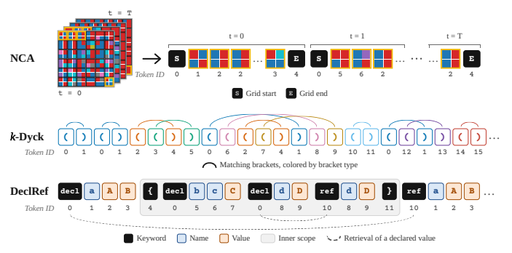
Figure 2 :Tokenizing synthetic pre-pretraining data.For NCA, each grid of a rollout is split into2×2patches that each become one token, and grids are concatenated in time order with start and end tokens. Fork-Dyck, the opening and closing bracket types are each their own token. For DeclRef, keywords, scope brackets, names and values are unique tokens. In the example shown, a reference inside the opened scope retrieves the value of a name declared in that scope, and after the scope closes a reference retrieves the value of a name declared before the scope. Generation and tokenization details are given in Section 2 and Appendix A.
出典 · CC BY 4.0 · Alexander Stern, Tim Rocktäschel, Acyr Locatelli, Laura Ruis · Rethinking Pre-pretraining · 論文の図を引用 · 元のPDFの5ページ目から図の部分を抽出しています。k-Dyckは、括弧の種類がk個ある形式言語で、開いた括弧が必ず最後に閉じられる文法を持ちます。たとえばk=2の語彙では、([()][])が有効な列になります。本研究では、Hu et al. (2025)がk=128で最良としたk-Shuffle Dyck版をk-Dyckとして使います。DeclRefは本研究で導入した合成コーパスで、Jiang et al. (2026)の手続き的タスクと同じく、文脈からの検索を対象とします。DeclRefでは、宣言、スコープの括弧、名前、値をそれぞれ固有のトークンとし、宣言された値を参照する例を図2で示しています。
計算量を揃えた比較では、総計算量をCとし、αはCのうちPPTに充てる計算量の割合で、トークン数は配分の結果として決まります。著者らはαを0、0.01、0.05、0.10から選び、0.10はデータ制約の設定でのみ実行しました。over-ChinchillaではNCAとk-Dyckをそれぞれ1%、すなわち500Mトークン分をPPTに使いました。
加算的計算量では、336Mパラメータのモデルに対しPT予算を50M、100M、1Bトークンに固定し、PPTのトークン数を5Mから1Bまで変えて検証損失を比べました。Muonは変換器ブロックの重み行列を更新し、埋め込み表と出力側の表はAdamWで更新します。PPTからPTへの境界では、語彙を自然言語のサイズに広げ、トークン埋め込み表と言語モデルのヘッドを再初期化して、Transformerの本体だけを引き継ぎます。各フェーズは別々の学習率スケジュールを持ち、オプティマイザの状態は境界でリセットされます。一方、C4の対照実験だけはPPTとPTを単一の学習率スケジュールで回し、オプティマイザの状態をリセットしません。
初期化を変えるとPPTの利得が縮む
この節では、ベースラインの重み初期化を変えたときにPPTの利得がどう変わるかを確かめました。著者らはまず、Lee et al. (2026)のNCA実験の設定を再現するため、400MパラメータのLlamaを約9Bトークンのテキスト(OpenWebText)で学習し、164M NCAトークンのPPTを加えました。元の初期化方式のもとでは、PPTによりperplexityが5.4%改善し、先行研究と同じ向きの結果が得られました。この再現は、先行研究で報告されたNCAの利得が実際に再現されるかを確かめるための、いわば正の対照として位置づけられています。
一方で、埋め込みの初期化だけをN(0,1)からN(0,0.02)に変えると、PPTを入れないベースラインのperplexityが9.0%改善しました。この改善幅は、PPTによる5.4%の利得そのものより大きく、ベースラインが埋め込みの初期化に強く依存することを示しています。さらに、同じ初期化をNCAの手法にも適用すると、両者は区別がつかないほど近づきました。つまり、NCAのPPTは追加の計算量を受けていても、ベースラインの初期化を変えるだけで同程度の性能に達したことになります。ただし、この実験は初期化への感度を示すもので、初期化ごとにPPTのトークン数を調整し直してはいません。そのため、この結果から最適なNCAの構成を判断することはできず、その検討は後続の加算的計算量と計算量を揃えた実験に委ねられています。
そこで著者らは、以降の実験で初期化方式を比較の変数として扱いました。加算的計算量の実験では、Hu et al. (2025)のN(0,0.02)、Lee et al. (2026)のN(0,1)埋め込みと残りN(0,0.02)、NanoChatのスペクトル初期化の3つを比べています。スペクトル初期化は、線形層の重みをN(0, σ)から引き、埋め込みはN(0,1)から引き、言語モデリングのヘッドと残差射影は0で初期化します。この初期化は、NanoChatのもとで使われてきたものであり、これ以降の計算量を揃えた実験でも用いられました。加算的計算量の実験では、50Mと100Mの自然言語トークンのもとでPPTが最良のベースラインを上回りました。
ただし1Bトークンでは、スペクトル初期化のもとでPPTの手法はすべてベースラインのseedのばらつきに収まりました。一方、別の初期化のベースラインに対しては、1Bトークンでも両方のPPTの手法がなお改善して見えました。
加算的計算量では小さな予算でPPTが効く
加算的計算量の実験では、PPTを自然言語学習の前に追加し、既存の自然言語予算は削らない設定で比べました。モデルは336Mパラメータに固定し、自然言語のPT予算を50M、100M、1Bの3通りにしました。初期化方式は三つ用意し、Hu et al. (2025)のN(0,0.02)、Lee et al. (2026)の埋め込みだけN(0,1)とするもの、NanoChatのスペクトル初期化を比べました。スペクトル初期化では、線形層の重みをσ=min(1,√(dout/din))/√dinのN(0,σ)から引き、埋め込みはN(0,1)とし、言語モデリングヘッドと残差射影はゼロで初期化します。
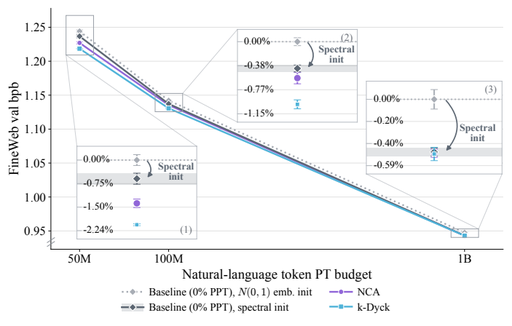
Figure 4 :PPT is useful at 50M–100M natural-language tokens, but its gain at 1B disap- pears under spectral-based initialization.In the additive-compute regime with a 336M-parameter model, NCA andk-Dyck, each at its lowest-loss configuration, improve on the optimal no-PPT baseline at 50M and 100M natural-language tokens. Under spectral-based initialization this gain disappears by 1B tokens, but under the other initializations it persists at every budget (Appendix E.1 shows the full breakdown). Because spectral-based initialization yields the lowest loss for every method at this largest budget, we use it in all compute-matched experiments, which run at compara- ble FLOP budgets.
出典 · CC BY 4.0 · Alexander Stern, Tim Rocktäschel, Acyr Locatelli, Laura Ruis · Rethinking Pre-pretraining · 論文の図を引用 · 元のPDFの8ページ目から図の部分を抽出しています。結果として、k-DyckとNCAは、50Mと100Mの自然言語トークンで、スペクトル初期化を含む最良のPPTなしベースラインを上回りました。50Mの予算では、k-DyckのDCLM COREが0.024±0.004から0.032±0.003に上がりました。この値は3つのseedの平均と1標本標準偏差で、表1に挙がった例外の一つにとどまります。つまり、小さい予算では合成言語が有用な帰納バイアスを与えていると解釈できます。図4は、PPTがk-DyckとNCAで50Mと100Mの自然言語トークンに有用である一方、1Bでは利得がスペクトル初期化のもとで消えることを示しています。
1Bトークンでは、スペクトル初期化のもとで全てのPPT手法がベースラインのseedのばらつきの範囲に収まりました。一方で、別の初期化をベースラインに用いると、両方のPPTカリキュラムは1Bでもなおベースラインを上回るように見えました。そのため、加算的設定には、小さい予算で初期化に関係なく効く効果と、1Bでは比較対象の初期化に依存する効果が重なっています。この加算的計算量の実験の詳細は、付録E.1の図8で初期化とPPTの最適化手法ごとに分けて示されています。
同じ計算量を分け合うと、PPTは自然言語学習を上回らない
データ制約の設定では、自然言語を100Mトークンに固定し、1×10 18 FLOPsの予算の一部をPPTに振り分けました。PPTに任意の割合を振り分けると検証BPBは増え、その増分は5%を超えると横ばいになりました。著者らは、その計算量は同じ自然言語データへの追加エポックに使うほうが良いと解釈しています。100Mのユニークな自然言語トークンを複数エポック使う設定が、自然言語の検証損失で、どの合成カリキュラムよりも良い結果でした。下流評価では、DeclRefの10%でBLiMPが0.721±0.004から0.731±0.005に上がりましたが、これは表1に挙がった例外の一つです。
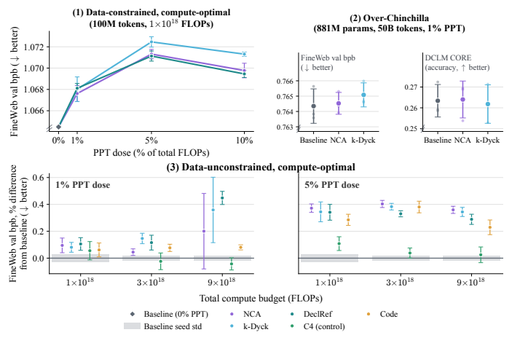
Figure 1 :Across all regimes, allocating compute to PPT never beats spending it on natural language.(1) Data-constrained: FineWeb validation bits per byte (BPB) against the fraction of a fixed1×10 18-FLOP budget spent on PPT, with repetition over 100M natural-language tokens. Op- timal model sizes range from 561M to 708M parameters. (2) Over-Chinchilla: an 881M-parameter model trained on 50B tokens,∼12×the compute-optimal token count, scored on FineWeb BPB and DCLM CORE. The PPT methods spend 0.5B tokens on PPT and 49.5B on FineWeb. (3) Data- unconstrained: the optimal model size found at each budget varies with the PPT method, from 179M to 186M parameters at1×10 18 FLOPs, 252M to 336M at3×10 18, and 438M to 561M at9×10 18.
出典 · CC BY 4.0 · Alexander Stern, Tim Rocktäschel, Acyr Locatelli, Laura Ruis · Rethinking Pre-pretraining · 論文の図を引用 · 元のPDFの2ページ目から図の部分を抽出しています。over-Chinchillaの設定では、881Mパラメータのモデルを50Bトークンで学習し、これは計算量最適のトークン数の約12倍にあたります。PPT手法は、0.5BトークンをPPTに、49.5BトークンをFineWebに使いました。この条件でもNCAとk-Dyckは、検証損失とDCLM COREの精度でベースラインを改善しませんでした。損失の関係にべき乗則を当てはめると、どのPPT手法も、ベースラインより小さい乗数定数や有意に大きい指数を示しませんでした。C4対照もベースラインと一致しており、データ非制約の設定でもPPTが自然言語学習を上回る結果は見られませんでした。
下流評価では、集約したBLiMPとDCLM COREの多くがベースラインと一致しました。データ非制約の1×10 18 FLOPs設定では、C4対照のDCLM COREが0.088±0.006から0.106±0.004に上がりました。著者らは、これらの改善の有意性は不明確だと述べ、C4対照も合成PPT手法と同程度のDCLM COREを示したと報告しています。ただし、個々のサブタスクではPPT手法が一部改善する例もあり、その改善は別のサブタスクの低下と引き換えになることが多いです。
つまり、著者らは、これらのPPT手法が大規模になっても自然言語学習を上回るとは考えにくいと結論しています。
PPTで得た性能はPT後に残らない
PPTで学んだ分布への性能が、その後の自然言語学習で保たれるかを、Lee et al.の議論を踏まえて確かめました。先行研究では、PPTで学んだ事前知識がPTに引き継がれると主張されてきました。著者らは、PPTからPTへの移行で性能が失われる原因として、学習データの性質に注目しました。2つの自然言語の間の移行でも、ドイツ語を300Bトークンの英語の後に継続事前学習すると、元の英語の分布で忘却が起きることが示されています。合成分布から自然言語への移行はこれより大きいと、著者らは考えました。この予算は、前の節で扱った予算より大きい設定です。
図5の右側の3つのパネルでは、PPT段階の間に3つの手法がそれぞれの分布を学習しました。しかしPPTからPTへの境界に入ると、PPT分布のBPBが直ちに上がり始め、モデルがPPT分布での能力を忘れたことが分かりました。コードの場合、PPT段階で見たトークンの多くはPT段階でも現れます。コメントや変数名には自然言語の意味が含まれるため、PT中もそれらを予測し続けます。それでもコードの分布での損失は境界の後に上がるため、著者らは、コード固有の事前知識は保たれず、分布が自然言語へ急に変わると上書きされると考えました。
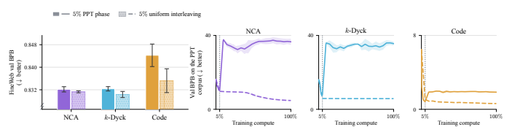
Figure 5 :Uniformly distributing the PPT data across training, rather than front-loading it, prevents forgetting on the PPT distribution.In the interleaved runs,5%of every batch consists of NCA,k-Dyck, or code throughout training. In the PPT runs, the same5%of compute is instead spent up front, at2.7×10 19 FLOPs. Left: FineWeb validation BPB at the end of training. Right: validation BPB on the PPT corpus itself across the whole run, one panel per corpus on its own scale, with the gray dotted line marking5%of total compute. Under the PPT schedule the models lose this ability at the PPT-to-PT boundary; under interleaving they keep it and continue to improve on it. Elsewhere in this work the vocabulary is replaced at the phase boundary for the synthetic PPT distributions, which means the PPT corpus cannot be scored after the PPT phase. Every run here instead shares a single vocabulary, extended to hold the NCA andk-Dyck tokens, so the corpus can be tracked throughout training. These runs are not hyperparameter-tuned (configurations in Appendix D.5, Table 7), so the FineWeb panel is included only to show that the interleaved runs sit in a similar range to their PPT counterparts.
出典 · CC BY 4.0 · Alexander Stern, Tim Rocktäschel, Acyr Locatelli, Laura Ruis · Rethinking Pre-pretraining · 論文の図を引用 · 元のPDFの9ページ目から図の部分を抽出しています。一方、バッチの5%をPPTのデータに充てて学習全体に混ぜると、PPT分布の性能は全体にわたって改善しました。PPT段階に同じ5%の計算量を前置きした場合と総計算量は同じであり、配置を変えるだけで忘却を防げたことになります。この交互配置の実行では、語彙を全PPT分布のトークンを含むように拡張し、コーパスを学習全体を通して追跡できるようにしました。ただし、FineWebのBPBの改善は全てのPPT手法で有意とは言えず、これらの実行はハイパーパラメータを調整していないため、改善の大きさは分かっていません。
つまり、著者らの結果では、PPTで得た分布への性能は前置きの配置のもとで失われ、交互配置で保たれました。ただし、交互配置はFineWebの自然言語の性能を有意には改善しませんでした。そのため、PPTの課題は、前置きで学んだ事前知識を境界の後にどう残すかにあると考えられます。
限界:探索範囲と比較の制約
本研究の結論には、探索範囲に関する制約があります。9×10 18 FLOPsを超えるハイパーパラメータ探索は、一試行が高価なため実行していません。過Chinchillaの実験は学習率のピークだけを振り、他のハイパーパラメータは小さい予算の値を流用しています。ただし、ベースラインとPPT手法は同じ縮小探索を受けるため、両者の比較は揃っています。PPTの共有比率も1%と5%に固定しており、その間の値や予算に応じた変化は試していません。
著者らは、本研究のPPTと no-PPT の差が先行研究の報告より小さいと述べています。その理由の一つは、NanoChatを使い、先行研究とは異なるトークナイザ、モデル構造、自然言語データセットを用いている点です。トークナイザだけでもPPTの効果を変えることが示されています。ただし、本研究内では比較対象の設定を揃えているため、差はPPTに帰属すると考えられます。
もう一つの理由は評価指標です。本研究はBPBで評価しており、先行研究が多く報告するperplexityは損失の指数であるため、相対的な差がより大きく出ます。そのため、本研究のBPBの差は先行研究のperplexityの差と直接比較できません。
著者らは、PPTが自然言語の学習より効率的かを検証することを目的としていました。3つの合成コーパスと複数の学習レジームで、計算量をPPTに充てても自然言語に充てるより良くなりませんでした。一方で、additive設定の最も少ない自然言語予算では、初期化を適切にしたベースラインに対しても効果が残りました。先行研究はカリキュラムを変える際に初期化を固定してきたため、今後の頑健性の確認では初期化も変える必要があると著者らは述べています。
本研究は言語モデリングのみを扱っており、画像などほかのデータ形式でのPPTは検証していません。また、PPTを明示的な段階として使うには、境界での忘却を先に解決する必要があります。忘却は学習データを交互に混ぜることで避けられますが、そのスケジュールが合成データを計算量の面で自然言語より有益にするかは未解決です。なお、ハイパーパラメータ最適化器LLMTunaは、目的に応じた探索ループの中で言語モデルを使うものであり、単なるコーディングエージェントではありません。
PPTを段階として使う是非
本研究の結果が示すのは、合成データを使うこと自体を退けるべきだという結論ではありません。著者らは、合成データは有用になりうるとしたうえで、PPTを独立した段階として前置きする使い方が効率の悪い方法だと述べています。理由は、PPTで学んだ内容が自然言語の学習が始まると次第に失われてしまうことです。そのため、著者らはPPTを段階として置く設計そのものを見直す必要があると結論づけています。一方で、合成データを学習コーパスとして使う道は残されており、著者らは今後の検討の対象として位置づけています。
著者らが次の候補として挙げるのは、PPTの代わりに学習の全体へ合成データを少しずつ混ぜるinterleavingです。実際に、学習全体に同じデータを一様に混ぜるinterleavingは、PPTの分布での忘却を防ぐことが確認されました。ただし、自然言語の検証損失を有意に改善するまでには至らず、その効果の大きさは未解明のままです。つまり、interleavingは忘却という問題には対処するものの、自然言語の性能向上という目的は果たしていないと読み取れます。そのため、著者らは、より良いinterleavingのスケジュールを探す研究が必要だと述べています。
初期化は、先行研究が固定して比べてきた軸ですが、著者らは比較の軸として変えることを提案しています。PPT研究の頑健性を確かめるには、カリキュラムだけでなく初期化のスキームも、PPT手法と対照条件の両方で変えるべきだとしています。また、自然言語の対照条件は、PPTの後に別の学習率スケジュールと最適化器の状態リセットを伴う段階として置く方式ではなく、単一の学習率スケジュールで扱うことが推奨されています。
論文情報
- 著者
- Alexander Stern, Tim Rocktäschel, Acyr Locatelli, Laura Ruis
- 学会・ジャーナル
- arXiv · プレプリント
- 公開日
- 2026年10月29日
- 登録日
- 2026年11月1日
- 更新日
- 2026年10月29日
- バージョン
- v1
- arXiv
- 2610.40051
- カテゴリ
- cs.CL · cs.AI
- ライセンス
- CC BY 4.0
- 掲載内容
- 論文情報・解説・論文の図
この解説は、Refivuの韓国語解説をAIで翻訳したものです。不正確な翻訳や誤りが含まれる可能性があります。論文と図の利用条件は各出典に従います。
アブストラクト
We report that allocating compute to synthetic pre-pretraining (PPT) never outperforms pure natural-language training in our compute-matched experiments. This holds across four PPT curricula (k-Dyck, neural cellular automata (NCA), declarative reference corpora, and code) and three training regimes: data-constrained, data-unconstrained, and a high token-to-parameter-ratio regime (881M parameters trained on 50B tokens). When natural language is scarce, repeated epochs over a 100M-token corpus beat every synthetic curriculum on natural-language validation loss, with no consistent downstream accuracy advantage from PPT. We find that PPT gains reported in prior work are sensitive to the weight initialization scheme. In an NCA reproduction, we recover a 5.4% perplexity improvement from PPT under the original initialization scheme. An alternative scheme improves both methods, but the no-PPT baseline more, closing the gap between them. However, when PPT receives additional compute rather than a share of the natural-language budget, gains persist at small natural-language budgets even with improved initialization, but disappear by 1B tokens. Finally, models forget what they learn during PPT in subsequent natural-language training; interleaving the same data throughout training prevents forgetting, but does not significantly improve natural-language performance. Our results suggest limited benefits of synthetic pre-pretraining as a distinct training stage and motivate rethinking how such data are used in language model training.
論文の図
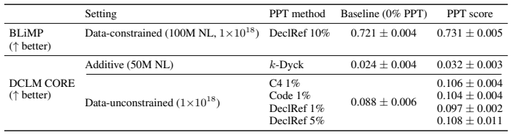
Table 1 :Downstream benchmark improvement.Across the models reported in Figures 1 and 4, these are the cases whose aggregate BLiMP or DCLM CORE score sits above their baseline. How- ever, C4, the natural-language control, reaches a DCLM CORE score in the same range as the PPT methods. In this table, NL denotes natural-language tokens.
出典 · CC BY 4.0 · Alexander Stern, Tim Rocktäschel, Acyr Locatelli, Laura Ruis · Rethinking Pre-pretraining · 論文の図を引用 · 元のPDFの8ページ目から図の部分を抽出しています。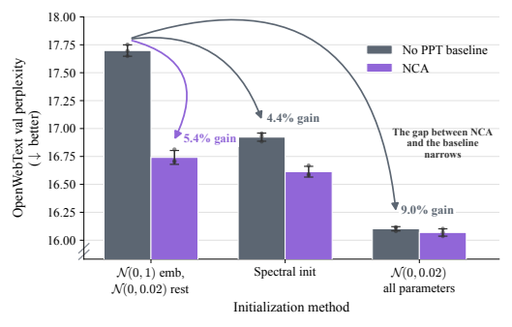
Figure 6 :The NCA positive control under three baseline weight initializations.A 400M- parameter Llama model trained on 164M NCA tokens, and then∼9B tokens of OpenWebText, following Lee et al. (2026). Validation perplexity for the no-PPT baseline and NCA under three initializations, namely that of the original work (N(0,1)embeddings andN(0,0.02)elsewhere), N(0,0.02)embeddings and head, and the spectral-based initialization of the NanoChat version we use. Under each alternative initialization the baseline improves and the gap between NCA and the baseline narrows.
出典 · CC BY 4.0 · Alexander Stern, Tim Rocktäschel, Acyr Locatelli, Laura Ruis · Rethinking Pre-pretraining · 論文の図を引用 · 元のPDFの17ページ目から図の部分を抽出しています。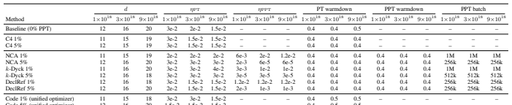
Table 4 :Data-unconstrained setting: reported configurations.The methods of Table 10 at each budget. Two schedule details have no column:k-Dyck 1% warms its PPT phase up over the first 0.1 of the phase at every budget, and the unified code 5% method warms up over 0.02 of training at 3×10¹⁸ and9×10 18; every other experiment has no warmup.
出典 · CC BY 4.0 · Alexander Stern, Tim Rocktäschel, Acyr Locatelli, Laura Ruis · Rethinking Pre-pretraining · 論文の図を引用 · 元のPDFの20ページ目から図の部分を抽出しています。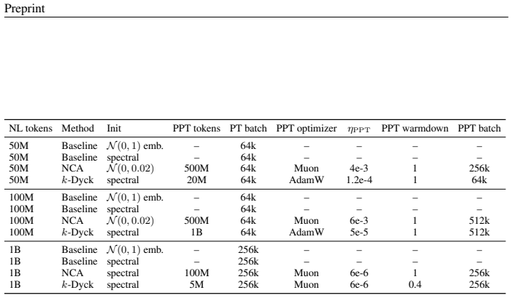
Table 5 :Additive setting: reported configurations.The twelve points of Figure 4: per natural- language (NL) budget, the two baselines the figure draws and each curriculum at its lowest-loss initialization, PPT token count and PPT optimizer. Every experiment settled onη PT = 0.02with a warmdown of 0.4, and the PPT phase runs with no warmup.
出典 · CC BY 4.0 · Alexander Stern, Tim Rocktäschel, Acyr Locatelli, Laura Ruis · Rethinking Pre-pretraining · 論文の図を引用 · 元のPDFの21ページ目から図の部分を抽出しています。
Table 6 :Over-Chinchilla setting: configurations.Depth 24 (881M parameters) on 50B tokens, the methods of panel (2) of Figure 1. Hyperparameter search details are given in Appendix D.6.
出典 · CC BY 4.0 · Alexander Stern, Tim Rocktäschel, Acyr Locatelli, Laura Ruis · Rethinking Pre-pretraining · 論文の図を引用 · 元のPDFの21ページ目から図の部分を抽出しています。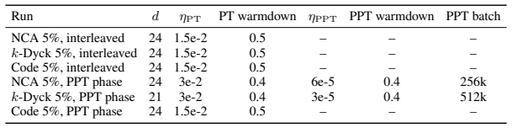
Table 7 :Retention experiment: configurations.The runs of Figure 5 at2.7×10 19 FLOPs. The PPT runs use each method’s 5% configuration, extrapolated from the smaller budgets, with a shared vocabulary. The interleaved runs train under one schedule, so they have no PPT-phase entries, and all three share the code 5% configuration so that only the interleaved corpus differs.
出典 · CC BY 4.0 · Alexander Stern, Tim Rocktäschel, Acyr Locatelli, Laura Ruis · Rethinking Pre-pretraining · 論文の図を引用 · 元のPDFの21ページ目から図の部分を抽出しています。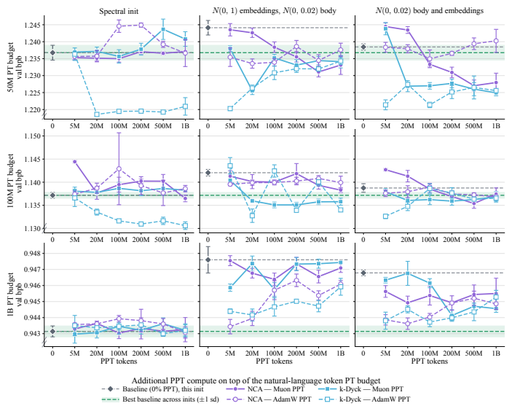
Figure 8 :Full synthetic PPT token sweep behind Figure 4.FineWeb validation bits-per-byte against the amount of synthetic PPT added on top of a fixed natural-language token budget. Rows are that budget, columns are the initialization scheme: two as used in the prior literature that introduced these curricula, and the spectral-based initialization. The model size here is 336M parameters. Within each panel the leftmost point is that configuration’s own baseline with no PPT, marked by the gray dashed line. The green dashed line and band mark the lowest-loss no-PPT baseline across the three initialization schemes, providing a reference for comparisons across initializations. Solid lines with filled markers are Muon PPT and dashed lines with open markers are AdamW PPT. AdamW performs better than Muon for the PPT methods at the lower natural-language budgets; at 1B tokens, however, the two are indistinguishable under spectral-based initialization. Importantly, if one is to train with the alternative initializations, the PPT benefit would still exist even at this larger budget.
出典 · CC BY 4.0 · Alexander Stern, Tim Rocktäschel, Acyr Locatelli, Laura Ruis · Rethinking Pre-pretraining · 論文の図を引用 · 元のPDFの22ページ目から図の部分を抽出しています。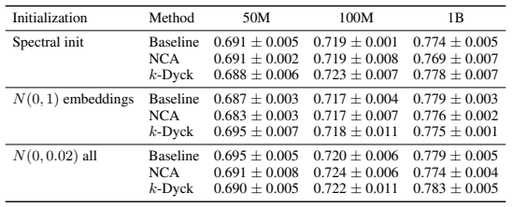
Table 8 :BLiMP in the additive setting.BLiMP accuracy for the additive-compute experiments of Figure 4: for each natural-language budget and initialization, the baseline and each curriculum at its best (lowest-loss) PPT token count (Table 5 lists the counts). Higher is better, and bold marks values whose one-standard-deviation interval lies entirely above that of the baseline with the same initialization (none are bolded here as all perform similarly to the baseline).
出典 · CC BY 4.0 · Alexander Stern, Tim Rocktäschel, Acyr Locatelli, Laura Ruis · Rethinking Pre-pretraining · 論文の図を引用 · 元のPDFの23ページ目から図の部分を抽出しています。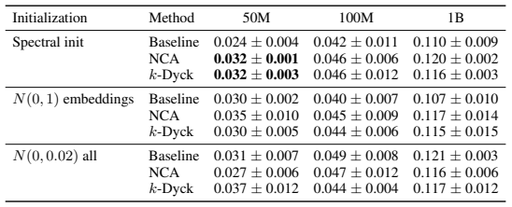
Table 9 :DCLM CORE in the additive setting.Centered CORE accuracy for the same experiments as Table 8: for each natural-language budget and initialization, the baseline and each curriculum at its best (lowest-loss) PPT token count (Table 5 lists the counts). Higher is better, and bold marks values whose one-standard-deviation interval lies entirely above that of the baseline with the same initialization.
出典 · CC BY 4.0 · Alexander Stern, Tim Rocktäschel, Acyr Locatelli, Laura Ruis · Rethinking Pre-pretraining · 論文の図を引用 · 元のPDFの23ページ目から図の部分を抽出しています。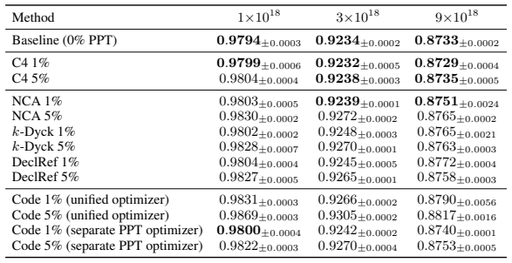
Table 10 :Allocating a larger share of a fixed compute budget to synthetic PPT generally increases loss.FineWeb bits-per-byte. Hyperparameters were searched independently for each method at every budget. Code appears under both the separate and the unified optimizer recipe. Bold marks values whose one-standard-deviation interval overlaps that of the column’s lowest.
出典 · CC BY 4.0 · Alexander Stern, Tim Rocktäschel, Acyr Locatelli, Laura Ruis · Rethinking Pre-pretraining · 論文の図を引用 · 元のPDFの24ページ目から図の部分を抽出しています。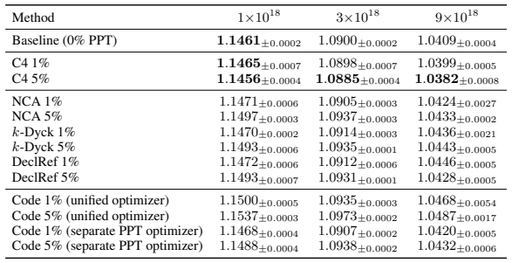
Table 11 :The data-unconstrained comparison on the held-out C4 split.C4 bits-per-byte for the methods of Table 10, same checkpoints, same protocol. Bold marks values whose one-standard- deviation interval overlaps that of the column’s lowest.
出典 · CC BY 4.0 · Alexander Stern, Tim Rocktäschel, Acyr Locatelli, Laura Ruis · Rethinking Pre-pretraining · 論文の図を引用 · 元のPDFの24ページ目から図の部分を抽出しています。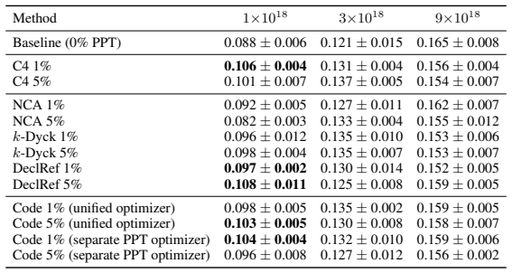
Table 14 :DCLM CORE across the data-unconstrained sweep.Centered CORE accuracy; higher is better, and bold marks values whose one-standard-deviation interval lies entirely above the base- line’s.
出典 · CC BY 4.0 · Alexander Stern, Tim Rocktäschel, Acyr Locatelli, Laura Ruis · Rethinking Pre-pretraining · 論文の図を引用 · 元のPDFの26ページ目から図の部分を抽出しています。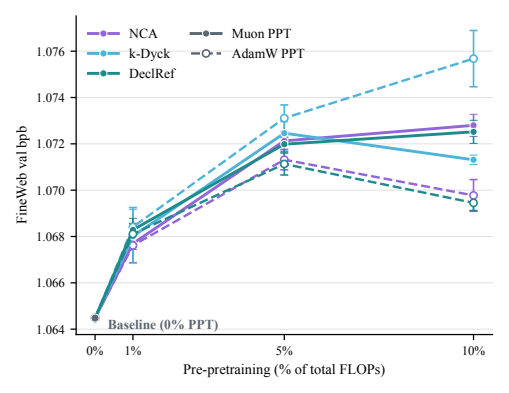
Figure 10 :Data-constrained results separated by PPT-phase optimizer.The experiments behind panel (1) of Figure 1, with Muon PPT drawn as solid lines with filled markers and AdamW PPT as dashed lines with open markers. Each experiment was searched independently under the same search space and stopping rule, so the two differ in the optimizer used during PPT and in the configuration each search found. Neither optimizer is always better than the other: AdamW is lower for NCA and DeclRef at every PPT percentage, whilek-Dyck is lower under Muon. No experiment of either optimizer reaches the no-PPT baseline.
出典 · CC BY 4.0 · Alexander Stern, Tim Rocktäschel, Acyr Locatelli, Laura Ruis · Rethinking Pre-pretraining · 論文の図を引用 · 元のPDFの27ページ目から図の部分を抽出しています。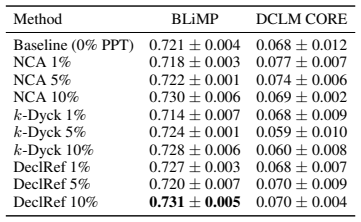
Table 15 :BLiMP and DCLM CORE in the data-constrained regime.100M unique natural- language tokens at a fixed1×10 18-FLOP budget, the experiments of panel (1) of Figure 1, each at the lower-BPB PPT optimizer. Higher is better, and bold marks values whose one-standard-deviation interval lies entirely above the baseline’s.
出典 · CC BY 4.0 · Alexander Stern, Tim Rocktäschel, Acyr Locatelli, Laura Ruis · Rethinking Pre-pretraining · 論文の図を引用 · 元のPDFの27ページ目から図の部分を抽出しています。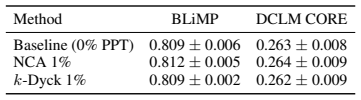
Table 16 :Over-Chinchilla benchmark summary.BLiMP and DCLM CORE for the over- Chinchilla regime: 881M parameters on 50B tokens, NCA andk-Dyck at 1%. Higher is better, and bold marks values whose one-standard-deviation interval lies entirely above the baseline’s. No method separates from the baseline on either benchmark.
出典 · CC BY 4.0 · Alexander Stern, Tim Rocktäschel, Acyr Locatelli, Laura Ruis · Rethinking Pre-pretraining · 論文の図を引用 · 元のPDFの28ページ目から図の部分を抽出しています。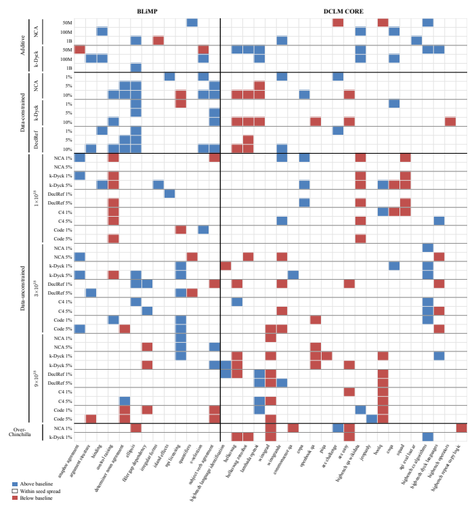
Figure 11 :Breakdown of downstream performance by benchmark sub-tasks.Each row is a PPT model from Figures 1 and 4, and each column is one of the 13 BLiMP or 22 DCLM CORE tasks. Blue cells are significantly above the baseline, red cells significantly below, and white cells on par. Most cells are white, so on most sub-scores the PPT models perform on par with their baseline. The colored cells show that, even so, the PPT method changes how the model performs on some sub-tasks of these benchmarks.
出典 · CC BY 4.0 · Alexander Stern, Tim Rocktäschel, Acyr Locatelli, Laura Ruis · Rethinking Pre-pretraining · 論文の図を引用 · 元のPDFの29ページ目から図の部分を抽出しています。この論文を引用
Alexander Stern, Tim Rocktäschel, Acyr Locatelli, Laura Ruis (2026). Rethinking Pre-pretraining. arXiv:2610.40051v1. https://arxiv.org/abs/2610.40051v1
BibTeX
@misc{stern2026rethinking,
  title = {{Rethinking Pre-pretraining}},
  author = {Alexander Stern and Tim Rocktäschel and Acyr Locatelli and Laura Ruis},
  year = {2026},
  eprint = {2610.40051},
  archivePrefix = {arXiv},
  url = {https://arxiv.org/abs/2610.40051v1}
}