論文解説
Medical Image Segmentation: Foundation Model Adaptation versus Task-Specific Training
医用画像セグメンテーション:基盤モデルの適応とタスク特化型学習の比較
- 課題 大規模な自然画像で事前学習されたDINOv2を医用画像セグメンテーションに適応させることが、タスク特化型のU-Netより有利になるのはいつか、また必要な適応の容量が何によって決まるのかを、3つのドメインで分布内と分布外の評価に分けて検証します。
- 手法 DINOv2-Smallのエンコーダは凍結し、BitFit、LoRA(ランク4~32)、完全なファインチューニングを適用します。線形デコーダも合わせて学習します。plain U-Netとresidual U-Netは、nnU-Netの手順でそれぞれ独立に学習して比較します。
- 結果 分布内では、学習セット全体を基準にした適応で精度の優位は見られませんでした。一方、分布外の8つのセットでは、2つのタスク特化型構造のどちらに対しても、DINOv2がDSCで上回りました。必要なLoRAランクはドメインによって異なり、BitFitでも同じドメインの順序が現れました。
既存比較の限界と研究の問い
本論文は、大規模な自然画像で事前学習された基盤モデルを医用画像セグメンテーションに適応させる方法が、ドメインごとに学習したタスク特化型モデルを置き換えられるのかを問うています。既存の比較の多くは学習分布の中で行われ、タスク特化型のベースラインの設定が十分に正当化されないまま、単一の運用点で行われています。そのため、新しい病院や機器での性能は分かりにくいままです。
著者らはこの問題を2つの軸に分けています。アーキテクチャの軸では、適応させたDINOv2と、最初から学習したU-Net系を比較します。適応の軸では、DINOv2のどこまでを適応させる必要があるかを見ます。大腸内視鏡のポリープ、乳房超音波、皮膚病変の3つのドメインで、学習分布内のテストと、別の施設での分布外テストを分けて評価します。
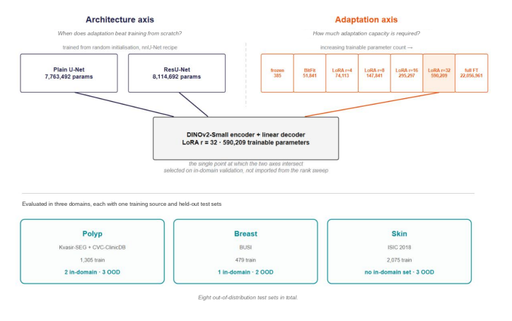
Figure 1 : Experimental design. The architecture axis compares an adapted DINOv2 against two models trained from random initialisation; the adaptation axis compares seven configurations of the same model by trainable parameter count. The two intersect at LoRA rank 32, selected on in-domain validation. All comparisons run across three domains and eight out-of-distribution test sets.
出典 · CC BY 4.0 · Emre Kutlusan, Yongmin Li · Medical Image Segmentation: Foundation Model Adaptation versus Task-Specific Training · 論文の図を引用 · 元のPDFの6ページ目から図の部分を抽出しています。DINOv2の適応方法と基準モデル
適応実験では、DINOv2-Smallのエンコーダと、1×1の畳み込み1つからなる線形デコーダを使います。このデコーダは384次元のパッチ埋め込みを1チャンネルのロジットマップに変換し、385個のパラメータを持ちます。デコーダを重くすると、適応がエンコーダではなくデコーダで吸収されてしまうおそれがあるため、エンコーダがどの程度変わる必要があるかを見るために、ここまで小さくしています。
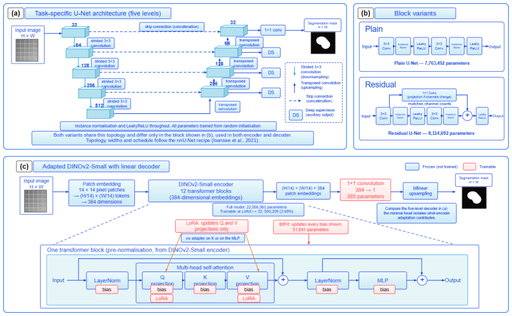
Figure 3 : Model architectures. (a) The five-level encoder–decoder topology shared by both task-specific comparators. (b) One block in each variant. The two differ in the residual addition and its projection shortcut, applied in both encoder and decoder, while widths, normalisation, activation, downsampling and training recipe are identical. (c) The adapted model: a DINOv2-Small encoder producing 384-dimensional patch embeddings, reduced to a one-channel logit map by a single1×1convolution of 385 parameters and upsampled to the input resolution. The magnified block shows where each adaptation strategy intervenes. Blue marks parameters held frozen and red marks parameters updated.
出典 · CC BY 4.0 · Emre Kutlusan, Yongmin Li · Medical Image Segmentation: Foundation Model Adaptation versus Task-Specific Training · 論文の図を引用 · 元のPDFの9ページ目から図の部分を抽出しています。容量の軸では、エンコーダを凍結する設定、BitFit、LoRAのランク4·8·16·32、完全なファインチューニングを比較します。LoRAはクエリと値の射影に低ランクの更新を加え、BitFitはエンコーダのバイアス項のみを学習します。タスク特化型の比較対象としては、plain U-NetとresidualU-Netを、nnU-Netの手順に従ってそれぞれ独立に学習しました。2つのモデルは残差接続の有無だけが異なり、それ以外の構造と学習手順は同じです。
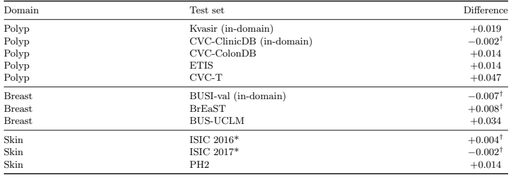
Table 7 : Plain U-Net minus ResU-Net by test set, all domains, single seed. Positive values favour the plain architecture; a dagger marks differences below the floor.
出典 · CC BY 4.0 · Emre Kutlusan, Yongmin Li · Medical Image Segmentation: Foundation Model Adaptation versus Task-Specific Training · 論文の図を引用 · 元のPDFの15ページ目から図の部分を抽出しています。分布内の結果と分布外の結果の対比
分布内の評価では、学習セット全体を基準にした場合、DINOv2に精度の優位は見られませんでした。ポリープの2つの分布内セットの平均では、plain U-Netが0.8803、適応モデルが0.8780で、測定限界の0.013より小さい差でした。乳房では、タスク特化型モデルが検証分割で上回りましたが、この分割は早期終了にも使われたため、暫定的な結果と解釈すべきです。
分布外では、両方の構造に対して、8つのセットすべてでDINOv2がDSCで上回りました。方向性は強い一方、大きさはドメインやセットによって異なります。
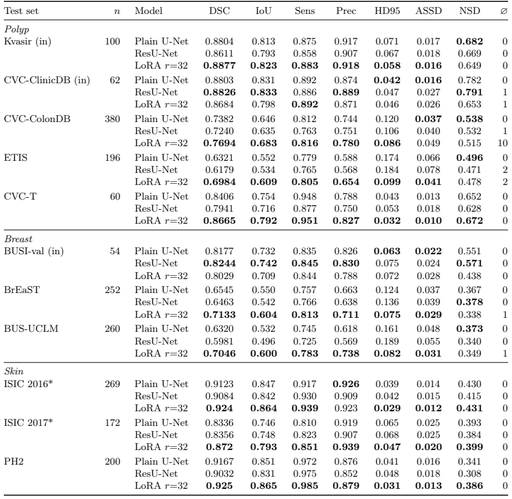
Table 5 : Six metrics by model and test set. DSC, IoU, sensitivity (Sens), precision (Prec) and NSD: higher is better; HD95 and ASSD are divided by the image diagonal (Section 3.6): lower is better. NSD at a tolerance of 2/224 of the image width.∅: images with an empty prediction. Resolution 224px in polyp and breast; in skin 392px for DINOv2 and 384px for the U-Nets. Task-specific models trained for 300 epochs in polyp and breast and 100 in skin; DINOv2 for 40 epochs in polyp and breast and 20 in skin, single-seed except skin DINOv2, a three-seed mean (its ∅ is the mean per seed). (in) marks in-domain sets; BUSI-val also served for model selection. Asterisks mark skin sets drawn from the same archive as the training data; all CVC-T images also occur in CVC-ColonDB (Section 3.2). DSC values are those of the original evaluation, which the re-evaluation that produced the other metrics reproduces to within 0.0007 (Section 3.6). Bold marks the best value for each test set.
出典 · CC BY 4.0 · Emre Kutlusan, Yongmin Li · Medical Image Segmentation: Foundation Model Adaptation versus Task-Specific Training · 論文の図を引用 · 元のPDFの13ページ目から図の部分を抽出しています。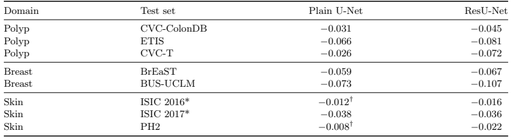
Table 6 : Deficit of each task-specific model relative to DINOv2 + LoRAr=32on the eight out-of-distribution sets. Negative values indicate the task-specific model is behind; a dagger marks differences below the 0.013 floor.
出典 · CC BY 4.0 · Emre Kutlusan, Yongmin Li · Medical Image Segmentation: Foundation Model Adaptation versus Task-Specific Training · 論文の図を引用 · 元のPDFの15ページ目から図の部分を抽出しています。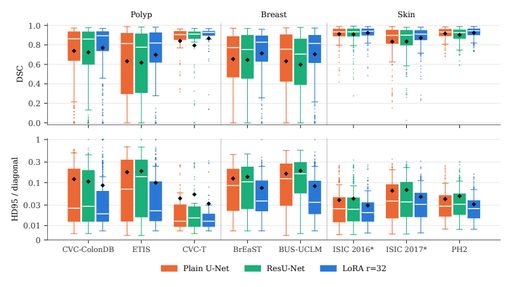
Figure 5 : Per-image DSC (top) and HD95 divided by the image diagonal (bottom, symmetric-log scale; lower is better) on the eight out-of-distribution sets. Boxes span the interquartile range with the median in white; whiskers extend to 1.5 times the interquartile range; diamonds mark the mean. An empty prediction scores DSC 0 and HD95 1. Models and budgets as in Table 5; skin DINOv2 values are per-image means over three seeds.
出典 · CC BY 4.0 · Emre Kutlusan, Yongmin Li · Medical Image Segmentation: Foundation Model Adaptation versus Task-Specific Training · 論文の図を引用 · 元のPDFの16ページ目から図の部分を抽出しています。容量要求と評価条件の解釈
容量の軸の結果は、ドメインによって異なる形で現れます。ポリープでは、ランクを32まで上げると分布外の性能が上がり続けました。乳房ではランク16付近で横ばいになり、皮膚ではランク4以降ほとんど変わりませんでした。BitFitでも同じドメインの順序が見られ、ポリープではLoRAのランク32がBitFitを上回った一方、乳房と皮膚ではBitFitが同程度か上回りました。
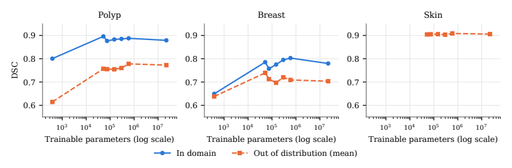
Figure 8 : Capacity axis by domain: DSC against trainable parameter count (logarithmic scale), with the values of
出典 · CC BY 4.0 · Emre Kutlusan, Yongmin Li · Medical Image Segmentation: Foundation Model Adaptation versus Task-Specific Training · 論文の図を引用 · 元のPDFの21ページ目から図の部分を抽出しています。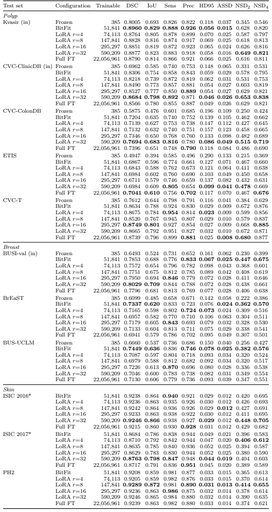
Table 19 : Capacity axis by test set in all metrics. Polyp and breast at 40 epochs, skin at 20 to match its rank sweep, all seed 42. The skin frozen configuration is omitted: its checkpoint was trained under an earlier protocol and is not comparable. DSC values are those of the original evaluation, except on CVC-ClinicDB, which was not reported there and is recomputed. HD95 and ASSD are divided by the image diagonal (lower is better); NSD2 and NSD4 at 2/224 and 4/224 of the image width. BitFit’s BUSI-val value is its own selection criterion, not an independent result. (in) marks in-domain sets. Bold marks the best configuration for each test set and metric.
出典 · CC BY 4.0 · Emre Kutlusan, Yongmin Li · Medical Image Segmentation: Foundation Model Adaptation versus Task-Specific Training · 論文の図を引用 · 元のPDFの27ページ目から図の部分を抽出しています。ただし、学習エポック数を20から40に増やすと、乳房の分布外におけるランク効果はほぼ消えました。一方、分布内の効果は大きく変わりませんでした。著者らは、20エポックの設定で見られた容量要求の一部は、収束速度の差だった可能性があると解釈しています。また、LoRAは完全なファインチューニングと同じDSCを示しながら、精密度が低いままでした。この結果は、DINOv2-Smallという1つのバックボーンと、シード数が限られた条件で得られたものです。

Table 4 : Epoch budgets, matched within every comparison but not across domains.
出典 · CC BY 4.0 · Emre Kutlusan, Yongmin Li · Medical Image Segmentation: Foundation Model Adaptation versus Task-Specific Training · 論文の図を引用 · 元のPDFの11ページ目から図の部分を抽出しています。
Table 16 : LoRAr=32against full fine-tuning, polyp, 20 epochs, three seeds. Values are three-seed means (seeds 42, 123 and 2024); the seed-42 LoRAr=32run alone appears in Table 24.∆is LoRA minus full fine-tuning; the verdict applies the criterion of Section 3.6, not the measurement floor. “No difference” records a failure to reject, not equivalence.
出典 · CC BY 4.0 · Emre Kutlusan, Yongmin Li · Medical Image Segmentation: Foundation Model Adaptation versus Task-Specific Training · 論文の図を引用 · 元のPDFの25ページ目から図の部分を抽出しています。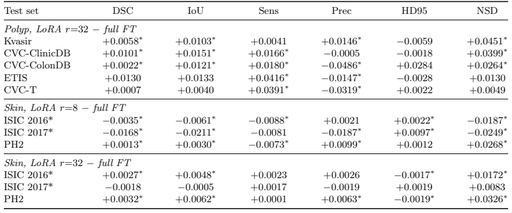
Table 17 : LoRA against full fine-tuning in all metrics, three seeds (42, 123, 2024), 20 epochs; polyp as in Table 16, skin as in Table 20. Each entry is the mean over images of the seed-averaged per-image difference, LoRA minus full fine-tuning; for HD95 (divided by the image diagonal) a negative value favours LoRA, for all other metrics a positive one. An asterisk marksp <0.05in a Wilcoxon signed-rank test on the seed-averaged per-image vectors (Section 3.6).
出典 · CC BY 4.0 · Emre Kutlusan, Yongmin Li · Medical Image Segmentation: Foundation Model Adaptation versus Task-Specific Training · 論文の図を引用 · 元のPDFの26ページ目から図の部分を抽出しています。
Table 18 : Effect of doubling the epoch budget on the measured rank effect. Breast rows user=16 −r= 4and the polyp rowr=32−r=4, in each case that domain’s span at 20 epochs. Single seed.
出典 · CC BY 4.0 · Emre Kutlusan, Yongmin Li · Medical Image Segmentation: Foundation Model Adaptation versus Task-Specific Training · 論文の図を引用 · 元のPDFの26ページ目から図の部分を抽出しています。適用範囲と限界
この研究の主な限界は、1つのバックボーンにしか適応の軸を適用していない点です。すべての適応戦略はDINOv2-Smallに適用されたため、必要な容量がバックボーンに固有のものかどうかは検証されていません。また、BitFitはドメインごとに学習率の探索を受けましたが、LoRAと完全なファインチューニングは受けていないため、比較に非対称性があります。ほとんどの軸は単一シードの結果であり、測定限界は反復実行の差から得た値です。

Table 22 : BitFit learning-rate search, polyp, 40 epochs. Validation selects 1e-3. Bold marks the best value in each column.
出典 · CC BY 4.0 · Emre Kutlusan, Yongmin Li · Medical Image Segmentation: Foundation Model Adaptation versus Task-Specific Training · 論文の図を引用 · 元のPDFの29ページ目から図の部分を抽出しています。さらに、3つのドメインに限られているため、ドメイン依存性の原因までは説明できません。データ量を増やすと分布内の差は縮まりましたが、ドメイン間の分布外の差は予測できませんでした。したがって、どのドメインにどの程度の適応が必要かは、対象ドメインで直接選ぶ必要があります。
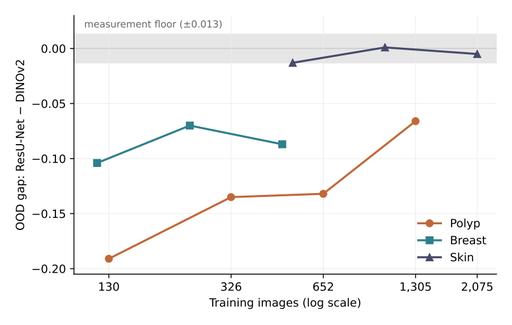
Figure 7 : Out-of-distribution gap between ResU-Net and DINOv2 + LoRAr=32against training-set size, by domain. Negative values indicate the task-specific model is behind; the shaded band marks the 0.013 measurement floor.
出典 · CC BY 4.0 · Emre Kutlusan, Yongmin Li · Medical Image Segmentation: Foundation Model Adaptation versus Task-Specific Training · 論文の図を引用 · 元のPDFの19ページ目から図の部分を抽出しています。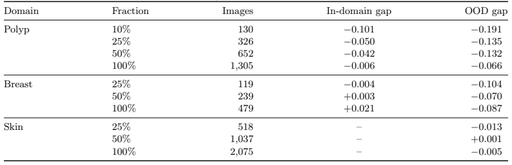
Table 13 : Data-size sweep. Gaps are ResU-Net minus DINOv2 + LoRAr=32on the identical subset, single-seed; positive favours training from scratch. In-domain and OOD gaps are averaged over each domain’s in-domain and out-of-distribution sets respectively. Skin was run at224×224at every fraction (Section 3.5), so its gaps are not comparable with Table 5 and are compared only within the sweep.
出典 · CC BY 4.0 · Emre Kutlusan, Yongmin Li · Medical Image Segmentation: Foundation Model Adaptation versus Task-Specific Training · 論文の図を引用 · 元のPDFの25ページ目から図の部分を抽出しています。論文情報
- 著者
- Emre Kutlusan, Yongmin Li
- 学会・ジャーナル
- arXiv · プレプリント
- 公開日
- 2026年11月10日
- 登録日
- 2026年11月12日
- 更新日
- 2026年11月10日
- バージョン
- v1
- arXiv
- 2611.14519
- カテゴリ
- cs.CV · cs.AI
- ライセンス
- CC BY 4.0
- 掲載内容
- 論文情報・解説・論文の図
この解説は、Refivuの韓国語解説をAIで翻訳したものです。不正確な翻訳や誤りが含まれる可能性があります。論文と図の利用条件は各出典に従います。
アブストラクト
Foundation models pretrained on large natural-image collections are increasingly adapted for medical image segmentation, in the expectation that they will replace models trained for each task. Most comparisons, however, use data from the training distribution and a single task-specific baseline whose configuration is rarely justified, and therefore provide limited evidence of performance at new clinical sites. It also remains unclear how much of a foundation model must be adapted, and what determines this. We adapted a foundation model, DINOv2, with strategies ranging from tuning only its bias terms to full fine-tuning, and compared it with U-Nets and ResU-Nets trained from scratch. Experiments covered colonoscopy, breast ultrasound and dermoscopy, with testing on held-out data from the training source and on independent datasets from other institutions. The adapted foundation model generalised better on every external dataset. Within the training distribution, the task-specific models remained competitive when training data were abundant, and delineated boundaries more precisely, while the foundation model more often missed small lesions. Only a small fraction of the foundation model required adaptation, and the capacity needed was determined by the imaging domain rather than by the adaptation method. A widely used polyp test set was also found to duplicate images from another benchmark. Foundation-model adaptation is therefore warranted where models must work across sites, with capacity selected on the target domain.
この論文を引用
Emre Kutlusan, Yongmin Li (2026). Medical Image Segmentation: Foundation Model Adaptation versus Task-Specific Training. arXiv:2611.14519v1. https://arxiv.org/abs/2611.14519v1
BibTeX
@misc{kutlusan2026medical,
  title = {{Medical Image Segmentation: Foundation Model Adaptation versus Task-Specific Training}},
  author = {Emre Kutlusan and Yongmin Li},
  year = {2026},
  eprint = {2611.14519},
  archivePrefix = {arXiv},
  url = {https://arxiv.org/abs/2611.14519v1}
}