논문 해설
Medical Image Segmentation: Foundation Model Adaptation versus Task-Specific Training
의료 영상 분할: 파운데이션 모델 적응 대 과제 특화 학습
- 연구 문제 대규모 자연 이미지로 사전학습된 DINOv2를 의료 영상 분할에 적응시키는 것이 작업 특화 U-Net보다 언제 유리한지, 그리고 필요한 적응 용량이 무엇에 의해 정해지는지를 세 도메인에서 분포 내와 외부 분포 평가로 나누어 검증합니다.
- 연구 방법 DINOv2-Small 인코더에 고정, BitFit, LoRA 랭크 4~32, 완전 fine-tuning을 적용하고 선형 디코더를 함께 학습하며, plain U-Net과 residual U-Net을 nnU-Net 절차로 독립 학습해 비교합니다.
- 주요 결과 분포 내에서는 전체 학습 세트 기준 적응의 정확도 우위가 관찰되지 않았지만, 외부 분포 8개 세트에서는 두 작업 특화 구조 모두에 대해 DINOv2가 DSC에서 앞섰습니다. 필요한 LoRA 랭크는 도메인에 따라 달랐고 BitFit에서도 같은 도메인 순서가 나타났습니다.
기존 비교의 한계와 연구 질문
이 논문은 대규모 자연 이미지로 사전학습된 파운데이션 모델을 의료 영상 분할에 적응시키는 방식이, 도메인별로 학습한 작업 특화 모델을 대체할 수 있는지 묻습니다. 기존 비교는 대개 학습 분포 안에서 수행되고, 작업 특화 기준 모델의 설정이 충분히 정당화되지 않은 채 단일 운영점에서 이루어집니다. 그래서 새로운 병원이나 장비에서의 성능을 알려 주기 어렵습니다.
저자들은 이 문제를 두 축으로 나눕니다. 아키텍처 축은 적응된 DINOv2와 처음부터 학습한 U-Net 계열을 비교하고, 적응 축은 DINOv2의 얼마만큼을 적응시켜야 하는지를 봅니다. 대장내시경 폴립, 유방 초음파, 피부 병변 세 도메인에서 학습 분포 안의 테스트와 다른 기관의 외부 분포 테스트를 분리해 평가합니다.
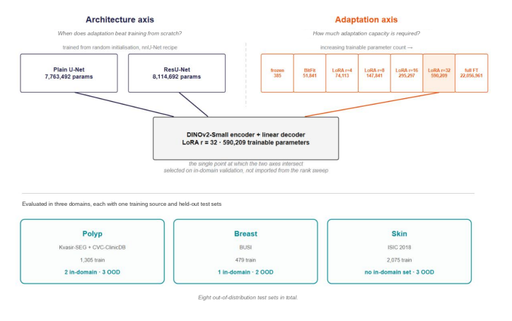
Figure 1 : Experimental design. The architecture axis compares an adapted DINOv2 against two models trained from random initialisation; the adaptation axis compares seven configurations of the same model by trainable parameter count. The two intersect at LoRA rank 32, selected on in-domain validation. All comparisons run across three domains and eight out-of-distribution test sets.
원문 · CC BY 4.0 · Emre Kutlusan, Yongmin Li · Medical Image Segmentation: Foundation Model Adaptation versus Task-Specific Training · 원문 그림 인용 · 원본 PDF 6쪽에서 그림 영역을 추출했습니다.DINOv2 적응 방식과 기준 모델
적응 실험은 DINOv2-Small 인코더와 1×1 합성곱 하나로 이루어진 선형 디코더를 사용합니다. 이 디코더는 384차원 패치 임베딩을 한 채널 로짓 맵으로 바꾸며 385개의 파라미터를 가집니다. 디코더를 무겁게 만들면 적응이 인코더 대신 디코더에서 흡수될 수 있으므로, 인코더가 얼마나 바뀌어야 하는지를 보기 위해 이렇게 최소화했습니다.
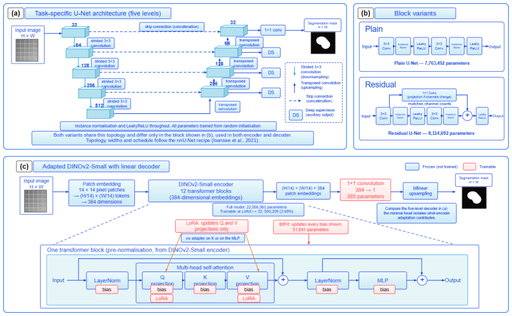
Figure 3 : Model architectures. (a) The five-level encoder–decoder topology shared by both task-specific comparators. (b) One block in each variant. The two differ in the residual addition and its projection shortcut, applied in both encoder and decoder, while widths, normalisation, activation, downsampling and training recipe are identical. (c) The adapted model: a DINOv2-Small encoder producing 384-dimensional patch embeddings, reduced to a one-channel logit map by a single1×1convolution of 385 parameters and upsampled to the input resolution. The magnified block shows where each adaptation strategy intervenes. Blue marks parameters held frozen and red marks parameters updated.
원문 · CC BY 4.0 · Emre Kutlusan, Yongmin Li · Medical Image Segmentation: Foundation Model Adaptation versus Task-Specific Training · 원문 그림 인용 · 원본 PDF 9쪽에서 그림 영역을 추출했습니다.용량 축에서는 인코더를 고정하는 설정, BitFit, LoRA의 랭크 4·8·16·32, 완전 fine-tuning을 비교합니다. LoRA는 쿼리와 값 투영에 저랭크 업데이트를 붙이고, BitFit은 인코더의 편향 항만 학습합니다. 작업 특화 비교군으로는 plain U-Net과 residual U-Net을 nnU-Net 절차에 따라 각각 독립적으로 학습했습니다. 두 모델은 잔차 연결의 유무만 다르며 나머지 구조와 학습 절차는 같습니다.
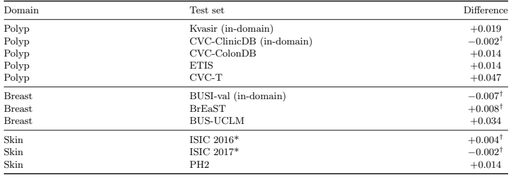
Table 7 : Plain U-Net minus ResU-Net by test set, all domains, single seed. Positive values favour the plain architecture; a dagger marks differences below the floor.
원문 · CC BY 4.0 · Emre Kutlusan, Yongmin Li · Medical Image Segmentation: Foundation Model Adaptation versus Task-Specific Training · 원문 그림 인용 · 원본 PDF 15쪽에서 그림 영역을 추출했습니다.분포 내 결과와 외부 분포 결과의 대비
분포 내 평가에서는 전체 학습 세트 기준으로 DINOv2에 정확도 우위가 관찰되지 않았습니다. 폴립 두 분포 내 세트 평균에서 plain U-Net은 0.8803, 적응 모델은 0.8780으로 측정 한계 0.013보다 작은 차이를 보였습니다. 유방에서는 작업 특화 모델들이 검증 분할에서 앞섰으나, 이 분할은 조기 종료에도 쓰였으므로 잠정적 결과로 읽어야 합니다.
외부 분포에서는 두 구조 모두에서 8개 세트 전부에서 DINOv2가 DSC 기준으로 앞섰습니다. 따라서 같은 방향성은 강하지만 도메인과 세트에 따라 크기가 달라집니다.
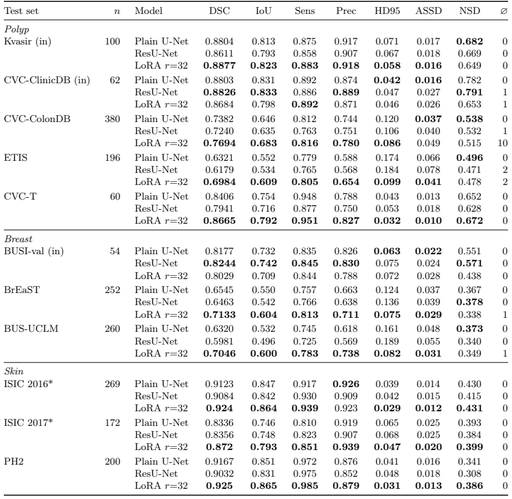
Table 5 : Six metrics by model and test set. DSC, IoU, sensitivity (Sens), precision (Prec) and NSD: higher is better; HD95 and ASSD are divided by the image diagonal (Section 3.6): lower is better. NSD at a tolerance of 2/224 of the image width.∅: images with an empty prediction. Resolution 224px in polyp and breast; in skin 392px for DINOv2 and 384px for the U-Nets. Task-specific models trained for 300 epochs in polyp and breast and 100 in skin; DINOv2 for 40 epochs in polyp and breast and 20 in skin, single-seed except skin DINOv2, a three-seed mean (its ∅ is the mean per seed). (in) marks in-domain sets; BUSI-val also served for model selection. Asterisks mark skin sets drawn from the same archive as the training data; all CVC-T images also occur in CVC-ColonDB (Section 3.2). DSC values are those of the original evaluation, which the re-evaluation that produced the other metrics reproduces to within 0.0007 (Section 3.6). Bold marks the best value for each test set.
원문 · CC BY 4.0 · Emre Kutlusan, Yongmin Li · Medical Image Segmentation: Foundation Model Adaptation versus Task-Specific Training · 원문 그림 인용 · 원본 PDF 13쪽에서 그림 영역을 추출했습니다.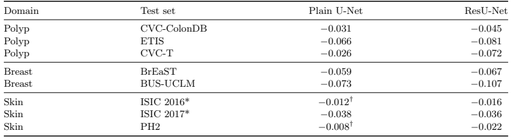
Table 6 : Deficit of each task-specific model relative to DINOv2 + LoRAr=32on the eight out-of-distribution sets. Negative values indicate the task-specific model is behind; a dagger marks differences below the 0.013 floor.
원문 · CC BY 4.0 · Emre Kutlusan, Yongmin Li · Medical Image Segmentation: Foundation Model Adaptation versus Task-Specific Training · 원문 그림 인용 · 원본 PDF 15쪽에서 그림 영역을 추출했습니다.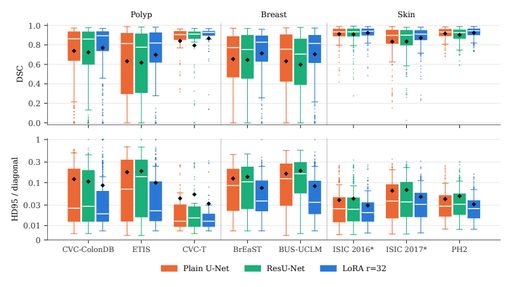
Figure 5 : Per-image DSC (top) and HD95 divided by the image diagonal (bottom, symmetric-log scale; lower is better) on the eight out-of-distribution sets. Boxes span the interquartile range with the median in white; whiskers extend to 1.5 times the interquartile range; diamonds mark the mean. An empty prediction scores DSC 0 and HD95 1. Models and budgets as in Table 5; skin DINOv2 values are per-image means over three seeds.
원문 · CC BY 4.0 · Emre Kutlusan, Yongmin Li · Medical Image Segmentation: Foundation Model Adaptation versus Task-Specific Training · 원문 그림 인용 · 원본 PDF 16쪽에서 그림 영역을 추출했습니다.용량 요구와 평가 조건의 해석
용량 축의 결과는 도메인에 따라 다르게 나타납니다. 폴립에서는 랭크를 32까지 올릴 때 외부 분포 성능이 계속 올라갔고, 유방은 랭크 16 부근에서 평탄해졌으며, 피부는 랭크 4 이후 거의 변하지 않았습니다. BitFit도 같은 도메인 순서를 보였고, 폴립에서 LoRA 랭크 32가 BitFit보다 앞선 반면 유방과 피부에서는 BitFit이 비슷하거나 앞섰습니다.
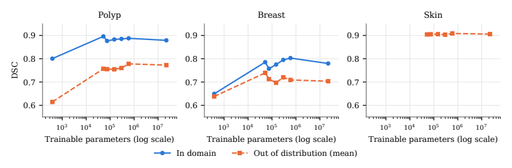
Figure 8 : Capacity axis by domain: DSC against trainable parameter count (logarithmic scale), with the values of
원문 · CC BY 4.0 · Emre Kutlusan, Yongmin Li · Medical Image Segmentation: Foundation Model Adaptation versus Task-Specific Training · 원문 그림 인용 · 원본 PDF 21쪽에서 그림 영역을 추출했습니다.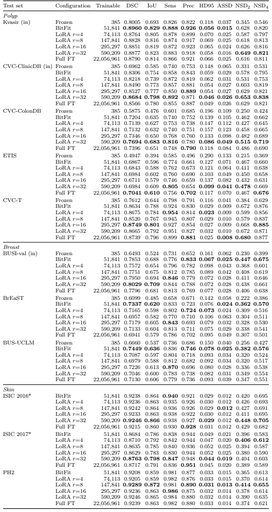
Table 19 : Capacity axis by test set in all metrics. Polyp and breast at 40 epochs, skin at 20 to match its rank sweep, all seed 42. The skin frozen configuration is omitted: its checkpoint was trained under an earlier protocol and is not comparable. DSC values are those of the original evaluation, except on CVC-ClinicDB, which was not reported there and is recomputed. HD95 and ASSD are divided by the image diagonal (lower is better); NSD2 and NSD4 at 2/224 and 4/224 of the image width. BitFit’s BUSI-val value is its own selection criterion, not an independent result. (in) marks in-domain sets. Bold marks the best configuration for each test set and metric.
원문 · CC BY 4.0 · Emre Kutlusan, Yongmin Li · Medical Image Segmentation: Foundation Model Adaptation versus Task-Specific Training · 원문 그림 인용 · 원본 PDF 27쪽에서 그림 영역을 추출했습니다.다만 에폭 예산을 20에서 40으로 늘리자 유방의 외부 분포 랭크 효과는 거의 사라졌습니다. 반면 분포 내 효과는 크게 변하지 않았습니다. 저자들은 20에폭 설정에서 관찰된 용량 요구의 일부가 수렴 속도 차이였을 수 있다고 해석합니다. 또 LoRA는 완전 fine-tuning과 같은 DSC를 보이면서도 정밀도가 낮았습니다. 이 결과는 DINOv2-Small 한 백본과 시드 수가 제한된 조건에서 얻은 것입니다.

Table 4 : Epoch budgets, matched within every comparison but not across domains.
원문 · CC BY 4.0 · Emre Kutlusan, Yongmin Li · Medical Image Segmentation: Foundation Model Adaptation versus Task-Specific Training · 원문 그림 인용 · 원본 PDF 11쪽에서 그림 영역을 추출했습니다.
Table 16 : LoRAr=32against full fine-tuning, polyp, 20 epochs, three seeds. Values are three-seed means (seeds 42, 123 and 2024); the seed-42 LoRAr=32run alone appears in Table 24.∆is LoRA minus full fine-tuning; the verdict applies the criterion of Section 3.6, not the measurement floor. “No difference” records a failure to reject, not equivalence.
원문 · CC BY 4.0 · Emre Kutlusan, Yongmin Li · Medical Image Segmentation: Foundation Model Adaptation versus Task-Specific Training · 원문 그림 인용 · 원본 PDF 25쪽에서 그림 영역을 추출했습니다.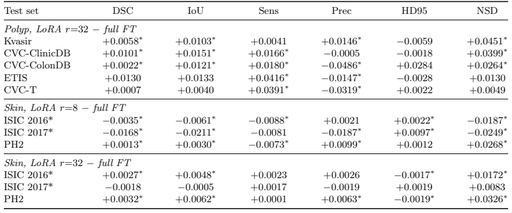
Table 17 : LoRA against full fine-tuning in all metrics, three seeds (42, 123, 2024), 20 epochs; polyp as in Table 16, skin as in Table 20. Each entry is the mean over images of the seed-averaged per-image difference, LoRA minus full fine-tuning; for HD95 (divided by the image diagonal) a negative value favours LoRA, for all other metrics a positive one. An asterisk marksp <0.05in a Wilcoxon signed-rank test on the seed-averaged per-image vectors (Section 3.6).
원문 · CC BY 4.0 · Emre Kutlusan, Yongmin Li · Medical Image Segmentation: Foundation Model Adaptation versus Task-Specific Training · 원문 그림 인용 · 원본 PDF 26쪽에서 그림 영역을 추출했습니다.
Table 18 : Effect of doubling the epoch budget on the measured rank effect. Breast rows user=16 −r= 4and the polyp rowr=32−r=4, in each case that domain’s span at 20 epochs. Single seed.
원문 · CC BY 4.0 · Emre Kutlusan, Yongmin Li · Medical Image Segmentation: Foundation Model Adaptation versus Task-Specific Training · 원문 그림 인용 · 원본 PDF 26쪽에서 그림 영역을 추출했습니다.적용 범위와 한계
이 연구의 주요 한계는 하나의 백본에만 적응 축을 적용했다는 점입니다. 모든 적응 전략은 DINOv2-Small에 적용되었으므로, 용량 요구가 백본에 특이적인지는 검증되지 않았습니다. 또 BitFit은 도메인별 학습률 탐색을 받았지만 LoRA와 완전 fine-tuning은 그렇지 않아, 비교에 비대칭이 있습니다. 대부분의 축은 단일 시드 결과이며, 측정 한계는 반복 실행의 차이에서 얻은 값입니다.

Table 22 : BitFit learning-rate search, polyp, 40 epochs. Validation selects 1e-3. Bold marks the best value in each column.
원문 · CC BY 4.0 · Emre Kutlusan, Yongmin Li · Medical Image Segmentation: Foundation Model Adaptation versus Task-Specific Training · 원문 그림 인용 · 원본 PDF 29쪽에서 그림 영역을 추출했습니다.또한 세 도메인이라는 제한이 있어 도메인 의존성의 원인을 설명하지는 못합니다. 데이터 양을 늘리면 분포 내 격차는 줄었지만 도메인 간 외부 분포 격차를 예측하지 못했습니다. 따라서 어떤 도메인에 적응이 얼마나 필요한지는 목표 도메인에서 직접 선택해야 합니다.
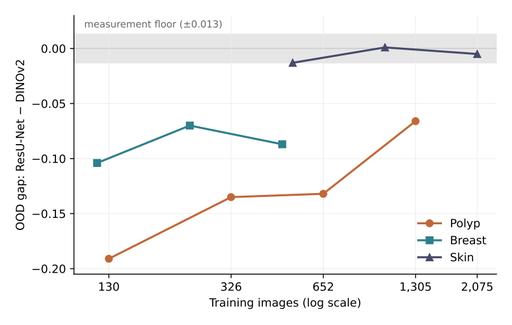
Figure 7 : Out-of-distribution gap between ResU-Net and DINOv2 + LoRAr=32against training-set size, by domain. Negative values indicate the task-specific model is behind; the shaded band marks the 0.013 measurement floor.
원문 · CC BY 4.0 · Emre Kutlusan, Yongmin Li · Medical Image Segmentation: Foundation Model Adaptation versus Task-Specific Training · 원문 그림 인용 · 원본 PDF 19쪽에서 그림 영역을 추출했습니다.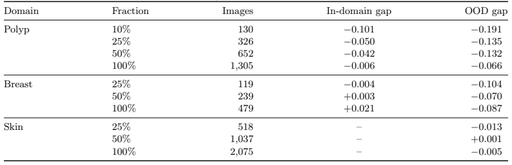
Table 13 : Data-size sweep. Gaps are ResU-Net minus DINOv2 + LoRAr=32on the identical subset, single-seed; positive favours training from scratch. In-domain and OOD gaps are averaged over each domain’s in-domain and out-of-distribution sets respectively. Skin was run at224×224at every fraction (Section 3.5), so its gaps are not comparable with Table 5 and are compared only within the sweep.
원문 · CC BY 4.0 · Emre Kutlusan, Yongmin Li · Medical Image Segmentation: Foundation Model Adaptation versus Task-Specific Training · 원문 그림 인용 · 원본 PDF 25쪽에서 그림 영역을 추출했습니다.논문 정보
- 저자
- Emre Kutlusan, Yongmin Li
- 학회·저널
- arXiv · 프리프린트
- 최초 공개일
- 2026년 11월 10일
- 등록일
- 2026년 11월 12일
- 수정일
- 2026년 11월 10일
- 버전
- v1
- arXiv
- 2611.14519
- 분류
- cs.CV · cs.AI
- 원문 이용 조건
- CC BY 4.0
- 제공 범위
- 논문 정보, 해설, 허용된 원문 그림
AI 해설은 논문 원문과 별개의 설명이며 오류가 있을 수 있습니다. 원문과 그림은 각 출처의 이용 조건과 따로 표시된 권리를 따릅니다.
초록
Foundation models pretrained on large natural-image collections are increasingly adapted for medical image segmentation, in the expectation that they will replace models trained for each task. Most comparisons, however, use data from the training distribution and a single task-specific baseline whose configuration is rarely justified, and therefore provide limited evidence of performance at new clinical sites. It also remains unclear how much of a foundation model must be adapted, and what determines this. We adapted a foundation model, DINOv2, with strategies ranging from tuning only its bias terms to full fine-tuning, and compared it with U-Nets and ResU-Nets trained from scratch. Experiments covered colonoscopy, breast ultrasound and dermoscopy, with testing on held-out data from the training source and on independent datasets from other institutions. The adapted foundation model generalised better on every external dataset. Within the training distribution, the task-specific models remained competitive when training data were abundant, and delineated boundaries more precisely, while the foundation model more often missed small lesions. Only a small fraction of the foundation model required adaptation, and the capacity needed was determined by the imaging domain rather than by the adaptation method. A widely used polyp test set was also found to duplicate images from another benchmark. Foundation-model adaptation is therefore warranted where models must work across sites, with capacity selected on the target domain.
원문 인용
Emre Kutlusan, Yongmin Li (2026). Medical Image Segmentation: Foundation Model Adaptation versus Task-Specific Training. arXiv:2611.14519v1. https://arxiv.org/abs/2611.14519v1
BibTeX
@misc{kutlusan2026medical,
  title = {{Medical Image Segmentation: Foundation Model Adaptation versus Task-Specific Training}},
  author = {Emre Kutlusan and Yongmin Li},
  year = {2026},
  eprint = {2611.14519},
  archivePrefix = {arXiv},
  url = {https://arxiv.org/abs/2611.14519v1}
}